
The Miami town that was wiped off the map, but didn’t quite fade away
Accident in #Pennsuco on Okeechobee Rd SB at NW 138th St, stop and go traffic back to NW 118th Ave, delay of 2 mins #SFLtraffic
Severe Thunderstorm Warning including Pennsuco FL until 6:30 PM EDT
-
You might be asking yourself: Where is Pennsuco?
Good question.
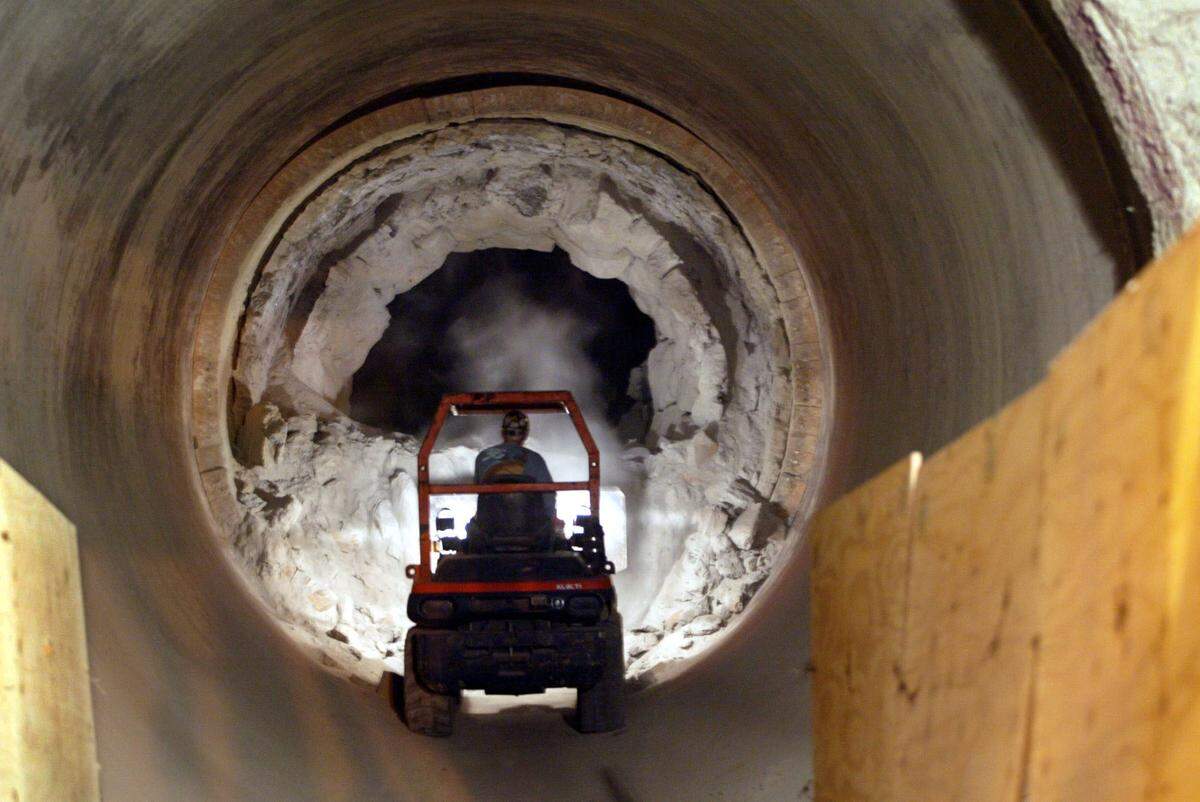
It’s a town that is no longer on the map after it was dissolved in the 1980s. But the industrial area of Northwest Miami-Dade, known best for its cement plant and the birthplace of former Sen. Bob Graham, still is on the radar of the weather and traffic service.
Just because an official town disbands, like the city of Weeki Wachee did earlier this year, doesn’t mean it disappears from people’s minds.
Okeechobee Road runs through the industrial heart of the old city, a few miles northwest of Doral.
Pennsuco, short for Pennsylvania Sugar Company, has history. Step back with us now for a look at the area through the pages of the Miami Herald archive.
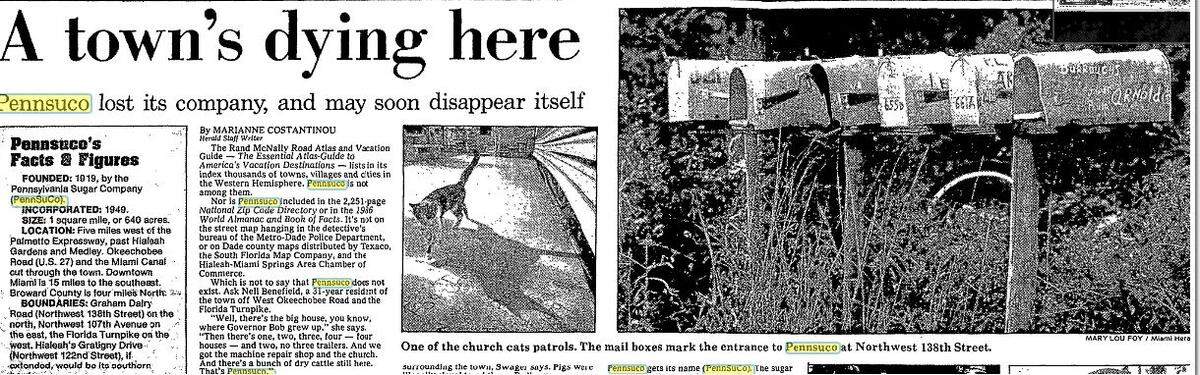
THE END OF PENNSUCO
Published July 9, 1986
Pennsuco, a once-lively town in Northwest Dade and childhood home of Gov. Bob Graham, died Tuesday. It was 37.
The one-square-mile municipality with no stores, no city hall, no bars and one church was struck down in a special election held strictly by the book. In 12 hours of polling, eight of the town’s 15 registered voters showed up at Graham Baptist Church to decide whether Pennsuco should disincorporate.
The vote was unanimous. In 10 days, the area that was Pennsuco officially will become part of that vast entity known as unincorporated Dade County.
“I hate to see it go. I’ve been here so long,” said Nell Benefield, 66, who has lived in town with her husband, Ernest, for 27 years.
“If it was my way I’d keep it as it is. But they say it’ll benefit a lot of people.”
At last official count last year, the population in this hodgepodge of industrial plants, cow fields and ramshackle trailers was 16. No election had been held since 1971, and no one could really say whether a town council existed -- until recently.
That’s when William E. Graham, executive vice president of The Graham Companies and nephew of the governor, stepped forward and said he had been appointed vice mayor some time ago, though he wasn’t sure when. The mayor, Kenneth Hammack, had moved to Central Florida, and they’d lost track of two other councilmen.
Aside from Graham, that left Billie Jean Tucker and Gerry Toms, the town’s first mayor. The council, such as it is, passed a resolution in March calling for the special election.
Metro-Dade assistant elections supervisor Joe Malone called the town’s governmental history “a very strange thing.”
“I don’t know who gave anybody the convening authority to call the election,” he said, “but I guess we’ll just have to wink at the whole thing to get it resolved.”
Graham said the abolition of the town will make for better police, fire and insurance protection, leave construction, platting and zoning matters to the county, and smooth the way for more development.
“I think it’ll solve a lot of problems,” he said.
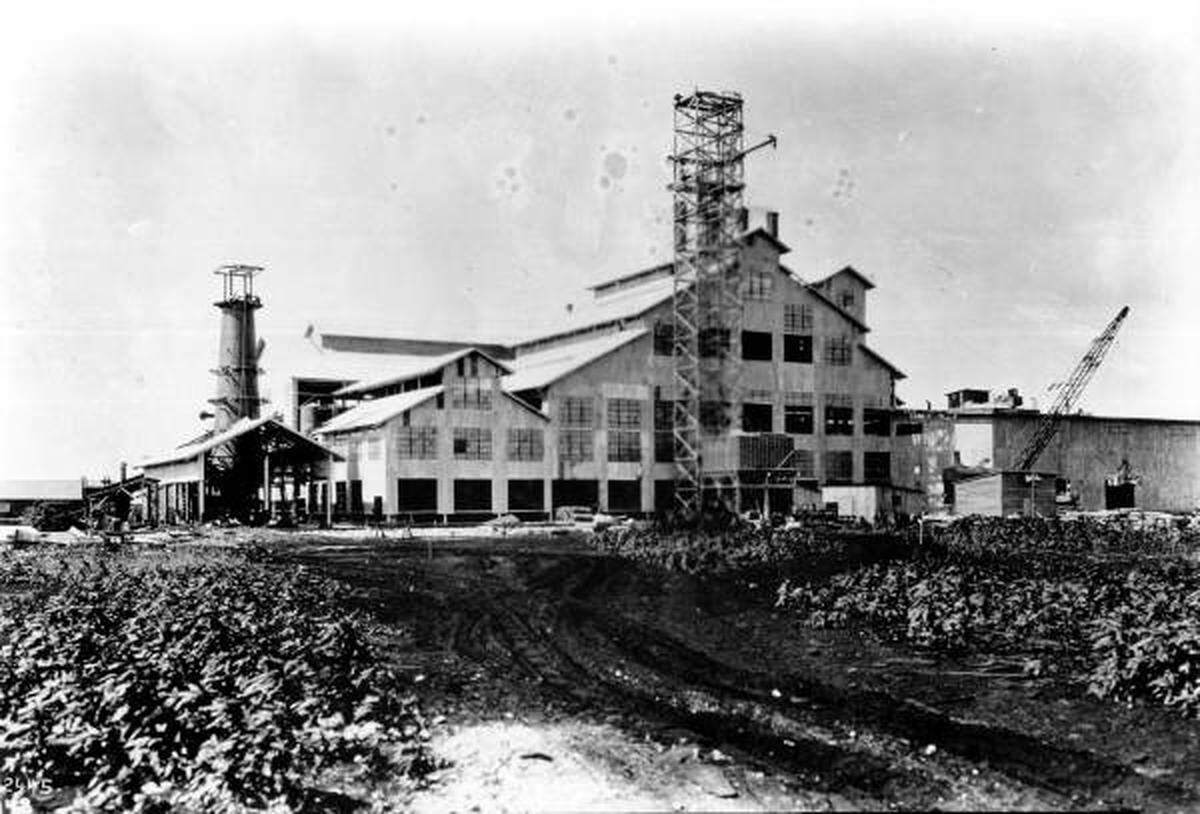
Pennsuco’s roots were planted in 1919, when the Pennsylvania Sugar Co. arrived and laid claim to 70,000 acres. The company soon employed nearly 1,000 workers, but frosts and finally the hurricane of 1926 killed the sugar crops and drove the company away. Ernest Graham, a company manager and the governor’s father, stayed behind and started a cattle farm. In 1949, Graham Farms and its employees chose to incorporate, and Pennsuco was born.
The town’s decline began in the early 1960s, as the company started development of the planned community known as Miami Lakes and moved most of its dairy operation to Central Florida.
Growing up in Pennsuco 20 years ago was like living in Mayberry R.F.D., said Benefield’s niece, Connie Bragg, who lives in the old coral rock home that was once the governor’s with her husband and two children.
“There were at least 100 people, and a lot of little kids running around. It was nice, very peaceful,” said Bragg, 30.
Then came the widening of two-lane Okeechobee Road into the six-lane U.S. 27, which cut diagonally through town and uprooted residents.
“Now there’s hardly anyone living out here. Just about the only thing left is the memories, really,” Bragg said.
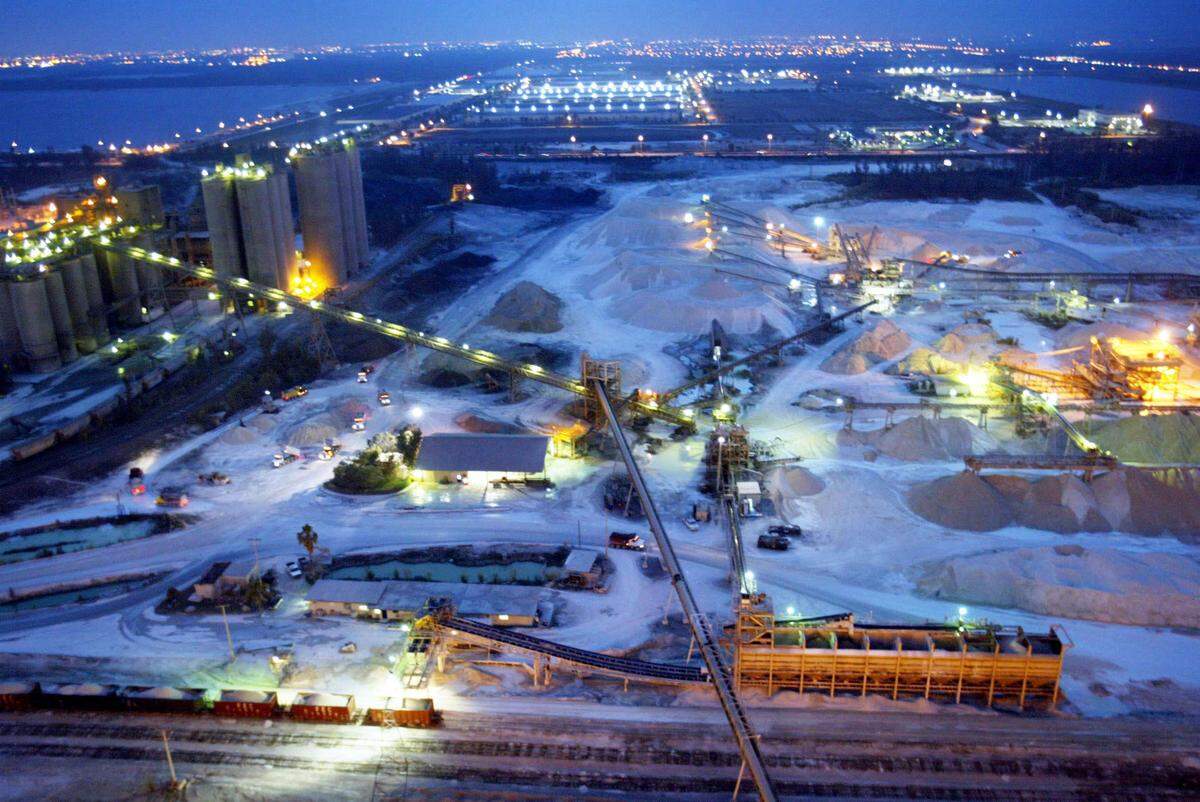
The Graham Companies still owns 84 of the town’s 640 acres, and still raises dairy cows there. Much of the rest of the land was bought by Rinker Materials Corp. A spokesman for Rinker, which already has a plant in Pennsuco, said plans for their remaining land are still being discussed. Graham said his company has “no plans.”
And neither does Nell Benefield.
“I’ll stay here as long as I can,” she said. “I wouldn’t know what to do no place else.”
Fading into history
Published May 11, 1986
Pennsuco may die young.
Incorporated in 1949, the once-lively town in northwest Dade may fade into history if residents there agree to dissolve it during an election tentatively set for July 8.
The question is whether anyone will notice.
“Excuse me?” a telephone operator said when asked for Pennsuco information. That’s a typical response. Pennsuco, county planner Oliver Kerr said, is “a paper town.”
At last count some months ago, 22 people lived there.
The last election was in 1971. And it seemed until recently that Pennsuco had no mayor, no council, no government.
But William E. Graham, executive vice president of The Graham Companies, says there is a council, and he is on it.
“I guess I’m vice mayor.”
Kenneth Hammock, a Graham Company employee, “may still be mayor, but he moved away,” to Glades County, Graham said.
Two other council members listed by acting town clerk Armando Trelles, another Graham employee, aren’t on the dais anymore, Graham said. That apparently leaves Graham, Billy Jean Tucker and Gerry Toms, president of Graham Farms.
Marginal though it may be, Graham said the three council members recently passed a resolution to dissolve the town. Graham said a census is being taken of the residents to prepare for the election.
If the town dies, the area will become part of Dade County, which probably won’t change things much. The county already provides fire and police protection and collects taxes. But instead of going to town engineer Jim Marks for building and other permits, people will go directly to Metro.
“It’s not really a city,” Graham said. “And now it’s in the path of growth. It needs services -- public works, sewers, roads. We believe in Metro government, so we’re returning it to them.”
The Pennsylvania Sugar Co. founded the town in 1919, but abandoned its namesake (PennSuCo) a few years later when freezes and floods destroyed the crops.
Gov. Bob Graham’s father, Ernest, stayed behind and started a cattle farm -- Graham Dairies. The company grew and decided to incorporate the area.
Graham Farms eventually became a subsidiary of The Graham Companies, which owned all 640 acres in Pennsuco until 1970. By that time, the company had lost interest in the community and sold 70 percent of the land to Rinker Materials. Okeechobee Road, which runs through the town, was widened to a six-lane highway soon after. People moved away.
If Pennsuco is dissolved, Graham said his company will continue to raise dairy heifers there. As for Rinker’s plans, spokesman Jill Fitzgibbons said, “We don’t know at this time.”
IS PENNSUCO ON THE MAP?
Published Feb. 20, 1986
The Rand McNally Road Atlas and Vacation Guide -- The Essential Atlas-Guide to America’s Vacation Destinations -- lists in its index thousands of towns, villages and cities in the Western Hemisphere. Pennsuco is not among them.
Nor is Pennsuco included in the 2,251-page National Zip Code Directory or in the 1986 World Almanac and Book of Facts. It’s not on the street map hanging in the detective’s bureau of the Metro-Dade Police Department, or on Dade County maps distributed by Texaco, the South Florida Map Company, and the Hialeah-Miami Springs Area Chamber of Commerce.
Which is not to say that Pennsuco does not exist. Ask Nell Benefield, a 31-year resident of the town off West Okeechobee Road and the Florida Turnpike.
“Well, there’s the big house, you know, where Governor Bob grew up,” she says. “Then there’s one, two, three, four -- four houses -- and two, no three trailers. And we got the machine repair shop and the church. And there’s a bunch of dry cattle still here. That’s Pennsuco.”
Pennsuco, population 22, is a company town whose company deserted it. It is a town without a mayor, a council, a town hall, a police department, a school, or a store. The town collects no taxes from its residents and provides no municipal services. The last town election took place in 1971.
There are no street signs or paved roads in Pennsuco. The town lost its one traffic light when Okeechobee Road was widened in the late 1970s.
“It’s so foggy out there,” says Detective Jim Swager of Metro-Dade Police, who was the assistant police chief of neighboring Hialeah Gardens for five years until 1982. “Everything was a theoretical street and a theoretical avenue. You never knew exactly where you were in the vast unknown of Pennsuco.”
Criminal activity was not uncommon in the acres of trees and overgrown weeds surrounding the town, Swager says. Pigs were illegally slaughtered there. Bodies were dumped. An escaped convict who shot and killed a state trooper was found hiding in Pennsuco.
“He went to no-man’s land -- Pennsuco,” says Swager.
Except for the residents, those who know of the town speak in the past tense.
“Pennsuco is kinda defunct now, you know,” says Gerry Toms, who grew up in the town and is now president of Graham Farms, a subsidiary of Graham Companies, which until 1970 owned all 640 acres of the town.
“It’s just kind of died,” says William E. Graham, executive vice president of Graham Companies.
Once, Pennsuco was a lively town in far Northwest Dade where hundreds of residents first raised sugar cane, then beef and dairy cattle.
The town was founded in 1919 by the Pennsylvania Sugar Company, from which Pennsuco gets its name (PennSuCo). The sugar company pulled out a few years later after freezes and floods destroyed the crops. Ernest Graham, the governor’s father and the company manager, stayed behind and started his own cattle farm.
In 1949, Graham Farms decided to become a municipal entity. The residents, nearly all of whom worked for the company, voted to incorporate. Toms, the company president, was elected mayor.
“It was just part of my corporate duties in those days,” Toms says of his 12 years as mayor.
t was not long before the company lost interest in its town. In the late ‘50s, the company started developing what was to become the planned community of Miami Lakes. In 1959, the company stopped bottling milk in Pennsuco. In 1964, the company started milking cows in Moore Haven in Glades County. In 1970, the company sold about 70 percent of its land, or 430 acres, to Rinker Materials, a concrete manufacturing and limestone mining company.
Pennsuco began to shrink, from 117 residents in 1960 to 74 in 1970. Then came the widening of Okeechobee Road, from a two- lane road to a six-lane highway.
“U.S. 27 took away most of the town,” says Toms. “It was already kind of dead. They just finished it off.”
Dozens of homes on either side of the road were torn down to make way for the road. By 1980, only 15 residents remained, their homes tucked behind the trees on the Okeechobee service road.
“They tore down my old frame house,” says Mabel Hoover, 56, who has lived in town for 31 years. “My friends left. It made me sick.”
Only a handful of men still work for the company at Pennsuco, raising the few dozen calves and heifers and repairing the old tractors and backhoes. The Graham company still owns 70 acres and most of the houses in town, including the coral rock house where the governor grew up.
For the past several years, attorneys for the Graham Companies and Rinker Materials have discussed dissolving the town so the county can provide services.
“There’s no reason for us to have a town,” Toms says.
What are the advantages of not dissolving it?” William E. Graham asks.
Yet as Pennsuco’s obituary is being prepared, the town is showing some spark. In the last few months, six people have moved into the town, most of them relatives of the old-timers. The new residents are all under the age of 40.
“You don’t have to lock your doors at night out here,” says Tammie Ann Tucker, 24, who shares a white wood house with her boyfriend and a friend. “Everybody knows everybody. You can be yourself.”
“Here in Miami, this is the closest you can come to being in the country,” says Jodie Howard, 31, who recently moved into a friend’s house with her daughter and sister.
Howard grew up in cities, in Miami and Hialeah. In Pennsuco, she has her own goat. Days are spent barefoot, raising turnips, sitting out by the lake, gazing at the cattle. Evenings are spent with her neighbors around a campfire, barbecuing and sharing dinner. No phone calls interrupt her. Few residents own a phone.
It’s quiet, restful,” says Nell Benefield, 66, the only resident who owns her own home, a trailer. “Nobody bothers you. We don’t bother anybody. It’s just peaceful as a church.”
They plan to stay as long as they can.
“I love this place where I live,” says Mabel Hoover, who lives in a trailer overlooking the lake. “It ain’t no mansion, but it’s home.
“Let me just live over here till I die. When I die, I want them to cremate my ashes over my yard. I don’t ever want to leave here.”
LIFE IN THE TOWN
Published April 12, 1984
A herd of curious cows breaks through the confines of a small ranch in Pennsuco and heads for the nearest street -- U.S. 27. Frantic neighbors rush down a dusty road. Arms raised and hands waving, they lure the mild pack back into the corral.
It’s a typical scene, one that occurs frequently in this small town of 15 residents. It is perhaps the only thing that ever happens in Pennsuco.
That’s why there’s speculation among residents and observers alike that Pennsuco’s days may be numbered.
“It’s basically nonfunctioning,” said Gerald Toms, president of the Graham Co., the dairy operation which once owned the town.
“Years ago there were several hundred people living here. We actually installed a safety stoplight and had a little playground.”
Now, he said, “There are no real inhabitants living there who have a real interestin the town.”
Once Pennsuco was a land were sugar cane crops waved in the warm southern breezes; a place where state Sen. Ernest Graham, father of Gov. Bob Graham, built a fortune in dairy farming, real estate and cattle.
Now Pennsuco is little more than a name on a map, an incorporated city with a town council but no police force or utilities.
Rinker Materials owns nearly 70 percent of the land. The company could decide the fate of Pennsuco.
“The problem is not many people live there and you have to have a viable city,” said Allan Milledge, an attorney for Rinker. “I think
Rinker would like to have good municipal services at the lowest cost.”
Those services are something Pennsuco can’t provide. For more than a year, attorneys from Rinker and the Graham Co. have discussed dissolving the town’s charter. The move would allow another municipality or Dade County to take over the land and bring needed services to the area.
“It would be pretty simple,” said Albert Quentel, attorney for the Graham Co.
“The Town Council would pass a resolution and there would be an election. It
Pennsuco would become unincorporated Dade or annexed by another municipality. There’s no particular magic to it.”
Rinker, on the other hand, could ask another municipality to annex its property even if the town decides against dissolution.
For the moment, Pennsuco remains one of Dade’s least populous towns.
Located just south of where the Florida Turnpike crosses U.S. 27, Pennsuco is a one-square-mile piece of land split up the middle by Okeechobee Road.
It is two towns -- one caught in the mystique of the Graham past, the other caught up in the promise of an industrial boom. Only a few trailers, a handful of wooden houses, rusted cars and abandoned tires dot the landscape on the northern side of U.S. 27. Across the highway, huge trucks and bulldozers rumble through the dirt entrance leading to the Rinker plant where limestone quarries produce high grade rock products. Other companies operating nearby send tractor-trailers up and down the road.
The old Graham family home, built in the 1920s from coral rock, stands out on the north side, majestically keeping a vigil on the progress unfolding around it.
“They say that sooner or later Pennsuco will die,” said Nell Benefield, 65, a 30-year resident of the town.
“But it will never die as long as that old rock house is still up there,” she said. “I’ll go with it. I’ll fight for this town until I die.”Incorporated in 1949 by 28 residents, Pennsuco was for years Graham country. It got its name from the Pennsylvania Sugar Co., which operated a sugar cane plantation on the land in the early 1920s. On Dec. 20, 1920, a 17-degree frost destroyed the entire crop. Ernest Graham, then 35, was sent to investigate the problem, and later became resident manager of the plantation.
Plagued by cold weather, the operation never flourished and in 1926, the sugar company pulled out. Graham stayed behind. He purchased 640 acres of the land, built a dairy empire, the coral rock house and his own town. He called it Pennsuco.
“Ernest Graham was the founder of the town and wanted to control his own destiny,” said Toms, a childhood friend of the family and a former mayor of Pennsuco.
That’s why he incorporated it, Toms said.
Graham was elected to the Florida Senate in 1936. He died in 1964. The Graham family has long since left Pennsuco, moving most of its dairy operation to Glades County and its homes to Miami Lakes, a community it founded and built. But the coral rock house and a few residents have continued to cling to the land. Most of the town’s people work for the family in either the small cattle operation that remains, or in the company garage where tractors and trucks are repaired.
There is no school, post office or police station in the town. There is a church -- Graham Baptist Church -- where Rev. Melbron Self delivers a sermon twice a week. Until recently, there was even a mayor.
“I was mayor, town marshal and councilman,” said Kenneth Hammack, 49. His wife, Barbara, still listed as a councilwoman, now lives in Hialeah.
“One day a year I would shine up my badge and wear it,” Hammack said. “Had to, to make it legal.”He and the council met once a month in the old general store until it burned down. They then met in Hammack’s home, the rock house, where many of the town’s people have lived at some point in their life.
Once a year the town held an election. Once in a while, there was a problem and Chief Hammack would investigate.
“About the most interesting thing that happened was when a guy’s dog caught a chicken,” he laughed.
Hammack left Pennsuco five months ago to run the Graham Co. calf operation in Moore Haven. He says he isn’t sure who the mayor is now.
With good reason; there is none.
Only one of the five council members, Billie J. Tucker, still lives in the town. And the town clerk, Armando Trelles, has a slender connection to Pennsuco through his employment with Sengra Corp., the Graham family business which developed Miami Lakes. Sengra now owns about 40 acres in Pennsuco.
Life in Pennsuco is simple. The garage and the calf operation located behind the rock house keeps most of the town’s men busy. The wives and the widows busy themselves with memories of the past.
Ruth Hammack, 76, lives with her 37-year-old son Bobby in the small white house where her children, including the former mayor, spent much of their lives.
When she moved to the area in the late 1940s, it wasn’t called Pennsuco, she recalled with a frail but radiant smile.
“We lived over yonder just off of Red Road till the children were grown. Then we moved down yonder on the highway,” she said, referring to what is now U.S. 27.
“We used to have a blinker light. And, oh, how I miss it since it’s been gone.”The light disappeared when the highway was expanded to six lanes. The expansion also did away the homes and bunk houses on the side of the road where many of the Graham employees once lived.
The highlight of Ruth Hammack’s week is attending services in the white trailer on the south end of town. She helped to establish it in 1960 and was the church secretary for nine years.
A glow lights up her face as she recalls the day they brought the first church into town on rollers.
“I said ‘Oh Bobby, yonder comes the church.’ I was so happy to see a church coming on wheels around the corner. About the only thing we have to look forward to is church.”
Down the road, her old friend Nell Benefield recuperates from a bout with the flu. Between puffs on a long brown cigarette and hacking coughs that block her words, she talks about her family -- Pennsuco.
Her husband Ernest has worked for Graham Co. for more than 20 years. They lost their house when the highway was expanded. Now they live in a trailer furnished by the Graham Co., adjacent to the garage.
“Honey, the only thing that was out here when I moved here was Pappa Graham and his old house. He was senator then,” she said.
“I remember when Bob Graham was that big,” she recalled, raising her hand just a few inches from the floor.”
Now the town is run by Toms, she said. “He’s the boss, or he thinks he is. And we all love him.”
Pennsuco is one big happy family, to hear the residents tell it, which is not far from the truth. Many of the town’s people are related; those who aren’t related by blood or marriage share a close bond -- if not a common employer.
Benefield’s brother-in-law, 67-year-old Grady Cochran, reflected on that as he tilled the garden of his home next to the Graham’s old coral rock home.
“This is Pennsuco, what’s left of it,” he said. “I like it out here. You don’t bother with nobody and nobody bothers you.”
That won’t change, said Benefield, even if the town’s legal status does.
“It is a close town. We all love each other and we’ll do anything for each other,” she said.
“We’re just here and that’s all. I guess we’ll be here till we die.”
This story was originally published June 20, 2020 at 11:15 AM.