
The Ludlam Trail’s first piece has been pushed back. The rest of it is up in the air
.jpg "This architectural rendering shows the Ludlam Trail as it weaves across a planned retail-lined plaza and along a new apartment building at a development “node” on the south side of Bird Road.")
A developer who planned to break ground by the end of this year on the first piece of the long-promised Ludlam Trail, the six-mile “linear park” on an abandoned railway connecting Downtown Dadeland to Miami International Airport, has postponed the start of construction.
The delay won’t be long, promised Vincent Signorello, a principal with the team of developers that plans to build half a mile of the cycling and walking trail as part of a larger project comprising apartments and retail where the old rail line meets Bird Road.
Blaming permitting delays, Signorello said through a spokesman that the development group plans to start building by the end of the first quarter of 2020. Completion of the first phase of the project, which includes building and maintaining his piece of the trail at no cost to taxpayers, would take about 16 months, he said.
But when precisely users will be able to enjoy the full promised, park-like trail, and what it will look like, is still very much up in the air. That has frustrated leaders of Friends of the Ludlam Trail, the non-profit citizens organization that pushed for creation of the facility.
Miami-Dade County bought 80 percent of the rail corridor for $25 million in 2018 from Florida East Coast Industries. It has now embarked on a lengthy study to analyze and plan how to mitigate soil contamination along its portion of the trail, which doesn’t include the piece purchased separately from FECI by Signorello and his partners. Discovery of the contamination nearly two years ago put a stop to a popular program of activities coordinated by FECI and the Friends group to publicize and activate the trail, which is sandwiched between Southwest 69th and 70th avenues.
That county study should be completed by the end of 2020, said Kamali Burke, a spokeswoman for Miami-Dade parks, which is managing the trail project. Once that’s done, the county must hire contractors to remediate the contamination and to design and build the trail. The county has secured about $27 million of the $94 million price tag for construction of its share of the Ludlam plan.
That timeline means the finished trail, or significant portions of it, would not be ready for two more years at the earliest, said Tony Garcia, co-founder of Friends of the Ludlam Trail. He’s urging the county to reopen the bare trail to the public for supervised activities as soon as the contamination issue is resolved. Rails were removed years ago, and the corridor is now mostly packed dirt and gravel.
“The key at this point is to do the remediation to get the trail open as soon as possible, so that people can continue to use it,” Garcia said. “It doesn’t have to be the final version.”
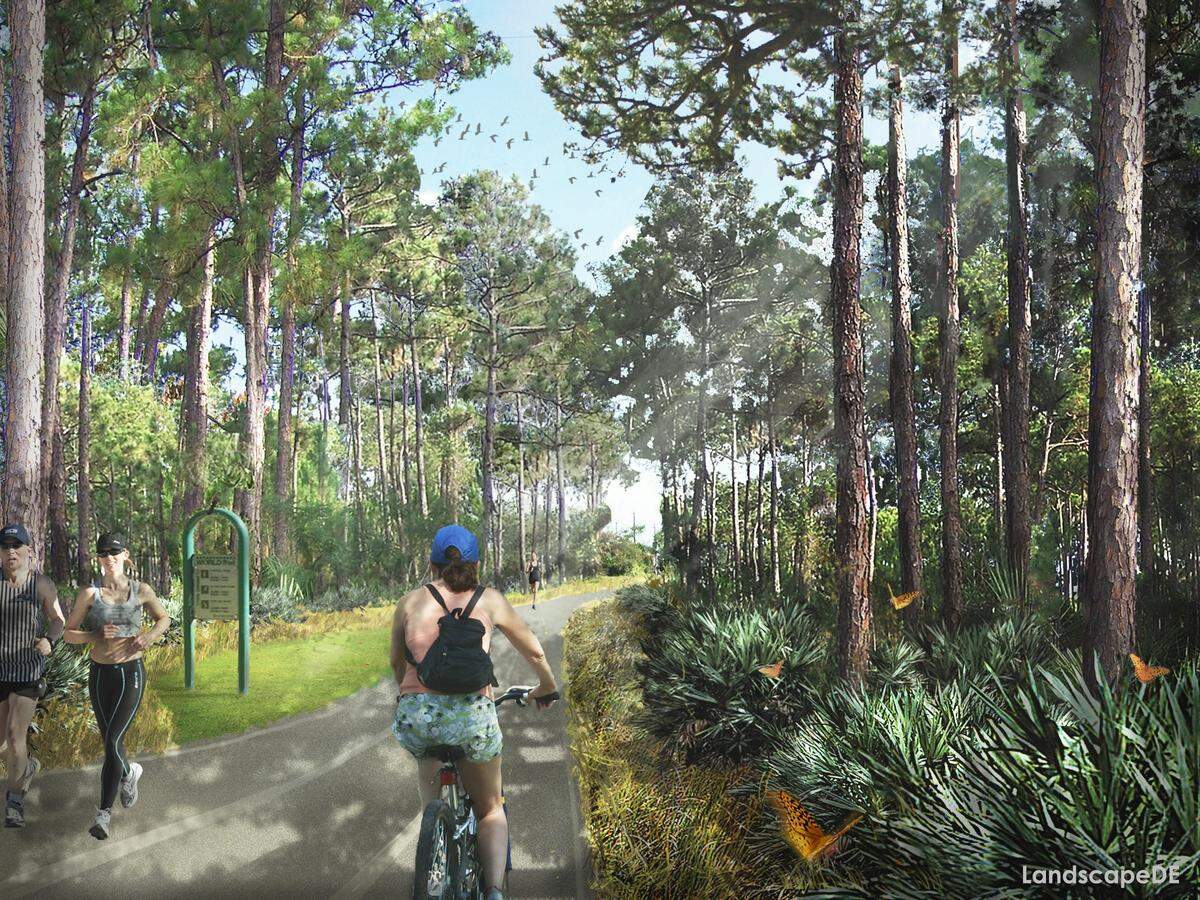
By contrast, a similar county-managed plan for the Underline, a park-like trail for people on bikes and on foot that would run for 10 miles under the elevated Metrorail tracks from Dadeland to the Miami River in Brickell, has already begun construction on its first phase, a half-mile piece at the northern end. Plan backers also recently announced they have snagged full funding for a second phase, through Coral Gables, which also includes a piece to be built by a developer as part of a larger mixed-use project.
The Underline, however, had one important advantage in that the county already controlled the land under the Metro, and there was little opposition to the idea. The launch of the Ludlam Trail plan comes after years of sometimes fractious negotiations among the county, the city of Miami, FECI, trail backers and neighboring residents.
Garcia, a planner specializing in street design and cycling and pedestrian facilities, also said the county and developers handling different pieces of the Ludlam Trail now need to seek out meaningful public input into its design — something he complains Signorello did not do in preparing his blueprint. Garcia said he met once with the developer and pointed out what he described as numerous deficiencies with the plan, including a lack of public access at key points and a brew-pub that’s placed in the middle of the trail.
“Those plans need a little more attention to the design of the public spaces,” Garcia said. “There should be some public process that brings together planning for the private and public components. This is a premier public space. There needs to be more thought given to master-planning and coordination efforts.”
Burke, the parks spokeswoman, said the county plans to hold two public meetings, likely one in spring and one in fall, during the planning phase of the trail project.
“The Ludlam Trail is a priority project for Miami-Dade Parks and Miami-Dade County,” Burke wrote in an email. “We are making all efforts to coordinate with agencies and developers toward the implementation of the Ludlam Trail and to provide this asset for the community.”
Signorello doesn’t need to wait for the county contamination plan to be completed before breaking ground on his project, which includes 950 apartments and 35,000 square feet of retail. His group, which also includes Orlando-based ZOM Living and Miami investment firm Mattoni Group, bought 13 acres of land straddling the rail line as well as the trail right-of-way from FECI for $36 million last March.
Under the strategy approved by the county, private developers would build dense mixed-use projects at four “nodes,” or intersections where the rail line meets major roads, including Bird. The developers are responsible for mitigating contamination, the result of years of herbicide application to keep the rails clear of plant growth, on the privately owned portions of the trail. Signorello has said previously that soil problems on his piece would likely be fixed by installing a cap of clean fill before building the paved trail atop it.
Signorello’s project would occupy the trail portion just south of Bird. The county is studying construction of a bridge across the busy road for cyclists and pedestrians to the next trail segment. The Signorello group also owns the piece immediately abutting Bird on the north side of the road, but has announced no plans for the land. No plans have been unveiled for the other nodes, either.
County planners and backers of the trail project, including Friends of the Ludlam Trail, have pitched the linear park not just as a recreational facility for runners, walkers and cyclists, but also as a protected bike-commuting corridor. The trail would connect five schools, including South Miami High; four parks; three waterways; and two Metrorail stations at Dadeland North and South with a planned link to the Underline. The Underline would then connect to Brickell and the Miami River.
This story was originally published December 24, 2019 at 6:30 AM.