
Paint gives hope to Opa-locka’s Ali Baba Avenue
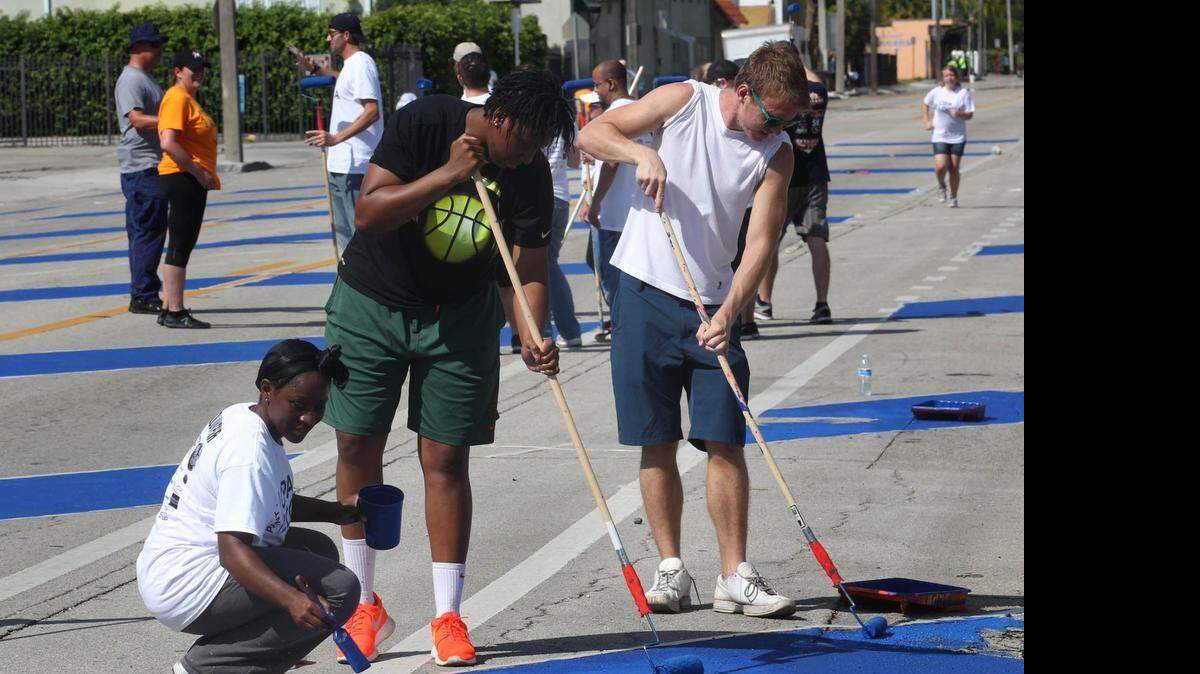
On Opa-locka’s barren stretch of blacktop on Ali Baba Avenue, a new oasis has arrived.
On Saturday, 212 volunteers helped revitalize the asphalt with a fresh coat of paint — part of landscape architect Walter Hood’s vision of geometric lines, circles and a four-lobed quatrefoil pattern down the main thoroughfare.
The daylong public art project was part of the Opa-locka Community Development Corp. and Hood’s two-phase plan to redevelop Ali Baba Avenue
“Not only does this change the aesthetic view of Ali Baba and demonstrate how art could really uplift and make a difference in the area,” said Willie Logan, executive director of the OLCDC, who is overseeing the art transformation. “It brings a bunch of folks together who normally would not be in Opa-locka to come learn about the city and participate in a very meaningful way to bring about change.”
“People really seem to be enthused about being a part of this,” Logan said.
Opa-locka Mayor Myra Taylor was less than enthused.
“Who gave permission to paint these streets?” Taylor said to City Manager Kelvin Baker at a city administrative workshop Tuesday morning. “I didn’t vote on that.”
Taylor advised Baker not to let another drop of paint spill onto the street until the city commission had a better understanding the OLCDC’s vision.
“It does not go along with what I want to do,” Taylor said. “We appreciate what you’re doing, but you have to get with us. The city of Opa-locka already has a history that needs to be adhered to. Whoever did this is [interfering with] this commission.”
The OLCDC and Miami Rise, a group of about 20 individuals from the Great Miami Chamber of Commerce’s Leadership Miami Program, hosted the paint project, rallying volunteers from Baptist Health South Florida, Wells Fargo, AIG, Banco Mercantil and the University of Miami, among others.
“We partnered up with OLCDC because we truly believe that this community can be transformed through arts,” said Mery Arcila, a Miami Rise member. “This community goes through struggles every single day and I think that having something that tells them that there are other people that care is very powerful.”
Starting early one Saturday morning, the large crowd of people at the OLCDC were given directions for the project. Within hours, about a half-mile of the 2.1-mile stretch was painted with wide diagonal lines in three shades of blue. Red and yellow circles were painted around light posts, street signs and fire hydrants.
“This is the first project that’s actually been implemented out of our proposals,” Hood said. “It’s part of a larger project we’ve come up with called Oasis Oases.”
He added that this design was to show locals that they area can be transformed into a wonderful zone without much money or effort. Miami Rise raised approximately $24,000 through two events to cover the costs of the public art project.
“We’re spearheading this process where the community, both local and from South Florida, are coming together and they’re seeing and physically being part of this transformation,” said Aileen Alon, the arts & creative industry manager of the OLCDC.
The second phase, however, will be a little more challenging to implement.
Hood, with the support of the OLCDC, wants to bring sustainable infrastructure to the street and introduce built-in seats to the sidewalks and utilize bio-swales, an alternative to storm sewers with gently sloped sides that can carry rainfall into areas filled with plants and trees.
He says that green infrastructure standards are already implemented in South Florida, but that none is practiced in Opa-locka.
Hood’s first attempt to bring in the sustainable infrastructure plan stalled last fall. That’s when he brought the art project to the table — to help show the inequities and the ignorance of the street’s current infrastructure while bringing a punch of color to Ali Baba.
“Part of the motivation behind this is that the city’s taken a $50 million infrastructure project and 99 percent of that project has to do with moving water in pipes underground into canals,” Logan said. “If you’re going to tear up the streets and the sidewalks that were built over half a century ago, do it in a such a way that’s more sustainable.”
The paint identifies all of the issues that the OLCDC feels the city needs to address when it tears up the road. “Part of this is showing how the area can be redesigned and identifying things that need to be done differently,” Logan said.
The city commission is already working on the water flooding issues on Cairo Lane, but has not yet addressed Ali Baba Avenue.
For Nefertiti Bartley, a community activist from Miami Gardens, the art project seemed more like the beginning of gentrification to push residents out of Opa-locka. She said the city needs more residents caring about their community.
“We need to see more marches for changes,” Bartley said. “I see a lot of walking around for photo ops.”
This story was originally published April 21, 2015 at 2:20 PM with the headline "Paint gives hope to Opa-locka’s Ali Baba Avenue."