Who is Philip Levine, the ex-Miami Beach mayor named by Jeffrey Epstein associate?
On Thursday, Jeffrey Epstein’s longtime personal assistant, Sarah Kellen, testified to the House Oversight Committee that she was sexually assaulted by Philip Levine, the former mayor of Miami Beach and a 2018 Florida gubernatorial candidate.
The allegation, which was reported Friday by the Miami Herald, was a bombshell, implicating a wealthy businessman-turned-politician who had come under scrutiny in recent months over emails showing that he was closer with Epstein and Epstein’s associate Ghislaine Maxwell than he previously let on.
Levine, 64, didn’t respond to repeated requests for comment on Kellen’s claims. A full transcript of Kellen’s remarks is expected to be released next week.
In the years since his unsuccessful run for governor — in which he pumped $29 million of his own money into the Democratic primary but finished third with 20% of the vote — Levine has kept a fairly low profile. He has written semi-regular opinion pieces and appeared as a TV pundit, often criticizing the Democratic Party from a moderate perspective. He and his wife started a horse ranch in Ocala.
But Levine made his biggest imprint on South Florida in the 2000s and 2010s, first as the CEO of a multimillion-dollar media business focused on the cruise industry, then as Miami Beach mayor for four years starting in 2013.
Levine, a Boston native who moved to Florida when he was 10, has said he started his business in a South Beach studio in 1990 with just $500 in capital. His company, Onboard Media, produced TV advertisements, magazines and port marketing for cruise lines.
He got a boost from the father of Craig Robins — Levine’s college roommate at the University of Michigan who would go on to develop Miami’s Design District — who became a silent partner in the company in the mid-1990s.
Onboard Media grew into the world’s largest duty-free shopping and media firm in the cruise industry, with hundreds of millions of dollars in revenue. Levine sold it to LVMH Moët Hennessy Louis Vuitton in 2000. He created another cruise media company, Royal Media Partners, that works exclusively with Royal Caribbean International and is headquartered on Alton Road.
“His business ended up being a game-changer,” former Royal Caribbean CEO Richard Fain told the Herald in 2018. “Not so much because the concept was extraordinary, but because his execution was extraordinary.”
As his cruise marketing business boomed, Levine amassed more than $100 million in real estate investments, much of it in Miami in partnership with Robins’ brother, Scott.
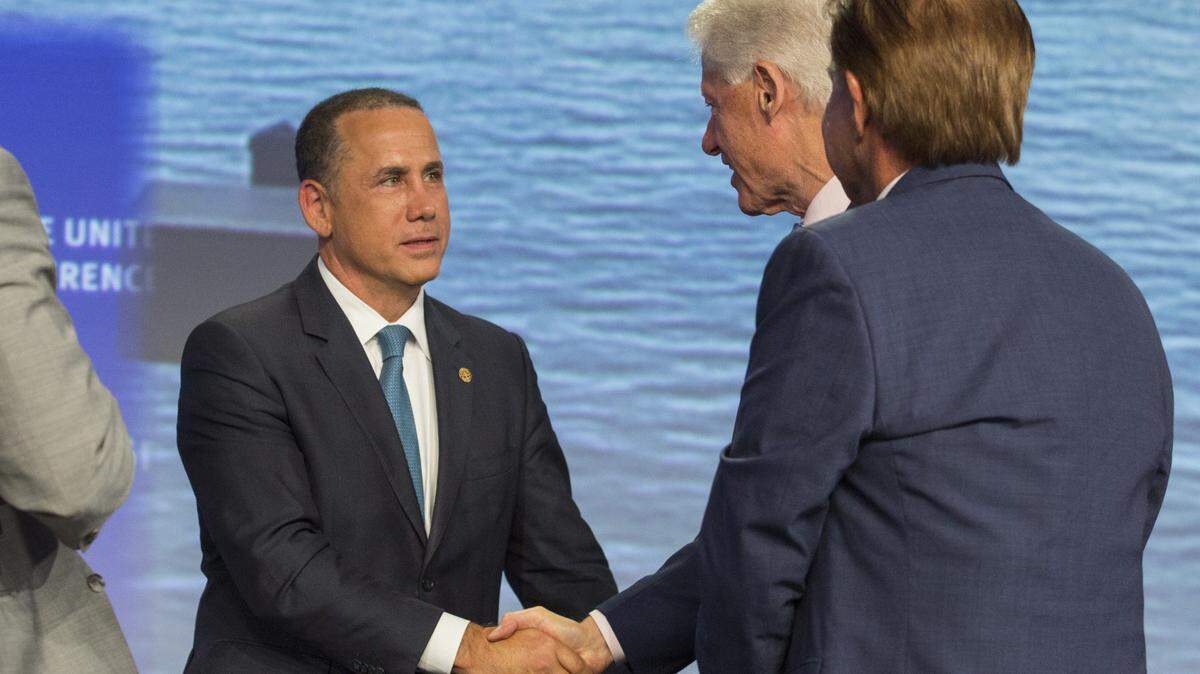
Levine also became a major Democratic Party donor and began hosting fundraisers at his home on Sunset Islands. That’s how he met former President Bill Clinton. They became close friends.
Self-funded political campaigns
When Levine ran for Miami Beach mayor in 2013, it wasn’t your typical municipal election campaign. He spent about $2 million of his own money on the race. Clinton endorsed him. He defeated a sitting commissioner, Michael Góngora, promising to run the city like a business and get things done.
He accomplished that in office, most notably by pushing for massive anti-flooding projects that involved raising roads substantially in multiple Miami Beach neighborhoods. Levine’s approach ruffled feathers as he sparred with those who challenged him and appointed his business partners to key roles.
“He was certainly a ‘my way or the highway’ guy,” Mike Grieco, a former Miami Beach city commissioner who served with Levine, told the Herald on Friday. Still, Grieco said, “We always talked about getting s--- done. He got s--- done.”
In 2018, Levine ran for governor hoping that his business acumen and self-made multimillionaire status would woo voters as he competed for the Democratic nomination against Jeff Greene, Andrew Gillum, Gwen Graham and Chris King.
Levine touted gun reform, increased public school funding and raising the minimum wage to “as high as we can get it.” The Herald’s editorial board recommended Levine in the Democratic primary, citing his leadership experience and efforts to combat sea-level rise in Miami Beach.
But the cash Levine pumped into his own campaign — about one-fifth of his net worth at the time — wasn’t enough to beat Gillum, the former Tallahassee mayor, a progressive who won the primary in a stunning upset.
Levine came in third place behind Graham, a former congresswoman. Gillum even beat Levine in Miami-Dade County by 9,000 votes, the Herald reported.
Gillum narrowly lost the 2018 gubernatorial election to Gov. Ron DeSantis.
Scrutiny surrounding Epstein connections
Levine faded from the spotlight. Then, in 2019, Epstein was charged with child sex trafficking and died in his jail cell later that year. Days later, the Herald reported that Epstein had more than a dozen contacts for Levine in his so-called “little black book.”
Levine downplayed the connection, saying he had met Epstein “a couple of times” but had “no clue” how they’d met, and that he “never had a friendship or business relationship” with Epstein.
Last year, Maxwell told the Department of Justice that Levine was her “very good friend” — a claim that Levine also brushed off, saying his relationship with Maxwell “was that of a friend to my wife and I, nothing more and nothing less.”
But emails released earlier this year showed that Levine had a chummy past with both Epstein and Maxwell. The emails showed that Levine remained friendly with Epstein even after his 2008 conviction in South Florida, and that he and Maxwell exchanged numerous flirty and sexually suggestive emails in the early 2000s — including an exchange in which they joked about Levine being “hung like a horse.”
The released files also provided a deeper window into Levine’s level of access with the rich and powerful.
In 2002, Levine sought to have Clinton call Jimmy Carter to include Levine in Carter’s delegation to Cuba that May.
He also corresponded with Andrew Mountbatten-Windsor (formerly, Prince Andrew) of Britain.
In the summer of 2009, Sarah Ferguson, Mountbatten-Windsor’s former wife, spent a night at Levine’s with her daughters Princesses Beatrice and Eugenie. The next day, she was planning a lunch with Epstein at his Palm Beach mansion, the emails show.
British authorities are currently investigating Mountbatten-Windsor’s ties to Epstein. Ferguson had called her relationship with Epstein a “gigantic error of judgment“ in 2011, but the Guardian reported last year how she had privately continued corresponding with him.
Epstein also introduced Levine to Alan Dershowitz in 2010, the records show.
“[T]old him what a mensch you are,” Epstein wrote to Levine, suggesting that the former mayor should feel free to contact the high-profile attorney.
Levine told the Herald in a statement earlier this year: “As I have stated previously, my only connection to Jeffrey Epstein arose solely through my former friendship with Ghislaine Maxwell. I met Epstein only a few times. I never conducted business with him, never visited his island and never flew on his aircraft. I regret ever meeting him.”
This story was originally published May 22, 2026 at 6:53 PM.