A Miami Beach hotel will vanish before our eyes. What you can expect, and what we’ve seen
The Deauville hotel is coming down.
There’s now a demolition date for the resort, whose most famous guests were The Beatles in 1964.
The building at 67th Street and Collins Avenue in Miami Beach is scheduled for implosion the morning of Nov. 13.
Here’s a look at what will happen at the building, as well as a look back at other Miami-area buildings that have been demolished to make way for new construction:
What to expect at the Deauville
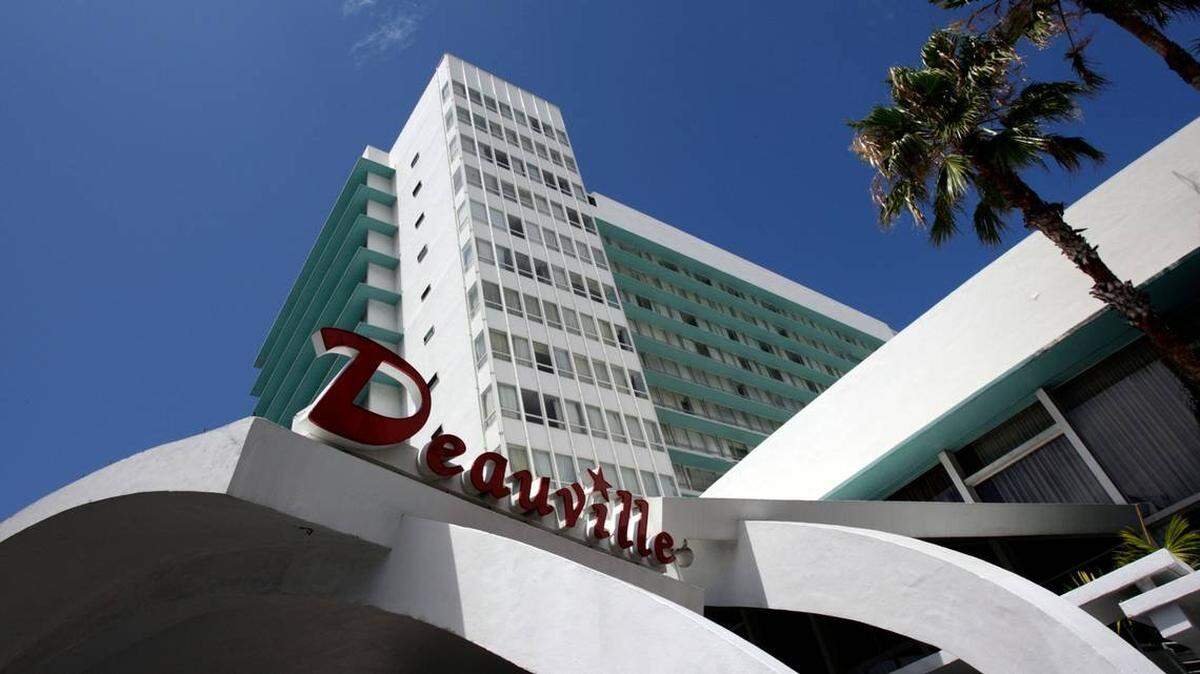
▪ At 7:30 a.m. on Nov. 13, a Sunday, Miami Beach police officers and firefighters will make an “exclusion zone” between Collins Avenue and Harding Avenue, from 65th to 70th streets.
▪ Traffic on Collins Avenue will be closed at 65th Street and diverted to Indian Creek Drive.
▪ After the implosion, the contractor will begin to clean up the dust and the roadway is expected to reopen around 10 a.m.
Now, let’s look through the Miami Herald archives at recent high-rise hotel demolitions in the area:
Americana/Sheraton Bal Harbour (2007)
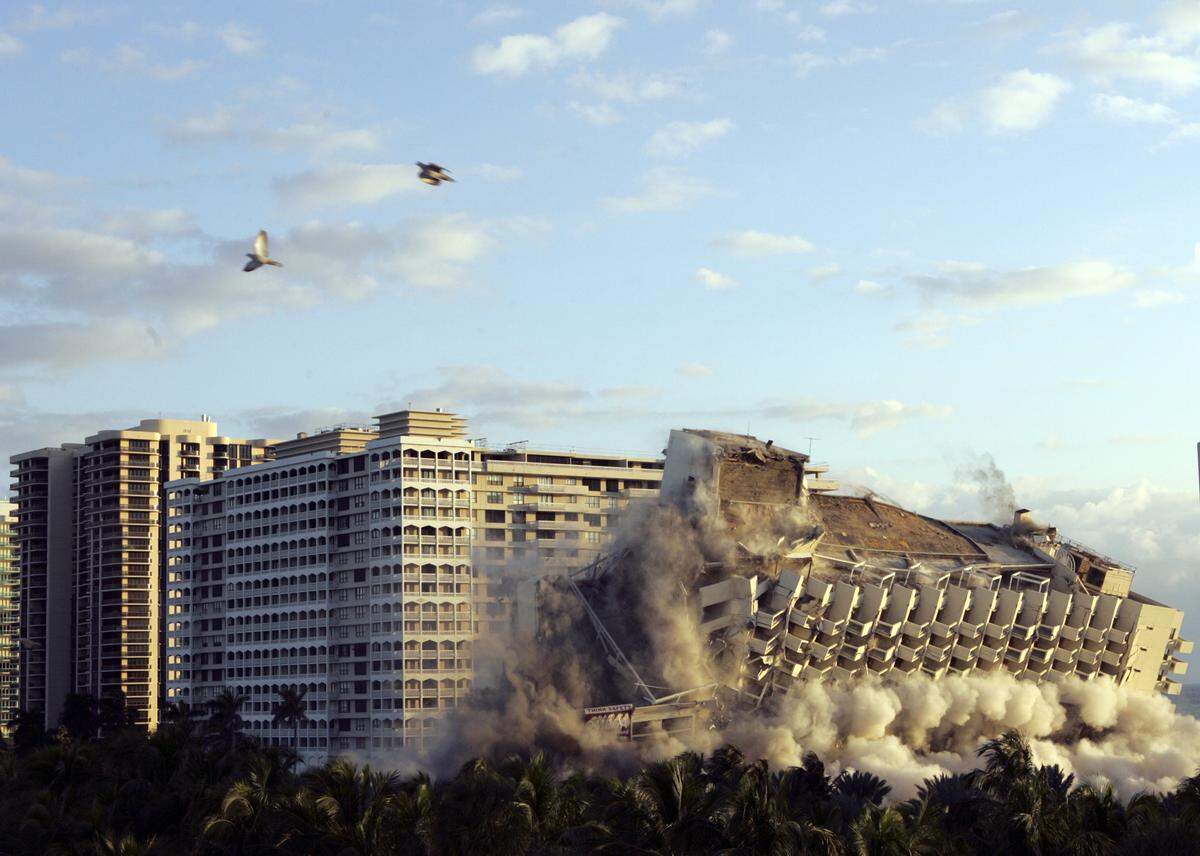
In a matter of seconds, memories turned into a cloud of dust as the Sheraton Bal Harbour was imploded Sunday morning — despite residents’ concerns.
“It’s been a two-year process for the implosion,” said Assistant Mayor Jean Rosenfield, moments before the Miami Beach icon was blown to bits. “Bal Harbour is beautiful, but it will be even more beautiful.”
The 645-room hotel at 9701 Collins Ave., which opened as the Americana in 1956, tumbled down to make way for a 350-unit condominium and a 250-unit St. Regis Hotel, owned by Miami’s Related Group and Starwood Hotel and Resorts.
The implosion was scheduled at 7 a.m., but was postponed just a few minutes after Police Chief Thomas E. Hunker ordered some residents from the nearby Majestic Towers to go indoors as they looked outside from their balconies.
“It’s an awesome project, said Hunker. “It takes a lot of people to get this to happen.”
Those who were curious saw the show from the Bal Harbour shops parking lot, south of 96th Street on the beach, and on the water, as private boat owners enjoyed the event. Viewing was limited because Collins Avenue was closed between 96th Street and 108th Street.
“We made sure the streets were closed off until we cleaned off the dust — although there was no debris on the streets after the implosion,” said Hunker.
Some residents still decided to stay indoors because they felt their health was at risk. “I am not going to take a chance. I went for a walk yesterday and my respiratory infection got worse,” said Brian Mulheren, who lives at the Carlton Terrace just a few blocks away from the implosion. “I’ve been affected by this ongoing dust ever since they started to take it down in August.”
Residents living in neighboring condominiums such as Majestic Towers and The Balmoral were advised to close all exterior sliding glass doors, lower all shutters and turn off air conditioning units. At the Majestic, residents were welcomed to see the implosion downstairs at the lobby and enjoy a continental buffet breakfast.
Ken Smuts, director for the St. Regis project, says the proper precautions were taken.
“We conducted two studies under the supervision of D.E.R.M. [Department of Environment Resources Management] and the village conducted their own independent study. All the studies tested the pH in the concrete and proved it was OK,” said Smuts. “We made sure to remove all the interior material that brings the most dust.”
Soon after the dust settled, condo employees began the clean-up stage.
“Everything went well; we had no danger,” said Juan Salaveria, property manager at the Majestic. “We had extra personnel and the Related Group also brought out an extra crew for us.”
In response to resident outcry over the demolition and construction, the developer of the St. Regis agreed to pay $2.5 million to split between both buildings, while the village received $11.8 million.
Over at the Bal Harbour shops, which is across from the Sheraton, property owners taped the edges of store doors, turned off air-conditioning units, and covered the mall entrances with large tarps to avoid dust getting in. The implosion didn’t affect store hours because the mall opens at noon on Sundays.
For Morris Skolnick, who looked at the debris as the Miami-Dade Fire Rescue Urban Search and Rescue Team conducted an emergency services training drill to simulate high-rise condominium disasters, it’s sad to see the memories vanish in a matter of seconds.
“We were sorry to watch it be torn down, but I know it will be better,” he said. “We’ve been coming down here since it was the Americana. There were a lot of memories in that building.”
“I remember coming to my high school prom in that building,” said Dianne Panka from Surfside. “It’s one of those moments. It’s nostalgic.”
But, Morris says he is looking forward to moving in to his new home.
“We purchased a condo at the St. Regis about a year ago,” said Morris. “So, I am looking forward to new memories in the new building.”
Sonesta Beach (2006)
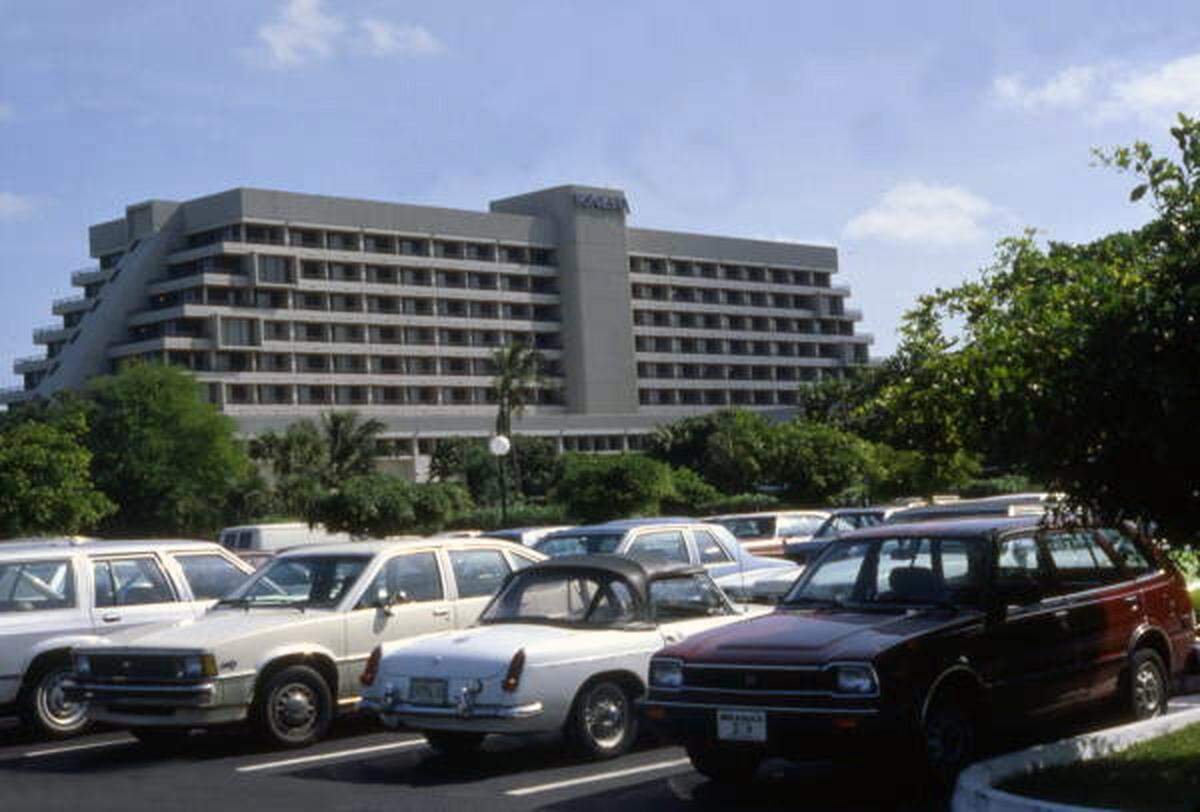
The Sonesta Beach Resort in Key Biscayne, where South Florida celebrated weddings, bar mitzvahs and proms for 37 years, is no more. The last wedding was particularly poignant for a bride who practically grew up there. Before Natalie Fuentes walked barefoot down the aisle of sand and sea oats, before her father Ruben kissed her in a final farewell to childhood, before she whispered “I do” to the rhythmic lapping of waves, she sat in Room 718 of the Sonesta Beach Resort and wept.
Natalie Fuentes, 24, had practically grown up at the venerable Key Biscayne landmark, where her father organized conferences for nearly 20 years, and now she and Erik Pizarro were to be the last couple to wed there.
The unique beachfront pyramid — where so many South Floridians have celebrated life’s joyful events, from proms to weddings to bar mitzvahs — closed this week, the latest landmark to fall to the wrecking ball. It is likely to be replaced with a condo-hotel.
“It’s a very emotional situation,” says Ruben Fuentes, who sometimes found himself working seven days a week to ensure conferences went off without a hitch. “For both guests and employees, this was very much like a home away from home.”
The Sonesta was labeled by The Miami Herald as “This Year’s Hotel” when it opened around Christmas 1969. On a 10-plus acre oceanfront site, the hotel cost just over $7 million to build and boasted 22,000 square feet of conference space, a 7,200-square-foot ballroom overlooking the Atlantic and 294 rooms and suites, each with a private balcony.
It was the third hotel built on the Key and proved unique in ways beyond its silhouette. The Sonesta was 15 feet taller than the signature Key Biscayne lighthouse, said Key resident and historian Joan Gill Blank.
Locals who have celebrated life events at the place or simply stayed there for weekend getaways were dismayed to hear of the 37-year-old hotel’s impending demise.
“I still can’t believe they’re closing,” says Lynn Shapiro. Through her 20-year-old company, Parties by Lyn, she has thrown countless celebrations at the Sonesta, including her son’s bar mitzvah and her daughter’s bat mitzvah.
She adds: “The staff there is very professional. They’re awesome. They take such personal care of each and every person and they make you feel like you’re very important.”
Mari Molina first stayed at the Sonesta in 1998 and has been taking her two daughters for weekend getaways ever since. She squeezed in her final visit in July.
“I was shocked when I found out [it was closing],” Molina admits. “It’s such a great place to stay. Everybody takes the time to make you feel welcomed. You feel like you’re part of a family.”
Family. It is the theme — and source of lament — for those who bemoan the place’s closing. David Fine, vice president of sales and marketing for Sonesta of Florida, has been gathering data for a retrospective video prepared for employees at a farewell lunch. He displays a sheaf of letters with pride.
“What brought us back every year was the sense of family established by the people that were working there, the service and beautiful surroundings,” gushes one missive from John J. DeLucca, who has visited every year for the past 22 — interrupted only once, as he points out, by Hurricane Andrew. In 1992, Andrew battered the resort, forcing it to close for 13 months for repairs and renovations. Pool manager Alex Ballora remembers that year. Like some of his colleagues, he has spent most of his hospitality career with Sonesta, arriving on the hotel property seven months before it opened. Back in ‘69, “the pool was just a big hole.”
He had planned to retire last year but was asked to stay on until closing. He chokes on the words when he talks about the end. “I’ve seen guests coming here and then bringing their children and then those children bringing their children,” he reminisces.
Ruben Fuentes, the hotel’s director of conference management, has met his share of the famous and the infamous. One year the Beatles’ George Harrison rode up in a limo. Fuentes had the pastry chef make him a chocolate guitar.
Fuentes figures he has handled 6,500 groups during his tenure as conference manager at the resort — “50 percent of it repeat business,” he announces proudly. When daughter Natalie was about 12, repeat customer Bantam Books invited singer Chubby Checkers to perform. To Natalie’s delight, the man who memorialized The Twist asked her and a friend to dance on stage.
For Natalie’s wedding to be the hotel’s last hurrah was symbolic beyond the obvious. She spent some of the best moments of her childhood there. Her extended family were the pool manager, the bartender, the catering manager, the room service manager.
In a city of transients, many Sonesta employees came and stayed.
Judi Koslen — aka “The Bead Lady” — has been teaching children (and their parents) how to bead since long before it became popular. In 32 years of seven-day-a-week classes at the resort, she has supervised the making of millions of earrings, bracelets, necklaces, even foot thongs. She tears up talking about it.
“We get a huge variety of people from all different backgrounds,” she says between sniffles. “One day I can have one person, the next day 20. It’s completely random. I don’t always know what to expect.”
She’s not sure what she will do after the hotel closes. “My whole social life revolves around this hotel,” she adds.
Geno Marron, the poolside bartender, took what he intended to be a temporary job in 1980, on his way to Brazil with a chemistry degree. It was a good thing — for the Sonesta and for Marron — that he never left. He met his wife Brenda at the hotel, and the Sonesta has received untold publicity from his invention of pouring rum down the drinking straw of “The World Famous Piña Colada.”
His exuberant personality dazzles both straitlaced conventioneers and bikinied guests alike. Drinking poolside with Geno — nobody calls him by his last name — requires audience participation, from keeping the beat on the bar, to singing along with the songs, to jitterbugging with your neighbor.
“If you like it mellow,” states a 2005 Copley News Service travel piece, “throw back a couple of Marron’s world-famous piña coladas and you’ll want to drown your laptop in the sea, shed your tie and coat forever, and strap your surfboard to your Woody in search of an America that minutes ago seemed lost and gone forever.”
Natalie Fuentes, the last bride to be married at the Sonesta, mellowed out with six of her friend’s at Geno’s bar the day before she wed. She made sure, of course, to indulge herself with a piña colada. Or two.“I feel like one chapter is closing and another is opening,” she said. “Sometimes it’s hard to think it’s really happening.”
Howard Johnson (2005)
It’s hard to get sentimental about a Howard Johnson motel.
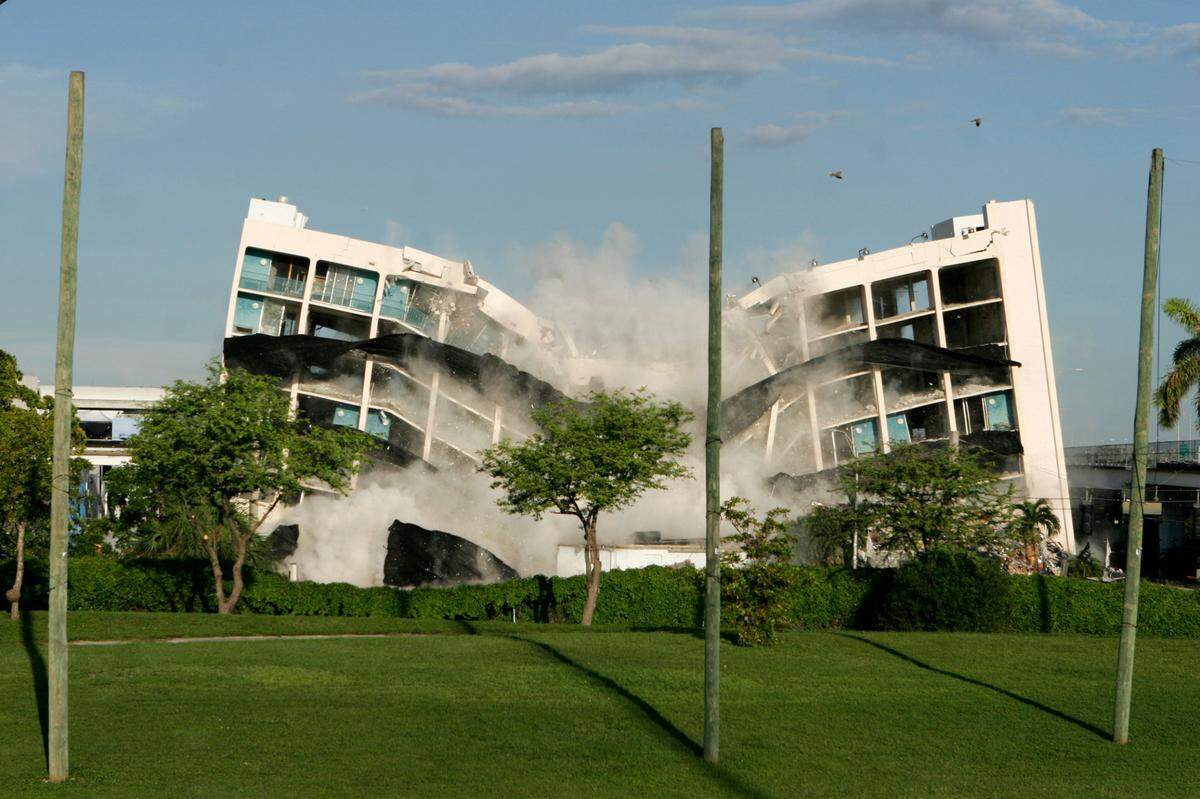
But spectators who watched the dramatic implosion of the squat, seven-story beige-colored HoJo on Biscayne Boulevard on Sunday felt a twinge of nostalgia — if not for its orange roof which once served as a beacon for American family motoring — then for the quickly changing face of downtown Miami.
“It’s sad, but in all fairness, I can see why they’re getting rid of it,” said Kristen Busold, 20, who watched Sunday morning as demolition experts detonated 93 pounds of old-fashioned dynamite to bring down the landmark.
A 67-story condo tower — the Marquis — will rise in its place, a shimmering sentinel of glass at the gateway to South Beach. It’s expected to open in the summer of 2008.
Following the Everglades Hotel earlier this year and the Dupont Plaza before that, the HoJo is the third once-popular hotel to come down as Miami expands skyward.
Also scheduled for oblivion in the coming months is the Sheraton Biscayne Bay.
Though not a historic site, Audrey Finkelstein said the old Howard Johnson building was still a landmark and would be missed by some for simply being part of their lives’ landscape.
It had been on Biscayne since 1966.
The chain began building restaurants, then motor lodges across America in 1925.
Anyone who grew up in Dade County remembers passing the HoJo’s restaurant and lusting after the incredible “28 flavors of ice cream” offered inside.
“I share a regret in the sense of loss of any of the things that have become our background, our framework, for the life that we led here,” Finkelstein said.
But to city and county employees, and building and demolition contractors, it’s the future, not the past, which beckons.
“It’s exciting to see our skyline change and really envision what the city will look like,” said Miami Mayor Manny Diaz, who was gathered with the crowd at Bicentennial Park to witness the implosion, which caused the building to split from its roof and crumble seven stories.
Diaz is proud of what will replace relics like HoJo’s, which in its final year operated as the Port of Miami Hotel at 1100 Biscayne Blvd., next to the Interstate 395 exit to the boulevard.
“We’re standing on the site of Museum Park,” Diaz said, referring to the 29-acre site that will house the Miami Art Museum, the Miami Science Museum and open park space. “Right down the street is the Performing Arts Center. This whole area is going to be exciting, lots of people, lots of pedestrians, restaurants, nightlife.”
Diaz and Mark Armstrong, director of construction for Leviev Boymelgreen, Marquis’ developer, were tapped to count down the last seconds of HoJo’s life.
“5-4-3-2-1 . . . “ “Fire!” Diaz shouted.
Six loud cracks were heard, followed by a short but pregnant pause. Then, an earth-shaking boom.
The building came down in a few seconds.
The event made the news cycle on CNN and Fox News.
“It’s a place whose time has come and gone,” Armstrong said as a cloud of HoJo’s dust swept over him. “We say goodbye to it, and we tip our hats, but we look forward to the past that starts at this moment.”
Dupont Plaza (2005)
The former Howard Johnson’s motel on Biscayne Boulevard will be imploded today, becoming the latest obsolete building in downtown Miami to make room for high-rise condos.
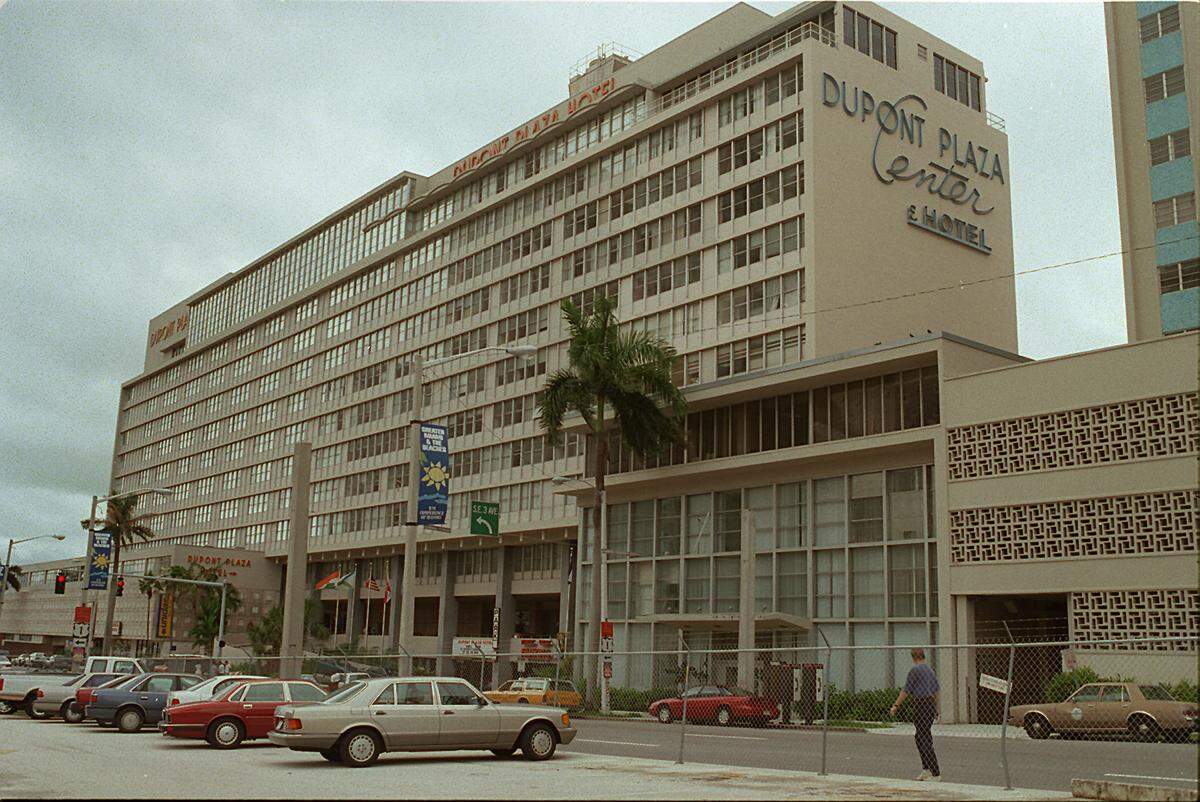
The Dupont Plaza, the Everglades Hotel, the big old downtown tire store . . . Poof! All vanished, victims of the high-rise condo boom.
Now another one bites the dust: The obsolescent former Howard Johnson’s on Biscayne Boulevard is to be imploded early today to make way for a 67-story condo tower.
It won’t be the last to go.
Already coming down is 550 Brickell, the first office building on Brickell Avenue. It is now well under deconstruction. Soon to follow: the Sheraton Biscayne Bay across the street, not even 25 years old and once Brickell’s nicest hotel.
Not all will be lamented.
The 550 Brickell building, designed around 1950 by eminent local architect Robert Law Weed, has many fans and is featured in MiMo, the new book on Miami Modern design. But the vacant tire store — also near the HoJo — was an eyesore for decades. And the motel going down Sunday is generic HoJo design.
But the disappearance of so many large buildings at once serves as one more reminder of the breadth and speed of the transformation under way in and around downtown Miami.
“This is a city that has razed its historical buildings in pretty rapid fashion before, but now it’s just accelerating,” said Miami historian Paul George. “There’s never been a boom like this.”
The HoJo, 1100 Biscayne, is the last old building remaining on the boulevard between the Freedom Tower and the Interstate 395 overpass, a strip once known as Gasoline Alley for its profusion of service stations, George said. Only one gas station survives.
“It’s not like the HoJo is a historical building. But we have very little left of what the boulevard once looked liked,” George said. “It’s amazing.”
Not every building goes out with a bang like the HoJo.
The Dupont takedown, for instance, took place over months, more a dismantling than a demolition.
But some developers like the speed and the impact of controlled explosions (no pun intended), the method used to bring down the historic Everglades Hotel earlier this year.
Big implosions can mean big publicity. Sometimes, the instant demolitions play bit parts in Hollywood productions.
The Mark’s developer, CEO Jorge Perez of the Related Group, hoped the Sheraton could also go out “in style,” downed by explosives and caught on film for a movie or TV show.
But concerns over possible damage to the seawall and the adjacent Miami Circle archaeological site put the kibbosh on that, he said.
The Everglades (2005)
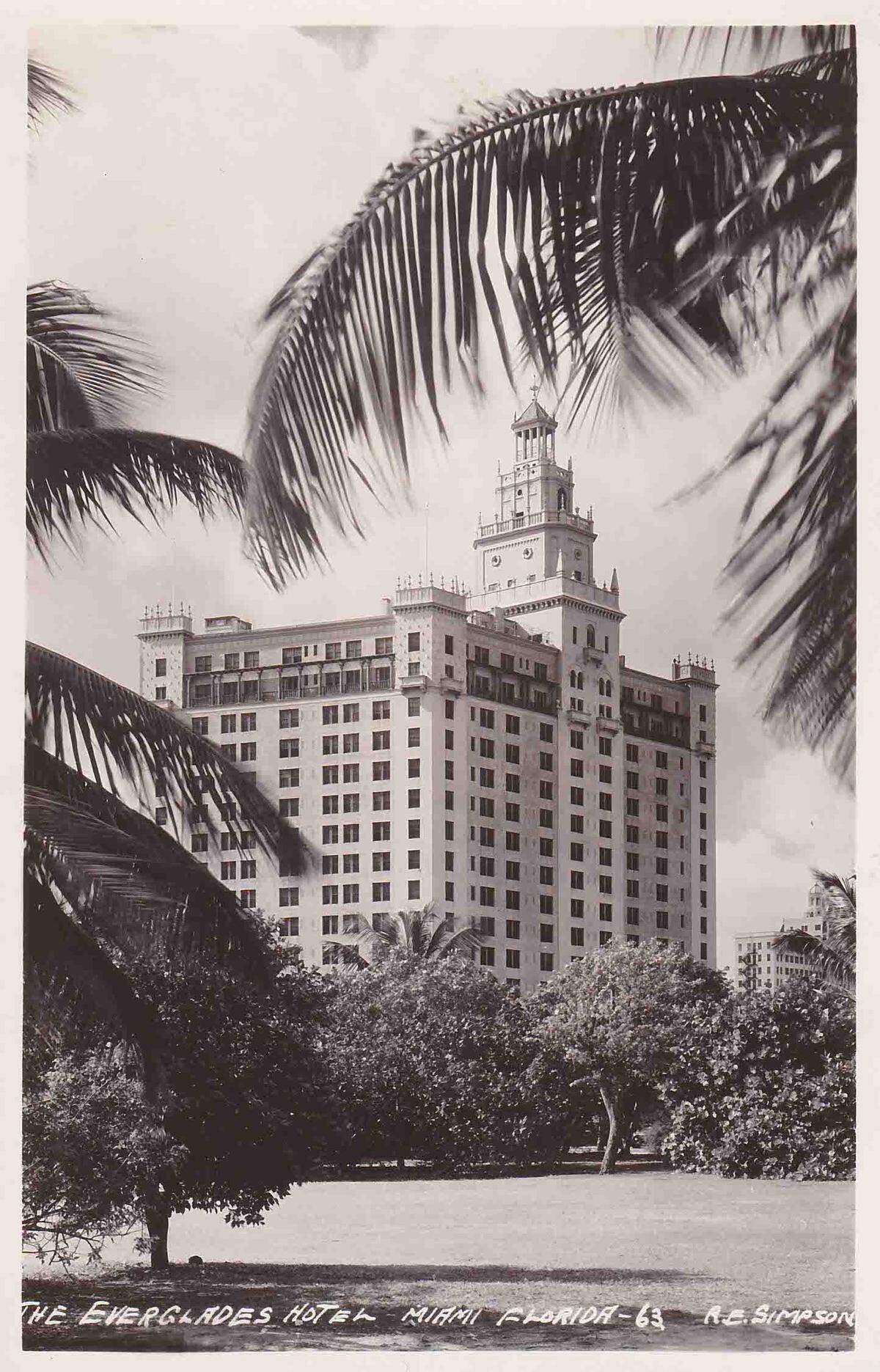
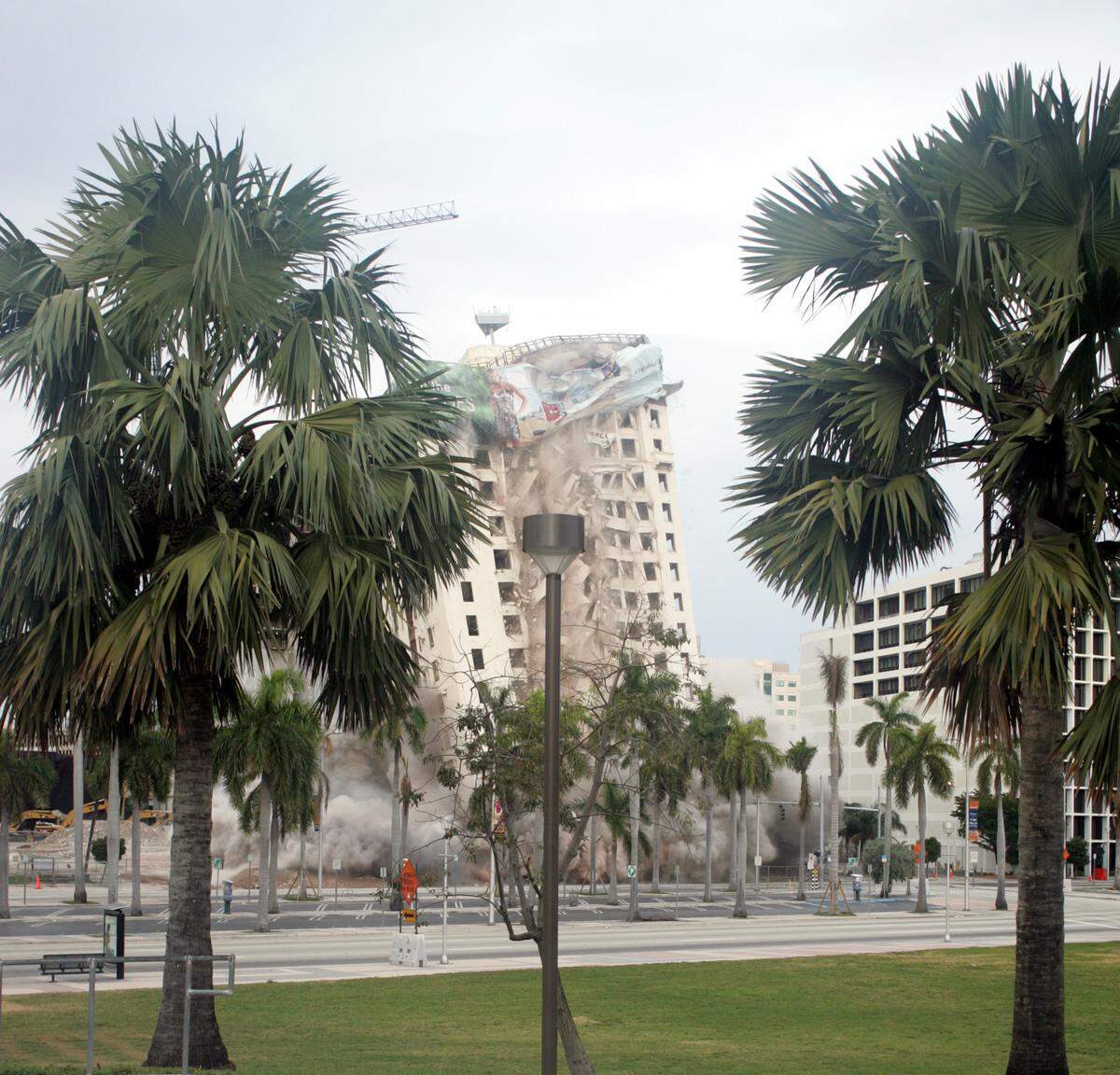
It stood tall as a downtown landmark for seven decades, but was gone in eight seconds.
The Everglades Hotel, which at 16 stories once reigned as Miami’s largest and most luxurious hotel, went down in a thundering implosion, sparking an instant transformation of the city’s skyline.
Early Sunday morning, 50 pounds of explosives along with 137 pounds of “steel cutting charges” were ignited inside the hotel to make way for a massive condo project — Everglades on the Bay.
Five. Four. Three. Two. One.
“Pah! Pah! Pah!” went the loud blast, and a cloud of dust covered the sky.
The takedown drew several hundred spectators to the site at 244 Biscayne Blvd. in downtown Miami, near Bayfront Park.
Many gathered on the streets with digital cameras to capture the historic hotel crashing to the ground.
“Wow! I didn’t think the explosion would be that loud and powerful,” said 12-year-old Kyle Nolfo, a student at Miami Lakes Middle School. “This is much better in real life.”
Though Kyle was thrilled with Sunday’s dramatic scene and all its Hollywood elements, his father, Brian Nolfo, 51, was sad to see the 1920s skyscraper go.
Nolfo remembers visiting as a child. His grandmother worked as a cashier at the hotel’s coffee shop from 1950 to the 1970s.
“Whenever I came down from New York I always got a free meal there,” said Nolfo, now a Miami Lakes resident. “I’m nostalgic about it. It was part of Miami’s original skyline.”
Anita Fernandez and her 11-year-old son, Blaze, woke up at 5:30 a.m. to make it on time to the 8 a.m. implosion. They stood in front of Bayfront Park, gazing at the empty building, stripped of its interiors and windows.
Fernandez recalled the many times she met friends for dinner at the hotel.
Sunday morning those friends stayed at home, she said.
“They didn’t want to come,” said Fernandez, a teacher at Naranja Elementary School. “This is more of a sad moment for them.”
Still, some couldn’t wait to witness the building collapse into a pile of rubble. It’s a rare opportunity, they said.
“This is an event. I love this stuff,” said Jerry Miller, manager of the Bayside Plaza. “This is the best free entertainment in Miami.”
Jacobo Cababie, a principal in CABI Developers, gave final approval for the implosion. He and a group of dignitaries had a private viewing party at the Bayfront Park Amphitheater.
Cababie expects the new luxury condominiums, which will feature two 49-story towers, to be completed within 2 1/2 years.
“It was just amazing to see how quickly it came down,” Cababie said. “I’ve seen the implosion of a building before, but it’s different when it’s your own.”
Miami Mayor Manny Diaz said this project is part of a long line of continued upgrades for the city.
“Today, we began redefining downtown Miami’s skyline,” he said.
Emergency coordinators from five different agencies, including Miami fire rescue, stood nearby. They took advantage of Sunday’s controlled implosion to simulate the 9/11 World Trade Center disaster.
“We can’t even imagine what New York went through,” said Tom Miller, 16, of Coral Springs, who stayed to watch the emergency drill. “This wasn’t even one-tenth of the mess, noise and destruction they had there. I was amazed.”
Video of other demolitions
This story was originally published October 28, 2022 at 6:30 AM.