
After poop in water shuts down kayak ramp, Miami Beach hires professor to investigate
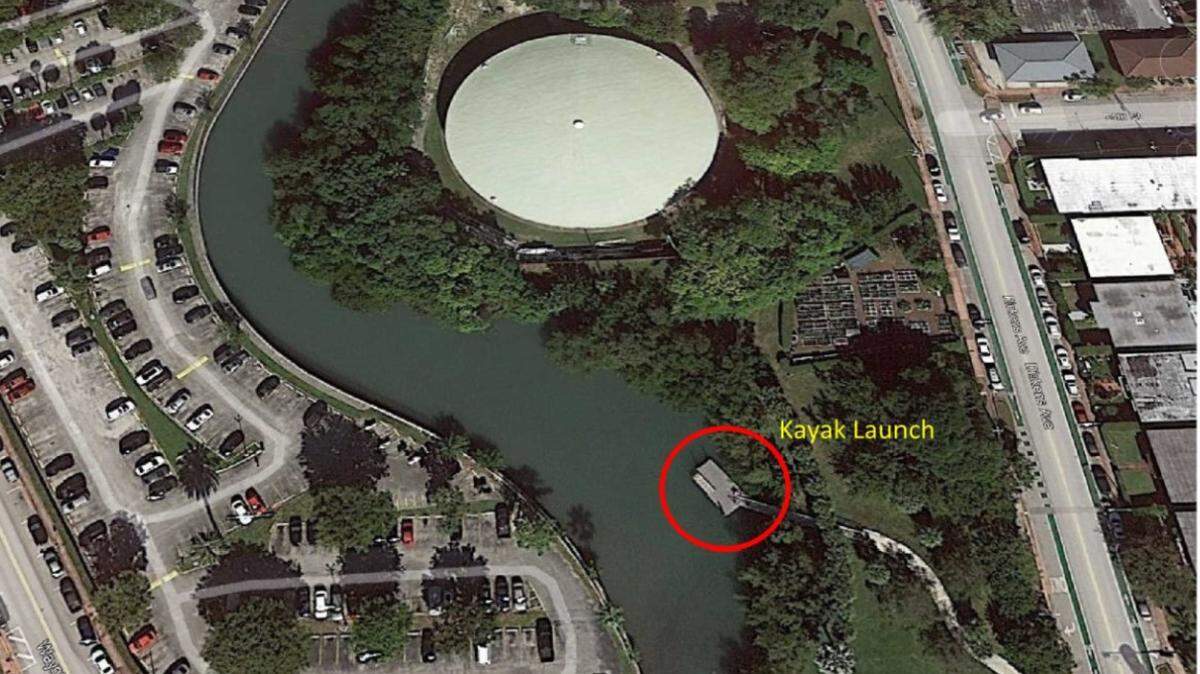
It’s been over two years since Miami Beach first warned residents to avoid the canal near the Parkview Island neighborhood due to high levels of poop particles in the water.
The city, which has blocked access to a kayak launch on the canal since 2020, says it searched for sewage leaks and has tested the water, but still hasn’t found the source of the enterococci fecal bacteria pollution — although it has pointed a finger at dog owners after traces of pet poop were found in water samples.
A March 2020 sewer line break on 72nd Street and Collins Avenue led officials to issue a no-contact-with-water advisory for the area near the kayak launch and the city never lifted the public health advisory. The levels of fecal bacteria have consistently measured well above the Florida Department of Health recreational swim standards.
Recently, the city hired a University of Miami professor to investigate the polluted water over the next three months and issue a report with recommendations for how to treat it.
Residents of the neighborhood in North Beach say the prolonged environmental hazard has hurt their quality of life. A water sample taken at the kayak launch July 7 by the environmental group Blue Water Task Force recorded fecal bacteria levels 345 times beyond state standards.
Omar Jimenez, president of his neighborhood association, said he doesn’t think the city has acted quickly enough to address the issue and he longs for the days when he could swim or kayak freely outside his home.
“It’s definitely beyond frustrating at this point,” he said.
Miami Beach trying to find source of pollution
City officials say they have been actively working to figure out what may be causing the pollution. The city says it has spent over $70,000 on efforts such as blowing smoke through the pipes to find leaks, video surveillance, water quality sampling, hiring a third-party group to conduct an initial investigation and cleaning out the sewer system.
Water samples have found high levels of dog and bird DNA, but the city says it has not identified a single source of the contamination.
Lindsey Precht, assistant director of the Environment & Sustainability department, said in a statement that the issue seems to be “non-point source water pollution,” which is defined by the Environmental Protection Agency as pollution caused by rainfall picking up pollutants as it runs along the ground.
“The city has not been standing idly by and has been extremely proactive in trying to determine the reasons for the elevated bacteria levels,” Precht said. She said the city is also “conducting an ongoing sanitary sewer evaluation of the infrastructure in that area.”
“Since the studies so far have not identified the source, the city determined a different expert evaluation was needed, and hired a renowned scientist with expertise in intertidal zone and sediment contamination,” Precht said. “Our goal with this next study is to identify any sources of pollution and develop long-term solutions to eliminate the elevated bacteria levels.”
In late June, City Manager Alina Hudak authorized emergency funding of $122,000 to hire University of Miami professor Helena Solo-Gabriele, an expert in water-quality research, to expand the water sampling in the canal, write a report on the possible sources of the contamination and issue recommendations and cost estimates to the city to treat the issue.
In a proposal to the city, Solo-Gabriele theorized that there may be “regrowth of enterococci in the environment,” so she wants to test the sediment at the bottom of the canal for the fecal bacteria. She also recommended installing an auto-sampler at the kayak launch to collect water samples twice a day, and to also sample water north and south of the launch.
Solo-Gabriele did not respond to a request for comment to discuss her work.
In a June 27 memo, Hudak said city staff has met with the Florida Department of Health and the Miami-Dade County Division of Environmental Resources Management to review water samples. The regulatory officials recommended continuing to inform the public about picking up after their dogs, Hudak said.
Hudak said the city has also contacted local governments in Monroe and Broward counties to “explore other potential solutions for reducing the high bacteria, which may be further replicating in the low flow, high nutrient environment of the canal.”
“This long-lasting issue is a concern to public health in the waterway,” Hudak wrote.
This story was originally published July 15, 2022 at 4:38 PM.
.JPG)