
‘My jaw dropped.’ Video raises questions about another Miami Beach arrest and a new law
Mariyah Maple, a visitor from New York, was arrested last month under a new Miami Beach ordinance intended to protect police officers from belligerent crowds interfering with their “lawful” duties.
The arrest report described her as part of a group that “refused officers commands” to back away from cops making an arrest on South Beach on July 25. When a police sergeant used his bicycle to “create a physical barrier,” the report claimed, the crowd “stood their ground and refused to move” — forcing him to use pepper spray.
A recording of the previously unreported incident obtained by the Miami Herald shows a much different sequence of events — the third time in recent weeks that video has contradicted Miami Beach police arrests under the ordinance.
The clip shows Maple, using her phone to video record a traffic stop in the middle of a street, standing peacefully on a sidewalk on the 600 block of Collins Avenue. “Back up. Back up,” a sergeant says. But before giving her a moment to do so, he whips his bike around like a shield, striking her hand and immediately deploys pepper spray. Maple, eyes stinging, then runs away with several friends.
“She was standing at a distance. She wasn’t doing anything to interrupt the investigation. She was standing on a public sidewalk,” said her defense lawyer, Chad Piotrowski. “When I watched the video, my jaw dropped. It’s a completely different depiction than the arrest report.”
Maple, 27, was not arrested immediately. The Miami Beach sergeant, Vincent Stella, walked away. Maple was only handcuffed after another officer noticed her down the street as her family rinsed her eyes out with water, and she complained about her burning eyes.
Her case is just the latest example of troubling arrests made under an ordinance that drew little attention or criticism when the Miami Beach City Commission passed it in late June. The ordinance makes it illegal to “approach or remain within 20 feet” of a Miami Beach police officer with the “intent to impede, provoke or harass” an officer engaged in lawful duties, after receiving a warning.
Emails obtained by the Miami Herald show the police department — which has drawn criticism for its handling of large, mostly Black crowds that periodically flock to the city for Memorial Day weekend, spring break and other events — pressed to get it into place before crowds arrived for Rolling Loud, the hip-hop festival that draws thousands of fans to South Florida.
City officials and Miami Beach’s police union insist that the law does not unfairly target bystanders video recording cops, and is needed to protect officers from the types of unruly crowds that caused chaos on South Beach during spring break. “The intent of that ordinance was never to prevent people from filming police. That should be crystal clear to anyone,” said Paul Ozaeta, the president of Miami Beach’s Fraternal Order of Police.
But critics — seeing how it has been employed in its first weeks — say the ordinance is unnecessary and arbitrary, emboldening police officers to arrest bystanders who are simply recording their actions with cellphones, which have become a powerful tool for documenting questionable police tactics. Activists have long accused Miami Beach police of treating minority groups unfairly. Records show that only Blacks have been arrested under the ordinance so far.
The Herald last week requested a list of all ordinance arrests made by Miami Beach police. A review of the 13 cases supplied by the department shows that at least eight of those arrests were of people who’d been using their phones to record officers. All 13 were young Black men or women. Most of them still face a potential criminal trial, including Maple.
“We’re turning bystanders and good Samaritans into criminals,” Kara Gross, the legislative director and senior policy attorney for the American Civil Liberties Union of Florida, said of the ordinance. “The ACLU opposes any efforts by law enforcement to adopt and utilize legislation as a tool for targeting and criminalizing Black and brown communities.”
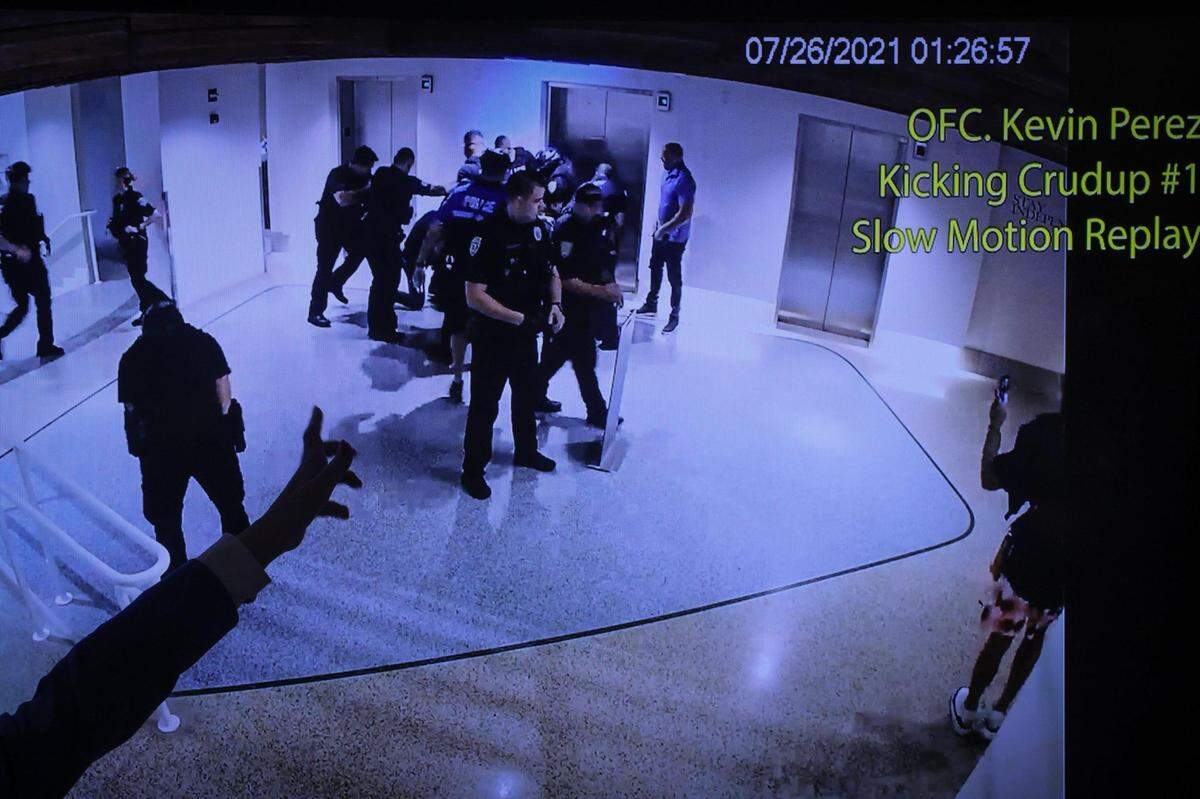
The ordinance didn’t gain widespread visibility until after a series of rough and questionable arrests at the Royal Palm hotel on July 26.
In a case that drew national attention, two New York men were arrested under the same ordinance as they video recorded police officers at the hotel. In the aftermath, five Miami Beach police officers wound up charged with misdemeanor battery after prosecutors said they used excessive force in making arrests.
The State Attorney’s Office dropped the ordinance cases against Khalid Vaughn and Sharif Cobb, both of whom were wrestled to the ground as they video recorded police officers, some of whom had been involved in the rough arrest of a third man accused of injuring a cop with his scooter.
In Cobb’s case, the arrest report claimed that he “refused several warnings to leave the area,” but body-worn camera footage showed he was following orders — walking backwards away from police.
Sgt. Stella, who pepper sprayed Maple the night before, was also involved in the unrelated take-down of Cobb, according to court documents. He has not been charged with any criminal violations, and it was unclear if he is the subject of any internal affairs investigations.
Maple’s arrest report was authored by another officer, Jorge Bercian, and approved by Sgt. Jose Perez — who also was charged with battery in the Royal Palm incident.
The Miami Beach City Commission passed the law with little fanfare on June 23. Nobody from the public objected. In sponsoring the ordinance, Commissioner Steven Meiner said it was based on HB11, a similar bill that was introduced in the Florida Legislature earlier this year but failed to become law. It’s been introduced again for the 2022 session.
“Officers who are interfered with or surrounded which we saw during Spring Break...this would allow our officers to issue a warning to back up beyond 20 feet,” Meiner said. “It would allow our officers to issue fines or potential arrest ... Officers get surrounded and right now they have limited options in how to break that up.”
Florida law already allowed officers to arrest people for resisting arrest, assaulting or battering a law enforcement officer, disobeying lawful comments, disorderly conduct and even unlawful assembly.
The only hesitance on the commission came from Commissioner David Richardson, who asked if the ordinance would interfere with a person’s right to lawfully record officers in public spaces. He cited the high-profile Minneapolis police killing of George Floyd in May 2020, in which a bystander video proved crucial in convicting Officer Derek Chauvin of murder.
During the meeting, Chief Deputy City Attorney Aleksandr Boksner insisted people recording cops would not be harassed. “Videoing of our law enforcement officers is legally permissible under the law,” Boksner said as Miami Beach Police Chief Rick Clements stood next to him, nodding.
Richardson agreed to co-sponsor the bill, as did Commissioners Ricky Arriola and Mark Samuelian. It passed unanimously.
Miami Beach Mayor Dan Gelber said the actions of police at the Royal Palm gave the city a “black eye” but he credits the police department with immediately suspending the officers and reporting the incident to the State Attorney’s Office.
He said the ordinance should not perpetuate a chilling effect on filming the police and that he hopes officers will be trained to handle cases of people filming them. “Filming should not lead to an arrest. Hard stop,” he said.
But as the mayor of a city that often draws large — sometimes rowdy — crowds to the South Beach entertainment district, Gelber said police officers should also be allowed to do their jobs without crowds gathering too closely around them.
“I think the idea that you need to let somebody do their job shouldn’t be a problem and I don’t think it should ever impact the right of a citizen to record,” he said.
Emails obtained by the Herald show the police department rushed to make sure the ordinance was programmed into a county-wide arrest report computer system before Rolling Loud crowds came to Miami Beach. “Please work on this today so we ensure it is available for this weekend’s festivities,” Anthony Loperfido, a Miami Beach police sergeant, wrote to a fellow technology support staff member.
The staff member, Miami Beach Officer Andre Morales, emailed the State Attorney’s Office one day before Rolling Loud, the three-day music festival, was set to begin. “We were hoping to be able to utilize this ordinance during this weekend’s upcoming event,” Miami Beach Police Officer Andre Morales, a tech coordinator, wrote in a July 22 email to the State Attorney’s Office.
The extent of how Miami Beach trained its officers in the ordinance remains unclear. Chief Clements was not available for an interview Wednesday, but a spokesman stressed the ordinance’s 20-feet distance requirement “never applies to people who are merely filming police.”
Still, critics say officers used the ordinance incorrectly and arbitrarily.
In Cobb’s case, he was using his cellphone outside the Royal Palm hotel — where he was a guest — to video record his friend’s arrest. Footage shows an officer cursing at him: “Twenty feet away from us. Twenty f--king feet away, let’s go. That ain’t 20 feet!” an officer yells as Cobb backs up.
“All right, all right,” Cobb says as he backs up, just before he is tackled to the ground and arrested.
“The filmer has no idea what 20 feet means, but he moves back,” said Stephen Hunter Johnson, a lawyer and chairman of the Miami-Dade County Black Affairs Advisory Board. “What’s interesting is the officer continues to move with the individual — how do you get to 20 feet if the officer is continuing to move?”
Johnson added that officers already had broad power to arrest people who might be endangering them on the job.
“I don’t blame the police department. If you get them a tool, I expect them to use it,” Johnson said. “I blame the elected officials who thought it was a good idea.”
Ozaeta, of the police union, stressed that investigation into all the factors behind the Royal Palm incident is still ongoing and more facts will emerge.
“If mistakes were made, it’s in our best interest to not repeat them,” he said, adding of how officers handled the ordinance: “It’s a relatively new ordinance. Let’s see how it played out in actual practice.”
In Maple’s case, Miami Beach police’s internal affairs unit will review how the case was handled, the department said.
In another case from that weekend, Sheritta McMillan, was arrested for the ordinance after police claimed she was “berating officers” who were questioning a man on the boardwalk at 12th Street. McMillan, in an interview, said that she happened to be walking by and asked bicycle officers “why they were messing” with the man. She said they rudely told her to “keep moving.”
“I didn’t approach the officers. I didn’t threaten them,” said McMillan, a visitor from Washington, D.C., whose case is still open. “They were totally disrespectful to me. I just felt like they had their egos bruised.”
Her arrest was also authorized by Sgt. Perez, who has been relieved of duty for the Royal Palm incident and is awaiting trial on the battery charge. In all, records show, he authorized six of the 13 ordinance arrests.
Except for Cobb and Vaughn’s cases, all of the ordinance arrests made by Miami Beach police remain open and pending trial. If there were no other charges but the ordinance violation, the cases will be prosecuted in branch court by the City Attorney’s Office, not state prosecutors.
“State Attorney’s Office prosecutors would never receive or review these cases,” said State Attorney’s Office spokesman Ed Griffith.
Still, in light of the Royal Palm incident, the office said it will examine any other questionable ordinance arrests.
“We are asking our Public Corruption division to review the overall circumstances and issues surrounding these specific cases,” he said.
Miami Herald staff writer Charles Rabin contributed to this report.
This story was originally published August 19, 2021 at 10:12 AM.