
As COVID-19 cases rise, Miami Beach is not enforcing its own face mask rules at beaches
Six weeks ago, widespread noncompliance with face-mask rules led Miami Beach to temporarily close one of its most popular parks.
The high-profile closure of South Pointe Park received national media coverage and furthered the city’s standing as a leader among other Florida municipalities for its quick action in closing beaches and imposing a curfew.
Now, with cases on the rise and beaches reopened, the city has taken a different approach: It doesn’t enforce its own rules mandating face masks or social distancing when people are with non-family members.
“There should ideally be greater enforcement of those rules, but people have to be willing to do it,” said Dr. Glenn Morris, an infectious disease professor who has counseled the city on its pandemic response. “I think we’re at a situation where the increasing case numbers really raise issues about whether we are doing enough to try to stop the spread of this infection.”
Morris, the director of the Emerging Pathogen Institute at the University of Florida, said while Miami Beach has done an “excellent job” so far mitigating the spread of the coronavirus, the city may need to “really tighten up on the masking” if new cases continue trending upwards.
New COVID-19 cases in the state have been trending up since mid-May, according to a Miami Herald analysis of real-time data. Increases in testing alone could not account for the trends, the Herald found.
In four of the last seven days, the state has reported a record number of daily total COVID-19 cases, which Morris called “very concerning.” Florida reported 2,783 new cases Tuesday, more than it has ever recorded in a single day.
“When you then look at the rise in the number of cases, there is a lot of concern that what we are seeing reflects the increasing levels of mobility,” he said. “The lockdown was very effective. It resulted in a clear drop in cases. What we have seen since that time is a gradual increase in the amount of mobility. People are starting to come out and move around.”
In early May, Miami Beach was aggressive in limiting the potential for coronavirus spread at its parks, which were allowed to reopen April 29 under a county order. The city issued 7,831 face-mask warnings in the first five days parks were reopened, including 3,140 at South Pointe Park.
A day before beaches reopened June 10, the percentage of daily positive test results was 6.9 percent and hospital capacity in the county was 27 percent, down from 38 percent May 4.
On Tuesday, the positive rate stood at 9.1 percent and 537 new daily cases were reported in the county.
Gov. Ron DeSantis on Tuesday said he would not consider a further shutting down of the state to stem the virus’ spread.
Miami Beach Mayor Dan Gelber, who has appeared on national news shows to discuss the city’s pandemic response, said the lack of enforcement on the beach does not indicate a lack of urgency by the administration. The city can impose more “exacting enforcement” if daily case totals continue to climb, he said.
“We’re not going to get perfect compliance and ultimately people have to decide they want to do the right thing,” he said. “The volume of the people we are dealing with is so massive.”
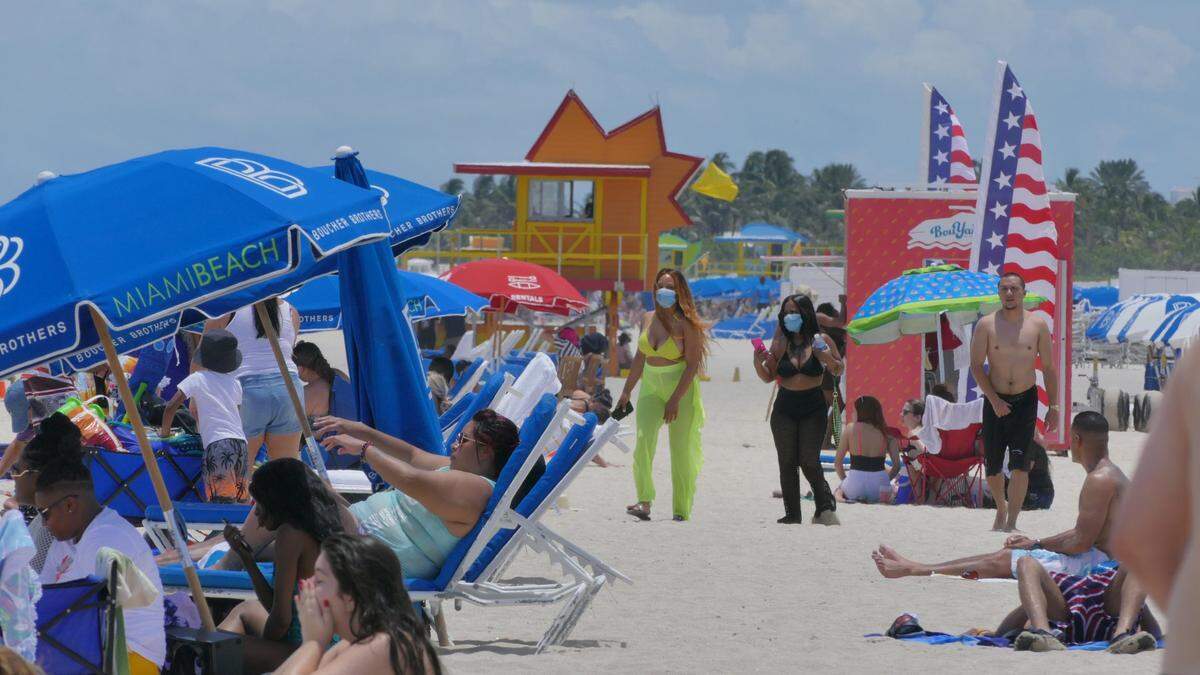
Unlike at parks, where city staff enforce social-distancing rules and document violations, the nearly 200 beach “ambassadors” stationed at entrances spanning the city’s seven miles of beaches do not serve an enforcement role. Instead, they are tasked with relaying information about the new rules to visitors as they enter the beach.
The city’s rules state that “facial coverings must be worn when social distancing of six feet cannot be achieved, except for members of the same household.” Masks are not required if social distancing is observed, when exercising or in the ocean. Children under 2 years old are not required to wear a mask. Neither are visitors with breathing conditions or who are unable to put on and remove a mask without assistance.
Ambassadors have been “directed” to report non-compliant beach goers to police or lifeguards.
“Fortunately, there has not been a need to remove someone from the beach for lack of social distancing with members outside of their household or not using a face covering when required,” a city spokeswoman wrote in a statement.
On 69th Street beach on Sunday, a reporter observed a group of more than 10 people lounging unbothered in front of a city ambassador, who did not look up from her phone.
“We can’t tell who’s in the same household,” the woman said. “It’s difficult to check. We were told to make sure groups were not within six feet of each other.”
The city’s messaging on beach reopening rules has also left room for interpretation.
“Face coverings are required when visiting beach concessions & bathrooms — not while laying out enjoying the sun,” the city falsely wrote from its official Twitter account on June 12, before clarifying the message. “Don’t worry, you won’t get a mask tan line!”
.JPG)