As Miami-Dade beaches open after coronavirus closure, people hurry to hit the water
As visitors to South Beach stepped onto the newly reopened public beach there Wednesday, they were asked if they had a face covering and if they wanted to rent a lounge chair.
Of the 160 “beach ambassadors” stationed across the city’s beaches to remind visitors of the new rules in place to stem the spread of coronavirus — you must wear a mask when social distance is not possible — 60 of them work for the private beach concessionaire Boucher Brothers. The rest work for Miami-Dade County and the city of Miami Beach.
“I want to let you know some rules we have in place,” Boucher Brothers employee Haizen Forero said as part of his greeting to visitors. “I see you have your mask with you. ... Are you looking to rent today?”
In Miami Beach, those rules include a ban on coolers, floats and inflatable devices. Across Miami-Dade County, the new rules state that no organized sports — even between two people — may take place. Masks are not required among members of the same household, but no groups of more than 10 people are allowed to gather.
Crowds largely followed the rules on Wednesday, as beaches reopened countywide almost 12 weeks after Miami-Dade Mayor Carlos Gimenez shut beaches down. But enforcement was lax. In Miami Beach, ambassadors will not be issuing warnings for violations, as park rangers have done at reopened parks.
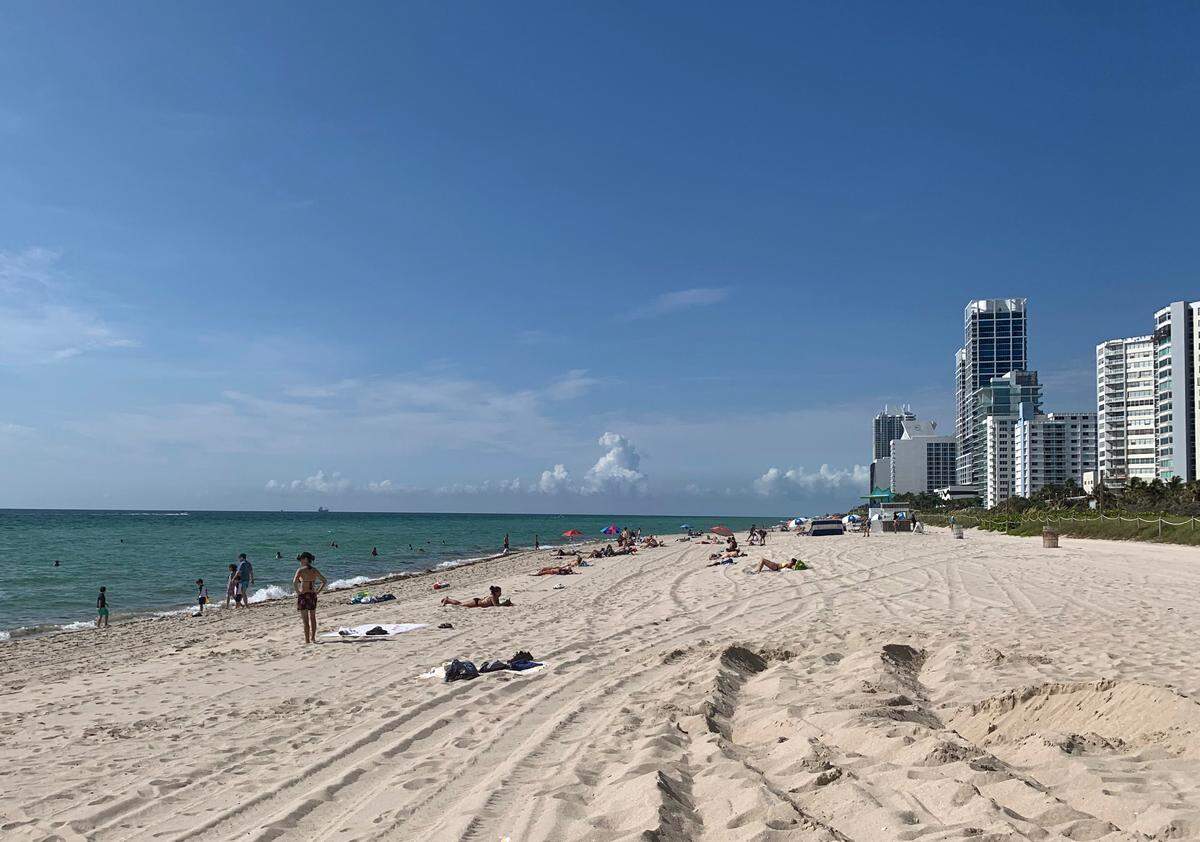
Apart from the initial check, visitors were left alone as they enjoyed themselves on the nearly empty beach. Some swam in the water and others sunbathed. News helicopters spotted a handful of sharks off the shore, seemingly welcoming visitors back. No incidents were reported, although the city declined to comment on a video showing sharks swimming close to bathers.
Jerry Petrochko, a 29-year-old Seattle man on vacation, got to the beach at 10th Street before 9 a.m. After flying into Miami on Monday, he thought the beaches would still be closed by now.
“I went to Google and they said they would open today, and they did,” he said.
Walking with his son, 2-year-old Jerry Jr., along the shore, Petrochko said Wednesday was his first time at a beach.
“He likes the waves,” Petrochko said.
Beaches had been scheduled to reopen June 1, but the county delayed the opening amid a curfew Gimenez imposed in response to anti-police violence protests in downtown Miami.
Aldo Ducci, 48, said the reopening of the beaches should not have been tied to the curfew, which Gimenez lifted on Monday. In the past week, Ducci said he has tried to “guess” when beaches would reopen but was disappointed when he was barred entry.
“It makes the life of the people more difficult,” he said. “I’ve been very upset so that’s why today I’m trying to [enjoy] this positive day.”
In the North Beach neighborhood around 75th Street, more than 100 beachgoers were scattered along the sand and in the water over a stretch of several blocks by around 10 a.m. Most lounged and swam in groups of one or two, sometimes three, with the exception of families with young children.
City workers, donning pink T-shirts with the words “safe distancing ambassador” on the back, were stationed at each opening to the beach, instructing people that alternating blocks were designated as either entrances or exits to promote social distancing.
Some followed their instructions, but others blew past them — most often after they had walked to the end of a narrow pathway trying to leave the beach, only to be asked to turn around and walk a block farther before exiting.
One woman bickered after a worker told her she couldn’t enter at 74th Street. “You go to Broward, you can go on the beach anywhere,” she said before following the instructions.
On the sand, the mood was light. Jules Conley, a North Beach resident, tended to her 9-month-old son, Torrin, and snapped photographs of her daughters — Layla, 9, and Amaia, 6 — jumping and splashing around in the shallow water.

They had arrived early Wednesday morning to start the day with a breakfast picnic on the beach.
“They were so desperate to come,” Conley said. “It’s been a long few months, especially having young children.”
Nearby, another local resident, Diego Luchetta, lounged on the sand with his partner. Before the beach shut down in March due to COVID-19, Luchetta said, he would come every day — even if only for five minutes — to relax.
“I was waiting for this for a long time,” said Luchetta, 45. “I was missing this a lot.”
This story was originally published June 10, 2020 at 11:19 AM.
.JPG)