
Miami Beach waits to open restaurants closed by COVID-19 but will add outdoor seating
Restaurants in Miami Beach must wait another two weeks before the city will let them reopen.
But when they do, following two months of closures due to the coronavirus pandemic, the city will allow all restaurants to extend their outdoor seating to sidewalks, parking spaces and streets.
The May 27 reopening of the city’s 855 restaurants — scheduled 10 days after Miami-Dade County will allow restaurants to reopen — will coincide with the start of a city pilot program officials hope will help lure the largest number of customers possible while limiting the potential spread of the virus in closed dining rooms.
Any restaurant that wants expanded outdoor seating will be asked to submit an application, with a site plan and insurance certificate, to the city. The administration is working with Miami-Dade County to close lanes of traffic and entire streets, including Ocean Drive and Washington Avenue.
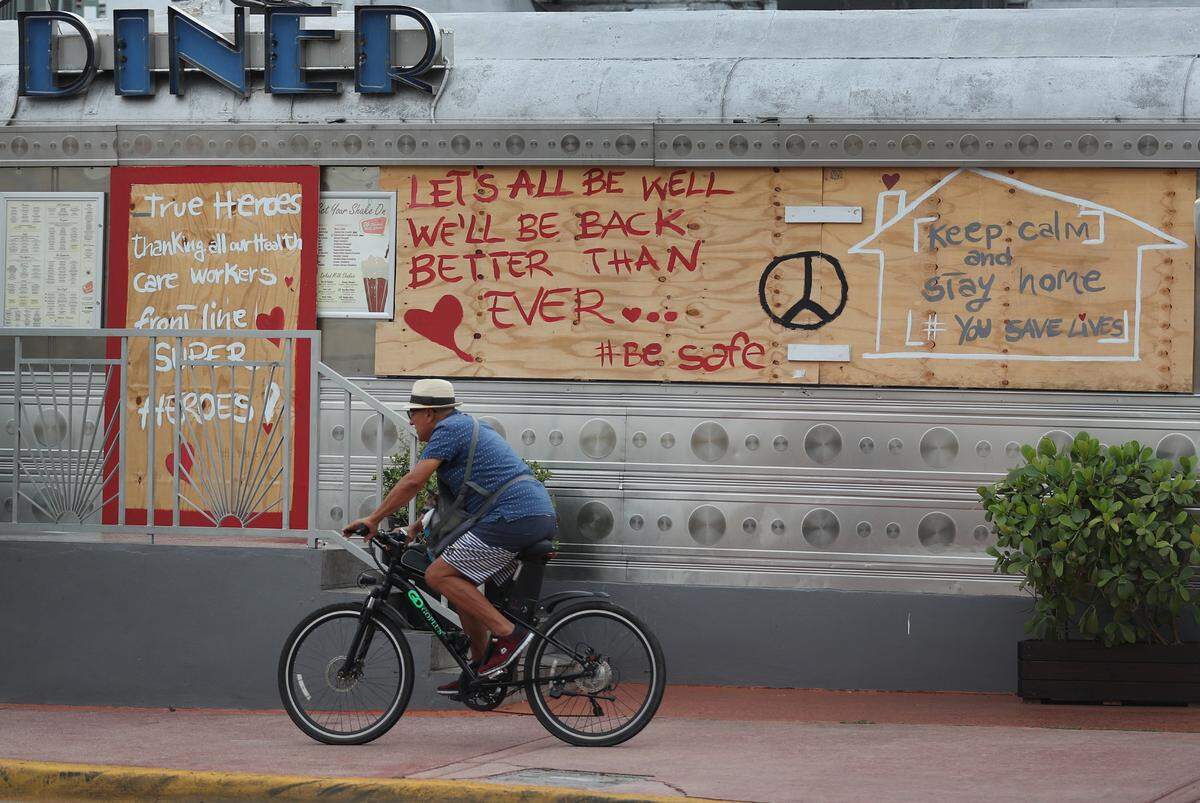
But for restaurant owners like Myles Chefetz, who has furloughed about 400 employees at his four Miami Beach locations due to the coronavirus, the prospect of more outdoor seating won’t give his staff their jobs back.
“I’d be lying if I said I was happy they were waiting another two weeks,” Chefetz told the Miami Herald. “When you’ve been closed for months, every week is a lot. Every day is a lot.”
Retail stores, barber shops, salons and museums — 761 businesses in total — will reopen in Miami Beach on May 20, two days after the same type of businesses open in Miami-Dade.
Beaches countywide remain closed, and Miami Beach Mayor Dan Gelber said the city doesn’t anticipate reopening its 7.5 miles of beaches until June at the earliest.
But the seaside city, which has had 757 COVID-19 cases per state data, is not alone in its gradual reopening of the economy. Miami, Miami Gardens and Hialeah are following a similar schedule as Miami Beach.
“What we didn’t want to do is open up everything simultaneously and find that we unleashed something we can’t control,” Gelber said. “The level of anger that is directed at me is going to happen no matter what I do.”
Miami Beach’s top administrator, City Manager Jimmy Morales, presented the scheduled reopening dates during a City Commission meeting Wednesday. The city’s marketing team branded the city’s revival with the slogan, “Indulge Again.”
Morales, who has led the city’s aggressive fight against coronavirus with special powers the commission granted him, said Wednesday that public health experts told him they feel “comfortable” reopening the city based on the “downward trajectory” of coronavirus hospitalizations and the daily percentage-positive rate of COVID-19 tests in Miami-Dade County.
“We do believe we are at the gating criteria. When you look at the criteria, the hospital capacity remains strong,” he said. “Key medical indicators continue to seem to be in a downward trajectory, and [the city’s health advisors] feel comfortable at least to enter into a Phase 1.”
Morales and Gelber have cautioned against rushing into a reopening, but they have felt pressured to reactivate the economy as soon as possible.
Chefetz, the Miami Beach restaurateur, said he was “disappointed” the city would not move more quickly on reopening the economy, but he was happy he could finally deliver good news to his employees.
“We’ve been waiting two months, and I’m excited that we finally have a date,” he said. “Just having a date is all we wanted. These employees can start planning their lives and get off unemployment.”
Reopening hinges on crowd control
When he first presented the commission with his reopening plan, Morales said a 14-day “decline” in key medical criteria would likely be necessary to reopen. A “robust” contact tracing program would also be needed, he said.
Daily hospitalizations, number of positive cases and the rate of positive tests have generally decreased in the last two weeks. But there has not been a consistent, day-over-day decline. The data shows no more than two consecutive days of declining positive cases in Miami-Dade.
Just under 5 percent of test results came back positive on Monday. By the end of last week, it was 6.6 percent, down from 16.5 percent the month before.
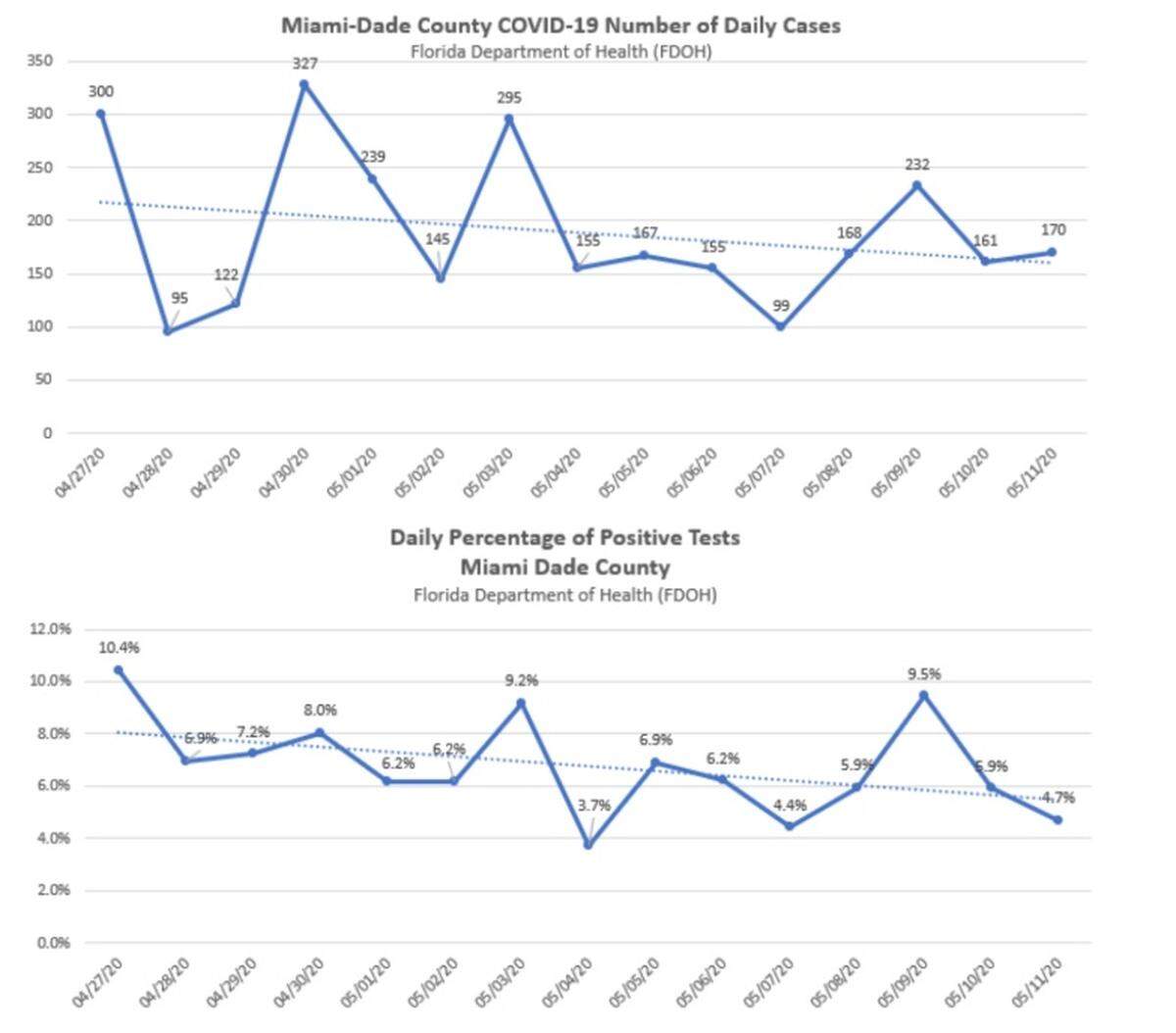
Daily coronavirus hospitalization numbers have fluctuated in the last two weeks, according to county data. During that period, the only sustained decrease in new cases occurred over a three-day span. On Monday, county hospitals reported 82 new cases. It was 68 on Tuesday. That number was as low as 51 on April 30.
Hospital capacity at Miami Beach’s only hospital, Mount Sinai Medical Center, and countywide has remained steady amid the pandemic. As of Tuesday, 45 percent of hospital beds in Miami Beach remained open to new patients, compared to 35 percent countywide.
Contact tracing capabilities by the state’s Department of Health have increased, but Miami-Dade remains “hundreds” of workers away from where public health experts would like, Gelber said.
“No matter when we open there will be a spike,” Gelber said. “We’ve clearly prioritized lives over livelihoods and will continue to, but at some point we have to open up the economy even if just a little bit.”
Gelber said the “limited reopening” will be dependent on how the public behaves. Miami Beach closed and then reopened the popular South Pointe Park after crowds defied a county face-mask rule.
“If we can’t control crowds, then we’re clearly going to have to rethink everything,” he said. “We view this is a cautious reopening, piece by piece with the ability to recede as necessary.”
The newly reopened businesses must follow public health guidelines, such as reduced occupancy numbers. Barber shops and salons will provide service by appointment only and with 15 minutes between the end of one appointment and the start of a new one. Employees will be required to wear masks and gloves, and their work stations will be set 6 feet apart from each other.
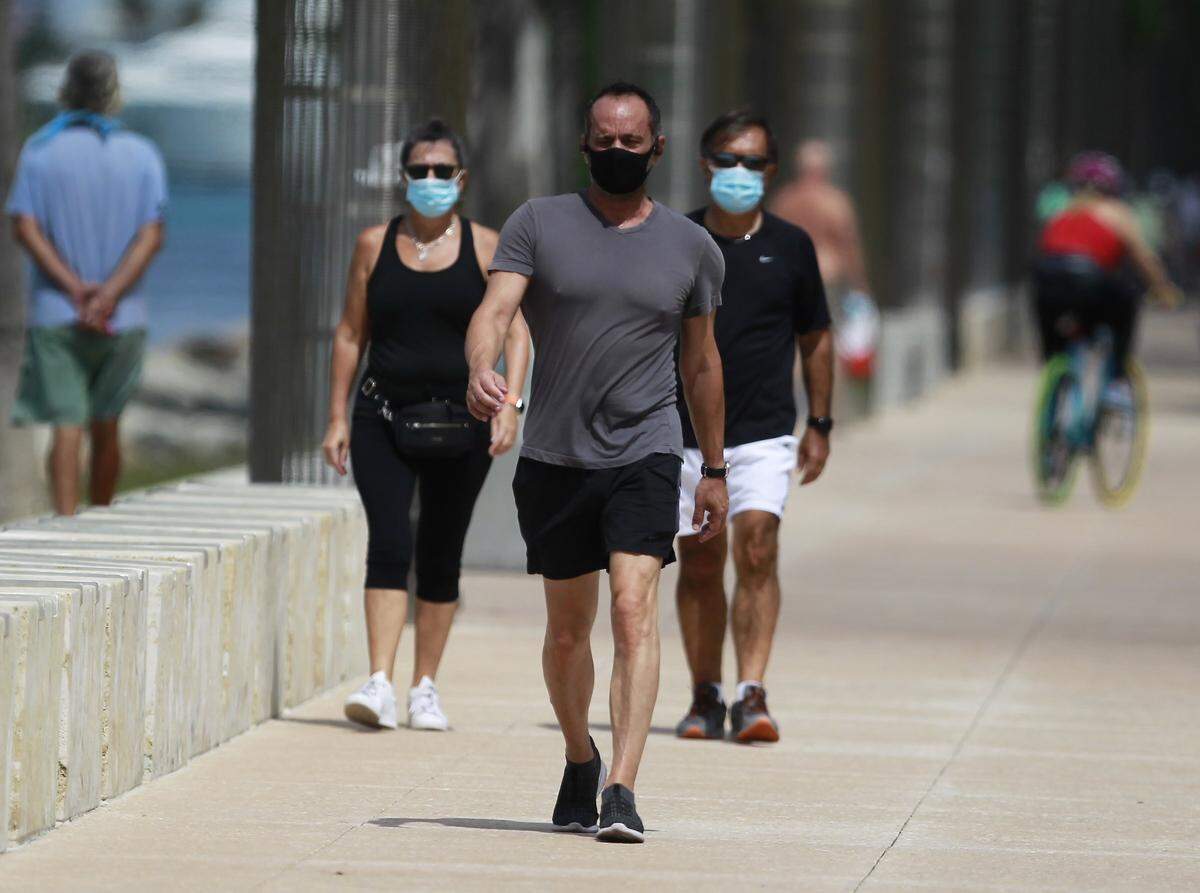
Restaurants will also be required to keep 6 feet between tables, limit parties to 10 guests or fewer and reduce their indoor capacity to 50 percent.
The expansion of outdoor seating will hopefully make customers more comfortable when eating out, said Chefetz, who owns a series of Ocean Drive restaurants: Prime 112, Prime Fish, Prime Italian and Big Pink.
“I think people feel more comfortable outside with the breeze,” he said.
Commissioner Ricky Arriola criticized the city’s reopening plan as being anti-business.
“What you’re doing is telling the business community this is not a business-friendly city, and that we’re here to make it painful for you to do business,” he said.
On social media, Arriola lauded Miami-Dade Mayor Carlos Gimenez’s work restarting the county’s economy.
“Great job Mayor! I wish you were the Mayor of MB! We need some common sense here!” he tweeted.
He called Morales and Gelber the “City Czar and his Commander” on Facebook.
Gimenez announces county plan
The news came hours before Gimenez released a new color-coded “New Normal” system to guide various reopenings, with a detailed list of businesses tied to a colorized scale linked to severity of COVID-19 spread and relative ease of protecting the public at various business types.
For now, Miami-Dade is at the Orange stage, where parks and open spaces are allowed to be open, along with essential businesses. Gimenez said he plans to shift the status to Yellow on Monday, a category that allows the reopening of a long list of industries that includes warehouses, offices and restaurants as long as customer counts are kept at a fraction of normal levels. Retailers are linked to the Green status, which would follow Yellow.
“Depending upon the situation, we may take intermediate steps between these phases, but knowing what color phase we are in will help you navigate your activities,” the report stated.
Even so, Gimenez has said in public comments this week that he expects stores to reopen Monday, along with barber shops and beauty salons. Like most businesses reopening after two months of closures, customer counts will be kept low. At a barber shop, Gimenez said on “The Joe Rose Show,” “you’re going to have to wait outside until your turn.”
Gimenez guidelines set a 50 percent capacity cap for indoor restaurant space, but his administration is awaiting clearance from Gov. Ron DeSantis to allow that many customers inside dining rooms. The current state cap is 25 percent.
While the county is releasing a detailed guide on how to follow rules decreed by future Gimenez emergency orders on businesses, cities are free to issue their own regulations that are stricter than the county’s.
Miami Herald staff writer Douglas Hanks contributed to this report.
This story was originally published May 13, 2020 at 10:17 AM.
.JPG)