
Bills would switch enforcement of Airbnb restrictions from Miami Beach to Tallahassee
From almost 500 miles away, a group of state employees based in Tallahassee would be responsible for enforcing Miami Beach’s ban on Airbnb-type vacation rentals in most of the city’s residential neighborhoods under a pair of bills lawmakers are considering.
If the legislation passes in its current form, the state’s Department of Business and Professional Regulation would regulate most short-term rentals and take over local licensing and inspection powers that currently belong to local governments.
The legislation includes a grandfather clause narrowly protecting local prohibitions of short-term rentals, but “expressly preempts the regulation of vacation rentals, including their inspection and licensing, to the state,” according to a summary analysis of Senate Bill 1128, sponsored by Hialeah Republican Sen. Manny Diaz Jr.
Diaz’s bill, which is accompanied by a House version introduced by Rep. Jason Fischer, R-Jacksonville, would have a major impact in Miami Beach, which has tougher restrictions and fines than most Florida cities.
The city prohibits short-term rentals in most residential areas, and it requires that hosts on sites like Airbnb obtain a business tax receipt number, resort tax certificate number and a vacation rental dwelling license from the state. Miami Beach Code Compliance regularly inspects rental properties to ensure operators are displaying the proper licenses.
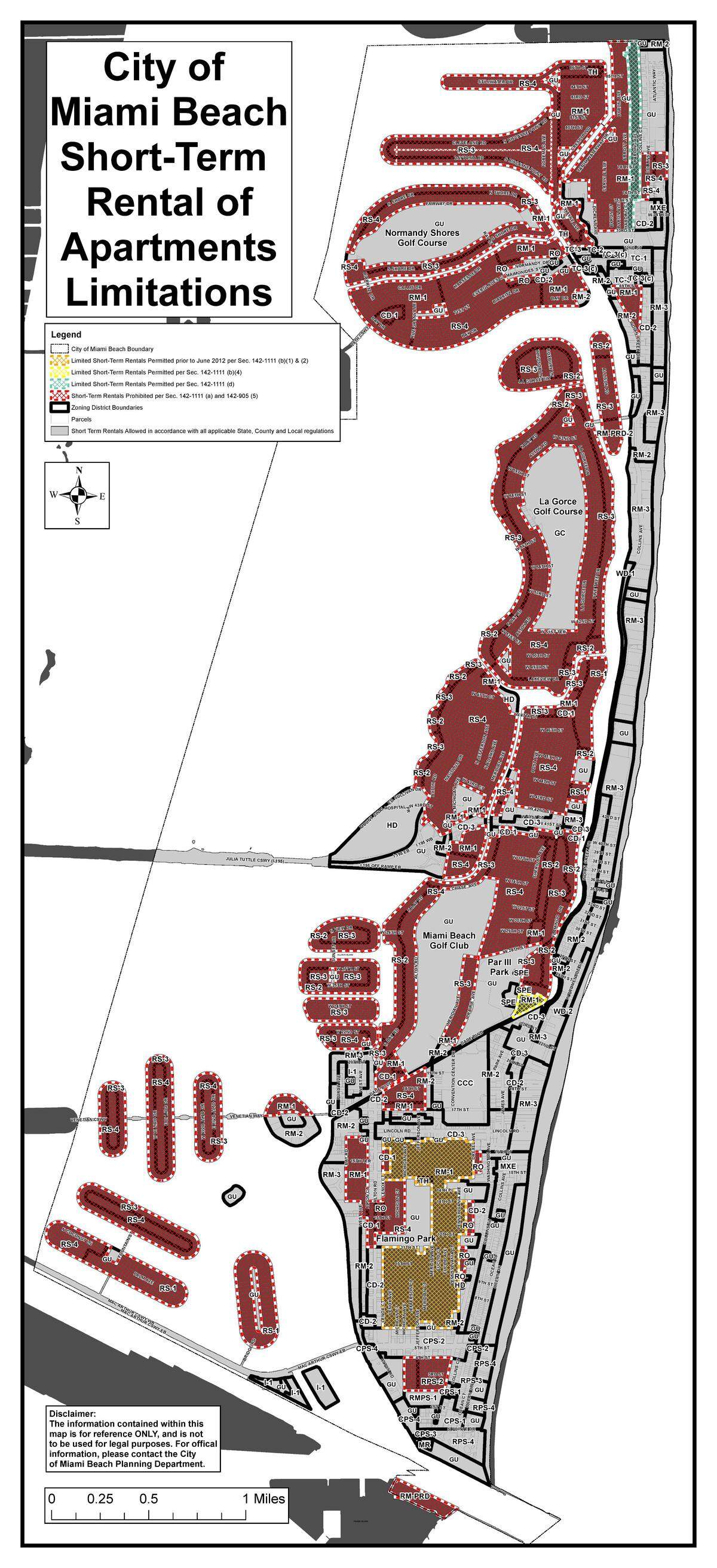
In the last 30 days, the city issued 10 violations under its short-term rental laws, according to a city spokeswoman. Nine properties were cited.
But under the new legislation, the state agency would inspect them only once or twice a year — and fines could not exceed $1,000 per offense. Miami Beach’s fines start at $20,000.
The bills, which a spokeswoman for Diaz called an “unfinished product,” must pass two more committees before going to the full House and Senate. Between now and then, senators and House members can tack on amendments.
For Diaz, the legislation would better protect the rights of property owners who want to earn money in the short-term rental market. But Miami Beach Mayor Dan Gelber said the city was concerned about the rights of homeowners who don’t want to live next door to what is functionally a hotel.
What that means for the effectiveness of local rules governing short-term rentals and the fines associated with them remains an open question, said Miami Beach Commissioner David Richardson, a former legislator who drove to Tallahassee on Monday and spent much of the week meeting with members of the Legislature and testifying against the bills.
He questioned how robustly the state would enforce violations of Miami Beach’s laws — and what would become of Miami Beach’s fine structure, which ranges from $20,000 for first violations up to $100,000 for fifth violations and each offense after that. The city’s fines for illegal vacation rentals are the highest in the country.
“I think [the state] would set the rules,” Richardson said. “We have to take this bill seriously.”
The bills were introduced at the end of 2019 but passed committee votes this month.
The legislation would replace the current patchwork of municipal regulations on short-term rentals with a “single, statewide system,” making it easier for hosts and guests to use sites like Airbnb but stepping on the toes of cities and counties with their own rules governing rentals in their backyards.
The legislation also states unequivocally that vacation rentals should be “permitted in residential neighborhoods” and that the state would safeguard the “constitutionally protected property rights” of vacation home operators.
“The bill’s only purpose is to put our ban at risk,” Gelber said. “That’s the only reason these bills are promoted, is to eliminate the protections we have created for our homeowners.”
Gelber said the legislation would create a “false enforcement mechanism that will never be used.” If passed, rental “conglomerates” would have free rein to open up shop in Florida’s residential neighborhoods, which Gelber said would harm homeowners’ quality of life and flout local zoning laws.
“I know that Airbnb desperately wants to start delivering strangers into our residential communities on a regular basis,” he said. “These are not mom and pop owners.“
Gelber, himself a former Tallahasee lawmaker, said Miami Beach’s code enforcement team is better staffed than the state agency that would take over. Enforcing local ordinances across the state is an impossible task without home rule, he said.
The state would hire six people to work on short-term rental regulations for the entire state, Richardson said.
“It’s an easy way of totally eliminating the enforcement,” he said. “There’s going to be no enforcement. It’s really scary.”
While Miami Beach’s Airbnb prohibition of short-term rentals is protected under the grandfather clause, the proposed bills nonetheless constitute a “chipping away” at home rule, said Aleksandr Boksner, chief deputy city attorney.
“It boils down to essentially the attempt by Tallahassee to take away local control,” he said. “We’re very mindful of that.”
Diaz said in a statement on Friday that his bill is a “good faith effort” not to nullify grandfathered-in prohibitions, like the one in Miami Beach, but to “establish consistency in vacation rental laws across Florida.”
“The idea is to work with my Senate colleagues to ensure uniformity in the industry,” he said. “Therefore, the bill has a two-pronged approach — protect the rights of privately owned properties by streamlining things such as licensing and inspections and making sure consumers are also protected when they visit our state.”
.JPG)