Outgunned: A firing range’s neighbors say it is a noisy nuisance. Florida law says tough
Way, way west of Homestead, past the crisp, white towers of the modern police station and colorful lights of the historic Seminole Theater, beyond the shade houses and the massive sprinklers and the ditches dotted with the occasional threadbare couch or worn-out fridge, the pavement gives way to dirt, which feeds into a dusty, secluded farming community. Fields filled with fruits and flowers extend for miles.
It is a place that Kevin Barber calls a “tropical paradise” — for the most part.
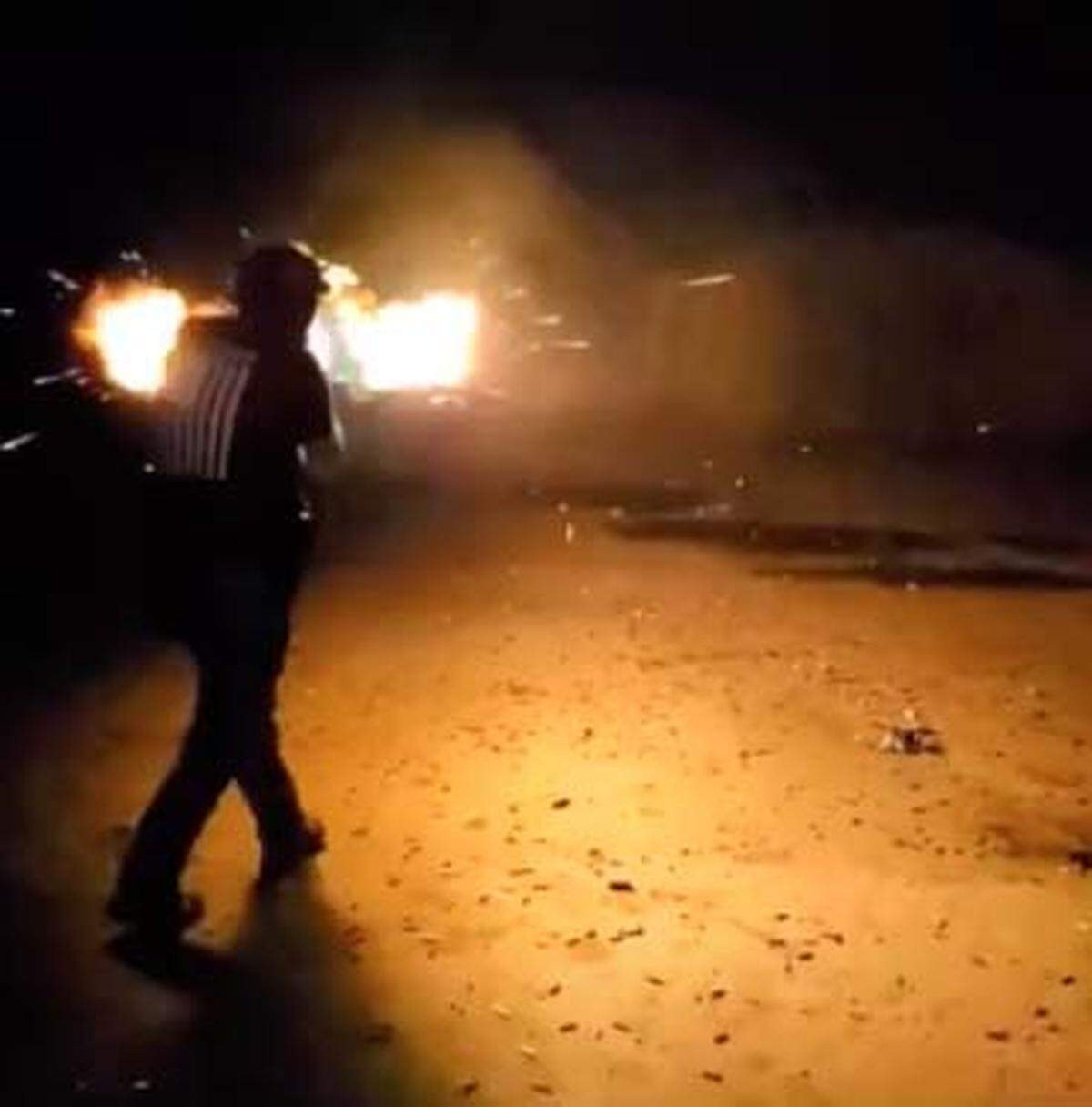
Except…this piece of paradise can be noisy. The pop-pop-pop of firearms rings out as do occasional explosions that shake the floor of Barber’s home, claims the 45-year-old military veteran. Not to mention on rare occasions the blistering, blast-furnace fwooooosh of a flamethrower as it scorches the foliage. The source of that commotion is Barber’s neighbor, Henry La Due, who owns and operates an outdoor gun range, one that is secluded, rustic — and popular, at least with those who sing its praises on social media.
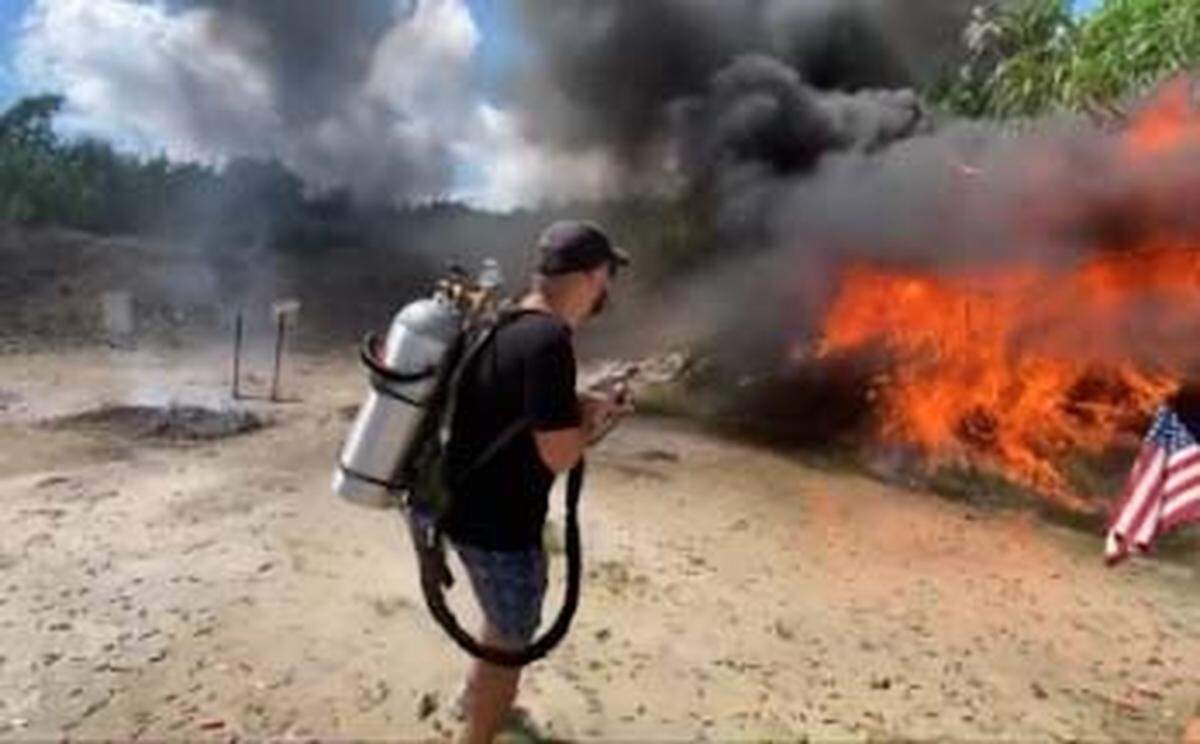
Here on the edge of civilization, where minding one’s own business is expected, an unlikely neighborhood dispute has broken out. It pits a long-standing, legally permitted firing range, Henry’s Sport Shooting, enveloped by trees at the end of a winding, rutted dirt driveway, against the farmers and tree growers who came here to till the land, tend the trees and live in peace.
Barber, who has led the opposition, has learned to his dismay that in Florida the laws look favorably on firing ranges and guns in general, with local agencies more or less preempted by state law from doing much of anything to address complaints.
Beware of exploding Santas
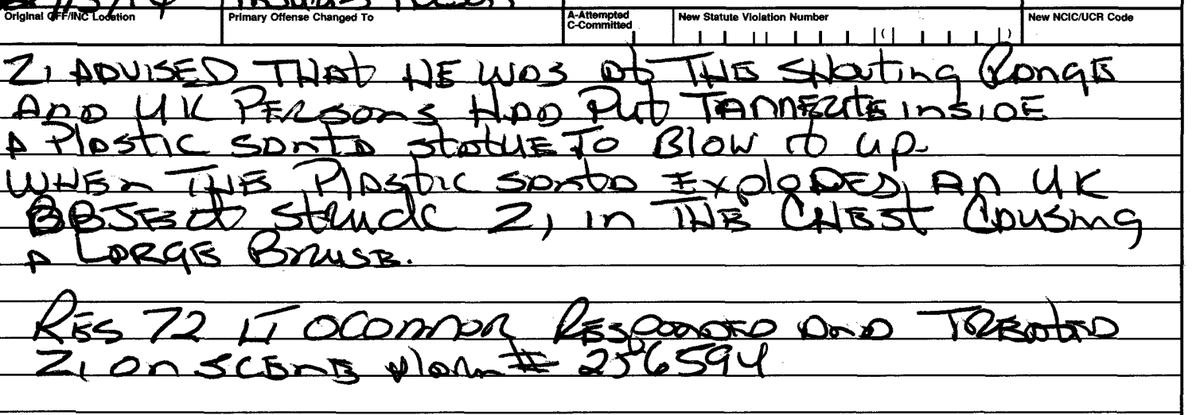
Henry’s is popular with shooters, including those who, if social media videos are what they appear to be, brandish military-style weapons and sometimes don fatigues and roll around while practicing a version of urban combat. One video on social media shows a patron blasting away with a handgun through the windshield of a car (hashtag: “roadrage”). Customers rhapsodize about targets rigged with explosive Tannerite. (According to one police report, a shard from an exploding “Santa” two weeks before Christmas in 2014 injured a patron of the range when it struck him in the midsection.) There is a wall-like berm across from where the shooters are positioned that should block stray bullets.

Barber alleges that the business, whose presence preceded him in the neighborhood by a decade, has fostered a culture of “disrespect” toward the surrounding community. He says that when visitors find the firing range gate locked and the business closed, they will indulge their trigger fingers by firing at whatever is handy, be it trees or the nearby canal bank that divides farmland from sawgrass and scrub. Located on the canal bank are signs that say “DISCHARGE OF FIREARMS IS PROHIBITED.” They are pockmarked with bullet holes.
Barber worries about the 8-year-old daughter he and his wife are raising.
La Due declined several invitations to discuss the range with the Herald and did not respond to a hand-delivered letter listing specific questions.
Aurora Giles, employed at an agricultural nursery less than a block from firing range for two months, said that stray bullets have reached the nursery in the past. They have never hit anyone, but they’ve come close, she said.
“I just don’t know how to turn the other cheek or pretend I don’t hear it anymore,” said Barber. “I did it for a while — I did and it just got me nowhere.”
The fight has spilled over into the code enforcement arena, and bad feelings abound. Barber claimed that shortly after he called the police on the gun range for detonating excessive explosions, inspectors showed up at his property, resulting in him having to spend $15,000 on a new roof. He said someone also alleged that his pet dogs amounted to an illegal breeding business.
Barber said shortly after he filed a complaint against the range he witnessed men in a car fire 60-plus rounds into his grove and later discovered that someone poisoned some of his trees. He doesn’t know who did it or why.
‘Unusual use’
The range has an “unusual use approval” allowing the range to operate. La Due went through a public hearing process in 2009 where he wrote in a letter of intent to Miami-Dade Planning and Zoning that he wanted to “build and maintain a sport shooting and training range” for his “private/recreational use.”
Approval was granted in 2010, despite a recommendation from county staff that the application be denied because “the proposed range facility will have a negative aural impact on the surrounding rural farm communities, is incompatible with the same, and could potentially be developed to serve residents outside of this community.”
Twelve years later, that prophecy seems on the money. But it is also true that users of the firing range seem to love it. In all but a handful of the over 100 reviews on Google, customers shared their satisfaction with Henry’s. The patrons describe, or post pictures of, themselves going with their friends and family, including small children. Organizations that conduct firearms training go there. Some customers stated that what makes the range appealing is its laid-back and less restrictive environment.
One customer on Google Reviews, referencing the rough roads that lead to Henry’s, praised the place and wrote “just when it feels your car suspension is about to break you’re there, and quickly forget about all that nonsense and proceed to have the most fun $20 can possibly buy you.” Another customer wrote “my first time at a range was great thanks to Henry! Made me feel welcome and the whole environment was so wholesome.”
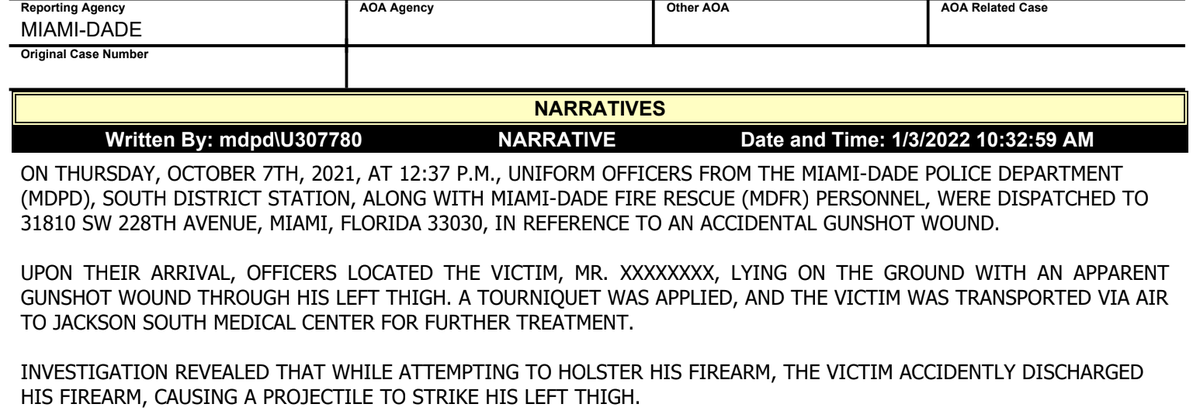
However, there are a handful of Google and Yelp reviews that list concerns about safety at the range. (One patron shot himself in the thigh in October 2021 and had to be airlifted to the hospital, but besides that, and a bullet fragment hitting someone’s arm and the exploding Santa, the Herald found no other public records describing range injuries.)
“Elliot,” a longtime customer of the range who didn’t want his last name published, said that one of his favorite aspects of the private range is the “homey” environment and that the range allows customers to shoot in a more “lifelike” way than other outdoor ranges.
“Being able to use your firearm in a way that you would need to use it [in real life], it teaches individuals, in my opinion, a better learning experience in terms of recoil and in terms of response from your firearm,” Elliot said.
Elliot estimated that he’s visited the range 10 times over the years and said that he’s had only positive experiences and never felt unsafe.
“I think most people are on the same page and they want to have a safe experience,” he said. “They want to go home at the end of the day like anyone else.”
Similar to Elliot, Kendra Geronimo, a regular customer, said she loves going to the range because of the community and environment. Geronimo said she’s been a customer for the past seven years and tries to go at least three to four times a year.
Geronimo is a firearms instructor and executive protection agent who works as an independent contractor. When she goes to the range she usually goes with Offshore Kinetics MV, a training and security consulting group. The organization rents out the range for the day.
She said being a woman in a male-dominated field can be difficult, but that La Due has always made her feel welcome.
“I do feel at home when I’m at his range. He’s never belittled me, He’s never made me feel like I was a little girl on the range or I couldn’t hang with the guys,” said Geronimo. “It’s always been the utmost respect; I don’t think I’ve ever had to gain it or earn it.”
She emphasized that reputation matters in the industry of security and firearm instruction and she holds Henry’s in high regard.
“If I went to horrible ranges and I went with bad instructors, people are gonna be like ‘well, that’s what you’re a product of’ so I made sure to keep good people in my circle. They make me better.”
Unsettling move
Barber moved down to this area of unincorporated Miami-Dade County in 2020 after Hurricane Michael, a Category 5 monster that was the most powerful recorded hurricane to hit Florida’s Panhandle, where he had a similar business. The 2018 storm destroyed his home in Panama City. Not only did he and his family need to seek refuge, but so did his trees.
He packed all of his trees that were spared into U-Haul trucks and had limited time to form a plan. Barber was able to get in touch with the Redland Fruit and Spice Park, a Miami-Dade landmark, where the assistant director, Louise King, agreed to help take care of his trees for a year. As he was looking for a place to live close to the park, a real estate agent showed him his current property, which is zoned for residential and agricultural use. The agent informed him about the gun range, but he was shown the property only on the days the range was closed.
Barber met La Due after catching two men and one woman stealing from his grove. He called the police and they told the officers that they were not stealing and claimed they were in the area because they were shooting at the range. The police asked La Due if their statements were true but he denied they were customers. Barber said he thanked his neighbor for helping him out.
Barber said the relationship began to sour as he had to endure loud explosions coming from the range. He said as time went on the explosions became more frequent and bigger. He also said he had to continuously call the police on people who were found shooting their guns recklessly near his property or by the canal close to his house. Things deteriorated further when La Due made a habit of using a bulldozer to level off the bumpy, pockmarked dirt road leading to his range. Barber said the impromptu road work would leave mounds of muck and debris on his property.
His concerns and frustrations came to a tipping point in February, when Barber claimed that there were at least 13 big explosions in one day.
Elliot explained that a customer can pay an extra $10 for the “experience” of an exploding target. He said that staff will set up Tannerite, a binary explosive brand that is sold for commercial use. Tannerite uses two agents that when mixed together become an explosive. The more Tannerite, the more powerful the explosion.
The Miami Field Division of the Bureau of Alcohol, Tobacco, Firearms and Explosives stated that when a person mixes together chemicals in a Tannerite package it is “considered manufacturing explosives and a person is required to obtain a federal explosives manufacturing license if they intend to engage in the business of manufacturing explosives for sale, distribution, or for business use.”
The Herald asked how it would find out if someone holds such a license, but ATF said that is “confidential.”
“I was in the Army. I’m not shy about guns. If things are being approached in a respectful way, then I can respect that,” said Barber. “The disrespectful nature of the individual and his business, it has residual effects, not only on me, but everybody in my community. It’s all bad, except for the patrons that get to go blow up [expletive]. Besides those guys, and Henry’s pockets, what else? How’s the community benefiting from [the range] being here?”
The nurseries, groves and fields that make up the community employ a number of growers and field workers. The Herald spoke with nursery owners and workers located nearby. Several expressed concerns about stray bullets and explosions, although some were hesitant to speak out by name.
Pedro Rubio, who works at his son-in-law’s nursery next to the range, said the loud, uncontrolled noises worry him.
“They go there to have shooting parties,” he said. Often, when Henry’s gates are closed, Rubio said patrons will honk their horns excessively, and if no one opens, they will start shooting their own targets around the area.
“We’re scared that we’ll get gunned down unjustly.”
Rene Ramos, a guava grower, said he doesn’t like to work — or send his employees out into the grove — on the weekends because it is the busiest time at the range. Ramos said the explosions can sound like “grenades’‘ detonating.
Who’s in charge?
From a legislative standpoint, the deck is stacked against the range’s neighbors. Florida statute 823.16 says firing ranges are immune from lawsuits and criminal prosecution over the noise they make as long as they are in compliance with National Rifle Association safety standards and whatever law was in effect at the time the range opened.
A separate statute, 790.333, says the state Legislature is in charge of the regulation of gun ranges. It preemptively prevents local governments from making their own more restrictive rules regarding gun ranges — or from suing a range that becomes a nuisance. The statutory language points out that “unnecessary” litigation and regulation of gun ranges “impairs the ability of residents of this state to ensure safe handling of firearms.”
The laws are a reflection of the state’s enthusiastic embrace of gun rights.
Exceptions to the hands-off policy are environmental agencies that oversee the use and disposal of lead and ATF, which can crackdown on illegal firearms and the use of explosives. According to county records, Miami-Dade’s Department of Environmental Resources Management took a look but saw no issues.
790.333 does state: “Nothing in this law is intended to impair or diminish the private property rights of owners of property adjoining a sport shooting or training range.”

Eric Friday, general counsel of Florida Carry, a nonprofit that promotes gun rights, said that particular clause can be interpreted to mean that someone living next to a gun range reserves the right to reject trespassing — be it in the form of a person or a projectile.
In other words, he said: “The minute a bullet enters from my range onto your property, that bullet, and therefore I for directing it, have trespassed onto your property.”
Barber has complained to police about people firing randomly, including into his property, but by the time the cruiser gets to his remote neighborhood, the shooter or shooters are long gone. In eight police reports examined by the Herald in relation to Barber’s property regarding “shots fired,” the majority say there was no evidence at the scene.
Barber said he thought getting his concerns addressed with the county would be “simple,” but as he learned more about state protections and witnessed lack of support from the county, he slowly realized the situation was bigger than just La Due’s range. He wondered if the enforcement might be better if he lived in an incorporated part of the county where more people live. Of course, a more populated place likely won’t have an outdoor firing range in its midst.
“I don’t want to get shot, just like you. Just because somebody works in a certain area or owns property in a certain area then our rights are diminished or our safety takes a backseat?” he said. “Who says that’s OK? And that’s the thing, nobody will say that it’s OK but everybody will have these gray areas that keep accountability from happening.”
End of the road
Outside the confines of the firing range and due west of Barber’s land, one side of a north-south canal is home to a vast, unpopulated expanse. Wildlife and lush trees outline the sky. On Barber’s — and the firing range’s — side of the canal, the bank is something else: a carpet of plastic and metal bullet casings that covers the ground like Sanibel Island seashells, the remnants of people shooting and leaving behind their debris.
“You got to think of it like this: This is the end of the road,” Barber said of the people who blast away in and around the canal. “So if you’re looking to do some [expletive] that you’re not supposed to be doing, this is the edge of civilization. And so they come as far as they can and to as rural of a location they can and this is the spot to do this.”
Three years ago, he saw the neighborhood as a beautiful oasis at a time of desperation for his family. Now, his safe haven from a treacherous storm has turned against him.
“I’m optimistic with what we’re doing right now, documenting the way that certain institutions are insulating this business and keeping anyone from being held accountable,” said Barber as he and his family continue to keep a record of his frustrations. “If we can correct that and make sure that everybody does what they’re supposed to do, everything should be better, right? Is that what’s going to be what happens? I don’t know. But I want to be optimistic.”
This story was originally published August 7, 2022 at 6:00 AM.