Brownsville neighborhood rejects Hialeah’s plan to incorporate its industrial zone
The City of Hialeah has been drawing up a plan for months to annex an industrial area of the Brownsville neighborhood to the southeast, but that community rejects any intention to be incorporated into this or any other Miami-Dade municipality.
The proposal comprises approximately 150.9 acres of primarily industrial and commercial land, although it also includes a mobile home area.
The Brownsville community gathered at Brownsville Church of Christ, a church located within the area that Hialeah wants to incorporate into its territory, where community leaders asked to defend their heritage, culture and history.
The community meeting was held on Monday, April 24, prior to the debate in the Hialeah council on the subject.
The church’s pastor, Harrell L. Henton, recalled the words of Martin Luther King Jr., “Our lives begin to end the day we become silent about things that matter.”
Henton asked the community to “say something, do something. We must never stay silent about what is important to our community,” he said. “This church has been standing for 50 years for the Brownsville community and now they want this area to belong to Hialeah.”
Fear of losing their African-American culture and heritage
Enid C. Pinkney, historian and African-American civil rights activist, alerted her community. “When cities and politicians want to improve an area, what they really want is to displace African-Americans from that area. This is how we lost Overtown,” she said.
For Pinkney, the Hialeah plan shows that “they believe they are superior to us, they say that if Brownsville is incorporated into Hialeah, it will have better services,” she said. “I am against the plan to incorporate part of Brownsville into Hialeah. They are not superior to us and never will be.”
Pinkney told el Nuevo Herald that “we believe more in the work of the county than in that of Hialeah. They have a very bad reputation in how they treat African American communities. We have a historical legacy that we don’t want to lose.”
Jesús Tundidor, the Hialeah councilman who is proposing the incorporation of the area, said, “We have good relations with Seminola (a mostly African-American area of Hialeah), which I think is what they are referring to. We are looking to incorporate the industrial, not the residential part of Brownsville,” he said.
The councilman added, “Hialeah is a very diverse place. I don’t see why (the ethnic and racial issue) would be a problem (for this community.)”
Mayor Esteban Bovo Jr. has not responded to el Nuevo Herald’s requests in this regard, but his office had previously indicated that the proposal “is an opportunity; this is how cities grow. We have to see what that area would represent for Hialeah in the long term.”
Kenneth M. Kilpatrick, president of the Brownsville Civic Neighborhood Association, said to el Nuevo Herald, “We don’t want to lose the integrity of our heritage. The Brownsville community prefers to stay in charge of its own destiny. We are a traditional African American community.”
In addition, Kilpatrick indicated that “Seminola is not an example community of how the Brownsville community would want to be treated. We have never had an interest in being annexed to Hialeah or any other city.”
The president of the association assured that the area that Hialeah wants to incorporate is strategic for Brownsville because it is a mostly industrial area. “Brownsville has invested heavily in its recovery and no city should benefit from the warehouse district before Brownsville does,” he explained.
For her part, Daniella Pierre, president of the Miami-Dade branch of the National Association for the Advancement of Colored People (NAACP), advocated “saving Brownsville. This community has a legacy that should not be touched.”
Also present at the conference was James Drew Bush III, former representative of Florida for District 109, who warned that this incorporation could mainly affect the elderly in the area with tax increases.
Bush assured that he would set up a meeting with Mayor Bovo and the community to explain to them that taking over the Brownsville industrial area would be taking away the income of the community. “It’s not a win-win situation for Brownsville,” he said.
For Kilpatrick, the fact that his community is majority African-American and that of Hialeah is Hispanic would imply “displacements, making homes more inaccessible. We don’t want more multi-family areas with tall buildings,” he said.
The community was outraged by this Hialeah plan of which they have not been informed.
Among them Jacqueline Culver Simpson, who asked, “How come the county hasn’t informed us homeowners that there is a plan to incorporate us into Hialeah?” she said. “Every time there is something new in the community, we get a letter from the county, and we have not received anything about this. How is it possible?”
Simpson asked what the disadvantages of being incorporated were, to which Kilpatrick replied, “First, taxes will increase because once the city incorporates the territory, the services will no longer be the county’s responsibility, but the city’s,” he said.
Kilpatrick added, “You have to remember that Brownsville has an incredible African-American history, and we have the reference that Seminola has not done well. If they did not do well in Hialeah, why would we do better than them?”
Brownsville, one of Miami-Dade County’s historic destinations, has also made a petition in Change to prevent the partial incorporation of its territory into Hialeah.
Why does Hialeah want this territory
The Hialeah project plans to incorporate 0.24 square miles, bounded by NW 54th St to the north, NW 37th Ave to the west, NW 35th, 33rd and 32nd Ave to the east and State Road 112 to the south.
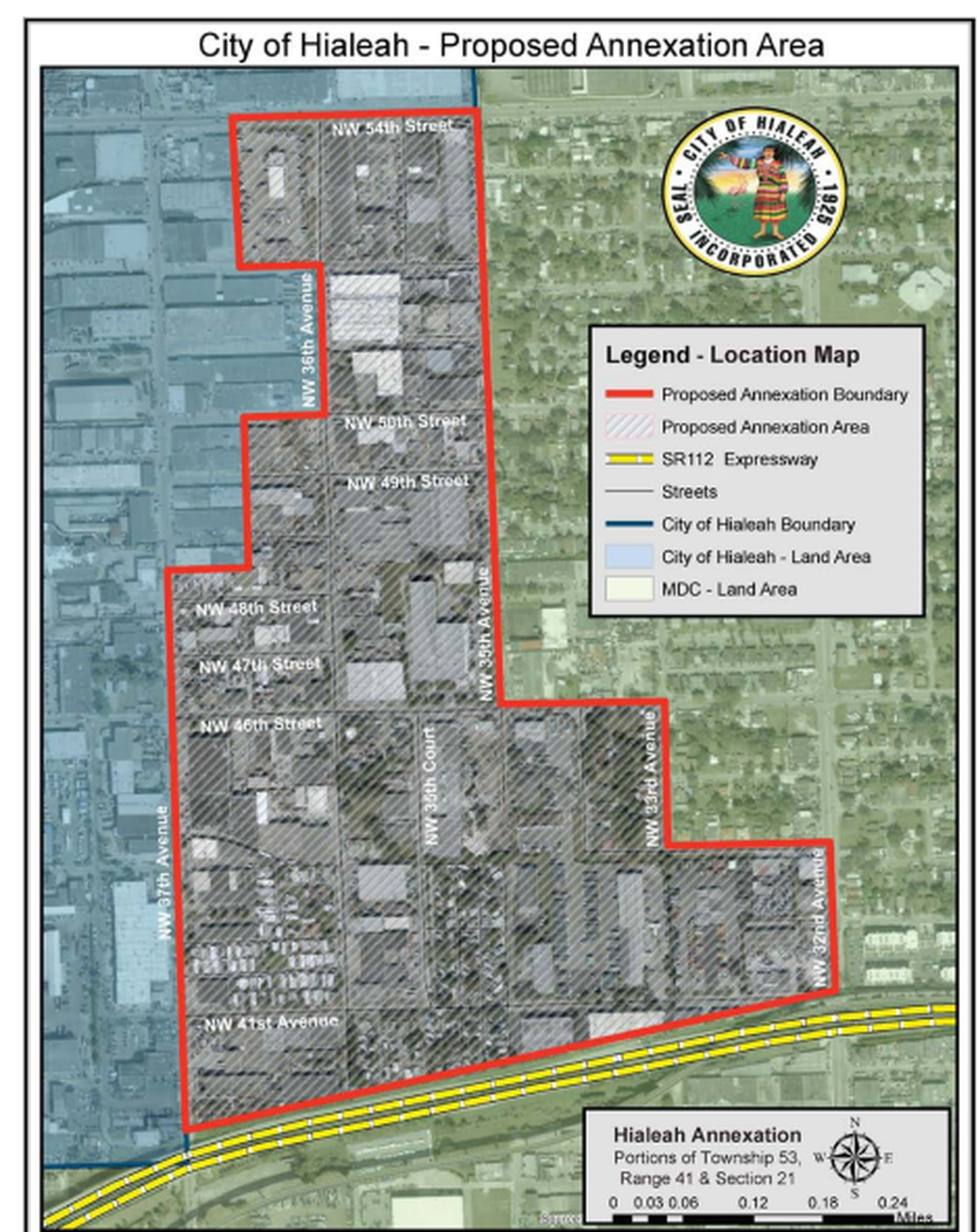
According to The Corradino Group, an engineering company hired by the city to make the report on the feasibility of incorporation, “the annexation area will provide fiscal strength to the city by increasing its tax base and allowing for significant creation of employment opportunities.”
The report accessed by El Nuevo Herald indicates that “the proposed annexation area would be part of the city’s plan to further develop a thriving entertainment district that would be close to the Leah Arts District to the north, Miami Casino to the south, and the historic market CRA (Community Redevelopment Agency) District to the immediate west.”
The city of Hialeah has not yet made a decision on the matter. It will just take the proposal made by Councilor Jesús Tundidor to the council, to find out the opinion of the rest of the politicians on the subject.
This story was originally published April 26, 2023 at 3:35 PM.