
A look back at the Miami Heat’s first home, and the rise and fall of the original arena
Do you remember the first home of the Miami Heat?
It was round and pink and full of spirit. It wasn’t far, just a few blocks west of the NBA team’s current bayfront home in downtown Miami.
Miami Arena in Overtown wasn’t around long, at least by arena standards. It opened in 1988 and was demolished 20 years later, obsolete and unloved at the end. The Miami Heat played there 12 years. The Florida Panthers played there before also leaving for a bigger and shinier space in Sunrise. The University of Miami basketball team also played at Miami Arena before its on-campus center opened.
Despite its smaller size and lack of luxury suites, Miami Arena found a place in our hearts. It’s where the Heat won its first game. Where the Panthers hosted the Stanley Cup Finals. Where hockey fans threw rubber rats onto the ice. Where the circus came to town.
Now, with the Heat and Panthers having just ended their 2021 seasons with playoff losses, and as AmericanAirlines Arena is about to get a new corporate name, let’s take a look through the Miami Herald archives at the original home court and home ice of our professional basketball and hockey teams: Miami Arena.
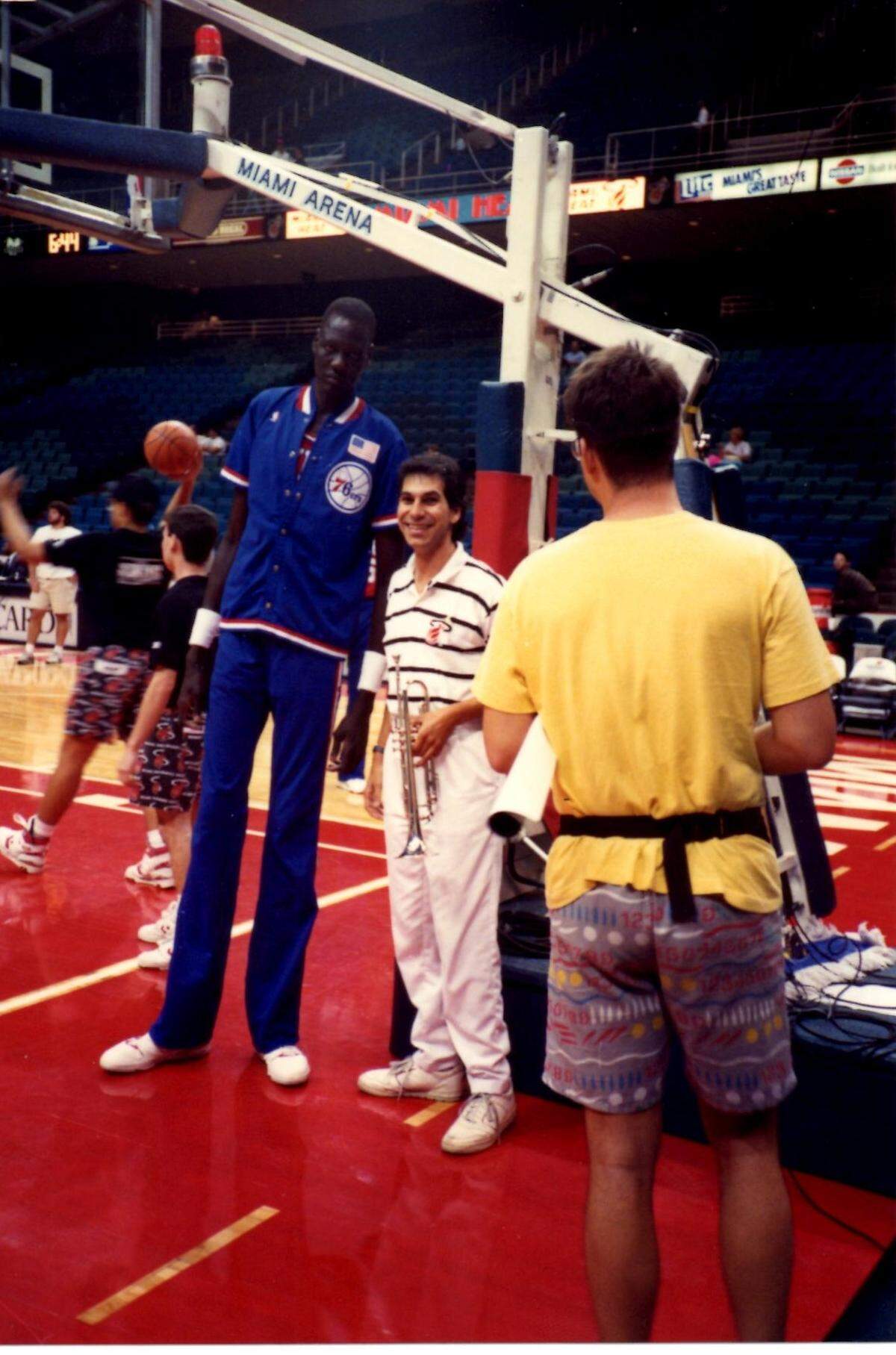
The band
By Michael Suman
Published June 16, 2013
I played for the Miami Heat for their first three seasons. Yet not one Heat fan knows my name, although they may recognize my face.
It was spring of 1988, and I was the music director on Norwegian Cruise Line’s MS Southward.
I have been a newspaper junkie since my days as a paperboy in my hometown of Knoxville, Tenn., and Sundays were our “Miami Day” - time to load up with a new crop of passengers, and my chance to grab a Sunday Miami Herald. I read with great interest the article outlining the NBA’s approval of a new team for the Miami market.
I was on my fourth year of working on ships, and starting to crave a “real” life. This was my chance to make a move. And as luck would have it, my ship contract was coming to an end. I contacted the Heat front office . For weeks, I kept calling - and I finally convinced them the team would probably not be very competitive the first season, and they needed a band to keep the fans entertained.
They finally relented and set up an audition, as they said several other bands had contacted them. The window of opportunity was open, but the rest of my band was on board the Southward, in the midst of a four-month contract. I had to act fast - the audition was four days away. Luckily, I ran into several great musicians playing at Bayside Marketplace. I told them about the opportunity, ran back to my new apartment on Collins and 29th Street, and spent the next two days furiously writing arrangements.
I rented a rehearsal studio, we got four songs under our belt (“25 or 6 to 4,” “The Heat is On,” “Wipeout,” and “I Feel Good”). We arrived at the mostly-finished pink Miami Arena, and won the audition! That first Heat Band consisted of Gary Mayone (keyboards), Rey Sanchez (guitar), Jim Kessler (bass), Ed Smart (saxes), Kelly Milan (trombone), and me on trumpet. Most of those guys are still around, enjoying successful freelance careers.
It was a great introduction to Miami, and I relished every moment of the first three seasons.
If you don’t remember, those were heady times for basketball: Michael Jordan was in his prime, Larry Bird and Magic Johnson were winding down, and Charles Barkley was as entertaining then as he still is. The band had a dressing room right near the players that we shared with Burnie, the Heat’s mascot, so interaction was easy.
Twenty-three years later, my band is still active, I am back in the cruise industry, and my wife Juliet and I have raised three children - Celia, Emma, and Given in this wonderful city now called home.
The Sumans currently reside in Miami Shores, and still root for the Heat, even though I am sure I am the only trumpet player released by a major sports team!
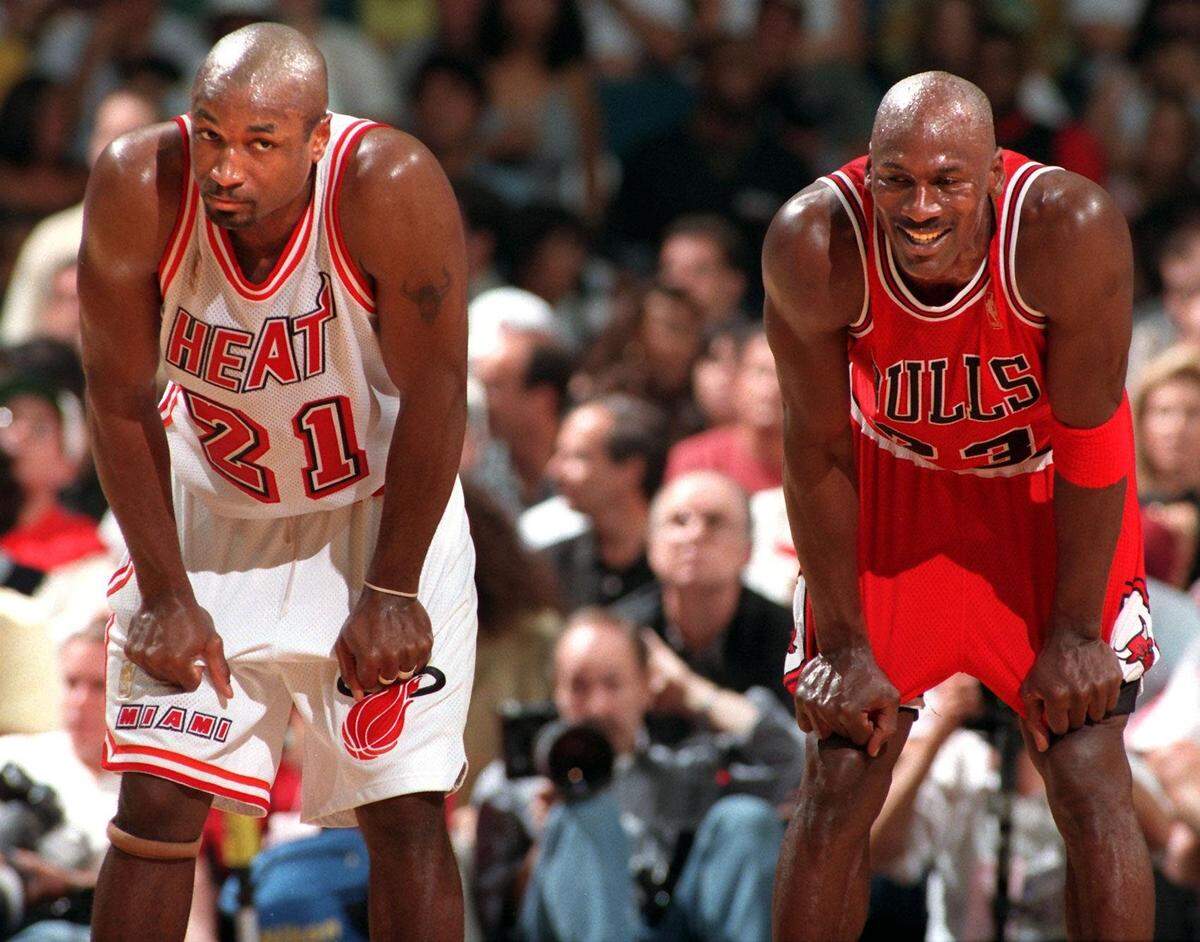
FIRST WIN AT HOME
By Bob Rubin
Published Dec. 24, 1988
Blowout! Rout!
So what else is new?
Everything. The Heat did the blowing out and routing, 101-80, Friday night over the Utah Jazz before a frenzied near sellout at Miami Arena, the franchise’s second victory and first at home in a dozen tries.
Don’t look now, but the Heat has won two of its last six. Are we talking dynasty, or what?
OK, so I’m giddy. The Heat did that to everyone in the building Friday night, including itself. This was by far its finest moment. Nothing comes close.
The Jazz, even a road-weary version, is one of the better teams in the NBA. Utah pushed the Lakers to seven in the playoffs last year. In 7-4 Mark Eaton, the Jazz has one of the game’s premier shot blockers; in John Stockton one of the best playmakers. In Thurl Bailey, it has a seven-footer who comes in off the bench to average 20, and in Karl Malone it has the planet’s most feared power forward.
And the Heat took it to them, stuffed them, put them away, kicked tush. The Heat outrebounded the much taller Jazz, 49-33. It played better defense, contesting everything, allowing few easy baskets. It outhustled the Jazz. It suffered none of those terrible, usually fatal lapses. It sustained effort and concentration 48 minutes. It never backed off, never got intimidated.
And it beat a good team. Not beat, beat up. “They outplayed us in every phase of the game,” Jazz Coach Jerry Sloan said. “They played extremely hard, and they will get some more wins before the season is over.”
Bet your Adidas, Jer.
The Heat’s determination was reflected in a couple of near fights with, of all people, Malone, who is 6-9, 254, plans to enter the Mr. Universe competition when he’s through playing but looks like a contender right now. Nevertheless, Billy Thompson and John Shasky did not back down when the Mailman tried to deliver them some grief.
Malone and Thompson tangled going for a rebound at the end of the third quarter. They had to be separated (lucky for Thompson).
“Hey, I’m going for the ball,” Thompson said. “I don’t care how big or strong you are, I’m going after it. Whoever gets it, gets it.”
Shasky and Malone flared in the fourth quarter.
“He cheap-shotted me with an elbow,” said Shasky, a rookie from nowhere who looks like a gawk but can play a little and maybe get better a lot. “I can’t let him get away with that, or I’ll get abused every night. So I got into his face and told him, um, politely not to do that again.”
But, John, he’s an All-Star, the Mailman, King Karl. You’re . . . well, you’re John Shasky.
Hey, baby, we weren’t backing down to anyone,” Shasky said. “You can’t in this league, or you’ll get stuffed.”
Hmmm. Feisty kids. Growing muscles and learning how to use them.
Any victory for the now 2-21 Heat would have been a joy. But beating the Jazz, and doing it so decisively in front of the patient, supportive, loyal home folk (Gad, am I really saying this about Miamians?) made it one for the franchise history book, one to be replayed and savored.
“It was a big step,” Shasky said. “We proved to ourselves we can do it. We should go into games now thinking we can win. Oh, we’ve said we believe it, but I’m sure in the backs of our minds there was some doubt. Coming close just doesn’t cut it anymore.”
Veteran guard Rory Sparrow, whose 19 points and steadiness down the stretch once again proved invaluable, had lipstick on his face in the locker room.
“My wife - I hope,” he said.
Speak, Sparrow.
“The Heat was on! It was an avalanche! No, they’ve been on the road 12 days and it kind of messed up their chemistry. But we played good. We’re going to look at this film again, again and again. No lapses. We usually have lapses. None tonight. A Christmas present, and a beautiful one at that.”
Pearl Washington, back off the injured list, played 22 minutes. He scored only two points, but had four steals, five assists and an ear-to-ear grin when it was over.
“Every time they came at us, we responded,” he said. “We didn’t back down. It shows we’re getting mature. The coach said we’ve got to protect our home turf, and we did. We got a taste. Now we want more.”
Strange and wonderful things happened in the final minutes of the game. The Jazz officially conceded with 1:48 left when Malone, Stockton and Bailey came out. With 55 seconds left, Heat Coach Ron Rothstein began to remove his regulars to ear- splitting tributes. The crowd sang, “Na-Na-Hey-Hey-Goodbye.” Melvin Bratton and other UM football players past and present boogied under a basket.
The Heat dancers took the floor. But there were nearly 13,000 dancing with them. Instead of a dirge, the speakers blared Celebration! They had waited 11 games and two months for this moment.
“I played in the Garden with the Knicks and it really rocks when they win, but no more than this place did tonight,” Sparrow said. “There was a special magic flowing from us to them and back to us. I was enjoying them enjoying us.”
“Did you see those people?” Pearl asked rhetorically. “You’d swear it was the seventh game of the championship series.”
No, just a Heat victory. A Heat rout. A Heat laugher. At home. Celebration.
OPENING NIGHT
By Richard Wallace
Published Nov. 6, 1988
Amid blazing lasers, blasting indoor fireworks and more tuxedos than you’d find in a penguin colony, South Florida took a big-league bounce forward Saturday night.
Miami opened its first-ever National Basketball Association season in the slam-jam-packed Miami Arena -- and the Heat, indeed, was on.
Big-time show business names opened the proceedings.
Ben Vereen took center court in smoky semidarkness among red, white and blue lights. The throng joined him in singing America the Beautiful.
Don Johnson pep-talked the sellout crowd, joking about a friend, West Coast basketball aficionado Jack Nicholson, who has raised being an L.A. Lakers fan to something of an art form.
“Let me tell you something, pal,” the Miami Vice star said. Then he proclaimed that Miami as a locale was a winner, regardless of game scores.
Then some perhaps lesser-known guys, with names like Rony Seikaly, John Sundvold and Pearl Washington, took on the Los Angeles Clippers.
“Go, Heat!” the crowd of 15,667 cried.
Wes Lockard cavorted courtside in a blazing orange, furry outfit. He had a flamelike projection of fabric pointing roofward. Fortunately, he was only the Heat’s new mascot.
“We don’t have a name for it,” he said of his fiery character. A contest will be held to select an appropriate monicker, he said.
In the cool, blue arena’s seats, the dress code was generally more formal. Many men wore tuxedos.
Sportscaster Ned Smith of WTVJ-Channel 4 was tuxed out as he worked. But he also wore a pair of white Reebok court shoes.
“My own personal touch,” he said.
He decided, though, that his original idea of wearing shorts would have been just a little bit much - or perhaps not enough.
Some fans unexpectedly found themselves sporting tuxedos. The Heat - which originally suggested that fans might want to celebrate the new season in formal attire - passed out free T- shirts with black tuxes, ties and red carnations emblazoned on them.
“We said it was going to be the lowest price we’re ever going to pay for a tux,” Pierre Burke of Hollywood said as he sat in a $25 seat.
“I’d be happy with 10 wins,” Burke said of the Heat’s long, long 82-game season.
Burke’s friend, Marty Onieal of Fort Lauderdale, however, said he was going to be a tougher customer. He has been a longtime fan of the Boston Celtics, who win championships, not just games.
“I have my expectations. I’m changing my allegiance to the Heat. I want at least 20 wins,” he said.
In a pre-season assessment of the team’s prospects, a national sports publication, The Sporting News, saw fans’ expectations as a potential hazard for a new team in a tough league.
It would be sure trouble for the Heat, The Sporting News said, “if Miami wins its opener against the Clippers and fans suddenly get visions of the playoffs.”
The Heat’s eventual 20-point loss in the game left South Florida without any premature playoff predictions.
The NBA’s commissioner, David Stern, was in the arena. Before the game began, he had two words of advice for South Florida fans: “Patience, patience.”
He praised the area and the team for their “good commercial arrangements, terrific fan support, government support.”
The support was evident throughout the evening.
Forty-five minutes before the 8:15 p.m. tipoff, a rolling wave of chants arose in the stadium: “Let’s go, Heat! Let’s go, Heat!”
Two hours before game time, crowds began to gather outside the arena. Dozens of people were trying to buy tickets either at box office windows or from ticket holders who might be persuaded to part with their precious ducats.
The trouble was everyone seemed to be holding on to what he had.
Roger Tempfer was one of the would-be ticket buyers on sidewalk patrol. “The tickets were all sold out,” he said in explanation of his plight.
He was willing to pay face value for a $25 ticket, but if he got a shot at one for $35, he said, “I’d probably take it.”
In retrospect, the pre-game show may linger longer in fans’ minds than the game ever will.
Along with Vereen and Johnson, the Miami Heat Dancers provided some moves - and shorter costumes - that outdid the players.
As the game progressed, the chances for a first-game victory grew increasingly remote. At the end, the Heat failed to break 100, registering only a relatively balmy 91 points, compared with the Clippers’ 111 final reading.
But there seemed to be little sadness among Miami’s nouveaux fans.
“I saw some good things tonight,” said University of Miami freshman Sean Thompson. “I’m really interested in the team’s doing well. I know it’s going to be a hard year.
“I’m looking forward to better things in about three to five years. I just hope the fans can be patient.”
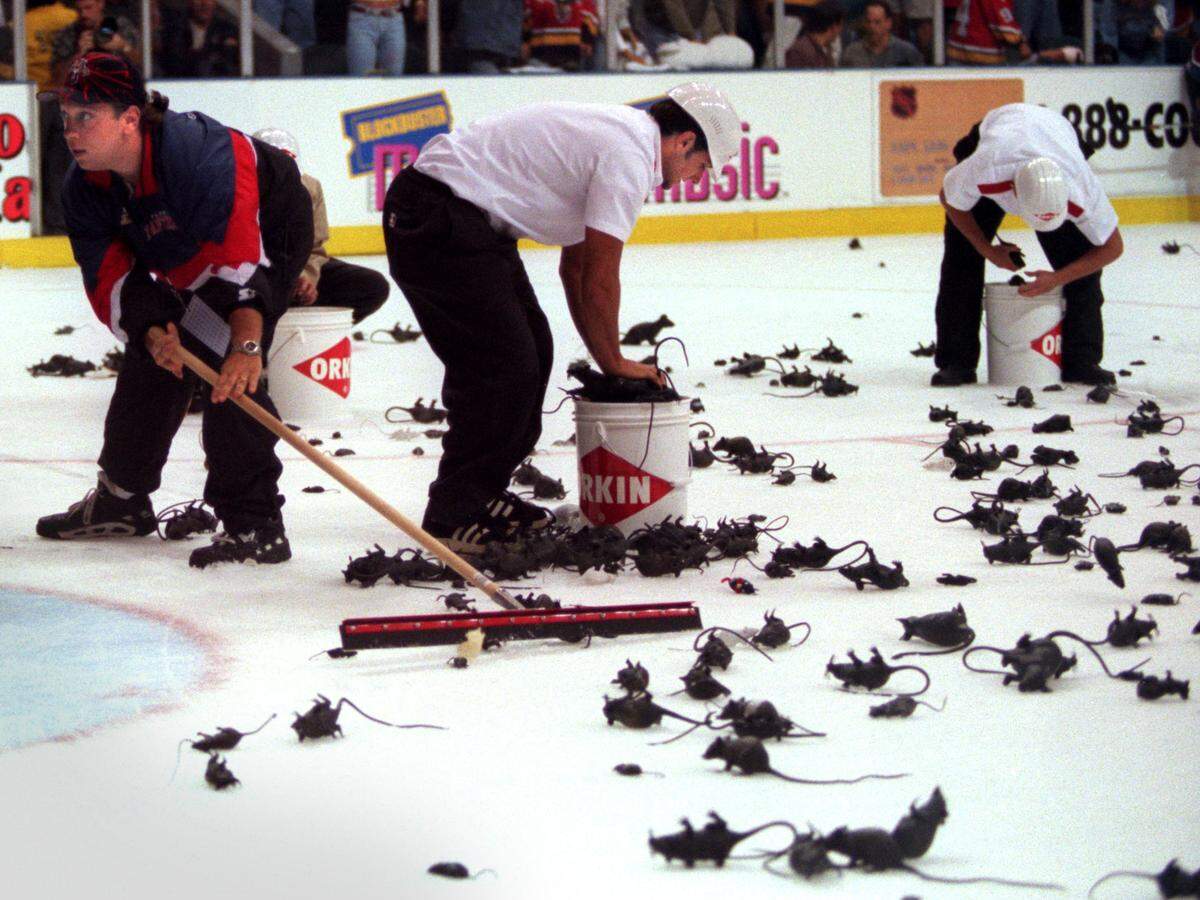
THE RATS
By Clark Spencer
Published Aug. 14, 1996
The NHL plans to play the part of the Pied Piper next season when it tries to rid Miami Arena of plastic rats thrown by Panthers fans after goals.
Not unexpectedly, the league’s general managers have agreed to enforce a rule prohibiting fans from throwing objects on the ice. That means no more rats in Miami, octopuses in Detroit and garbage in Boston.
The reason: such antics delay the game.
The penalty: referees will instruct public address announcers to warn fans if objects are thrown on the ice. If fans persist, referees can assess a two-minute delay-of-game penalty against the home team.
“We’re going to have to step in,” said Kevin Dessart, the Panthers’ assistant to the general manager. “We’re going to have to make fans leave if they throw rats.”
The rule is likely to be approved by the NHL’s board of governors in September.
Traditionally, fans have thrown hats on the ice when a hometown player gets a hat trick.
Octopuses started falling from the rafters in Detroit after Red Wings goals. Boston Bruins fans threw garbage on the ice last season at one game.
But it was the deluge of rats that followed every Panthers goal at Miami Arena that provoked the league to step in.
Rat throwing became a tradition after winger Scott Mellanby spotted a live rat inside the Panthers’ locker room last October and killed it by striking it with his stick. Mellanby scored two goals that night, a feat that goaltender John Vanbiesbrouck called a “rat trick.”
Thus began the custom. Rats were sparse at first. By the time the Panthers advanced to the Stanley Cup Finals, they rained by the thousands. Rat vendors became a cottage industry in South Florida. The Panthers even hired a crew decked in Orkin outfits to sweep the plastic critters off the ice.
“It took us less time to clean off 1,000 rats than it takes other teams to clean off 30 hats after hat tricks,” Dessart said.
But the NHL felt the tradition was getting out of hand. Opposing goaltenders during the playoffs had to take refuge inside their own nets to avoid the falling objects whenever the Panthers scored.
Fans in Pittsburgh, in an attempt to counter the Panthers tradition, threw wooden rat traps on the ice after their Penguins scored goals during the Eastern Conference finals.
“It’s a common-sense issue,” Toronto Maple Leafs GM Cliff Fletcher told The Toronto Globe and Mail.
Now everybody has to stop.
Or do they?
The rule doesn’t say a thing about throwing objects on the ice after a game-winning goal in overtime, which would result in no delay of game since the game would be over.
And Dessart, for one, doesn’t think rats will be completely exterminated from Miami Arena.
“I’m sure every now and then you’re going to see one or two rats on the ice,” he said.
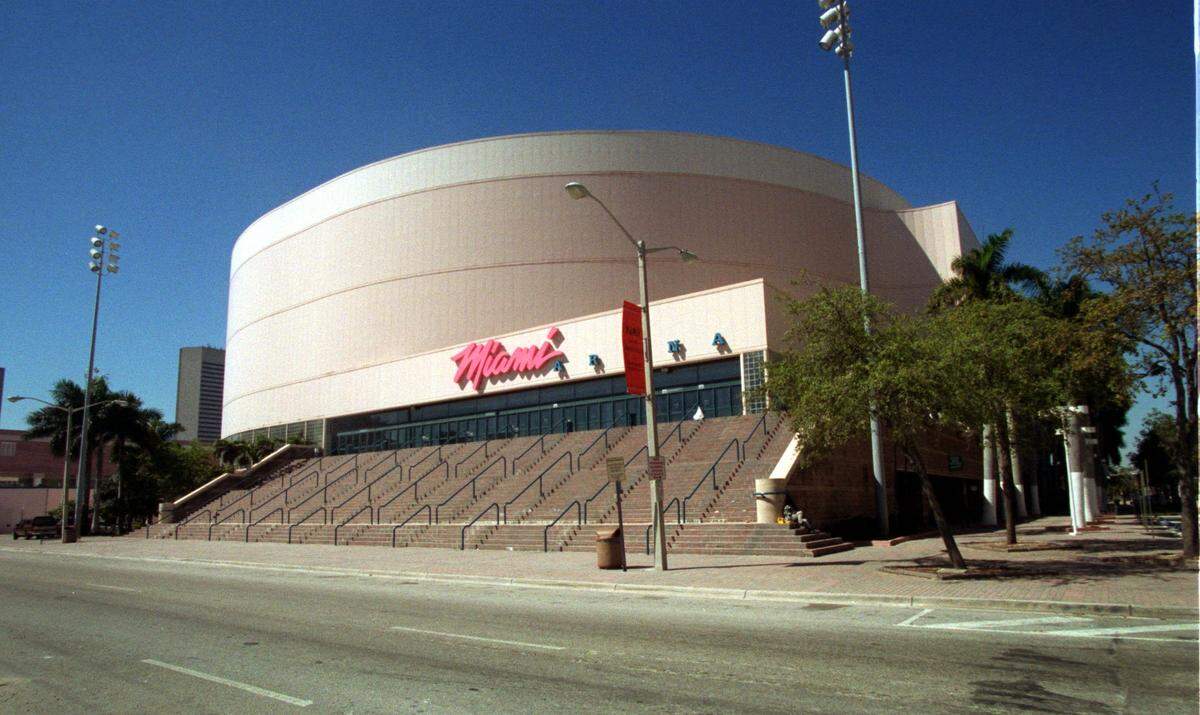
THE CONSTRUCTION
By Lisa Getter
Published Aug. 9, 1987
Rising in Overtown, nine stories high already, the $50 million Miami Arena is 10 months from completion.
That in itself is something of a miracle.
It has been a turbulent year since the Aug. 4 ceremonial ground-breaking - when Mayor Xavier Suarez dunked a basketball, Julio Iglesias showed up late, Zev Bufman danced a soft-shoe and no shovels broke ground.
The city, after tearing up its financial agreement with arena developers Decoma Venture, had to negotiate a new deal.
It had to find another million bucks to help pay for the arena.
It missed out on getting a National Basketball Association franchise by 1987 and had to settle -- albeit happily -- for a 1988 team.
It had to find 4,500 new parking spaces at the arena to satisfy the NBA. And to be ready in time for the 1988 basketball season, it started arena construction on Oct. 14 - before the design plans were finished.
“What we got ourselves into was build it, no matter what. We had to have an NBA team,” recalled Gene Marks, Miami Sports and Exhibition Authority chairman.
What a difference a year makes.
These days, there’s an excitement at the construction site, where inside the dome, one can actually sit on a concrete ledge and get an idea of the unobstructed view to the ground from the worst seat in the house.
Last week, 32,000 pounds of nuts, bolts and washers were delivered in buckets to install the steel roof trusses. More than 75 tradesmen are on the job, despite past protests from carpenters, plumbers and operating engineers about wages, contracts and hiring of out-of-town workers.
Decoma is working on booking events - concerts, the circus, Ice Capades, Sesame Street Live, the Harlem Globetrotters.
The sports authority is discussing adding cushioned seats and terrazzo floors to the arena to upgrade it.
“Things are really looking outstanding,” Decoma managing partner Dean Patrinely said.
Sports authority administrators have come up with the other $1 million by making better investments. The NBA has granted a franchise for the 1988-89 season. The Miami Heat basketball team is a reality.
Delays should not have surprised anyone affiliated with the project. The arena has gone through four city managers, three sports authority chairmen, two sports authority executive directors and several “final” agreements.
Even in the last year, the faces have changed. Executive Director Rick Horrow quit last September. Assistant Development Director John Blaisdell was named to take his place. The Miami City Commission did not reappoint Larry Turner as authority chairman in March. Marks took his place.
The arena is the most ambitious project ever undertaken by the sports authority, which is a semi-autonomous government agency. Its board members are appointed by the City Commission, and it gets most of its money from resort taxes.
Despite the optimism of late, Commissioner Miller Dawkins has repeatedly blasted the developers for not giving enough contracts to minority-owned companies. He got especially angry earlier this year when two contracts were awarded to wholly owned subsidiaries of Linbeck Construction, a Decoma-affiliated contractor.
City commissioners have scheduled a public hearing in September to discuss how much public money has gone into the project and how all the contracts were negotiated.
Commissioner J.L. Plummer, in particular, has questioned the public cost.
The arena is a public/private partnership, involving the sports authority, the city and Decoma.
The city of Miami paid $3.4 million for the land and expects to pay $500,000 in interest and at least $200,000 for street improvements.
The sports authority issued $38 million in bonds, guaranteed by resort and convention tax money. The authority also will put up $5.7 million in resort taxes money it had in savings.
The Off-Street Parking Authority, another semi-autonomous government agency whose board members are selected by the City Commission, is planning to spend $750,000 on paving parking lots required by the NBA, plus an undetermined amount of money for leasing the land.
Decoma, the private developer, will put up $7.1 million.
Plummer has never been comfortable with Decoma’s arrangement: Decoma is the operator, manager and developer of the arena.
“This project never would have happened otherwise,” Decoma’s Patrinely said.
Miami Heat owner Bufman found Decoma’s deal with the city so attractive he offered to buy out the developers. “I suggested putting a group together. I said I’d give you $10 million right now and I’d take over. They wouldn’t take $10 million,” Bufman said.
Bufman and Plummer think the arrangement favors Decoma because they say Decoma is risking little. “We realized they were going to technically have no money in the deal,” Bufman said.
Critics complain Decoma will get back its investment immediately.
Decoma will be paid $1.5 million as a development fee, $1.3 million as a construction fee, $275,000 as a management fee, $2 million from Harry M. Stevens, the concessionaire, and another $2 million from Stevens because he also bought into the Decoma partnership.
“It’s hard cash up front,” Patrinely said. “They’re standard management fees. That’s totally separate and apart from the money.”
While some say the deal appears to favor Decoma now, earlier versions were even better for the developer.
The first arrangement, tentatively reached in November 1985 and subsequently torn up, was negotiated by then-City Manager Sergio Pereira, Turner, Horrow, attorney Robert Sechen and Decoma. It was halted when Cesar Odio became city manager that December.
“I find this document unacceptable in its present state,” Odio wrote in a memo about the first deal.
He assigned Assistant City Attorney Chris Korge and assistant development director Blaisdell to negotiate a new deal.
The city and sports authority believed that the best revenue stream in the arena would come not from the arena profits but from a seat surcharge - 75 cents tacked on to every ticket sold at the arena.
Under the first deal with Decoma, the authority would not receive any share of the seat revenue, except as a loan. Under the new deal, the sports authority will directly receive 25 percent of the first $1.35 million of seat surcharge money.
Also under the new deal, the sports authority gets a bigger share of arena profits, but it also must include a $75,000 increase in the management fee paid to Decoma.
Blaisdell and Korge also changed what would happen if the completed arena came in under its construction budget. In the first deal, Decoma got all of the first $1 million in construction savings. In the second deal, the authority got 75 percent of the savings.
“I was the one who got it changed,” Plummer said of that clause in the first deal. “I thought it was ridiculous.”
“Decoma gave up a lot for different reasons,” Patrinely said. The second deal “took a different format. On balance, it’s like comparing an apple and a pear. We could have said, ‘Hey wait a minute, we just did this.’ There’s no question it was time-consuming and costly.”
Once the second deal was complete, construction began.
“From a pure investment standpoint, I’ve had better deals than this,” Patrinely said.
When the arena is finished in May, it will be the first completed project in the city’s plan to redevelop Overtown into a bustling, residential and commercial center.
And it will undoubtedly increase ridership on Metrorail and the Metromover. The Overtown Metrorail stop is just yards from the arena’s front door on Northwest First Avenue.
“Twenty years from now, I hope someone says ‘Decoma, you guys were visionary. You finally opened up the northwest business district,’ “ Patrinely said. “We think it’s going to tremendously energize Overtown like nothing before.”

THE DEMOLITION
By Jennifer Lebovich
Published Sept. 22, 2008
Loud booms, puffs of smoke and debris pushed skyward finally marked the end for the landmark Miami Arena on Sunday morning.
At 8:06 a.m., explosives rigged to the steel trusses were detonated and the roof caved in as planned.
Portions of the pink surrounding wall shifted in, too, but the outside remained intact.
The rest of the demolition of the oval arena, once called the city’s “Pink Elephant,” will come in the next few weeks.
“Everything went off as planned,” said Lisa Kelly, the owner of Advanced Explosives Demolition, the company responsible for the implosion.
The only hitch of the morning was a six-minute delay for officials to get people on neighboring balconies to go inside.
The company spent the days leading up to Sunday’s implosion rigging the 130 pounds of explosives, which were placed along the beams in two-foot-long strips.
Unfortunately, for the dozens of spectators who came out early, there was little to see from ground level.
“You’ll hear more than you see. The best view will be on TV from the helicopter,” Kelly said.
Still, onlookers, many of them homeless, gathered behind yellow police tape about a block east from the building to take in the early morning action, as sirens sounded.
“We got up at the crack of dawn,” said Isabel Stepniak, 23, as she sipped a coffee near the corner of Northeast First Avenue and Northeast Eighth Street. “All for the entertainment value.”
The arena’s roof gave in quickly.
“My heart said, ‘Holy cow,’ “ Stepniak’s friend Carolyn Balicki, 42, said of the blast’s noise.
The street view of the implosion did not impress Jodi Dombrowski, who stopped by the arena.
Overhead shots showed a row of smoke plumes as the explosives detonated and then within a matter of seconds the top of the roof pulled in and the dust moved up.
“I just wanted to see it. I know it’s been a part of history for 20 years,” Dombrowski said.
The arena opened in 1988 with a concert by Frank Sinatra, Liza Minelli and Sammy Davis Jr., who were touring together that year.
Miami Heat kicked off its inaugural season, and the Florida Panthers hockey team later played there. The University of Miami men’s basketball team also played in the arena until 2006.
The current owner, Glenn Straub, bought the beleaguered arena from the city in 2004 for roughly $28 million, about half of what the city paid to build it.
After more than a year, Straub closed the arena, which couldn’t compete with the nearby AmericanAirlines Arena and the BankAtlantic Center in Sunrise, he said.
“Once the Heat moved out of here, it wrote its epitaph,” he said.
A decision still hasn’t been made as to what will be built there.
Straub says he’d like to bring the Florida Marlins stadium to the site, calling it a “logical spot,” but it’s almost an impossibility with the team as far along as it is to finalizing a deal at the Orange Bowl.
Other possibilities for the five-acre site: an aquarium; a venue for a show similar to Cirque du Soleil; or a movie production studio.
The process has been slow, and Straub said he’s ready to move forward.
“I want to get the demolition out of the way,” he said. “Once we have this done we can get on with our lives.”
Before Sunday’s implosion, the interior had already been gutted and the seats removed. The pieces of “nostalgia” are being stored in a warehouse to be sold on eBay, Straub said.
The rest of the demolition will take about three to four weeks, with large equipment taking the walls and the rest of the interior down, said Steven Greenberg, CEO of the BG Group, the demolition company.
Miami police and fire rescue will use the inside of the arena for two days to practice rescue drills, he said.
Dan Jere, the project superintendent with Advanced Explosives Demolition said of the blast: “It went off with a bang. Always does.”
This story was originally published June 1, 2021 at 1:35 PM.