
Looking back at the rise of a Miami skyscraper that lit up the sky, then changed colors
The 47-story CenTrust Tower brought drama to Miami’s skyline when it opened in 1987.
The colored lights were dramatic. So were the flaws in the building. And the soon-to-be downfall of the banker whose office was inside the skyscraper.
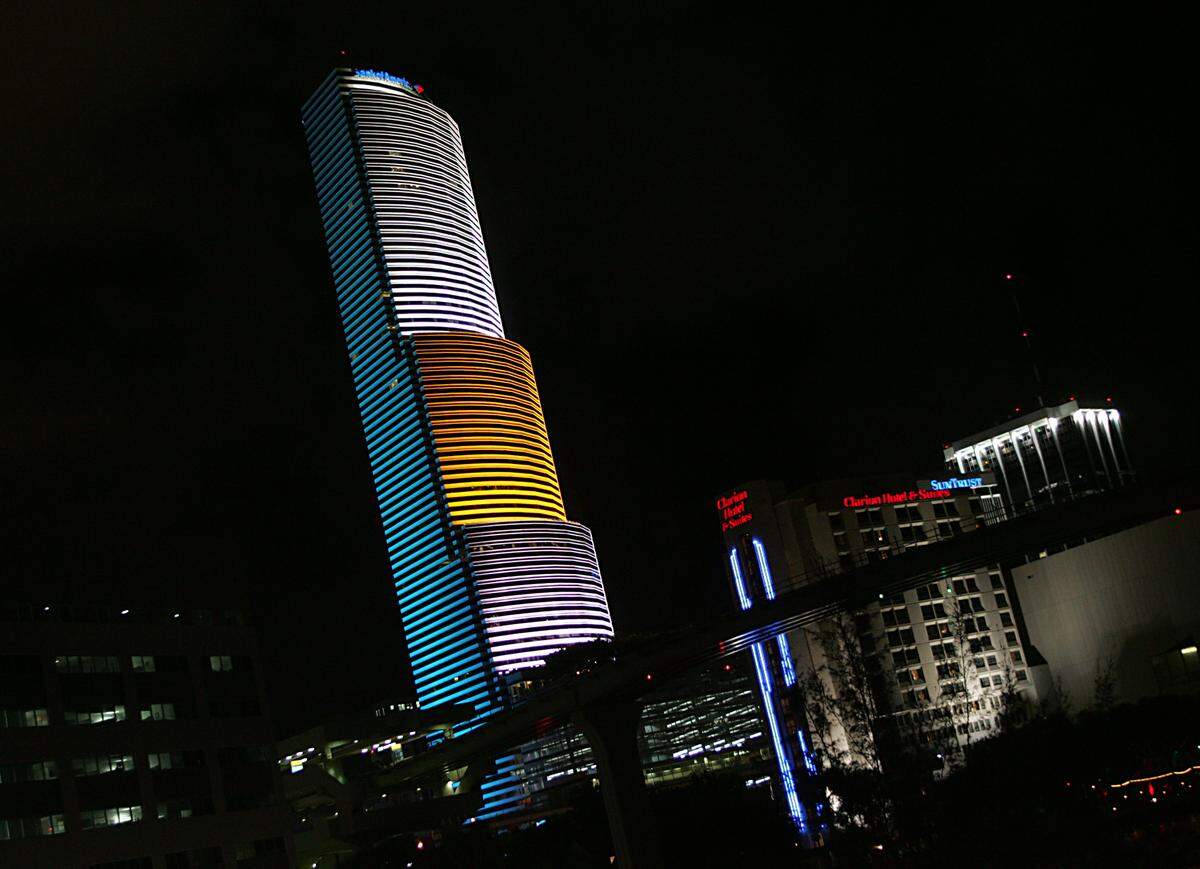
But aside from all that, the tower is best known as Miami’s mood ring. Giant glowing snowflakes around holiday time. Aqua and orange on the night of a big Dolphins game. Orange for Halloween.
Here’s a look through the Miami Herald archives at the birth of a building that helped remake Miami’s skyline, along with the tower’s tragedies and triumphs.
LIGHTING UP MIAMI
Published June 17, 1994
Juan Torres pleases thousands of people everyday with his handiwork. He changes the colors of the lights at the International Place tower.
Squeamish about heights, very hot lights or an occasional thunderstorm viewed from cloud level? This job’s not for you.
But if you’ve always coveted a spot that would elicit a wide-eyed “wow” from people, check it out. The 47-story tower, completed in 1987 as the home for David Paul’s CenTrust Savings Bank, is surely the most photographed building in the city.
Frankly, the job of changing lights is a straightforward operation: Colored Plexiglas disks about two feet in diameter and an eighth of an inch thick are inserted into brackets on top of powerful lights that circle the landmark tower.
The trickiest part is probably the height. The lights are all outside the building, and some of them are close to the edge, hundreds of feet off the ground.
The basic numbers:
▪ Three-hundred-and-eighty-two lights point up from perches on neighboring buildings and from setbacks on the tower’s 13th, 20th, 31st and 46th floors. (When the tower was built, there were only 275 lights. But that left unsightly streaks.)
▪ Most of the lights are 1,000-watt behemoths. Each bulb costs about $40, although the tower gets a volume discount from Sylvania. There’s less room on the 46th floor, so 30 smaller 400-watt lamps are installed there.
▪ The lights warm up to about 160 degrees at the lens when they’re on. Over time, the heat and the sun tend to warp the disks, turning them into giant, wavy potato-chip shapes. They’re replaced when they wear out, which is every four years or so. Management doesn’t like to say how much the disks cost.
▪ It typically takes about four hours for a crew of four to change the colors. Torres, the senior member of the crew, says it can take much longer if it’s raining or windy because the workers navigate more carefully.
▪ The colors are changed five to 10 times each month, depending on special events and holidays.
▪ Seven colors are available: teal, orange, red, yellow, blue, purple and, of course, white. Torres said red and teal (or aqua) seem to be most popular. Yellow is the newest color; it was added about six months ago. Management hopes to add a color -- perhaps wine -- before the end of the year.
▪ The lights are on each night from 10 minutes after sunset until 12:30 a.m. Torres said that when Paul was in charge, the lights burned until 2 a.m. New management cut back to save on electricity.
How much does the electricity cost? Torres doesn’t pay the bills, but he says half-jokingly: “I’m pretty sure that with what it costs monthly to light the building, you could retire off that.”
Well, maybe you can’t really retire on it. Winthrop Management, which supervises the tower, is reluctant to be specific. But here’s a clue: The lights require 365,000 watts. That’s 365 kilowatts. With a volume discount, you can assume the tower pays about 6.5 cents per kilowatt hour. If the lights are on for four hours, that’s roughly $100 a night.
Murray Green, property manager, said Winthrop tries to honor civic and charitable requests for special lighting. You can also “rent” the lights, basically on a first-come, first- served basis. The price, $1,000 a night, covers electricity, set-up and programming the computer-controlled switches. Special requests have come from film companies, corporations sponsoring special events and private parties.
Torres, who’s 28, earned his job literally by laboring for Paul when Paul was at the peak of his power.
A graduate of Miami High, Torres started doing construction work and odd jobs at Paul’s plush La Gorce Island estate. Paul then asked him to work as an engineer on his yachts. Later, Paul suggested he move to the tower.
That was eight years ago, when cranes were still hovering around the building. Paul has since been convicted of dozens of charges arising from the collapse of CenTrust.
Torres is still working even after the government took over CenTrust and the tower. The Resolution Trust Corp., which disposes of the assets of failed thrifts, hired a California company to manage the tower until it was sold. First Winthrop of Boston bought it for $44 million in 1991.
When Torres is not changing lights, he does the various tasks that building engineers do, maintaining and repairing the building.
“I take great pride in working here,” he said. On a cruise he took a few years ago, fellow passengers clustered around him when they heard where he worked, peppering him with questions about the lights.
He also tells of exercising at night in the Executive Club on the 19th floor of the building and realizing that several cameras were pointed in his direction.
“You look out the window, and all you see is flashes going off from the hotels,” he said.
THE MANY COLORS
Published Nov. 26, 1988
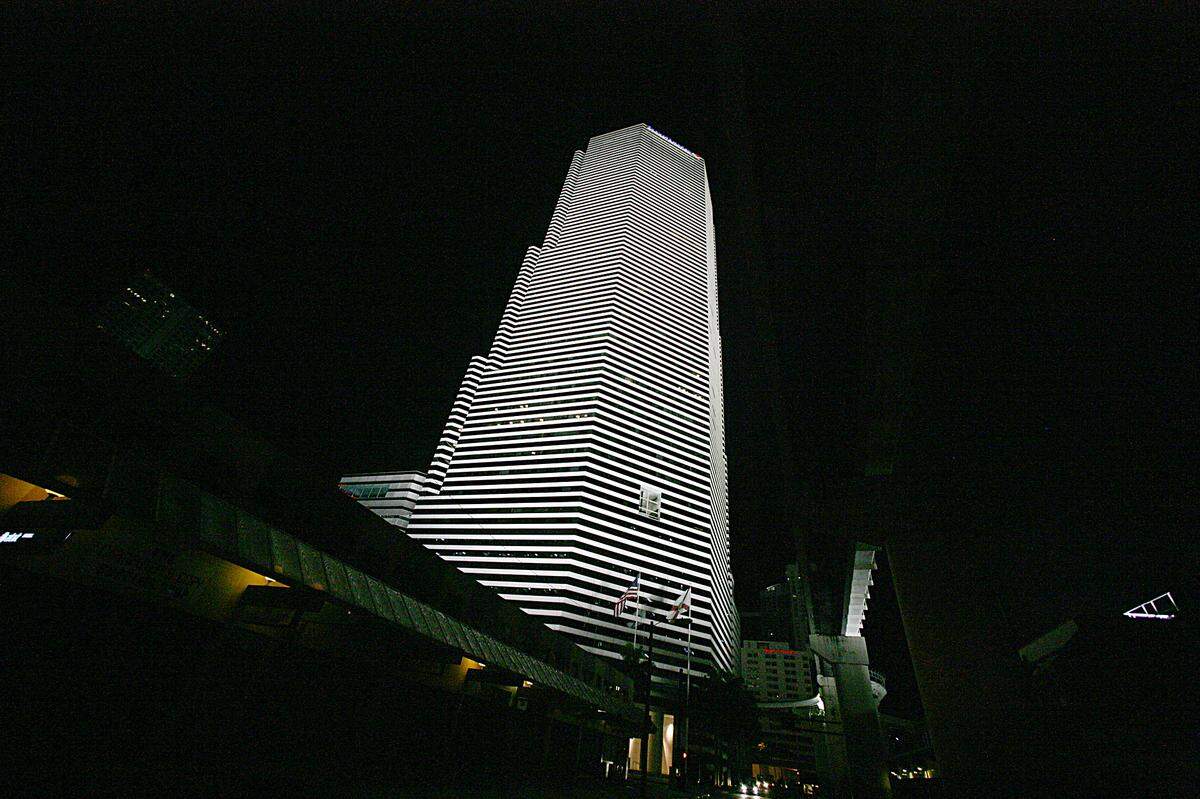
Against the skyline, painted cobalt blue by the distant brushes of tropical storm Keith, the CenTrust Tower, Miami’s most prominent night-time landmark is 47 floors of purple and unavoidable splendor -- a giant grape Popsicle that will melt into snowy white with the morning sun.
It is Sunday, three days before royalty arrives in the tank-top fashion of the National Basketball Association’s Los Angeles Lakers. Could this be their welcoming beacon, one skyscraper marking the way for the human versions? Could be. Five days earlier the skyscraper was leprechaun green when the Boston Celtics came to town to stomp the Miami Heat.
When real royalty came -- Princess Caroline, last spring -- royal blue shot strikingly heavenward to greet her, to endorse her stay and support of the Miami City Ballet.
The CenTrust Tower, gaudy and glorious, shouts wordless messages into the Miami night, using brilliant colors and occasional symbols that, even if only a few understand, fewer will miss.
Initially met by a community wary of flash at the expense of substance, reluctant acceptance to the lighting of the CenTrust Tower has yielded to proud approval.
Two years after the exterior lighting began, work-weary citizens trudging past the tower to Metrorail stops, to evening haunts, home to the suburbs, have fallen in love.
One beleaguered editor, briefcase in hand and sighing as he prepared to begin the overnight shift, suddenly straightened and chuckled to an elevator full of colleagues, “Hey, anyone see the CenTrust tonight? What on Earth do you suppose all those colors mean?” The short ride up six floors was transformed by laughter and whimsical conjecture about the electric combination of purple, orange, yellow, red, and blue.
Actually, that color combination was used to cap United Way Day, Sept. 22, and signified the charity’s logo of a hand with a rainbow. As in this case, various groups can request specific colors that CenTrust will display without charge as a gesture of public relations good will.
According to Frank Grant, the new acting chief engineer of the tower, the requests are individually authorized through the office of CenTrust chairman and CEO David L. Paul when they are deemed “appropriate.” For example, blue and gold colors on Oct. 14 commemorated the 213th birthday of the U.S. Navy.
On Thursday, Grant said, the tower was bathed in “red, white and blue.” Yesterday, the lights were to be changed to blue with white stars for the holiday season.
“Double change: not only putting up color, but changing to another -- that’s a lot of work,” Grant said. During the holiday season, it takes two men about six hours to install all the color filters on the units, and about eight hours to change over to a second color.
Grant, who is responsible for building operations, says there are a total of 383 lights located on the structure’s 13th, 20th, 31st and 46th floors, on the Metrorail line, and on top of three neighboring buildings. The 1,000-watt lights are turned on by an automatic timer at 7 p.m. and shut off at 2 a.m. from April to October and in the winter from 6 p.m. to 2 a.m.
The 24-inch colored filters are photographic gels sandwiched between two pieces of plexiglass that clip onto the light’s reflector and are stored in metal lockers on each of the platforms. The filters must be replaced regularly. “Like a gel, heat and rain warp them and they get hard to fit back in the boxes,” Grant said.
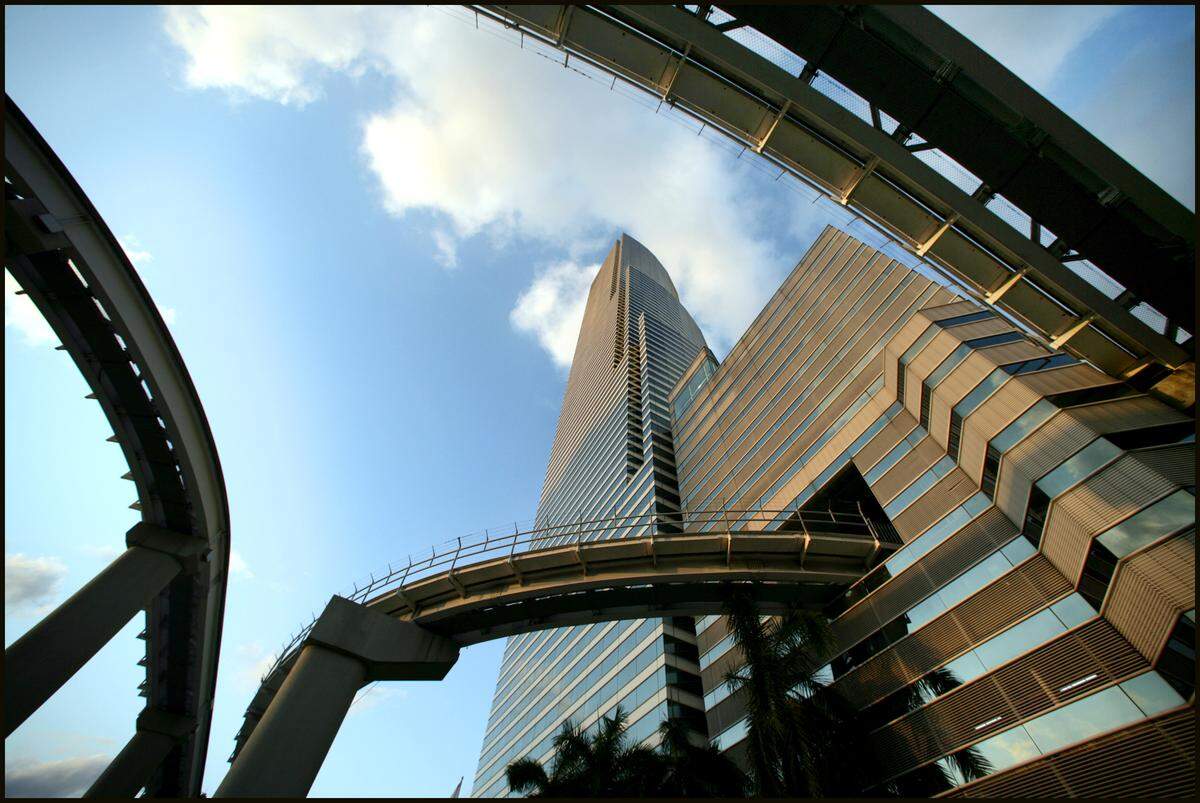
CenTrust Tower originally was designed by I.M. Pei, who also designed the National Gallery of Art in Washington, D.C., the John F. Kennedy Library in Boston, and the glass pyramid in the courtyard of the Louvre in Paris.
The dramatic exterior lighting was designed by Douglas Leigh of Leigh Lighting Group in New York City. Leigh also designed the exterior lighting for the Helmsley Building, the Empire State Building, and a billboard for Camel cigarettes that blew smoke rings on Times Square for 26 years.
Richard Goldberg, CenTrust’s vice president for commercial real estate, refused to estimate how much the monthly electricity bill runs for the tower’s nighttime dazzle.
“I’d rather not say. It might make some tenants nervous. It’s obvious that lighting such a large building is not (going to be) cheap.”
THE MAN BEHIND THE TOWER
Published June 15, 1986
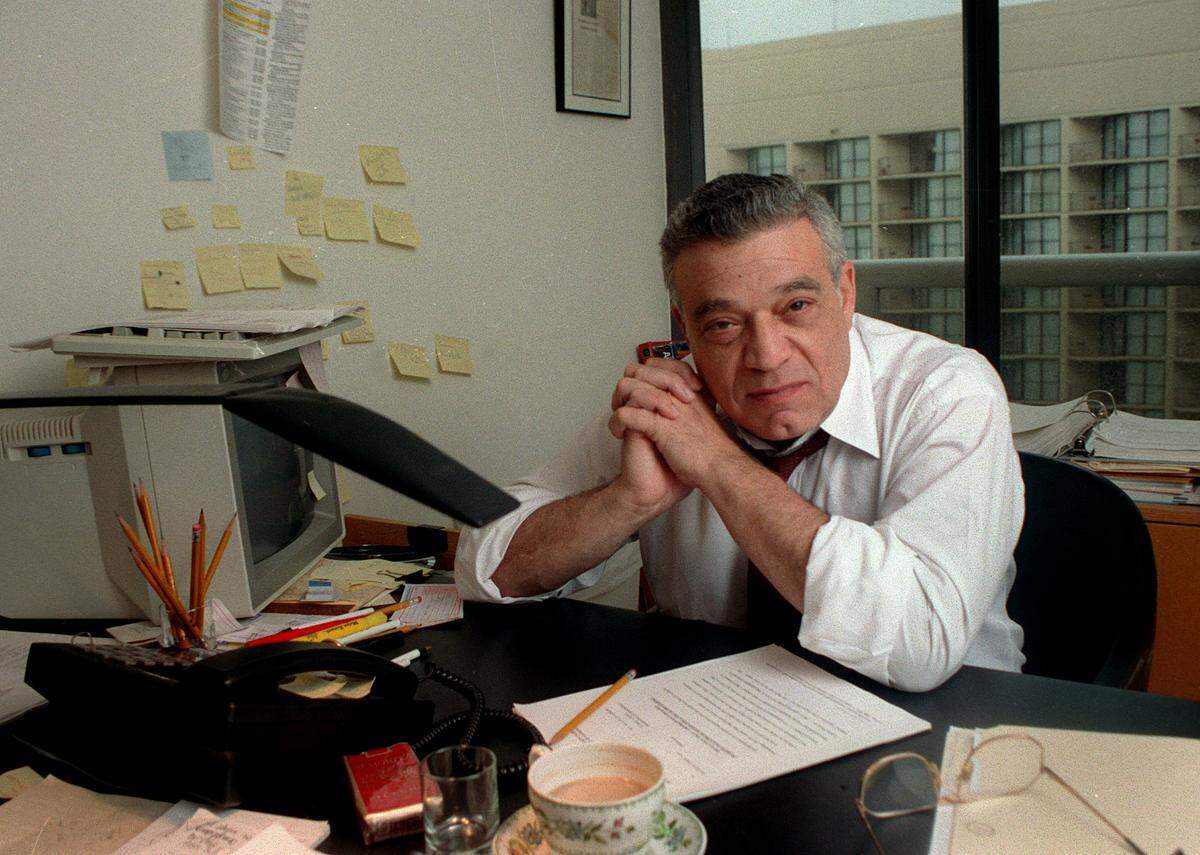
David L. Paul is not a patient man.
When he returned to Miami in 1983 to take over failing Dade Savings and Loan Association, he fired most of his senior executives. He backed out of old Dade Savings deals he didn’t like. People sued him. He sued back. He made enemies.
That was three years ago.
Today, Paul runs a renamed CenTrust Savings Bank. A basket case in 1983 as Dade Savings, it now is the state’s biggest and the Southeast’s most profitable thrift.
Paul has redrawn Miami’s nighttime skyline by bathing the sleek $90 million CenTrust Tower in brilliant lights. A spectacular downtown laser show is planned for the Fourth of July.
Paul, 47, has joined the right clubs - Bankers, City and Jockey. He sits on the board at Barry University. He works with Jackson Memorial Hospital; he’s a trustee of the National Foundation for the Advancement of the Arts. He hosts fancy parties; he gets invited to other people’s fancy parties.
He owns two homes on Miami Beach’s exclusive La Gorce Island in addition to his Connecticut home and Manhattan apartment. He had built a custom-designed 94-foot yacht, the Grand Cru to be delivered in September.
Paul even is boosting the population; his wife of 11 years, Sandra, is expecting their first child.
And since his inauspicious debut, David Paul has gained fans.
“He has one of the most creative minds in the financial industry anywhere,” said Miami lawyer and civic leader Martin Fine, whose firm represents CenTrust. “And he’s got a very unique dedication to a new community. He has made, and will continue to make, a very significant contribution to this community.”Paul’s success depends on the success of CenTrust. To revive the old Dade Savings, Paul is taking risks shunned by most other savings associations. His goal is to turn CenTrust into Florida’s most sophisticated banking operation, mimicking the giant New York banks.But some competitors fear that CenTrust is taking too many risks too quickly. Its basic lending business still is losing money; profits come from Paul’s uncanny trading success in financial markets.
Critics wonder if Paul can maintain his brilliant three- year winning streak on Wall Street. How, they ask, will Centrust fare when interest rates start rising and the economy worsens?
Not to worry, says Paul: “We know what we’re doing,”
Stocky and hyperactive, David Paul lives as if he’s the star of a Federal Express commercial. He has an administrative assistant, two executive secretaries and a half-dozen clerical staff. He has three phones at his desk, more than a dozen in his home. There will be 28 on his new yacht. He carries a portable Motorola phone when he’s not near a regular one. On the limo ride to his office, he’s usually on the phone. When he eats breakfast, a telephone buzzes next to his coffee. When he’s in his office, it’s a rapid-fire juggling act. He asks one secretary to call so-and-so; another tells him that Drexel Burnham is on line two; meanwhile, he’s punching up stock and bond prices to see if CenTrust is making money. Or he’s talking about how his mother on Miami Beach will be pleased with an article about his appointment to Barry University’s board. All the while, he chain smokes St. Moritz cigarettes and guzzles coffee.
Regularly, the company jet carries him to business in California, London or New York.Paul’s LaGorce Island residence may as well be CenTrust-by- the-Bay. Senior officers routinely are asked to 6:30 a.m. breakfast meetings there. If they can’t make it, it becomes 8 p.m. dinner. A recent board of directors meeting began at 6 a.m. and ended at 6:45 p.m.
An average workday -- seven each week -- runs from 6 a.m. to at least 11 p.m. Paul often spends mornings or evenings working at home. A cramped upstairs room overlooking Biscayne Bay is equipped with computers linked directly to Wall Street and CenTrust. Hired help directs the white-collar traffic flowing through the house.
Out back is Paul’s teak patio and dock, surrounded by a new garden, all of which he designed. A smaller yacht floats where the Grand Cru will rest.
All are fruits of the Protestant work ethic, says Paul, the son of a Jewish father and Catholic mother.
Born May 1, 1939, David Paul grew up at 6 Star Island just off the MacArthur Causeway. He attended school at North Beach Elementary before moving to New York at age 11, one year after his father, a lawyer and businessman, died.
A developer by trade, he is well-schooled. Paul attended prep school at Exeter, then squeezed into college at the University of Pennsylvania’s Wharton School. He earned a law degree and MBA from Columbia. He received a doctorate degree in city planning from Harvard.
Married at 22, he had two sons before divorcing 10 years later. He got custody of the children and raised them alone for the first half of the 1970s. Both attend prep schools in the Northeast.
During that period, Paul handled work for the booming real estate investment trust (REIT) industry. He built office buildings, shopping centers and apartment projects throughout the country, but primarily in New York and New England. When the real estate market soured in the mid-1970s, he took over failing projects for banks and REITs.
That became a Paul trademark. Before coming to Miami, he paid $6 million for an old building along Chicago’s scenic Lake Shore Drive. He spent about $90 million renovating it but buyers weren’t there.
In 1984, Chemical Bank foreclosed. Now operating under bankruptcy protection, that property was part of the assets Paul used to acquire Dade Savings, another down-and-out property. Buyers slowly are filling the building.Paul’s appetite for knowledge matches his appetite for a frenetic life style. He reads daily; his latest book was The Class of 45, a look at the Harvard Business School graduates of 1945. In conversation, he discusses accounting principles with the same confidence as physics laws and electronics.
“He’s the only guy I’ve ever met who has made me feel dumb on a number of occasions,” said Alfred L. Teti, chief operating officer at CenTrust. “Once in a while, he’s just seven or eight moves ahead of you.” That creates tension. Paul demands as much from key employees as from himself.
Bounding down the stairs of his home one morning, he asked with a pained look: “Did you ever have one of those mornings? Why can’t some people just do what they’re told. I left them orders and then came home last night to read my mail and nothing was done right. I don’t understand it.” He headed to the breakfast table: “And look at me, I’ve gained seven pounds. I’m getting fat. I can’t even fit into my clothes anymore.”
In an afternoon meeting, Paul chewed out a senior employee, then told him he’d lined up financing for his stock options. The employee’s gain on the stock: $120,000.
Said CenTrust’s Teti: “It’s not a patient world with David at all. He’s not inclined to pat you on the backside. And sometimes his adjectives are very strong.
“He’s a tough, tough guy to work for. If you’re afraid to tell David Paul how you feel, you’re making a big mistake. And if you’re not competitive, don’t work at CenTrust.”
Said Paul: “This is not like being the president of a fraternity. If a guy screws up, he screws up. What am I going to say, ‘Thank you very much, you’re a turkey?
“I would like to earn the respect of every person who works for me. I want to be fair. If they don’t like me, I don’t care. Running a business is not a popularity contest.”
Running CenTrust certainly hasn’t been.
When Paul took control of Dade Savings, the family-operated S&L was weighted down with old, fixed-rate mortgages while interest rates on deposits were soaring. It was losing a lot of money.
Paul says Dade Savings had trouble saying no to borrowers. That’s why when he came to town, Paul tried to back out of previous commitments made by Dade Savings executives. Lawsuits poured in.“I’ve never been involved in more litigation in my life,” he said. “I think there were about 30 at one time. It’s down to about 10 now.”
Although CenTrust is profitable, Paul is yearning for what he calls “quality earnings.” Those will come from its basic banking business -- taking in deposits and making loans -- which still is losing money. It won’t be easy.
Each year for the next 25, the S&L must earn $21 million just to offset the losses Paul set aside through an accounting tactic when he took control.
CenTrust’s costs also are higher than most S&Ls. Only 200 of 1,200 employees stayed over from the Dade Savings days, so retraining has been extensive. Top-notch people from commercial banks were hired at wages exceeding industry averages. The company is on an aggressive expansion plan to double its branches by 1989.
And then there’s the new CenTrust Tower, which Paul inherited from the old Dade Savings. (The lights are his idea.) It never will make money, he said, so CenTrust already has set aside $10 million to offset losses.
“It’s probably the prettiest building that will ever be built in Miami,” he said. “Should CenTrust have built it? No.”
.JPG "Pal00 Pei LGAL PPP (1).JPG")
ELEVATOR WOES
Published Feb. 12, 1986
Brightly lit CenTrust Tower, Miami’s second tallest building, has settled to one side, forcing the removal of part of its elevator system.For the past two weeks, Westinghouse Elevator Co., has worked around the clock to remove hundreds of feet of rail from the 47-story building.
Company officials say the bank building has settled to one side, throwing the elevator guide rails out of line.
“The settlement of the building that has occurred since our rail job was finished has been considerable, enough to justify taking the rails out,” said Ralph Cole, spokesman for Westinghouse. “I have in our files some information that there has been some shifting of the building.”
The tower, the future headquarters of CenTrust Savings and Loan Association, is scheduled for completion this fall.
While the elevator company blames the building’s foundation for its problems, CenTrust says the settling was expected and that the elevator was simply installed too early. If the system was put in after the building reached full height in November, CenTrust officials say the problem might never have occurred.
Jim Fazio, the city of Miami’s elevator inspector, said Westinghouse could solve the problem by cutting away at the shafts or installing smaller elevators. He said the building, which is rounded on one side, sank about five inches in the direction of the curve.
“The shafts are no longer plumb,” Fazio said. “I was asked about it by Westinghouse. I told them, ‘If you don’t feel it is safe, just stop working on it. I’ll back you up.’ “
Fazio said Westinghouse reported the shaft had moved five inches off center at the upper levels.
Neither Westinghouse nor CenTrust suggest the building is still settling, or that the problem in the elevator shafts could portend graver troubles for the sleek new structure.
Workmen installed the elevator system last summer. Since then, Cole said, the building has settled and all three levels of the elevator system have slipped out of kilter. He said the building’s tilt is accentuated with height, and that the upper elevator rails must be realigned.
“The rails are tilted some, but they didn’t tilt enough in the low- and mid-rise sections to remove them,” Cole said. If the upper system weren’t removed, Cole said, “It would lead to a maintenance problem, if not a safety problem.”
Cole said the tilt was diagnosed last September. He said the concrete inside the elevator shaft might have to be “chopped” before the elevators can be installed.
“I think before we get those rails installed, somebody will have to pick up a hammer and hit a lick or two,” Cole said.
Al Tarabori, the CenTrust senior vice president responsible for the project, blamed the problems on premature installation of the elevator hardware. He said the building stopped settling in November, months after the elevator rails were installed.
“Rumors we have heard about the building settling just are not true,” Tarabori said. “The building has only settled two inches. We had expected the settlement to be as much as six inches.”
Tarabori said CenTrust wants the building’s elevators to ride smoothly, and that removal and realignment of the rails was the best way to assure that.
“There is no tilt to the building,” Tarabori said, though he said settling had left one side of the tower 3/8 of an inch off level on the 11th floor.
“We haven’t got all the facts yet,” he said, discussing the cause for the elevator problems. “It could be a combination of a slight movement of the building and possibly some sort of misalignment.”
Tarabori said the rail removal and replacement “might exceed a couple hundred thousand dollars.” A Westinghouse source estimated the cost at $500,000. Westinghouse is a project subcontractor, working for Hollywood-based George Hyman Construction Co. So far, Tarabori said, no one has offered to absorb the cost of the work.
Work on the tower began in early 1984, rising on top of a city of Miami parking garage just north of the James L. Knight International Center. The parking structure was finished one year before work on the tower began.
New York-based I.M. Pei and Associates drew plans for the nine-story garage and the tower under contract with Dade Savings and Loan Association. When Dade Savings became CenTrust, the thrift severed ties with I.M. Pei.
“Our involvement with the design of the tower stopped some two years ago,” said Harold Fredenberg, associate partner with I.M. Pei. “The parking structure was designed to carry the load of the building above it. But I can’t speak for the building now. This is somewhat of an abnormal situation, because the architects are usually involved with the design of a building from start to finish.”
Coral Gables-based Urban Architects took over when I.M. Pei left. Nelson Mallo, an architect with the firm, said design alterations added two more floors to the building. But he said additions, and a number of other alterations, shouldn’t overload the foundation.
Bradodh Bonavalkar, executive vice president of Houston- based CBN Engineering, is the project’s engineering consultant. He said the building was designed to withstand a 120-mile-an- hour winds and is “exceptionally stable.”
Westinghouse’s Cole said elevator removal and realignment is common in Japan. He said even slight mis-adjustments in high speed elevators can cause shimmies, and that the problem is common is tall buildings.
Southeast Financial Center, Miami’s tallest building, is several blocks from the CenTrust Tower. Dean Johnson, an associate partner with Houston-based Skidmore, Owens and Merrill, was principally responsible for the Southeast building’s design.
“All I’ve ever done are tall buildings,” Johnson said. “In my experience, I’ve never heard of a whole elevator installation being pulled out.”
Building a high-rise in South Florida can be tricky, says structural engineer John Pistorino, because there is no bedrock to support foundations.
Engineers compensate by driving dozens of huge concrete pillars, as much as 100 feet deep, into the coral rock.
The weight of a 500-foot building, though, will cause even an elaborate base to settle some, Pistorino said. The engineer must predict how much the building will settle, and to allow for some unexpected settling.
Too much uneven settling ultimately can cause plumbing and electrical problems, said Pistorino.
“It’s not like a building is going to fall over,” he said.
According to Pistorino, skyscrapers have been known to settle as much as eight inches out of kilter without causing problems.
While Westinghouse revamps the elevators, city building officials continue to check the quality of construction in the building.
The project’s special inspector, Douglas Braaksma, reports to the city but is paid byCenTrust. He refuses to discuss anything about the tower.
“I’m not going to say anything about the Tower unless my client is present,” Braaksma said. “CenTrust is my client.”
Enrique Caro, Miami’s supervisor of building inspection, said that he is satisfied that the building is safe.
“We’re not talking about the Leaning Tower of Pisa here,” said “The building is sound.”

THE RISE AND FALL OF DAVID PAUL
Published Feb. 4, 1990
For a time, David L. Paul, financial wheeler dealer, was a flashy rising star in Miami high society and a beacon of philanthropy to the city’s strait-laced civic establishment.
He burned as bright and gaudy as the illuminated tower that bore the name of his bank, CenTrust. He swept into town just six years ago and bought a dying Miami savings and loan. Overnight, he rebuilt his S&L into the largest in the South on a shaky foundation of high-risk investments.
Friday, the David Paul light show went dark, even as the tower glowed red, white and blue. Federal regulators took over CenTrust and ousted Paul.
His spectacular rise and fall is a classic Miami tale that reveals much about a city so eager to enter the big leagues, and so thin on corporate heavyweights, that its most distinguished business leaders overlooked Paul’s nouveau riche excesses, risky business practices and lies about his past for the sake of his and CenTrust’s philanthropic generosity.
Paul now takes his place in Florida’s boom-and-bust gallery of high-rolling speculators, adventurers and dream-weavers. His mansion and yacht are up for sale. His visions of triumph are over. But he leaves behind hard questions for the city that trusted him.
Prior to the takeover, Paul declined to be interviewed for this story. But Saturday, he told The Miami Herald that the demise of CenTrust means he’ll no longer play the civic role he coveted. “I really will miss it,” he acknowledged.
Some of Miami’s top business people say Paul earned his way into the wood-paneled inner sanctums of civic leadership with diligent volunteer work, big donations and a creative drive that powered important community causes.
In a city with few corporate deep pockets, Paul represented a newcomer willing to pull out his -- and his company’s -- wallet, they say.
In November 1988, the Non-Group, Miami’s establishment- within-the-establishment, gave Paul its imprimatur. He was elected to the small, private society of leaders who have played a powerful role in the city since 1971.
“That’s the unique thing about Miami, being less than 100 years old,” said Greater Miami Chamber of Commerce President Bill Cullom, a Non-Group member. “David Paul could never have duplicated this in Boston or Cleveland or Tallahassee. In Miami, a person with the right attitude can be accepted very quickly.”
Other Non-Group members offer a harsher assessment. They say the socially ambitious Paul bought his way to respectability with his bank’s largess.
“His attitude was, ‘I bought the tickets to the dance; now you invite me,’ “ said one Non-Group member who voted against bringing Paul to the Non-Group dance. “The city is very improvident in buying into that philosophy. Miami continues to be a very immature community, where a $25,000 contribution is extraordinarily important.”
Feb. 4, 1988, embodied the paradox of David Paul.
That night, with a full moon hanging over the city, he made a spectacular entrance as a Miami philanthropist. At CenTrust Tower, ablaze in blue and white light, Paul hosted a sumptuous party for the debut of the New World Symphony. His S&L had donated $250,000 to the new orchestra, and Paul chaired its board. Penguin-suited guests grazed on 1,800 stone crab claws, 1,500 lobster tails and 150 Peking ducks.
That same night, Paul stood exposed as a liar who had invented parts of his past. A feisty business daily, the Miami Review, had unearthed the embarrassing facts and published them the day before.
Paul’s official CenTrust biography said he had a Ph.D. from Harvard and an MBA from Columbia University. He did not. He said the Citicorp and American Express buildings in New York were among “his most successful real estate projects.” They were not. He had told The Herald that his mother was Catholic. She was Jewish.
These perplexing prevarications were not to derail his ascent in Miami, though they complicated it. By then, his extravagant success and ostentatious, devil-may-care style had awed Eighties Miami.
When the stock market crashed in October 1987, Paul, heavily invested in CenTrust stock, ordered up wine and foie gras. He waged a prolonged, ferocious legal battle with the company that custom-built his 96-foot yacht, adorned with marble fireplace and gold-leaf ceilings.
In 1988, he imported six of France’s greatest chefs to prepare a feast of truffle soup and pasta with Beluga caviar at his La Gorce Island mansion -- paid for by CenTrust. That night, his guests ogled an Old Masters painting by Peter Paul Reubens, purchased with $13.2 million in CenTrust funds. Regulators later found both expenditures improper. Paul repaid the bank for the dinner and sold the artwork at a loss.
CenTrust itself seemed to be flying high, growing faster than any other major financial institution in Florida. A 1988 Herald report quoted critics who predicted that “CenTrust’s bright lights were about to explode in a ball of fire” because of the bank’s risky investments, but no one seemed to be paying the naysayers much mind.
“I’m naive as far as junk bonds are concerned, but it looked like he had taken a poor operation and made it good. As far as I could tell, it was a remarkable success story of how CenTrust was turned around,” said the Chamber’s Cullom.
Paul was also building up a reservoir of good will through civic do-gooding. He was the chairman of the New World Symphony and a board member at Barry University. He has served on the Public Health Trust that oversees Jackson Memorial Hospital since 1984.
“He doesn’t just come and sit; he actively works, particularly in the area of maternity care. This town is going to miss him,” said B. Boyd Benjamin, a retired businessman who is the chairman of the Trust.
Benjamin said he believes Paul’s civic activism was motivated by a desire to be known.
“He was to all purposes a stranger in this town when he came. I think he wanted to capture the attention of the city for himself and his institution,” Benjamin said. “I know of no one who has contributed more money to the cultural advancement of this city.”
Indeed, Paul gave away large sums of money. CenTrust contributed $150,000 to the “A World of Difference” cultural diversity project sponsored by the Anti-Defamation League, Channel 10 and Greater Miami United.
When Elizabeth Taylor came to Miami for a glittering AIDS fund-raiser, Paul hosted a dinner for the movie star aboard his $7 million yacht -- and CenTrust donated $50,000.
CenTrust, or Paul, has given $100,000 to Barry University: Sister Jeanne O’Laughlin, Barry’s president, said she’s not sure whether the donations were corporate or personal. Likewise, CenTrust or Paul contributed heavily to the University of Miami. UM officials won’t say which gave the money.
CenTrust also gave to causes important to Alvah H. Chapman Jr., Non-Group founder, chairman of the executive committee of Knight-Ridder Inc., which owns The Herald, and dean of the Miami establishment:
In 1986, CenTrust gave $50,000 to the campaign against casino gambling. In 1987, Paul co-chaired the fund-raising drive for the visit of Pope John Paul II. CenTrust donated $25,000 to the effort.
And in 1987 and the spring of 1988, Paul and Chapman served together on a blue-ribbon panel charged with recommending a location for a new performing arts center. Paul supported Chapman’s advocacy of a Bicentennial Park site -- a controversial choice that did not survive political scrutiny.
In the fall of 1988, Paul was nominated for membership in the Non-Group by a Non-Group committee picked by Chapman and banker Harry Hood Bassett. Chapman said Paul had paid his civic dues. “I felt it was proper to have him in.”
Paul’s nomination deeply divided the Non-Group, which then had 48 members. Paul had ties to a number of them.
Through his philanthropic efforts, he knew Barry University’s Sister Jeanne and UM President Tad Foote. Chamber President Cullom was grateful for the many times Paul lighted up CenTrust Tower in colors Cullom requested for special occasions, recently in the Chamber’s colors of green and blue.
“He’d do it about 10 times a year,” Cullom said.
Paul hired the firms of three Non-Group members, lawyers Martin Fine and Robert Traurig and public relations man Hank Meyer, to do work for CenTrust. And he is close friends with Carnival Cruise Lines Chairman Ted Arison.
Despite his activism, a number of important Non-Group members disdained the flamboyant entrepreneur and fought his inclusion with gentlemanly parliamentary maneuvers that never broke into open opposition.
Developer David Blumberg, one of the dozen original members of the Non-Group, pushed for a secret ballot and a requirement that new members receive a two-thirds majority, Non-Group sources said. A secret ballot was adopted, but the Non-Group retained its simple majority rule.
Republic National Bank Chairman Luis Botifoll was among those who voted against Paul.
“I didn’t like the fella. I don’t know if he’s the kind of person I would like to be a banker. Usually bankers are low key and moderate. He was not that type. We are not used to that kind of showiness here,” Botifoll said.
Another Non-Group member said he was put off by what he called Paul’s “ravenous hunger” for social advancement and the lies he had told.
Still another member, who opposed Paul because “he did not represent the values of that group,” explained the workings of power and philanthropy in Miami, circa the ‘80s, thus:
“People access the great favor bank in the sky. It’s reciprocal. I’ll do for you; you do for me. It’s like some community Mafia, and there’s an understanding that when you call, I’ll help,” he said.
When the vote was tallied, Paul was elected. The outcome was different at the UM board of trustees, which rejected Paul. The falsehoods he told about his academic credentials hurt him there.
Non-Group member Ted Hoepner, who just moved from Miami to Orlando, where he is CEO of Sun Bank, N.A., said Paul’s ascent raises questions about how Miami leaders are chosen.
“Was it right or wrong that he rose to that civic role? I don’t know. People want people to do well in Miami and accept mistakes that may or may not be right. You wondered if the bad news about him was true.
“Someone could say he cynically bought his way in. But is that true? I’ve been there when it was discussed. That’s an agonizing question. There’s no clear-cut answer,” Hoepner said.
Former Miami Mayor Maurice Ferre, himself a former Non- Group member, said bluntly that Paul was chosen for the Non- Group “because he kowtowed to Alvah Chapman. . . . But the fact that people like that can make it into the Non-Group is not all bad.
“In hindsight, it was a misjudgment, but David Paul is a spectacular guy. He’s a super salesman, a gambler. And Miami is a place where people are awed by money as a status symbol of achievement. If you asked, ‘Can David Paul do more good than bad?’ the answer was yes.”
Paul missed the December and January Non-Group meetings. At the cocktail receptions before dinner, some members gossiped about his troubles.
“Guys in the Non-Group don’t like to see things like this befall their members. They find out they’ve been taken,” said one member who voted for Paul. “If they can’t distinguish the white hats from the black hats, who can?”
Chapman himself ran into Paul a couple of weeks ago at a social event and asked him how things were going. “Terrible,” Paul said. “I hope things work out for you,” Chapman replied.
Chapman said Paul was duly elected to the Non-Group by a majority of members and deserved inclusion. But the Knight- Ridder executive is philosophical about Paul’s future role.
“People come and go. This is a big city,” Chapman said. “David made some contributions, but if he’s not here, so be it. The community will continue to deal with its concerns.”
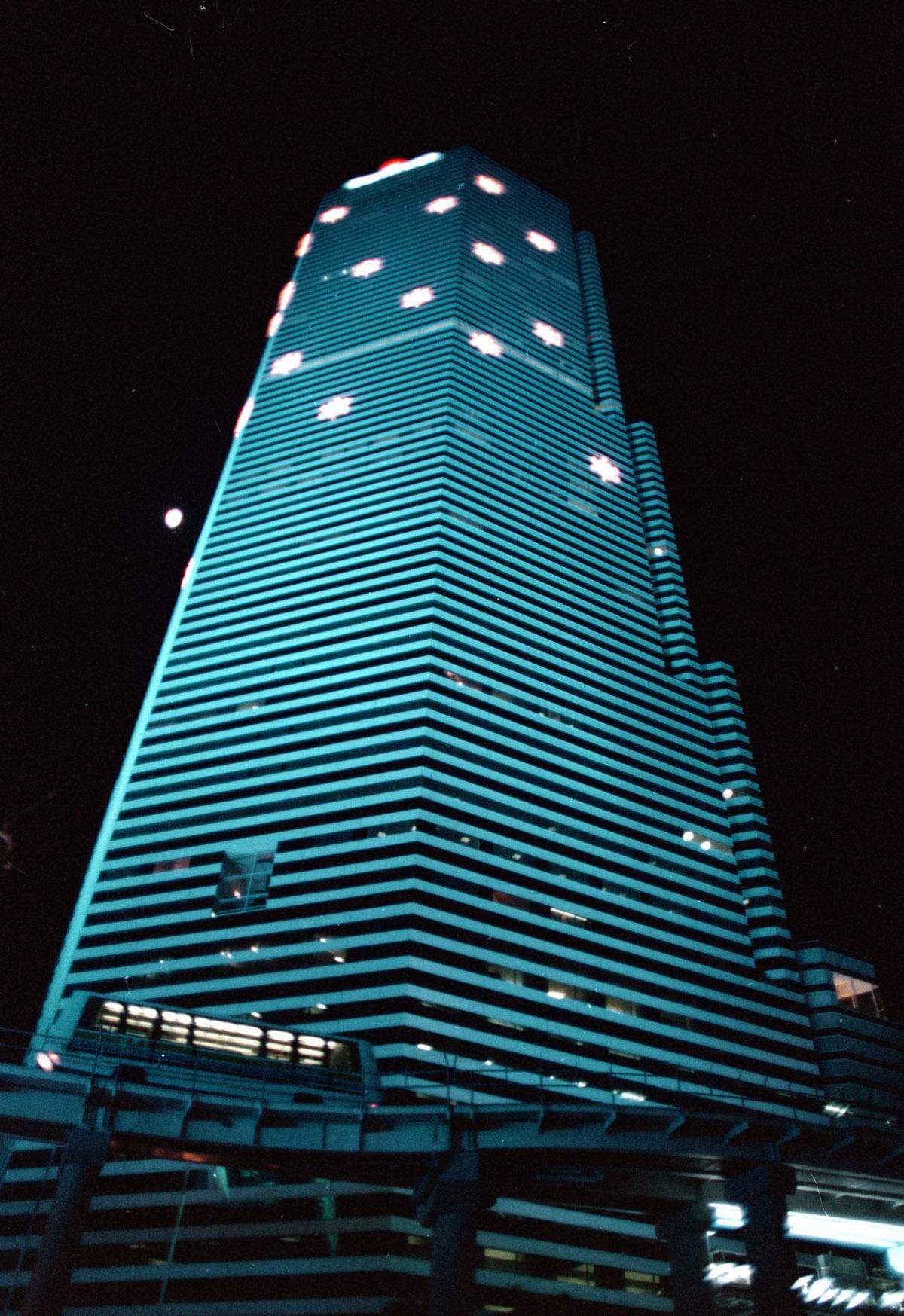
RETURN OF THE COLORS
Published April 24, 1991
Once the mood ring of Miami’s skyline, changing colors with the holiday or football seasons, the same 47-story high white light has glowed like a ghost in our nighttime sky since Jan. 2. It is CenTrust Tower.
Not for nothing has the city’s signature building been called a white elephant.
But color is about to return the tower, maybe as soon as Memorial Day.
When CenTrust Savings Bank sank like the Titanic in 1990, the institution’s headquarters building became part of the $17 billion portfolio of the federal government’s bank bail-out program. To minimize costs, the tower’s leitmotif, once a personal whim of CenTrust founder David Paul, was limited largely to basic white.
Also, the color filters, two- to three-foot discs placed over the 380 spots pointed at the building, were warped and damaged. The last dab of color used was orange for New Year’s Orange Bowl.
New, better filters -- red and blue -- have been ordered, said Jay Leone, building manager under contract by the federal Resolution Trust Corp. Later he hopes to get purple (Halloween) plus aqua and orange (something to do with sports).
When CenTrust goes back to color, “we would be receptive to public-service types of organizations” that want to brighten the night skyline for special occasions, said Leone. A plan to charge private groups for color service is being considered, he said.
In the meantime, Andrea Plater, RTC spokeswoman in Atlanta, said she expects an announcement of a new owner for the building as soon as this month. If so, color the tower green. Or pink. Again.