
It’s professor vs. professor as UM, Gables clear way for 1950s dorm demolitions
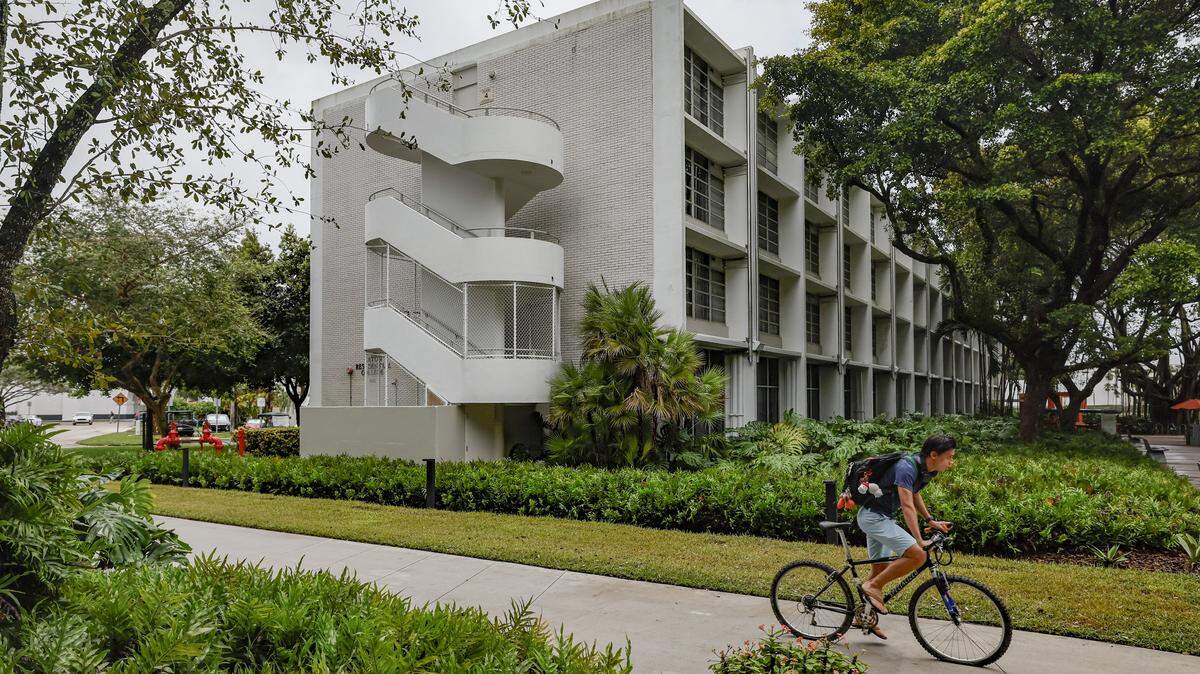
The University of Miami, widely held to be the first U.S. college campus entirely made up of Modernist buildings, seems set to erase a big chunk of that historic and architectural legacy as it looks to replace the last of its surviving original dorms — a move that has generated unexpected pushback from preservationists and pitted two of the school’s noted architecture professors against each other.
Meanwhile, administrators at the university, whose architecture school is known for its strong historic-preservation program and the civic involvement of its faculty, don’t want to talk about it.
The unusual imbroglio comes amid a multi-year billion-dollar project by UM to replace the aging, relatively Spartan residential facilities from its earliest years with the deluxe, amenity-laden accommodations that the university says are necessary to attract and retain students today.
It developed rapidly and with little public notice at the end of 2025, when the city of Coral Gables’ historic preservation office quietly cleared the way for UM to demolish two large Modernist dorm complexes that have been a cornerstone of campus life since the 1950s, the Pearson and Mahoney residential colleges. The dorms sit prominently at the school’s main entrance.
The city, which has jurisdiction over development at UM’s campus, is known as a bastion of historic preservation but has been far more meticulous about protecting its signature Mediterranean-style homes and buildings than its mid-20th century architecture — an issue that is increasingly confronting the city as more of its modern buildings exceed the age of 50 years, when they qualify for historic designation.
Because there was no public notification or hearing, critics of the UM demolition decision say they had no chance to contest the city’s conclusion, set out in a brief letter to university officials with no explanation or analysis, that the Mahoney and Pearson buildings have no historic or architectural value.
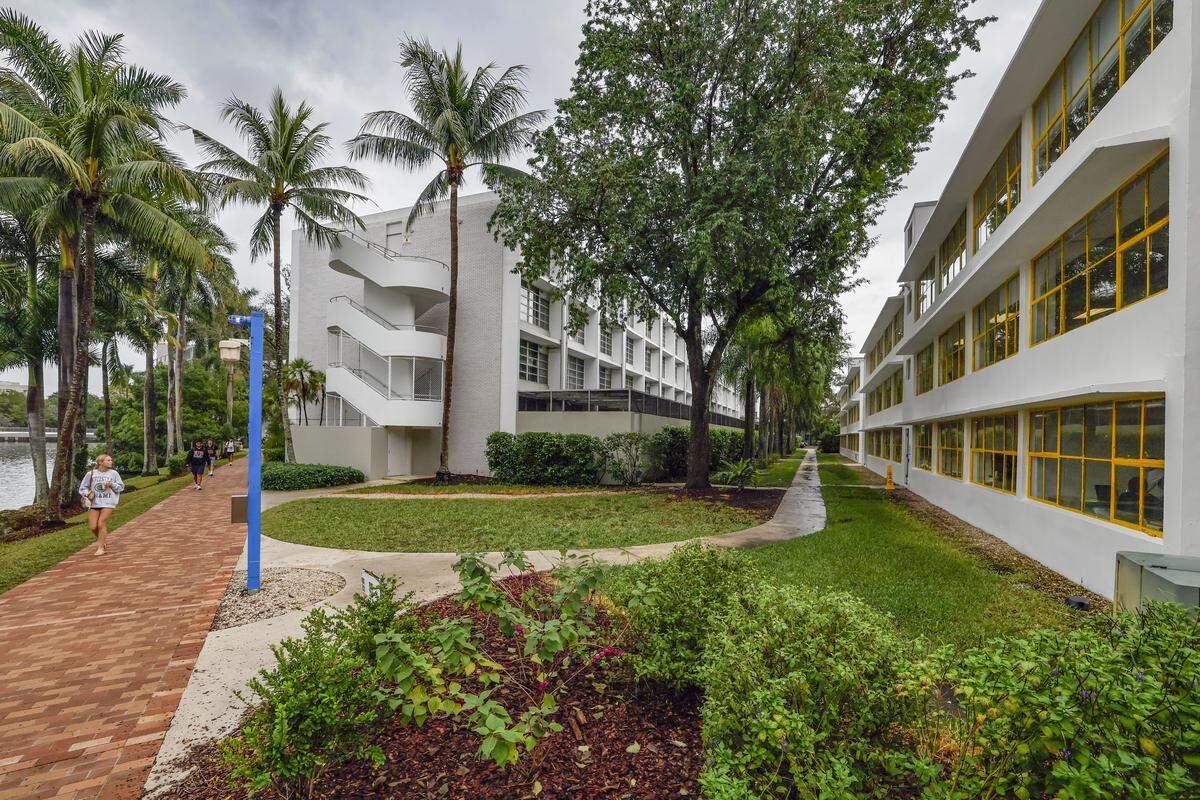
Shortly afterward, UM sought a second city determination that would allow the school to tear down its oldest standing dorm complex, Eaton Residential College. Clearance was again granted in a letter from city preservation director Anna Pernas, again with no analysis.
But this time preservationists got wind of the decision in time to file a legal appeal, prompting a contentious public hearing in December before the city’s preservation board.
By a 5-3 vote, the board narrowly rejected a request from Coral Gables resident and activist Bonnie Bolton, who was backed by longtime UM architecture faculty member Jean-Francois Lejeune, that the city designate the 1954 Eaton complex as a protected historic and architectural landmark.
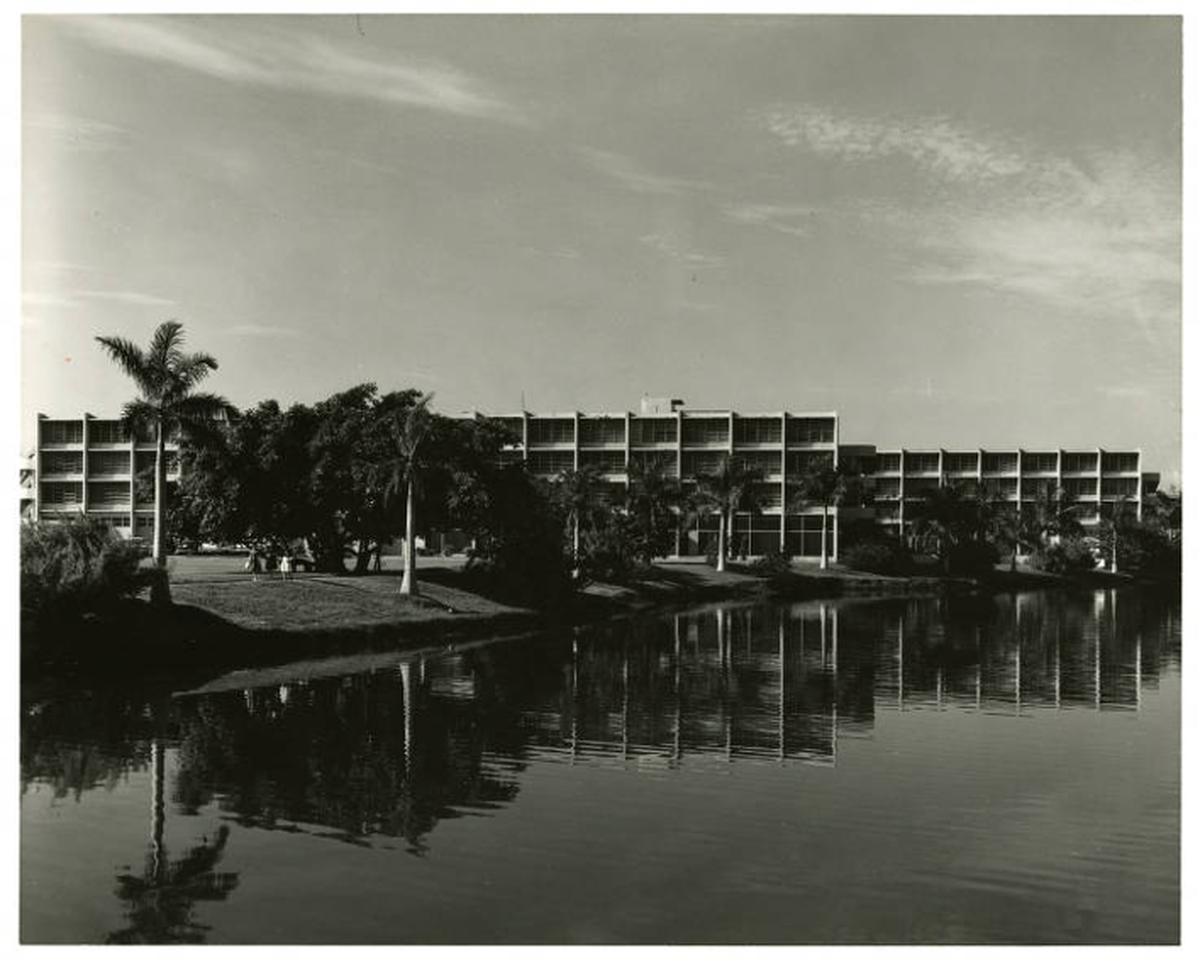
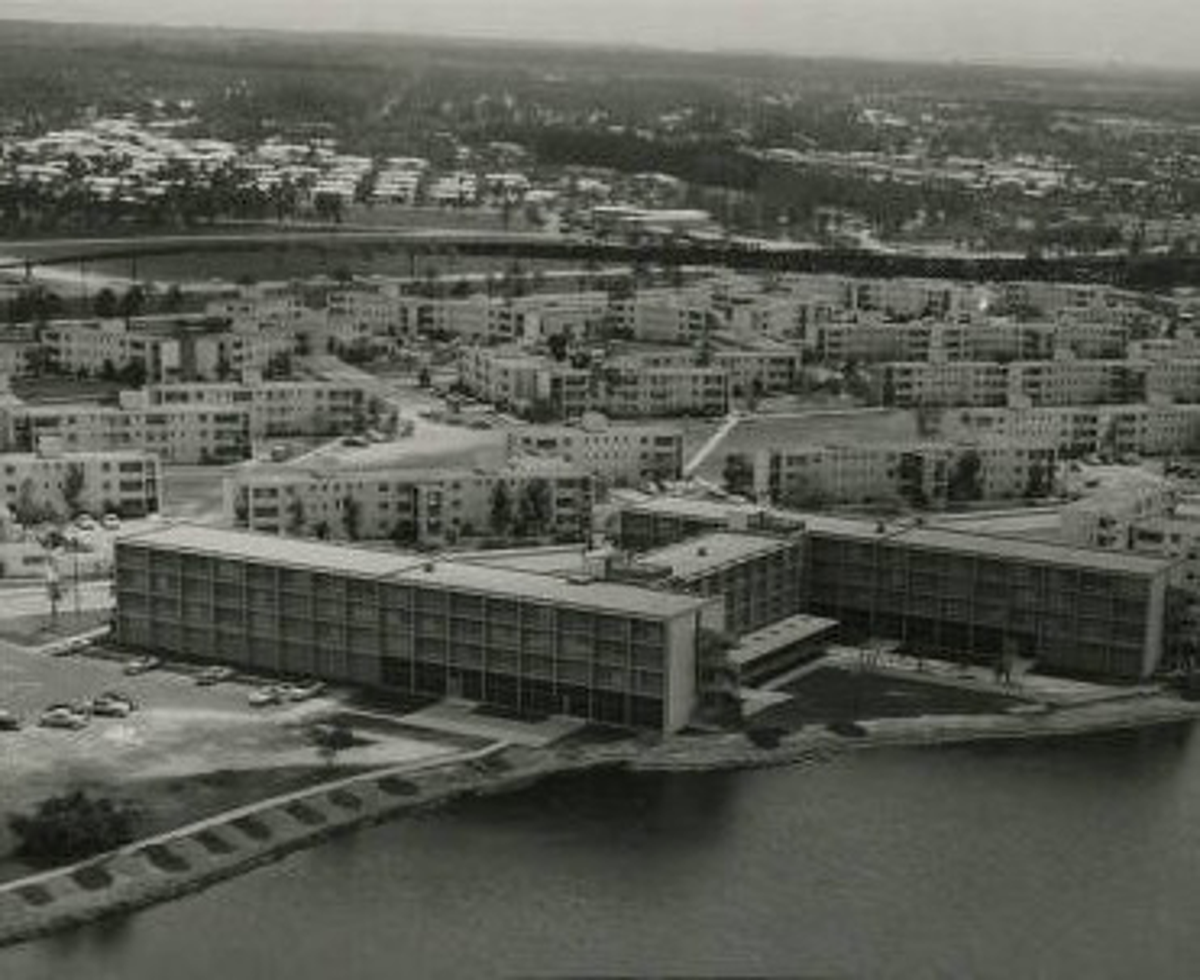
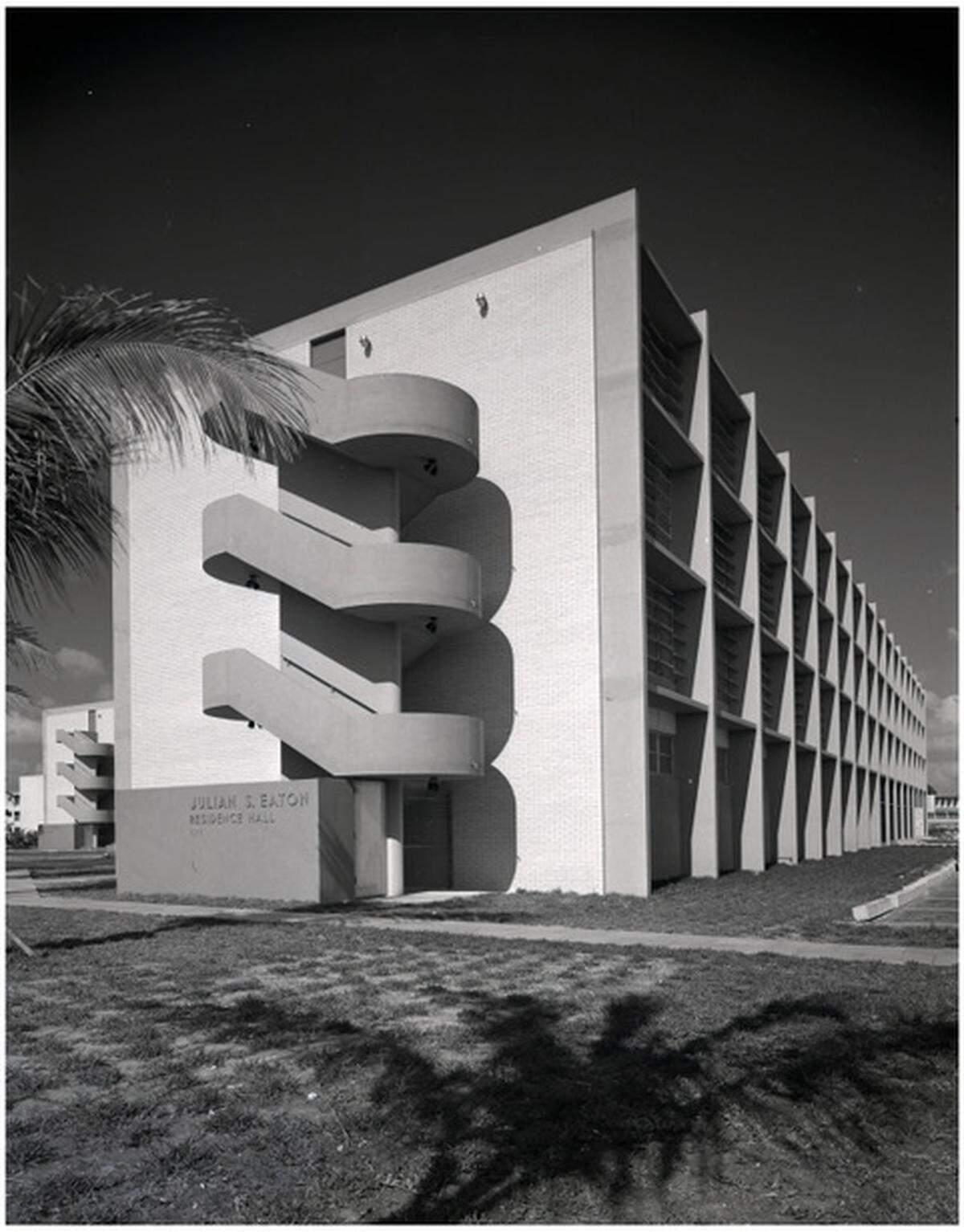
In a petition to the city, Lejeune and preservationist Brett Gillis, a former Gables preservation board member, argued the Eaton complex, which occupies a prominent spot on Lake Osceola, represents a pivotal point in UM campus history. Fusing Bauhaus and International Style architecture with elements of subtropical Modernism, they wrote, Eaton helped set the template for the school’s characteristic style for residential and classroom buildings for the next two decades.
Lejeune filed the petition with Bolton and Gillis in his capacity as Florida chapter secretary of Docomomo, an international organization that advocates for the preservation of significant modern buildings. Bolton’s petition was also supported by the Historic Preservation Association of Coral Gables and the Miami Design Preservation League.
Leading UM’s countercharge at the hearing: Jorge Hernandez, a veteran UM professor of architecture and historic preservation who was hired by the university, along with a high-powered team of consultants, to challenge Lejeune’s report.
In the counter-report he co-authored, Hernandez said Eaton’s design “was not a unique or distinguished exemplar of the mid-20th century” style of design but was instead a purely “functional” building erected quickly as the school worked to absorb a flood of new students after the end of World War II.
Though Hernandez’ view prevailed, it’s unclear precisely why. Board member Cesar Garcia-Pons, who noted he is a UM architecture alum, provided no rationale when he proposed a resolution rejecting the preservationists’ application. Earlier, Pons, mentioning that he had a nostalgic fondness for the dorm, had said Eaton has “a lot of elements of good design.”
Two board members with a close association to UM vocally favored designation, including Ana Alvarez, a UM architecture grad married to longtime UM architecture professor Frank Martinez, and Dona Spain, a UM architecture and town-planning alum and former Coral Gables preservation director who is married to longtime UM architecture professor Tom Spain, now retired.
Spain said Eaton is a key piece of the 1940s Modernist plan for the campus that guided its development and an exemplar of the International Style of design that then prevailed.
UM’s media relations office turned down a request from the Miami Herald to interview a school administrator about UM’s plans with no explanation. In a brief statement, the school said it is still figuring out what to do with the Eaton buildings, but it has already released elaborate plans for new dorms rising nine and 10 stories on the sites occupied by Mahoney and Pearson, which will be torn down this summer.

Karelia Carbonell, president of the Coral Gables historic association, said the cards seemed to be stacked against the preservationists on the city end as well.
The city did follow established procedure, under which property owners considering demolition of an older building must first get a determination from the preservation office that it’s not potentially historic. Properties are referred to the board for hearings if the city officer determines they may have historic or architectural significance.
But the city should have realized the import of the UM dorms and the impact of tearing them down and referred the matter to the board for a public discussion, Carbonell and Lejeune say.
“It’s an uphill battle. It’s UM versus UM, but it’s a fight against the city also,” Carbonell said. “Overall, it’s a sad situation.”
Colleague vs. colleague
To Lejeune, who served on the UM architecture faculty for 37 years until his retirement as full-time professor in 2024, the university’s opaque posture on the matter is at odds with its educational mission to foster debate and discussion. He said administrators didn’t tell anyone on campus it intended to demolish the 1950s dorm complexes.
By contrast, he said, when the university opted in 2019 to tear down four squat Brutalist dorm towers from the 1960s whose accommodations many alumni fondly recall as resembling jail cells, administrators first consulted with architecture professors and other faculty members, reaching a consensus that the buildings could not feasibly be renovated and modernized.
Lejeune argues that’s not the case with Mahoney, Pearson and Eaton, which he said likely could have been expanded and modernized.
At the very least, he said, the university should have sought the views of its experts in the school of architecture and held public discussions about the dorms’ fate — an approach he says would also have contributed to students’ education about the intricacies of history, development and architecture.
“What happened is a new approach of not discussing with anybody what the future of those buildings could be,” he said in an interview. “It’s a problem of the university that it does not even have a transparent role in relation to its school of architecture. It’s sad to see it treated with absolute indifference. And it’s happening on the 100th anniversary of the university.”
Making things worse, Lejeune contends, was the school’s hiring of longtime colleague Hernandez to oppose the petition. Lejeune complained that, among other statements he says are inaccurate, Hernandez in his own report and in testimony to the preservation board discounted the importance of Robert M. Little, the prominent Miami architect who designed the Eaton, Pearson and Mahoney halls.
The late Little is credited by architectural historians and UM itself with a key role in shaping the Coral Gables campus in a Modernist style once the school moved there from temporary quarters elsewhere in the Gables at the end of World War II.
Little designed around a dozen other buildings on the UM campus, including its first, the Solomon Merrick classroom building from 1950, and notable others, like its famed circular Ring Theater, on which he worked in collaboration with Marion Manley, another key Modernist designer of the campus. Little also designed a campus building designated as historic by Coral Gables, the 1954 Volpe building at the Frost School of Music. Other buildings and homes designed by Little are designated as historic by Coral Gables and Miami Beach.
“It’s expected that the university would try to counteract us,” said Lejeune, a former member of Miami Beach’s planning and preservation boards. “What we didn’t expect was that Jorge Hernandez, our colleague, would be the one to try to destroy our arguments. ... I was disappointed.”
Hernandez declined comment. The architect, a UM alum recognized as an authority on preservation, has served on the board of the National Trust for Historic Preservation and played a key role in saving a clutch of the campus’ earliest residential buildings, minimal but charming former dorms from 1948 co-designed by Manley, for conversion into the UM school of architecture in 1983.
Bolton and Lejeune decided not to pursue an appeal of the preservation board’s decision to the Gables City Commission, which would be an expensive effort. Lejeune said they concluded doing so would be fruitless because commissioners are unlikely to oppose UM’s wishes.
Lejeune and Carbonell note what they say is another irony: UM administrators have touted the school’s support of environmental sustainability, which includes a climate resilience research institute. But they cite experts who say preservation is a far more environmentally friendly practice than demolition and new construction, which consume substantial energy and materials and are a leading driver of climate change.
“Where is the sustainability in this?” Carbonell asked rhetorically.
‘Where do we draw the line?’
The debate over the UM dorms may now be moot, but it underscores the essential role that Modernist design played in the campus’ construction. The loss is also significant for the city of Coral Gables, Carbonell and Lejeune say, given that it has relatively few modern buildings of real architectural distinction.
What’s not in real dispute is that the dorms facing destruction played a key role in the university’s growth and development.
Coral Gables founder George Merrick, who helped launch the university, donated the land for the campus and outlined a plan for a Mediterranean-style campus, but that never came to pass. The Florida real estate crash of 1926 and the ensuing Great Depression meant its first building stood as an unfinished skeleton for two decades while UM operated out of temporary quarters off Lejeune Road in the Gables.
That changed dramatically with the end of the war and passage of the GI Bill, which paid for veterans’ college education. With veterans driving a geometric rise in enrollment, the university quickly erected scores of minimalist apartment buildings designed by Manley and Robert Law Weed while completing the Merrick classroom building under a new modern design by Little.
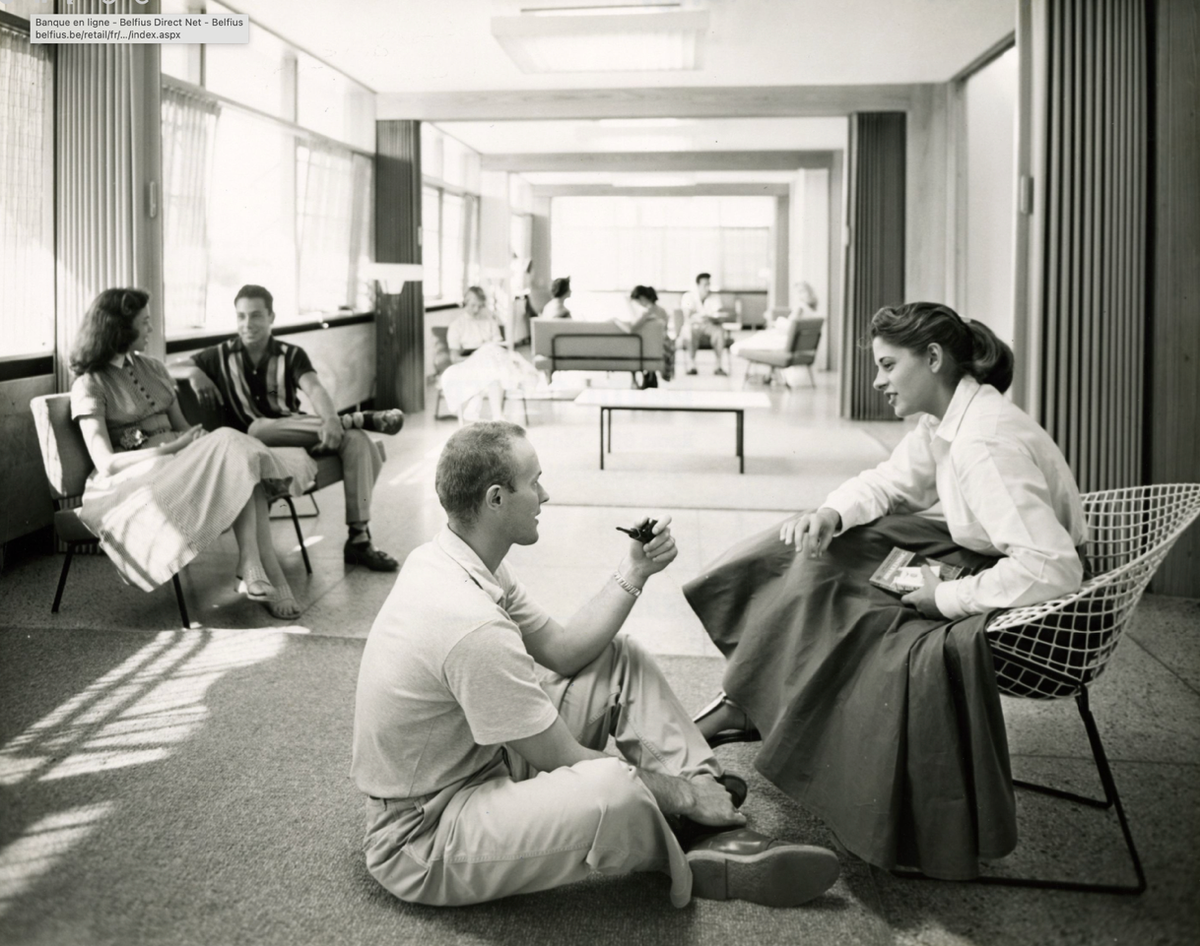
In 1954, Eaton opened as a women’s residence, dubbed the “ultra-ultra dorm” by the Miami Herald. It represented an expansive new vision for the school after that first wave of simple dorms, with common areas like meeting rooms and a large dining hall meant to foster a sense of community.
Lejeune said Eaton’s design is simple but distinctive, with an H-shaped footprint and large windows with operable glass panes shaded by concrete frames and open-air hallways, all features of subtropical mid-century modern design that would become the UM campus signature.
That began to shift under UM Presidents Tad Foote and Donna Shalala, who led efforts to upgrade the school’s longtime reputation as “Suntan U” by enhancing academics, admittance standards and school facilities. Virtually all the basic, original dorms co-designed by Manley were demolished.
In 2020, the new 1,100-bed Lakeside Village complex of dorms, built mostly on former parking lots, broke the historic mold. The post-Modern design by Miami’s Arquitectonica comprises 25 colorful mid-rise towers, conjoined and elevated over columns, with gardens and elaborate amenities, including a beach volleyball court. The new upscale dorms also allowed UM to charge students a substantial premium over the older Eaton, Mahoney and Pearson rooms.
The second wave of demolitions came in 2019, when the Hecht and Stanford residential colleges’ four towers began to come down, to be replaced by Centennial Village, a collection of five new residential colleges in a sleekly glassy contemporary design by VMDO Architects of Virginia. The first two colleges, Ibis and Coral, were completed and occupied in the fall of 2024, with the other three slated for opening this fall.
At that juncture, the university’s since-retired housing director, Jim Smart, said Eaton would be renovated and connected to Centennial Village. That now seems to have changed, but it’s unclear why. In a statement to the Herald, UM said the redevelopment green light by the Gables means “the University may now commence the design studies for that area. ”
“Eaton Residential College will continue to house students until the University determines how best to maximize its extraordinary central location within our campus,” the statement says.
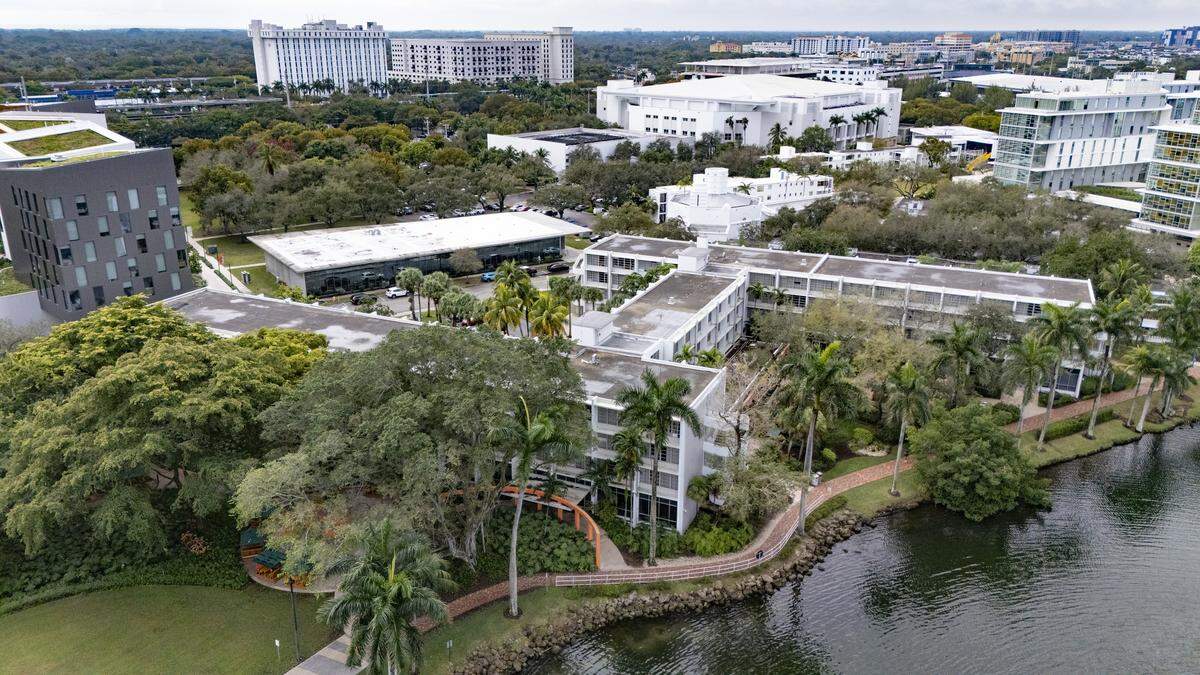
If Eaton does come down, Lejuene says, it will mark the disappearance of the last trace of an important phase in UM’s and Coral Gables history. He calls the Lakeside Village by Arquitectonica “a very successful project” and notes that it forms a picturesque triptych, along with its neighboring Eaton hall and architecture school buildings, of three significant layers of campus architectural history. Eaton’s demolition would leave a yawning gap in the story, he said, raising questions about what the school and the city think worthy of preservation.
“These are buildings that have marked the lives of thousands of students and faculty members,” Lejeune said. “You cannot protect every building in the city. But on the other hand, there’s not so many good or interesting modern buildings in this city which involve important architects. Where do we draw the line? This means we could pretty much tear down everything.”