Coral Gables is investigating a commissioner accused of ‘phishing.’ What to know
An ongoing investigation in Coral Gables is looking into a thorny situation involving emailed political surveys, an elected official under suspicion and an anonymous blog about city affairs.
City Commissioner Ariel Fernandez is facing accusations that he was behind a series of political surveys that improperly gathered intel on residents in 2023 and 2024. He denies the allegations, which he describes as “political retaliation.”
Details about the alleged “phishing” scheme, which were laid out in posts by the anonymous Aesop’s Gables blog, raised enough concern that commissioners called for an investigation this summer.
During a July City Commission meeting, Commissioner Richard Lara, who received at least one of the surveys but did not respond to it, summarized the allegations detailed in the blog posts. Lara said that Fernandez, based on information from the blog, “allegedly engaged in conduct which constitutes surveillance on residents through his position as sitting commissioner through a very complicated scheme of using fake email accounts — sending out emails with purported surveys without disclosing that he’s the one behind it, which also for those who actually conducted the survey and participated in it, involved embedded tracking software in it.”
After the discussion, commissioners voted 3-1 to launch an investigation into the allegations.
Commissioner Melissa Castro, who voted against the investigation, questioned the validity of the information in the anonymous post. Fernandez, who was absent the day of the vote and did not make himself available for an interview, denied the allegations in a text to the Miami Herald this week.
“A political directive is being used to harass and intimidate me while employing official resources to investigate claims by an anonymous blog post about an anonymous lawsuit. It is clear political retaliation against me for the courage to run for office and represent the interests of residents on the dais,” Fernandez said in the text, which did not say who he believes is retaliating against him.
Commissioners directed the city’s police department to identify and work with the appropriate external agencies, such as the Florida Department of Law Enforcement or the Miami-Dade State Attorney’s Office, to handle the investigation.
While the investigation is ongoing, details remain scant. Here’s what we do know:
The allegations
Starting two years ago, a series of surveys were sent to residents from People Count USA, a group that is not registered in Florida corporate or political committee records. Its website is no longer active.
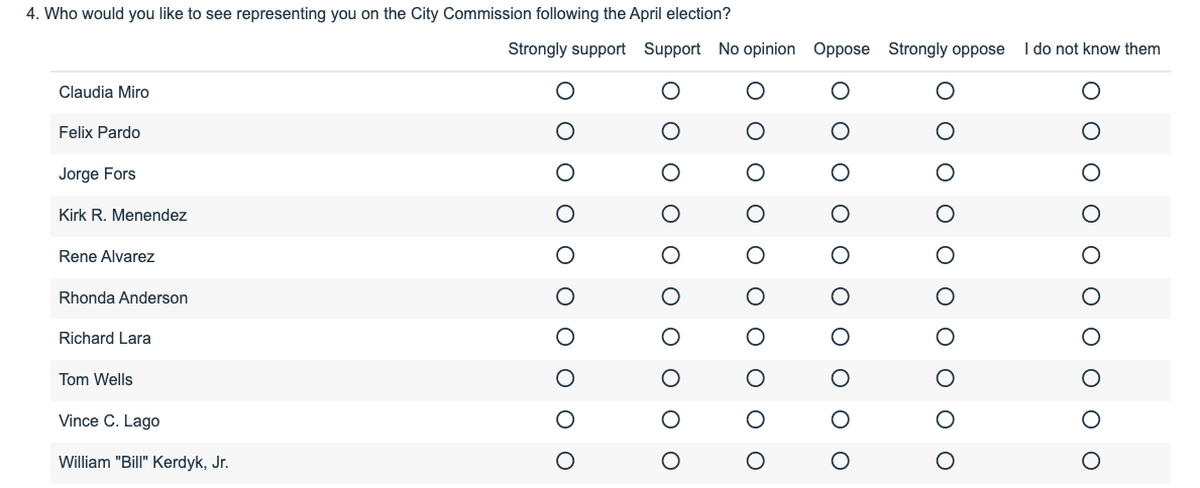
The survey links no longer work, but screenshots provided to the Herald show that voters were asked to weigh in on election date changes, their thoughts on commissioner salary changes, and who they would “like to see representing you on the City Commission.” A screenshot of the survey shows a list of names, including Mayor Vince Lago, Vice Mayor Rhonda Anderson, Commissioner Richard Lara, and former commissioner and mayoral candidate Kirk Menendez.
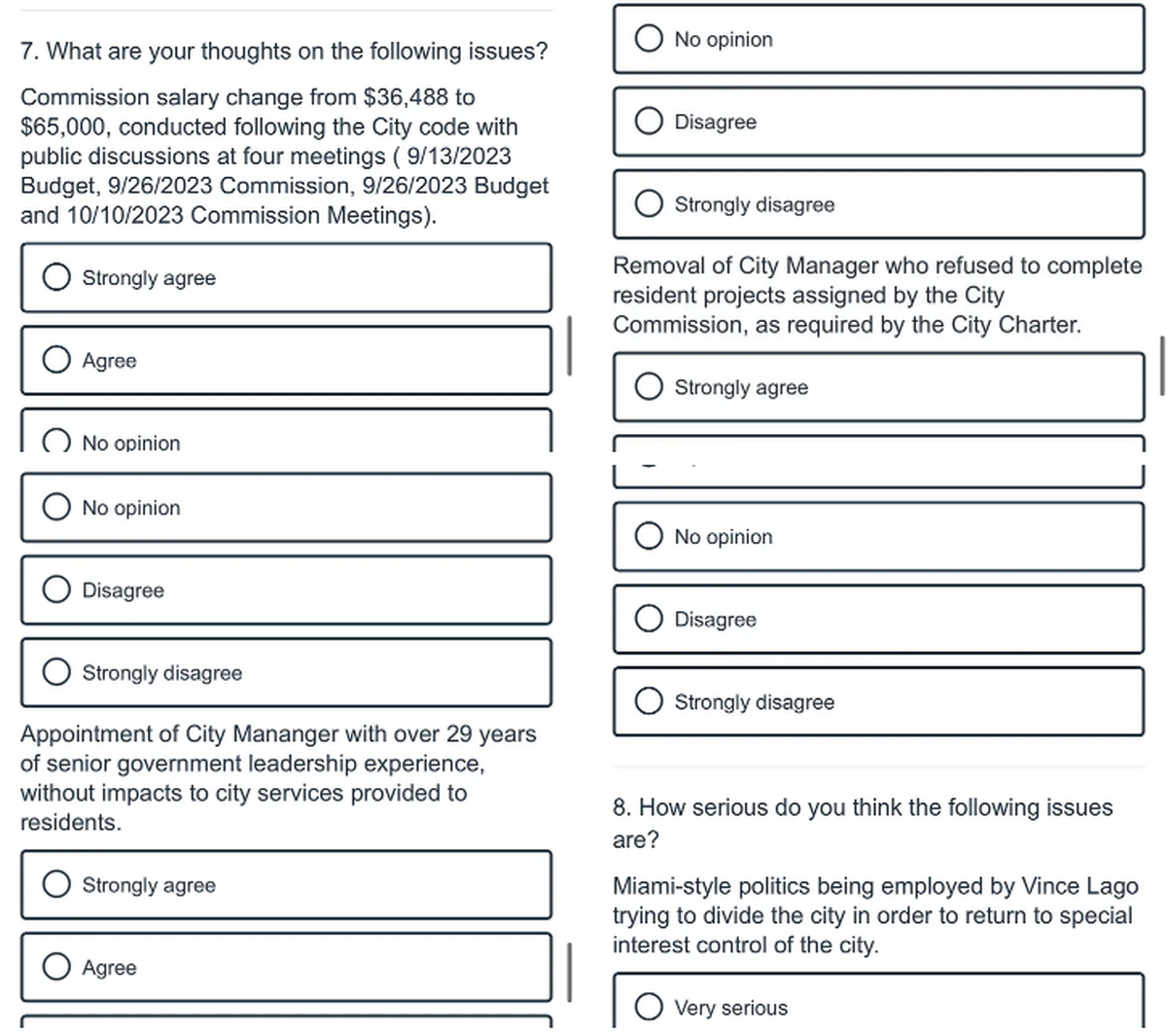
Other survey questions were more pointed. One asked residents to weigh in on how “serious” they consider the “Miami-style politics being employed by Vince Lago trying to divide the city in order to return to special interest control of the city.”
The emails began circulating in August 2023, about four months after Fernandez and Castro were elected, beating opponents who were supported by Lago.
This past February, Gables resident Norman “Tony” Newell filed a lawsuit seeking to discover the identity of the person behind the surveys. The suit claims the surveys did not properly disclose who was conducting the polling or what the responses would be used for, which the lawsuit says is at odds with state law and goes against general best practices for surveys.
Newell, in his lawsuit, alleged that People Count USA “engaged in deceptive and unauthorized interception and collection of private data in violation of Florida law.”
“Mr. Newell believed that the surveys which PeopleCountUSA sent were designed to look like legitimate political polling but in actuality were deceptively intercepting and collecting private data and information of the recipients,” said his attorney, Mason Pertnoy.
Newell, who has run twice to be a city commissioner and whom Lago describes as a good friend, was recently reappointed to the city’s Trial Board, which listens to appeals from city employees who ask for a written justification for their firing or suspension.
In the case of the surveys, Newell said he received and reviewed them but did not answer them. He then heard “anecdotal stories” from residents that they “were visited by canvassers soon after taking (or even just interacting with) the survey,” according to an email from Pertnoy, who also recently represented Lago in a defamation lawsuit. “From what Mr. Newell heard these canvassers appeared to have knowledge of the residents’ views expressed in the survey.”
Fernandez was not named in the suit, which was filed against “John Doe” as part of a legal process to learn the identity of the person or people behind the surveys.
Newell, through his attorney, told the Herald that, based on the info he obtained through the legal process, he believes Fernandez is linked to the surveys.
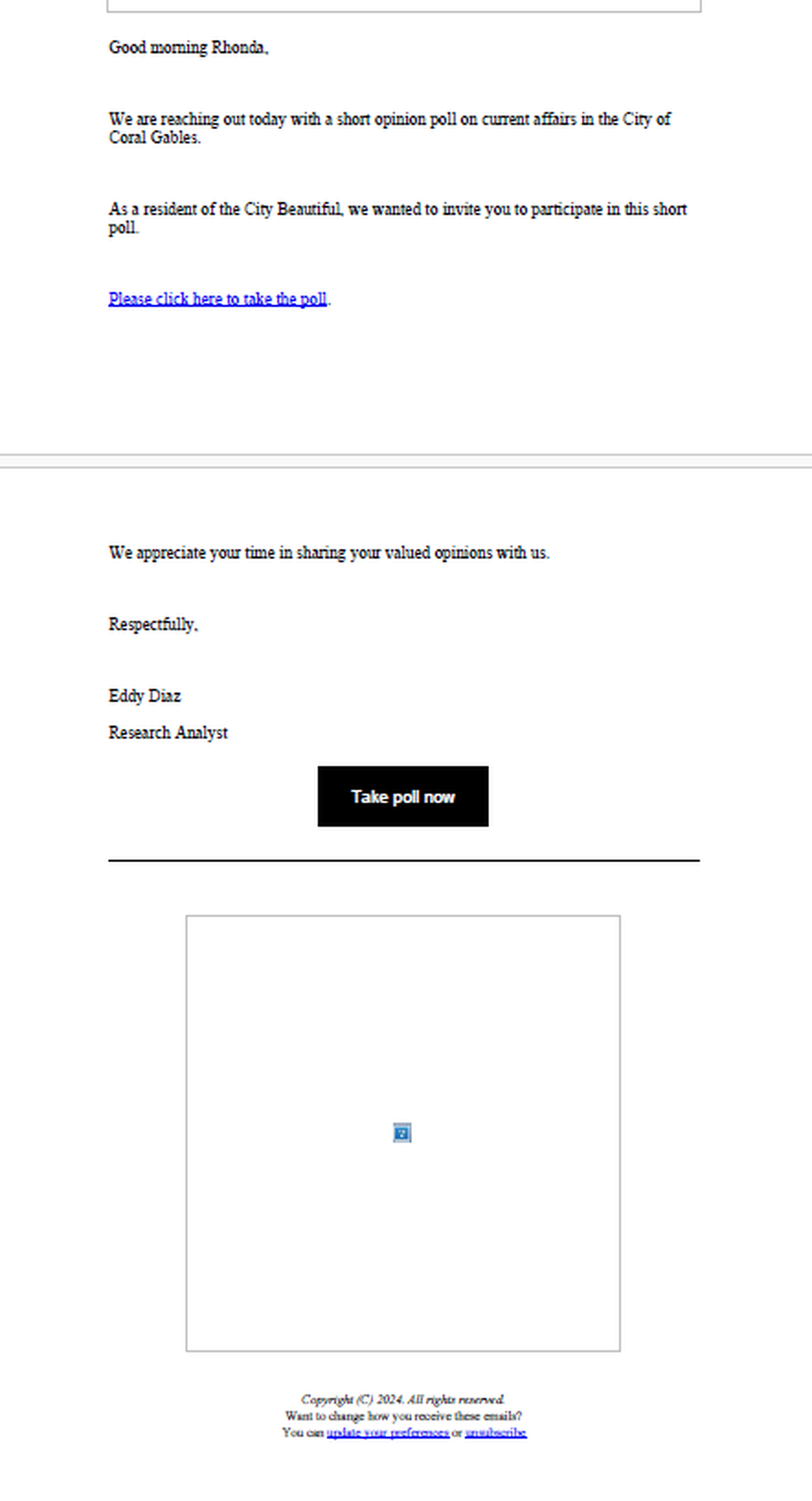
The surveys were emailed to residents using Mailchimp, an online platform that lets anyone create and distribute polls and surveys. Through the course of litigation, Newell and his attorney said they obtained two emails and an IP address associated with the People Count USA surveys.
Newell then shared that information with the Aesop’s Gables blog and other “individuals better positioned to analyze the technical details,” according to Pertnoy. Those people determined that one of the accounts associated with the surveys “used an email address with a domain owned or associated with Commissioner Fernandez,” he said. Newell and his attorney did not disclose to the Herald the identity of their analysts.
Records provided to the Herald by Pertnoy show that the name attached to one Mailchimp account linked to People Count USA is Jorge Dominguez, a name that is not uncommon in Hispanic-heavy South Florida. The Herald could not independently confirm if anyone with that name was behind the surveys, or if the name is an alias for Fernandez, like what the anonymous blog suggests.
Pertnoy said Newell voluntarily dismissed the lawsuit in June because he now “believes it is a matter of public concern” involving an elected official.
“The legal, ethical and any other consequences, if any, is in the hands of the public, voters, and law enforcement and governmental agencies to determine,” Pertnoy said.
The alleged links
Records provided to the Herald by Pertnoy included an email that the attorney says is associated with the URL americanaresearch.com. That URL was registered July 25, 2023, about four weeks before peoplecountusa.com was created, according to the WHOIS registry domain name database.
The americanaresearch.com URL redirects to Marketseur, a company registered to The American Strategies Group. Fernandez is president of Marketseur and The American Strategies Group, records show.
It’s worth noting that anyone can buy a URL and redirect it to another website, according to Stuart Madnick, a professor of information technology at MIT Sloan School of Management. He compares it to how people can set up phone numbers to forward to another number.
“You don’t have to have control of both sites to do that,” Madnick said.
The IP address from Mailchimp that was provided to the Herald does seem to be from Coral Gables. Several online IP locator tools place the IP address along U.S. 1 in Coral Gables, near Gables Inn and the University of Miami.
While IP addresses can sometimes give a general idea of where a person was when they went online, it’s not a foolproof way to determine their exact location, according to Madnick. The professor said IP addresses can change or be masked and rerouted through Wi-Fi connections, VPNs or other services like Tor.
In May, shortly before the city launched an investigation into the surveys, Gables resident Nicolas Cabrera questioned Fernandez about the People Count USA surveys during a commission meeting. Cabrera is well known in the city. He’s the son of former Gables commissioner Rafael Cabrera, secretary for the Coral Gables Museum Board of Trustees and president of the museum’s Young Associates group. He’s also served on several city boards through the years. Most recently, he was nominated earlier this year by Lago to serve his second term on the city’s Board of Adjustment.
“Did you have anything to do with People Count USA?” Cabrera asked.
“I don’t have any comment at this time,” Fernandez told him. “I’m not even sure what People Count USA is.”
In September, Cabrera brought up the allegations again during another meeting and accused Fernandez of lying. Fernandez sought clarification over whether residents were allowed to address commissioners individually during meetings and told the mayor that it appeared Lago was “running a political stunt here.”
The surveys
Coral Gables resident Samuel Lawson told the Herald he received three emails from People Count USA starting on Aug. 20, 2023. He remembers answering the first survey, which asked whether commissioners should move city elections from April in odd-numbered years to November in even-numbered years. The other two surveys focused on the possible annexation of Little Gables and the mayor.
It was clear that they were “not real surveys,” said Lawson, who runs an activist-like community group chat and has been fairly active in city politics over the last few years. He signed a letter last year against efforts to recall Lago.
He had harsh words for the surveys, which he described as “manipulative,” as well as “offensive” and a “violation of my trust.” He said the Aesop blog posts make him feel “vindicated.”
The 58-year-old resident doesn’t believe he was approached by anyone after filling out the survey but, like Newell, said he’s heard stories from residents who were.
Madnick, the MIT professor, after hearing about the allegations laid out by Newell and the anonymous blog post, said it’s possible the surveys could have used tracker IDs to let the sender track who responded, even if the polls were meant to be anonymous. He compared it to wedding RSVPs.
“Sometimes people write a little number in the back of the card so in case, when you fill out the card, your handwriting is so sloppy they don’t know who you are. They know this is card number one or five,” which then lets them identify you, he said. It’s difficult to know what was used since the surveys are no longer active.
Whoever purchased the People Count USA website domain did so on Aug. 20, 2023, the same day Lawson received his first email from the group. The website no longer works, though the domain registration doesn’t expire until 2026.
There is no known record of People Count USA in Florida. An organization with that same name was registered for years in Illinois but became defunct in 2007. An attorney associated with the now-defunct organization whose office is in Naples has not responded to the Herald’s calls and emails.
Joshua Scacco, director of the Center for Sustainable Democracy at the University of South Florida in Tampa, said the main issue he sees with the emails is the lack of transparency over who conducted the surveys and what the information would be used for.
“What really raises a little bit of the hair on my arm about this is that the identifying information for the group did not lead anywhere,” said Scacco, who is also an associate professor of political communication and someone who himself conducts research surveys.
Political surveys help researchers understand ”the contours of public opinion” and the country’s political environment, he said.
Scacco said allegations like those circulating around the People Count USA surveys can “violate public trust, especially in circumstances where sponsors are not clearly identified” and recipients don’t know what their data is being used for.
Jon Mills, dean emeritus and professor emeritus at the University of Florida’s law school, had a similar sentiment. People who conduct polls “have a duty to inform the people that they’re polling what it’s going to be used for and to obtain consent,” he said.
Mills said it’s possible that the person or people behind the surveys could be in legal trouble, but it would depend on what type of data was collected, if recipients knew what their data was being collected for and if they were able to give proper consent.
“ These statutes exist about getting consent to acquire information ... so it depends on the facts here, but it’s possible,” he said.
Commissioners call for an investigation
The Coral Gables Police Department declined to provide any information or public records to the Herald related to the matter, citing the ongoing investigation. A records request to the city produced one survey email that was sent to Vice Mayor Anderson in January 2024.
Anderson, who back in July initiated the discussion that led to the investigation, said she did not answer the survey and, like the rest of the commissioners, is waiting to see what the investigation uncovers. Lara, similar to Anderson, said he voted to launch an investigation because of how “serious” the allegations are.
One of the allegations from the anonymous blog — that Fernandez violated Florida law by withholding or destroying public records related to People Count USA — is a “clear black-and-white violation of the law, and it needs to be investigated,” said Anderson.
The mayor declined to comment, citing the ongoing investigation.
“As there is an active investigation regarding Commissioner Fernandez and the Mailchimp matter, I cannot comment,” Lago told the Herald in a statement. “I support a thorough, impartial review and expect full cooperation from all involved so that residents receive clear facts and accountability.”
Attorney David Winker, who is representing Fernandez, described the investigation as a “misuse of valuable police resources.”
“The Commissioner has not been contacted by law enforcement, but we welcome the completion of this investigation so that Commissioner Ariel Fernandez’s name is cleared of these baseless and politically motivated allegations arising from an anonymous blog written by political opponents,” Winker said in a text message.