
Seizing on Miracle Mile turmoil ‘an effective election strategy’ for Coral Gables candidates
Amid an unprecedented building boom in The City Beautiful, a proposal to spur new development throughout Coral Gables’ iconic commercial corridor is stirring up nervous energy in activists and residents — just in time for election season.
With Election Day barely two months away, candidates for mayor and city commission have seized on controversy around a plan to encourage new construction on the city’s famous Miracle Mile by tweaking the city’s zoning laws. They have turned the issue into a political football, frustrating city officials and creating skepticism among voters jaded by years of anti-development campaign rhetoric.
“It does affect the campaign,” said Commissioner Patricia Keon, who is vying with Commissioner Vince Lago to succeed Mayor Raúl Valdés-Fauli. The mayor is retiring in April after a political career that began in the 1980s.
The extent to which development continues to dominate politics in Coral Gables was clear Tuesday as the city commission voted 4-1 to pass new zoning regulations put forth after years of workshops and planning. The changes are a technical, dry as dust revision of a zoning code, but the Miracle Mile section — which was deferred to a later vote — triggered a response that has given candidates a chance to capitalize.
A demonstration outside Gables City Hall in the normally docile city became a de facto campaign event for candidates seeking attention during an election held in an off-time of an off-year. As many as 50 placard-bearing protesters listened to community leaders and candidates take turns speaking into a microphone, a rare opportunity to reach voters in a time where in-person events are at a minimum.
Tania Cruz-Gimenez, a consultant and Group Two candidate who is the daughter-in-law of Republican U.S. Rep. Carlos Gimenez, arrived with her husband, sporting a face mask with her name in big blue letters and trailed by a camera crew.
Javier Baños, a Group Three candidate, also came wearing a branded face mask and an orange yard sign bearing his name.
Another Group Two candidate, Mayra Joli, a Brickell immigration attorney briefly made internet famous in October for nodding enthusiastically behind former President Donald Trump at a Miami town hall, showed up without a protest sign. She borrowed one from a resident that said “Say no to concrete canyons” to pose for a photo while talking to a reporter.
“You, Mr. Valdés-Fauli, are on your way out,” Joli said during Tuesday’s commission meeting, yelling into her microphone. “We don’t want you to be selling out our city like it’s a piece of cake. That’s what you’re doing, all of you.”
The upcoming April 13 election will alter the makeup of the commission significantly, but some voters reacted skeptically, having seen candidates make development a central campaign issue in previous years. During the last election, candidates used the buzzword “smart development” to win over voters, said Sue Kawalerski, president of the Coral Gables Neighbors Association. She said the rhetoric feels empty now.
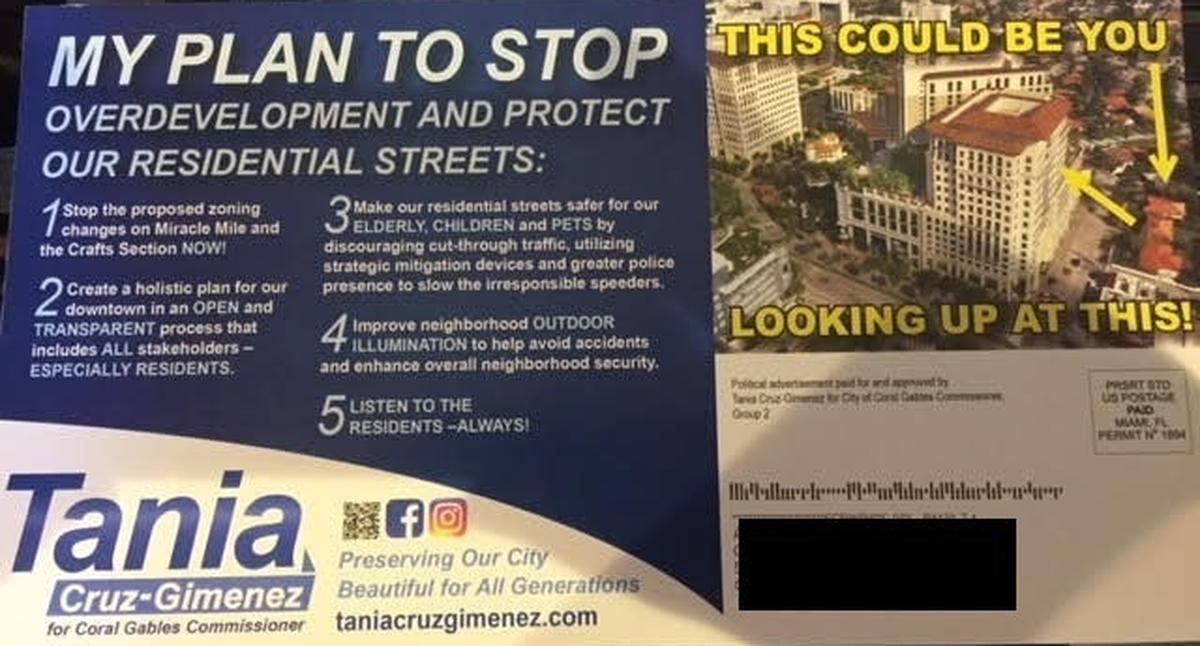
“Everybody is saying we are going to listen to the residents. There is a major distrust for everyone running,” said Kawalerski, a longtime Coral Gables resident. “It’s what every resident is talking about. We’re angry, so of course a candidate is going to glom onto that message.”
The campaign strategy has been effective. Part of the zoning code changes passed Tuesday, and an unresolved proposal to encourage new development along Miracle Mile by changing parking and possibly height restrictions has become fodder for online petitions, community forums hosted by local neighborhood groups and political mail advertisements.
Mayor’s race
The controversy has created a clear dividing line between the two commissioners running for mayor, with Lago the only commissioner to vote against the city’s zoning rewrite Tuesday.
Lago said he doesn’t see his stance on Miracle Mile as an election issue, and points to what he says is his more conservative voting record on development legislation.
“The two people running for mayor have polar opposite views on development,” said Lago, who was first elected in 2013. “My voting record speaks for itself.”
Keon says she believes the Mile needs to change to continue to thrive. She said it’s not the city’s job to tell people where they can and can’t build.
“The polarization and the politics are, I think, obscuring the planning and the public policy that need to be at issue there ... and I don’t want to see good planning and good policy be upended for politics,” she said. “There are many residents who would like us to just tell developers that they can’t build. We can’t do that.”
In the campaign to win the city’s Group Two seat, the issue has also put the mayor’s younger brother — candidate José Valdés-Fauli — in an awkward position.
Unlike the mayor, the younger Valdés-Fauli — who did not attend Tuesday’s protest — says he vehemently opposes changes to the zoning code. He wrote as much in a recent column posted on Gables Insider, a local blog operated by activist and public relations executive Ariel Fernandez, who ran for office six years ago.
Valdés-Fauli said Wednesday that voters know where he stands as his thoughts have been “widely circulated.” He said if he were a commissioner today, he’d vote against it.
“My brother is my brother, I adore him. He was always like a father figure to me,” Valdés-Fauli said. “But he and I are two totally different individuals.”
In a campaign email sent Thursday morning, he made no mention of Miracle Mile or new development.
More to come
With commissioners delaying a decision on proposed Miracle Mile changes until March, the posturing and campaigning around new development is all but guaranteed to continue.
The debate in March will boil down to how tall any new construction on the Mile should be, a question that’s also dependent on complex technical factors.
Commissioners have been at pains to explain to an often-skeptical audience that current rules mean a developer can already assemble enough land now to demolish those small buildings and replace them with a large 70-foot-tall project. Something they say they want to avoid is having a street-killing parking deck with a ramp on Miracle Mile.
City planners’ proposal aims to effectively disallow that.
Lago and Commissioner Michael Mena, who is not up for reelection, have each proposed alternatives that seek to effectively cap heights at four stories along the Mile and hopefully assuage the fears of residents who believe Miracle Mile will turn into a “concrete canyon.”
“I appreciate the fundamental concern about the Mile, that it not be developed into something that is out of scale with what residents expect Miracle Mile to be,” Mena said. “But we have to be cognizant of the property rights of those owners. We can’t just come in and say, ‘Hey, you can only do two stories now.’ “
Mena also expressed frustration over the tenor of the public debate and the election-season politicization of the zoning measures, saying much of the criticism is unmerited and based on misinformation spread on some blogs and social media. Some critics have accused elected officials and planners of writing the code in back rooms to favor developers, even though the city lists more than 20 public meetings over three years on the matter.
“There are a lot of people saying things flippantly about us and about our staff, and a lot of it is not based on facts and it’s unfair,” Mena said. “But it can be an effective election strategy. Only a certain number of people vote in these local elections, and they can be motivated by disinformation.”
This story was originally published February 11, 2021 at 2:00 PM.