
After four-year closure, ‘post-apocalyptic dump’ could once more host baseball in Coral Gables
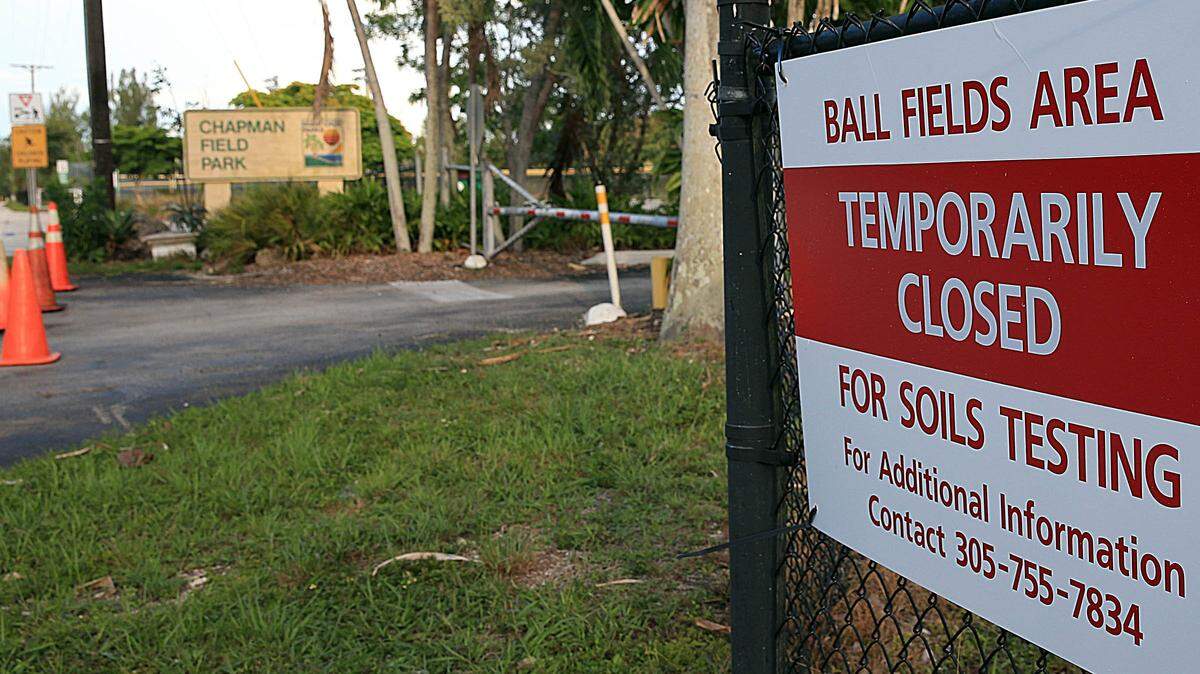
After four years of closure, there are no more angels in the outfield at Chapman Field Park — just weeds, trees, and memories.
And, of course, baseball fields tainted by arsenic, which prompted Miami-Dade County to shut down the storied and sprawling 560-acre park in 2014 and kick off a years-long remediation process marred by funding setbacks and bureaucratic gridlock. It’s believed the arsenic came from an herbicide that was used to maintain the fields.
Now, after steady pressure from baseball-loving families in communities surrounding the Coral Gables park, the county this week announced its first solid timetable for remediation and the future reopening of portions of the park.
“We have a timeline here because I know you all have been waiting for this and it’s been coming since 2014,” said Matilde Reyes, assistant director of Planning, Design and Construction Excellence for the Miami-Dade Parks, Recreation and Open Spaces Department.
She addressed a group of a few dozen residents from the Gables, Pinecrest, Palmetto Bay, and other nearby municipalities during a parks department community meeting at the Deering Estate Visitor Center Theatre.
“The project went through a holding process because of the funding and we decided to go ahead and initiate a Phase 1 to be able to bring the project to you.”
Of the three baseball fields, which have served as home for decades-old recreation leagues, just one will be cleaned up and reopened in 2020 as part of Phase I, an estimated $3 million project, Reyes said.
That leaves the future of the other two baseball fields unresolved, as sports parents with clashing interests gear up to hash out the issue in the coming months.
Reyes said the county has guaranteed at least one baseball field will stay, but the future of the others will be brought to another meeting that has yet to be scheduled. The parks department will gauge public interest before determining what Phase II will look like, whether that be fields for baseball or soccer, or something different.
“We want to hear from you,” Reyes said during Tuesday’s meeting. “We’re going to hear everyone’s opinion.”
The exact cost of Phase I is not yet known, and Phase II of the project is currently “unfunded,” said Danette Perez, a spokeswoman for the parks department.
“Our consultant is developing a current project cost estimate for Phase I and will be providing it in [its] next submittal,” she said in an email. “Preliminary estimates for Phase II will be developed at the appropriate time. As funding is identified, we will start designing the restoration of the area and will gather community input at the appropriate planning stage.”
Before it became the source of community bickering, Chapman Field Park, at 13601 Deering Bay Dr. in Coral Gables, was an airfield during both world wars. In May 2014, high levels of arsenic — more than 20 times the normal level — were found in the soil of the baseball fields.
The county has dismissed theories that the park’s use as a military base contributed to the high levels of the toxic metal, and sampling found no evidence of solid waste despite being located near a former trash dump. The contamination was found during a testing of all 263 county parks in 2011.
“[It’s a] temporary shutdown that seems to have become a permanent shutdown,” said Ken Fairman, a Pinecrest resident who serves on the boards of two recreation baseball leagues that once played at Chapman Field Park. “First it was a big surprise, then it was a relief that it wasn’t really a large health hazard, and then it was frustrating as we watched the invasive plant species take over the field.”
In recent years, recreation leagues like the Howard Palmetto Baseball Softball Association, which played at Chapman for decades, have become fractured as neighborhood children are forced to play games at different parks. Those families have complained about extended commutes.
Fairman, an executive board member for the Miracle League of Miami-Dade and the former president of Howard Palmetto, said he was encouraged by Tuesday’s meeting.
“They say they’re going to listen to the people and take that into consideration, so I’m thrilled they’re building a field back,” he said. “I personally think they should build all three back, but two would be a fair compromise. ... I’m excited they’re doing Phase I and hopefully Phase II is something that makes sense and brings the park back close to what it was.”
Nearly every resident who spoke up during Tuesday’s meeting spoke in support of keeping Chapman Field Park a baseball hub, but one attendee, Laura Metka, said she would rally support from her daughter’s soccer club and lobby the county to convert at least one of the baseball fields into a multi-use soccer field.
Metka, who lives in Palmetto Bay, said soccer’s growing popularity in the United States should warrant consideration from the county when it decides what to do at Chapman Field Park. She said the extended commutes that Chapman baseball families have experienced in recent years aren’t lost on her. She commutes an hour round-trip up to three times a week when her 13-year-old daughter practices in Kendall.
“For this community, we have to travel all the way to Kendall Soccer Park and Deerwood [Bonita Lakes Park] three times a week for the fields,” she said. “It’s just insane.”
Although one of the few dissenters in the mostly-pro-baseball room on Tuesday, she said the soccer community had the numbers to flood the next meeting, whenever that comes.
“The baseball coaches all knew about [the meeting],” she said. “I know that the soccer [community] will come together because we need the field.”
Fairman said he would be open to compromise that keeps two of the baseball fields intact and allows the third to be converted for another use.
“If we have to go down one baseball field, I understand they want to attract other people,” he said.
Grant Miller, the owner and publisher of Miami’s Community Newspapers and former baseball coach with Howard Palmetto, said the park should remain a baseball hub after the thousands of dollars in improvements that the baseball community poured into it over the years for amenities like batting cages and a new infield.
Even then, he said, Chapman Field functioned as more than a baseball complex. It was the “heart and soul” of the community.
“That was the town center for the South Dade community,” he said. “That’s what’s missing.”
Overtaken by an encroaching environment, the park now resembles a “post-apocalyptic dump,” said Pinecrest Vice Mayor Anna Hockhammer in a strongly worded column published after the meeting. Hockhammer said the county’s presentation “painted a stark and sad portrait of Chapman Field Park’s future.”
“They foresee spending $3 million over the next two years to remediate the arsenic contamination in just one ball field, rebuild that field, fix up the wonky parking lot next to it and run some water down to a dog drinking fountain in the county’s sad, strange dog park,” she wrote in her column, published in the Community Newspapers. “They will use a small part of the funds to chop down the trees that have grown up in the other playing fields so that it looks less overgrown, but that’s it for the rest of the baseball facilities.”
“Many residents are melancholy about losing the baseball and softball culture that used to be so strong down here in South Dade,” she added. “I feel their pain.”
This story was originally published December 21, 2018 at 8:10 PM.