
We could be like the woman who works, but is homeless. Compassion calls on us | Opinion
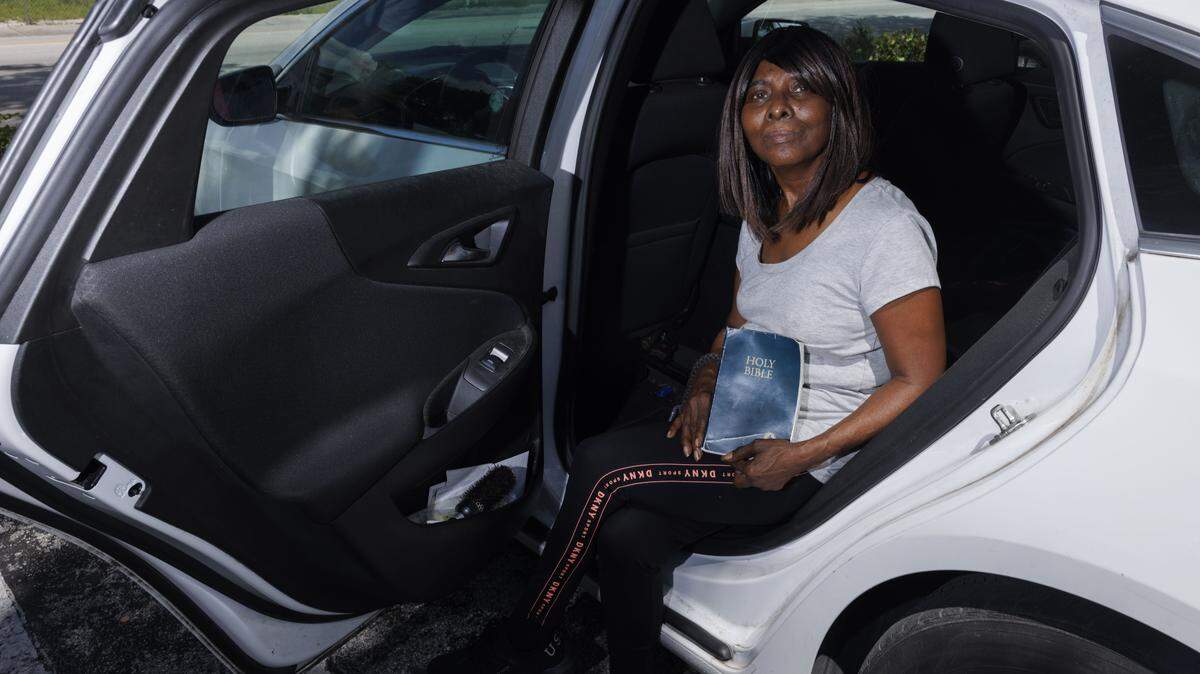
A few days ago, I read about the plight of Shirley Phinzee, who is homeless.
The headline said: “More than half of Miamians can barely make ends meet.” Phinzee, 63, although she works full time, is one of them. She makes $16 an hour — $3 more than Florida’s minimum wage. Yet, she doesn’t make enough to keep a roof over her head. She sleeps in her car.
Phinzee, along with about 54 percent of Miami-Dade households, is what the United Way considers ALICE (asset-limited, income constrained, employed), or people who have jobs but earn too much to qualify for state assistance and who basically live from paycheck to paycheck. That’s the highest rate of Florida’s larger metro areas.
The article, written by Miami Herald reporter Max Klaver, doesn’t say how many residents, like Phinzee, are living out of their cars.
READ MORE: More than half of Miamians can barely make ends meet, new report finds
I knew things were bad financially when I bought a dozen eggs and paid twice the price that I was used to paying. I have only myself to feed, but I thought about the many families who cannot afford to spend $6 for a dozen eggs.
Even at that, I had no idea that for so many families, hard times and food shortages are very real. These hard times are coupled with the Trump Administration’s decision in March to cut $1 billion in federal programs that helped schools and food banks feed children and families in need. The cut came just days before the release of the Trump Administration’s “Make America Healthy Again” report, an analysis of the factors causing chronic disease in children, which included poor diet.
As a person who cares about the plight of others, I asked myself, What can I do to help make things better for people like Phinzee? Keeping a few dollars – at least enough for a meal – in my car to give to the homeless man or woman who cross my path seems like such a small gesture.
But I give anyway, praying that the money will make a difference, if only for a day, in the life of the person the Lord placed in my path.
Sometimes that person is a young Black man hanging out beneath the overpass near my neighborhood. Parked nearby is a grocery cart filled with his worldly processions.
Sometimes the person is a white guy, standing or sitting on the concrete median strip of a busy intersection, whose slumped body tells his story of defeat.
And sometimes it is the guy who is so dirty, and his clothes so raggedy, that it looks like he hasn’t had a bath or a change of clothes in a decade. Yet, it isn’t his physical body that disturbs me. What touches me the most is the look of despair in his eyes as he moves, aimlessly, on to a destination that only God knows where.
I have been criticized by some because of my small act of kindness to homeless people. Several people have told me they never give money to beggars. Rather, they will buy them a sandwich and give it to them. “They will just buy drugs with the money you give them” they tell me.
That could be true, I say to them. But if the Lord speaks to my heart and tells me to give to someone, I don’t worry about what the person does with the money. I give to the glory of God and trust Him to take care of the rest.
I’m glad that my conscience won’t let me listen to such people.
I realize that homeless people are not only men, but women and children who just might need more than a sandwich and a soft drink to get through the day. Women need personal hygiene products. Children need socks and school supplies and other necessities. And sometimes a few dollars will be just enough to get some of these items.
Phinzee’s story is a good example of how not everyone uses their money to buy drugs. According to the Herald article, she is among a growing number of workers, including childcare, healthcare and restaurant workers, who help to keep the city going. They, too, could wake up one day and find themselves living out of their cars, or simply living on the streets, sleeping on bus benches and bathing in a nearby McDonald’s or a gas station.
So, when I give, I also pray that my meager alms to these people will somehow make their day a little brighter. And give them hope in knowing that somebody cares about their plight.
Thinking about the homeless makes me think about myself, an elderly woman, living basically on a fixed income, having used my retirement to take care of my late mother. “Lord, that could be me,” I think.
I often take a deep look at my life, and I know that I would not have made it this far — not spiritually, not economically, not even physically — had it not been for the God I serve. I know it is my faith that helps me to know the Lord’s words are true, and that when He said He would supply all my needs, I can put my trust in His words.
Still, I know that not everyone has the same faith. I believe that is one reason the Bible tells us that we are our brothers’ keeper. Anyone of us could be Phinzee. All it takes is one bad thing to happen to us. Too often, as is in Phinzee’s case, that first bad thing can be followed by a series of bad things.
Reading about Phinzee’s plight helps me to be more thankful for my own status in life, to not take for granted, the blessings afforded me. Although I don’t live in a mansion, I know I am blessed to have a roof over my head.
It is a blessing to have my own private bathroom, where the water runs freely when I turn on the faucet.
I am blessed to be able to walk into my own kitchen, take out one or two of those expensive eggs and have scramble eggs for breakfast.
Some, like Phinzee, can’t share in these blessings and that makes me sad. I pray that one day they will. Right now, I will do what I can to make somebody’s life a bit brighter, a couple of dollars at a time. And pray. That’s something we all I can do.
.JPG "MIA_20231006AD0543BeaHines (6).JPG")