
People died getting voting rights for Black men and women. It’s why you need to vote | Opinion
As we get closer to Election Day — early voting begins Monday — I feel compelled to remind folks, especially young Black folks, how important it is to vote. I’m not here to tell you who to vote for; I just want you to vote.
I also want to remind everyone that once upon a time, African Americans — and white women, too — were denied the right to vote. (The 19th Amendment, ratified in 1920, finally granted women the right to vote.)
While the Fifteenth Amendment, ratified in 1870, extended the right to vote to men of all races, states and local governments found ways around the law, still forbidding African American men the right to vote. They used poll taxes, literacy tests, grandfather clauses and just plain old intimidation to deny African American men the right to vote.
Almost 100 years later, the Voting Rights Act of 1965 abolished these roadblocks to voting for Black men and women. But that changed in 2023, when the Supreme Court gutted one of the Act’s key provisions, that is, states that had a history of discrimination had to get federal approval of any changes to their voting policies. With that no longer in place, many states, including Florida, have enacted new laws restricting voting access, once again making it harder for Black men and women to vote.
The vote is powerful. That’s why people over the years have been willing to die for the right to vote. If I remember correctly, one of the very first Black martyrs to die for the right to vote was the Rev. George Lee, the first African American to register to vote since Reconstruction in Humphreys County, Mississippi, where Black people were in the majority.
While life for Blacks in America was never a bed of roses, the post-WWII 1950s was a dangerous time for African Americans in this country, especially in the Deep South.
Black veterans had come home from the war to face more of the same injustices. Their service to America didn’t matter at all in places like Belzoni, Mississippi, the home of the Belzoni Citizens’ Council. The group was made up of white men who were determined to suppress civil rights activism and maintain white supremacy through threats, violence and economic intimidation.
And Lee was considered an “Uppity N----” He had moved to Belzoni to preach, but soon became active in the local civil rights movement by urging fellow Blacks to register to vote and by co-founding the Belzoni branch of the NAACP.
Lee was shot and killed in Belzoni while driving home on the night of May 7, 1955. The gunshots ripped off the lower half of his face and Lee died before he could make it to the hospital.
READ MORE: May 7, 1955: Murder of Rev. George W. Lee
When Medgar Evers, then the field secretary for the Mississippi NAACP (who himself was later assassinated), investigated Lee’s death, the county sheriff denied that Lee had been murdered, saying he had died in a car accident and the lead bullets found in his jaw were dental fillings.
An investigation found evidence against two members of the Citizens’ Council, but when the local prosecutor resisted moving forward, the case stalled, never bringing justice to Lee’s murderers.
I tell this story because to me, it wasn’t that long ago. I was a teenager when Rev. Lee was murdered. Although I lived in a Jim Crow-era, like many of my peers, I looked forward to a future filled with equal opportunities. I had hope.
But with the murders of Lee, and later the killing of Medgar Evans in 1963 as his Jackson, Mississippi, home, the light of hope was beginning to dim for people who looked like me. It wasn’t a good time for us. But we kept the faith and kept on fighting and dying for our denied rights and freedoms.
By the time the 1960s rolled around, activists like the Rev. Dr. Martin Luther King Jr, John Lewis (who later became a noted U.S. congressman) Diane Nash, Fannie Lou Hamer, Ella Baker, Bob Moses, Stokely Carmichael, the Rev. Jessie Jackson and others had started a massive push for voter registration. They were joined with the National Association for the Advancement of Colored People (NAACP), the Student Nonviolent Coordinating Committee (SNCC), the Congress of Racial Equality (CORE) and other groups.
The turbulent 1960s saw many freedom fighters — mostly college students — arrested by police. Many were beaten, some were killed.
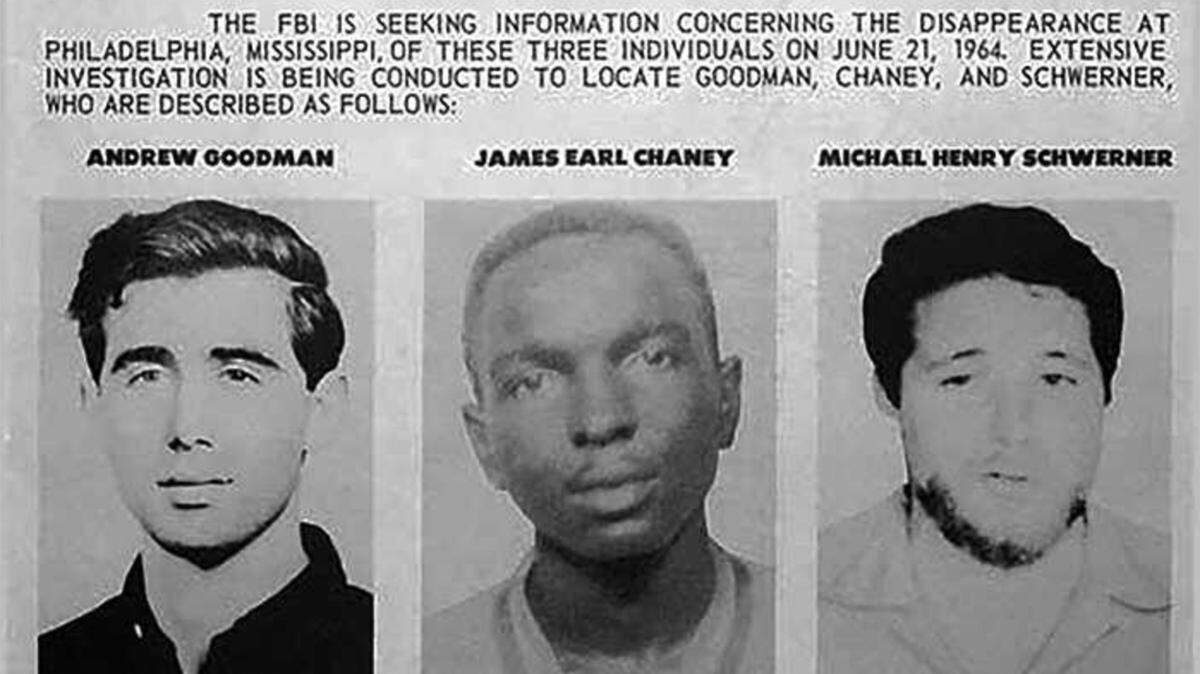
Among those killed were three young men working in the civil rights movement in and around Philadelphia, Mississippi — James Chaney, a 21-year-old Black CORE field worker from Mississippi; Michael Schwerner, a 24-year-old white CORE field worker from New York; and Andrew Goodman, a 20-year-old white Queens College student from New York City who had been training volunteers how to navigate the racism and violence they would encounter in Mississippi during the summer of 1964.
The three were murdered by members of the Mississippi Ku Klux Klan in June 1964 for simply registering Blacks to vote.
Six months before their murder, on Jan. 23, 1964, the 24th Amendment to the Constitution was ratified by the states, abolishing poll taxes on voters.
But that didn’t end the fight.
Still etched in my memory is March 7, 1965, when hundreds of protesters, led by a young John Lewis and the Rev. Hosea Williams, marched across the Edmund Pettus Bridge, leaving Selma, Alabama, on the way to Montgomery, Alabama’s capital, to demand voting rights for African Americans.
As they marched across the bridge, they were blocked by state troopers and other white men, who attacked the marchers with water hoses, attack dogs, clubs and tear gas. Some of the marchers, like Lewis, carried their scars to their graves. (A third march finally succeeded on March 21 with 1,000 military policeman and 2,000 U.S. Army troops protecting the protesters, who numbered roughly 25,000 people by the time they reached the Alabama State Capitol.)
On March 25, Viola Gregg Liuzzo, a white woman who the mother of five children, was murdered by a Ku Klux Klansman, who killed her as she drove to pick up another load of protesters.
These are not pretty stories. And it still hurts to remember and tell them again. But I tell them so we won’t forget.
I tell them, too, because I want to remind you what is at stake, if you don’t vote.