
State rep would hand control of Coconut Grove Playhouse to small town 18 miles away
In one of the most surprising twists in the long-running saga over the fate of the shuttered Coconut Grove Playhouse, a Florida state representative is trying to wrest control of the historic theater from Miami-Dade County and turn it over to ... the small town of Bay Harbor Islands.
The unusual proposal comes in a legislative bill filed this week by state Rep. Fabián Basabe, whose district includes Miami Beach and Bay Harbor but not Coconut Grove. The town of Bay Harbor, which has a population of about 6,000, sits some 18 miles northeast of the playhouse and the city of Miami’s Coconut Grove neighborhood.
In a news release that contains several apparent inaccuracies, Basabe said his aim is to ensure proper preservation and restoration of the 1927 playhouse, an important South Florida cultural and architectural landmark that has been closed since 2006.
Basabe’s bill suggests that Bay Harbor, known nationwide in part for its opposition to historic preservation, would provide better “stewardship” of the publicly owned Grove Playhouse than the county, which took control of the property in 2014 under a complex lease with the state in order to restore and reopen the rundown theater after the nonprofit that managed it failed financially.
It’s unclear, however, what practical effect Basabe’s bill would have, or how the small town of Bay Harbor would muster the resources or capacity to manage a planned restoration and new theater construction project miles away that’s expected to run into the tens of millions of dollars to complete.
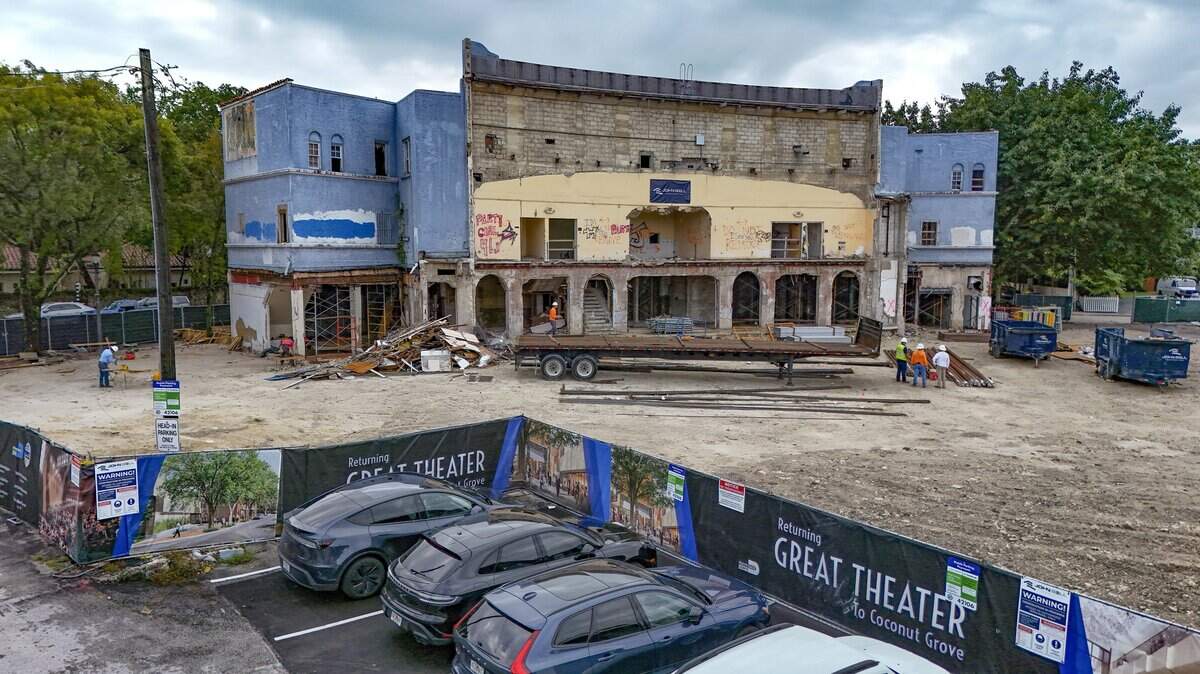
A county contractor recently finished tearing down the theater’s auditorium in preparation for construction of a new stand-alone, $23 million theater behind the playhouse’s historic but badly deteriorated front building, which would be fully restored as part of an ambitious, controversial plan to extensively revamp the property.
That plan was delayed for years by litigation from preservationists and legal and political tussles with Miami elected officials, including now former Mayor Francis Suarez, who tried to block demolition. But the county received needed city approvals and moved forward last year after trial and appellate courts ruled consistently in its favor.
Basabe declined requests by the Miami Herald for an interview, citing past unfavorable coverage by the newspaper, but answered some questions via email. He suggested the state, which has not exercised its authority to block or ask for significant changes in the county plan, needs to clamp down on the county, though he did not specify how. He said the bill does not seek to block progress on work or restore the demolished section.
“This bill isn’t about relitigating past lawsuits, second-guessing local permits, or undoing work that’s already been completed,” Basabe wrote. “It’s about legislative oversight and preservation enforcement for a state-owned historic property, and the state’s ongoing responsibilities under existing law.”
Basabe did not respond to questions about why he chose Bay Harbor.
“Bay Harbor Islands is referenced as a potential public stewardship or management partner within a framework that allows alternatives if existing arrangements fail to meet preservation and public-purpose obligations,” he wrote. “Bay Harbor, in my opinion, is a public entity that can be trusted as a neutral steward.”
In a brief phone call with the Herald, Bay Harbor Mayor Isaac Salver asked for an email outlining the topic. He did not respond to two emails on Wednesday and a voicemail message Thursday requesting an interview on the playhouse proposal.
Miami-Dade Commissioner Raquel Regalado, whose district includes the Grove and who has served as the county’s public point person for the playhouse project, dismissed Basabe’s bill as a “PR stunt” and said she found the Bay Harbor proposal perplexing. She said there is no legal basis and believes there is no political support for the bill, noting it has no Senate companion bill.
“I don’t know why that particular city. There is not even a nexus with the playhouse,” Regalado said, adding that she had met with Basabe to address his concerns. “I think he has an issue with this project, and he just wants to be in the news.”
Regalado also said state preservation officials have been routinely updated on progress on the county plan, and they toured the property and received a presentation on design plans last year, before demolition took place. They raised no objections, Regalado said.
A spokeswoman for the Florida Department of State, which oversees the state preservation program, did not respond to requests for clarification of officials’ position on the playhouse.
The county’s plan for the Coconut Grove Playhouse
Basabe’s bill arrives some six months after the county finally embarked on its plan to revamp the playhouse, once the leading producer of live theater in the region and widely considered an exemplar of 1920s Mediterranean-inspired architecture.
Preservationists have filed one more last-gasp challenge that seeks to block the county’s use of $15 million in bond proceeds to help pay for the project, alleging that the expenditure runs contrary to ballot language authorizing the cultural funding program that promised a “reconstruction” of the theater.
The judge in the case declined the plaintiffs’ request to block the partial demolition of the playhouse. The case is now set for trial in June, though the county has asked the judge to dismiss it.

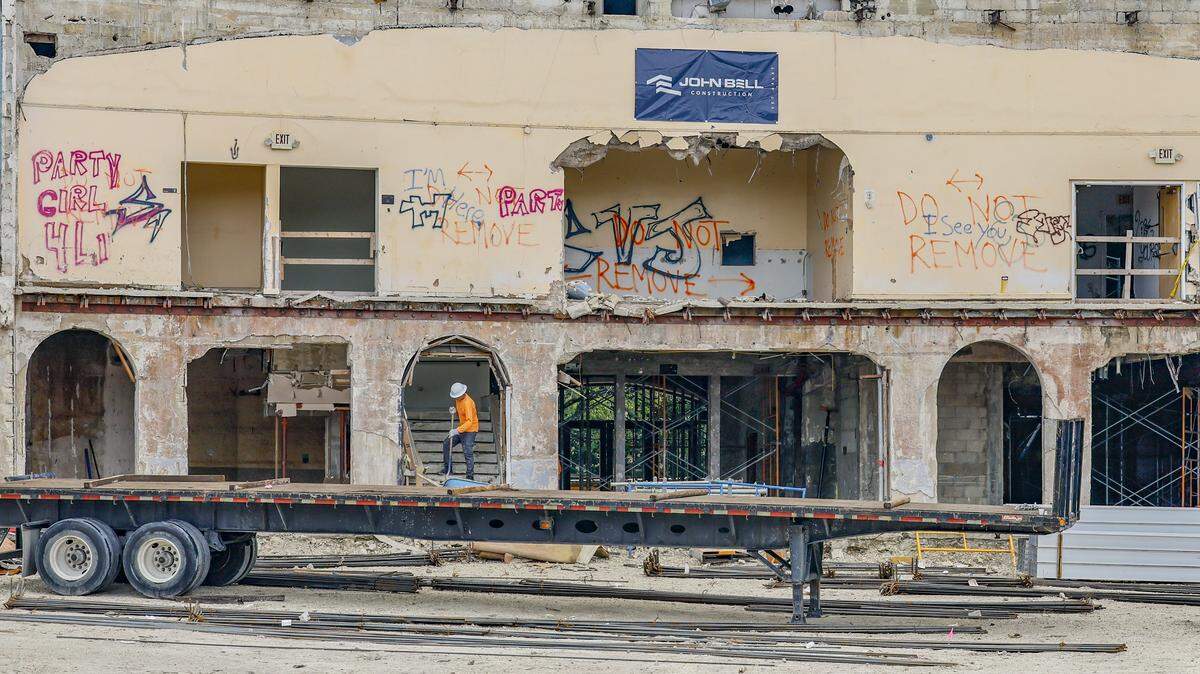
The county plan entails demolition of the playhouse’s auditorium, a job that has been completed, and replacement with a new stand-alone theater with significantly smaller capacity. Under that plan, the theater’s signature Mediterranean front building is to be fully restored. That three-story building has been stabilized with temporary supports since a portion of an interior ceiling caved in last summer during preparatory work. Final construction drawings for the new theater are done and will be submitted soon to the city building department, project officials say.
The city’s semi-autonomous parking authority, meanwhile, would build a new garage on the property’s surface lot. Revenue from the garage, which will include retail and office space, would help pay for the renovation of the front building and theater operations, to be managed by the GableStage theater company. The status of that portion of the plan is unclear.
County officials and consultants, noting that the nonprofit company formerly running the playhouse failed in large part because it could not fill its 1,100 seats, have said the planned 300-seat new theater will be far more financially and artistically sustainable.
Preservationists and some theater devotees had pressed for saving the entire theater, auditorium included, and a higher seating capacity, around 700 seats. They have also complained that planned commercial space amounts to turning the theater into a “mall.”
Basabe’s bill
Basabe cites a 2019 letter from state preservation officials who expressed concerns that planned changes to the playhouse could imperil its 2018 listing on the National Register of Historic Places, a mostly honorific list that confers no protections. That seven-year-old letter has long been a matter of public record. He also suggested that the officials have more recently expressed concerns about the state of the surviving front building but did not provide any documentation of those, asking the Herald to file a public records request.
Some assertions in his news release appear to be inaccurate. Basabe claims the county plan violates state and local preservation regulations because the city of Miami designated the entire structure as a protected historic landmark in 2005.
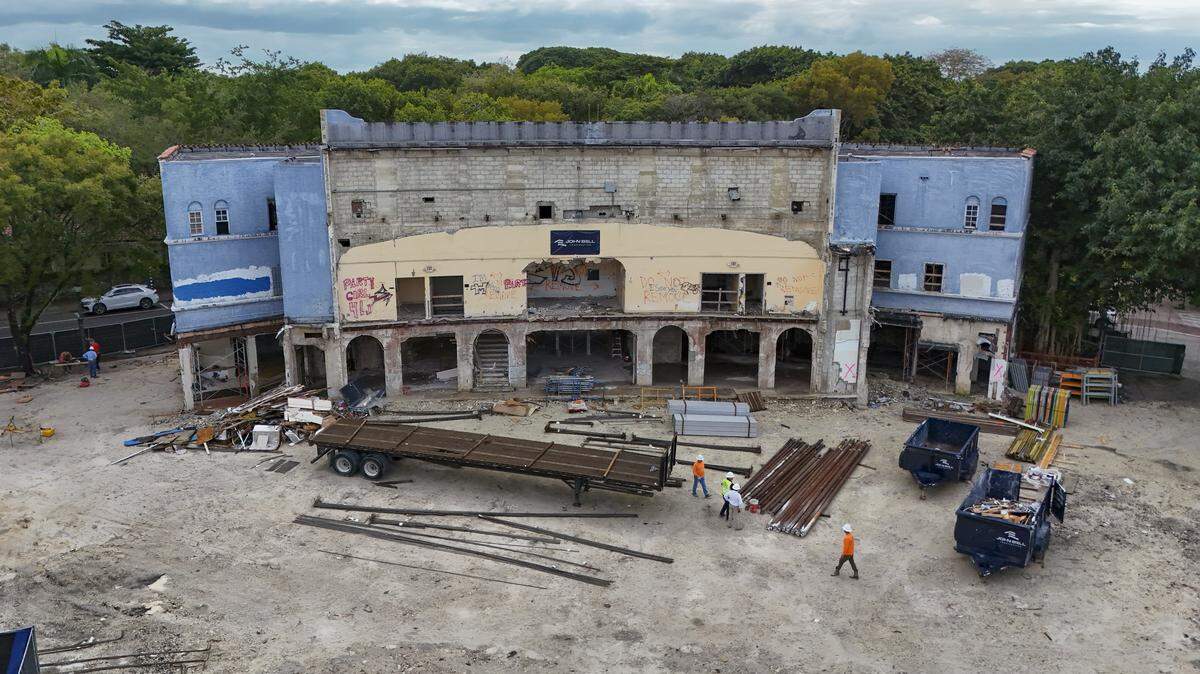
But in fact the inside — including the auditorium interior — was never included in the designation, only the front building and the building footprint, so that the city preservation board could retain a say in any future renovations. The city board, which has authority over designations and new construction on historic sites, ultimately approved the auditorium demolition after determining it wasn’t significant enough to save, a position upheld by court decisions.
Basabe also said Miami-Dade is violating “an active court order requiring demolition activity to halt until specific legal conditions are met.” But no such court order appears to exist. Regalado said there is none. Attorney David Winker, who has represented preservationists in several court complaints, including the pending case, said he knows of no such order.
Regalado said any interior demolition work now being done is to ready the front building for a planned structural reinforcement.
The Basabe bill calls for Bay Harbor to consult with the city of Miami and the state to develop “feasible and prudent alternatives to the demolition or alteration of the playhouse ... and on every renovation it plans to perform to protect the historic and cultural value of the property.”
It also calls for Bay Harbor to use “public funds and other funds reserved for the playhouse,” although the allocated money for the project is county funding, complemented by a Knight Foundation grant.
In his emailed response to questions, Basabe said the bill’s purpose — though not stated in the bill language — is to reassert state authority over the playhouse project. The state, as owner and landlord, bears ultimate responsibility for the theater’s fate, regardless of court, county or city decisions allowing the project to move forward, he argues.
“This Legislation is intended to force clarity and accountability by requiring the State to confront whether the lease is being complied with and whether enforcement action is required before further irreversible harm occurs,” he wrote. “It does not reopen old disputes or assign blame, but establishes a clear and lawful path forward that respects preservation law, court rulings, and the public trust.”
“The bill does not aim to reverse completed demolition, stop reinforcement work, or block a replacement theater,” he added. “The bill is meant to prompt active oversight going forward, not retroactive action. ... This legislation isn’t anti-theater, anti-county, or anti-city. It’s pro-process, pro-preservation, and focused on accountability for a state-owned historic asset.”