
Miami agrees to trim Coconut Grove’s peacock population, but it’s not an easy job
Quinton Glenn, a trapper in Miami-Dade, has captured a lot of peacocks in the past two years. The last bunch he took off a woman’s land in Coral Gables.
“They need to take them off the protected list,” he said. “They’re not from the area, and they have no natural predators. There’s more of them than iguanas.”
The city of Miami wants to remove some of the peafowl that run wild in Coconut Grove, especially in the Bay Heights neighborhood, where residents complain about the birds’ loud squawking, the poop they leave, the cars they scratch and the gardens they wreck.
The City Commission approved a management plan Feb. 13 to trap and remove “excess” peacocks and peahens. But removing them isn’t that easy. City and county laws prohibit trapping the birds, except under very limited circumstances, and Miami is designated a bird sanctuary.
In the case of Coconut Grove, that would mean removing no more than 10 percent of the flock, which has been estimated at 1,200-1,500 in that part of town, and finding a new home for them. And because peahens are in their nesting season, they can’t be removed before November.
Removing them is almost worse than the damage they inflict, Glenn said. Worse than iguanas. Worse than rats.
“It’s a workout trying to catch them,” Glenn said. Especially if you have to chase them with a net.
“You have to sneak up on them from behind a bush before the peacock “books it.””
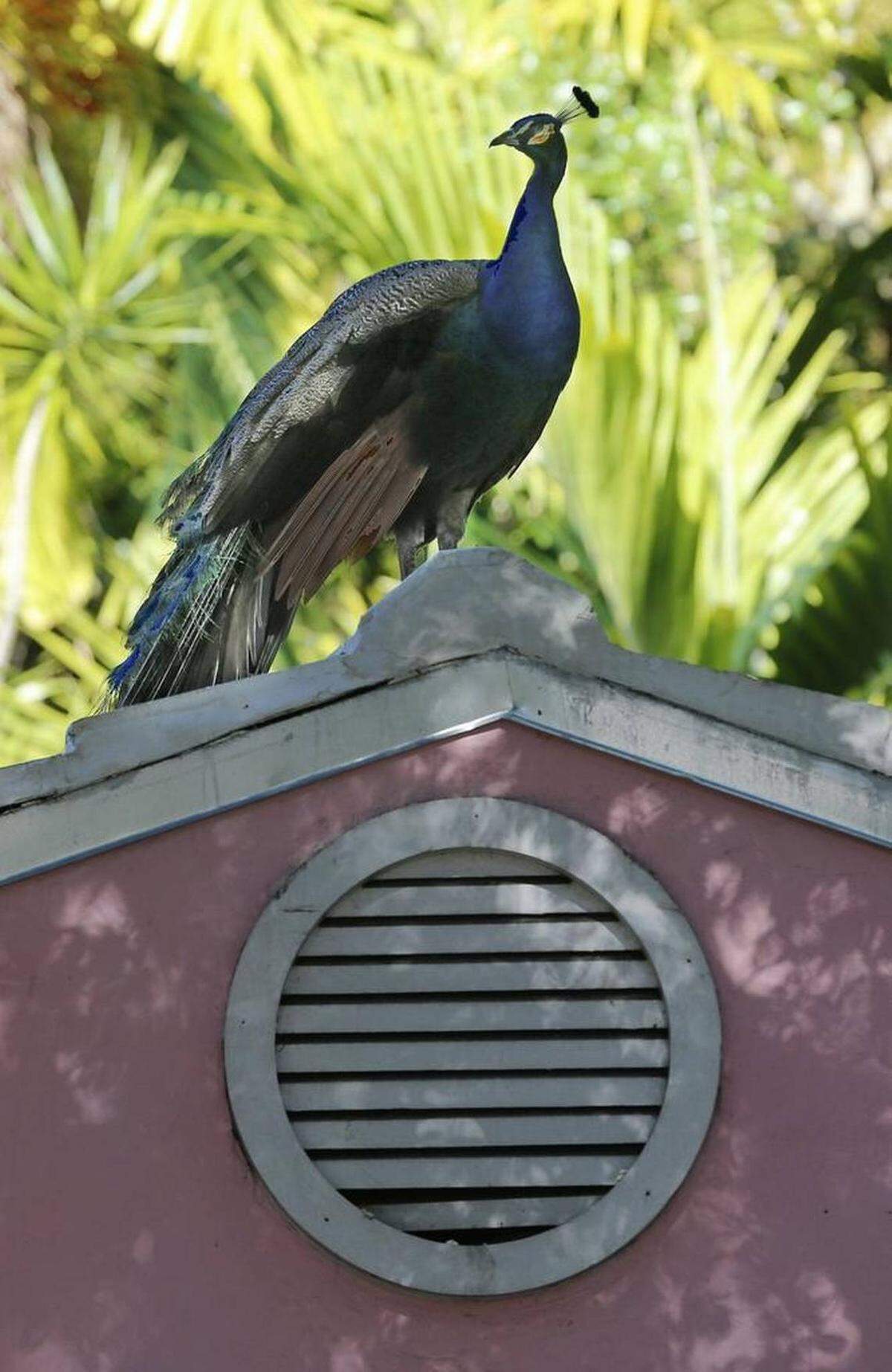
Usually Glenn uses a large cage baited with corn, wild bird seed or cat food. He places a mirror in the back of the cage and waits for the bird to wander into the cage.
The trapper runs into trouble, Glenn said, if the peacocks make distress calls for backup. Once, Glenn was chasing a peacock when a member of the bird’s posse came to its rescue and tried to attack Glenn.
“He was about to spur me, but I kicked him and he backed off a little.”
And sometimes he doesn’t catch them. That’s why he charges for the service, not the capture. Glenn said capturing a peacock is typically a $500 job when completed.
Most trappers deal with raccoons, iguanas, and other commonly found backyard pests in South Florida, but Glenn says he’s one of the few trappers in the county that deals with peacocks.
“Because of the difficulty of capturing the animal,” he explained,” you can charge a higher price.”
And Glenn works off commission.
People take ownership of the peacocks like they would a cat or dog, said another trapper, who asked that her name not be used. When trappers try to remove animals like ducks and peacocks, this trapper has seen residents wield machetes and go after the trapper’s pets, call the police, kick and scream.
“You need security to deal with the residents, they become so combative,” she said. “People make it such a negative and sometimes dangerous experience.”
“There’s not that many people that [trap peacocks],” Glenn laughed. “I know that I’m one of the main people that do this.”
Local laws require them either to euthanize the birds or find a sanctuary that will take the peacocks, they explained. Most sanctuaries are private, and “It’s already hard enough for them to feed the animals they have,” one trapper said.
In 2017, Animal Services offered to remove the birds if residents could find a safe, secure place to take them. But the city reached out to nine zoological societies in Florida and no one would take the birds.
But Commissioner Ken Russell disagrees that the city will have trouble finding a home for them. A wildlife sanctuary in California reached out to him on a Facebook post with interest in acquiring a few colorful friends as soon as the city passed the management plan.
And more requests for peacocks on the cheap flooded in as soon as the city passed the legislation. Russell’s office heard from wildlife sanctuaries around the country on Facebook, Nextdoor and through an influx of emails, he said.
The city wants to lessen the peafowl population using a humane management plan implemented by Rancho Palos Verdes, California in which excess peacocks are relocated to refugees where they can squawk, scream, and mate all night if they wish. Only the neighborhoods where the peacocks flock most densely will see any true change, he said.
“For some of the neighborhoods where it was out of control, the need to do something is urgent,” he said.
The Bay Heights neighborhood in the northernmost section of the Grove seems to have the most peacocks and the most problems with them. There are 60 to 80 of the birds in an area of 190 homes, one resident noted at the Feb. 13 meeting.
The peninsula at the north end of the Grove locks them in — two high walls, few predators and loyal peacock feeders have made the area a prime habitat for the large birds. Residents complain that their quality of life has significantly dropped as property damage and noise have increased.
The city’s plan is a humane solution for both the residents and the peacocks, Russell said.
The removal won’t start for a while because the city can only remove females between the months of November and February, when their chicks are not in their mothers’ nests, he said. Males could hypothetically be removed sooner.
Also, nothing can happen, Russell said, until Chris Baraloto, director of the International Center for Tropical Botany at the Kampong and an FIU botany professor, and his team of student interns finish their field study this spring or summer on the population size, density and habits of the colorfully festooned birds as well as residents’ attitudes toward and observations of the peacocks.
“This has got to be a scientific plan,” Russell said. “The No. 1 priority is the safety of the birds. We’re not trying to eradicate a population.”
Right now, the team is getting consistent headcount estimates of about 1,200 to 1,500 total peafowl across the Grove, Baraloto said. Bay Heights has a disproportionately large share of the birds, he said.
Russell and the city will hold community meetings to help ease this tension between the peacock lovers and those fed up with them by discussing what happens with the peacocks and answering residents’ questions.
He expects humane trappers will put their name in for the job once the city puts out a request for quotes. The relocations aren’t very expensive and the money for the removal will come out of the city’s general fund, he said.
.
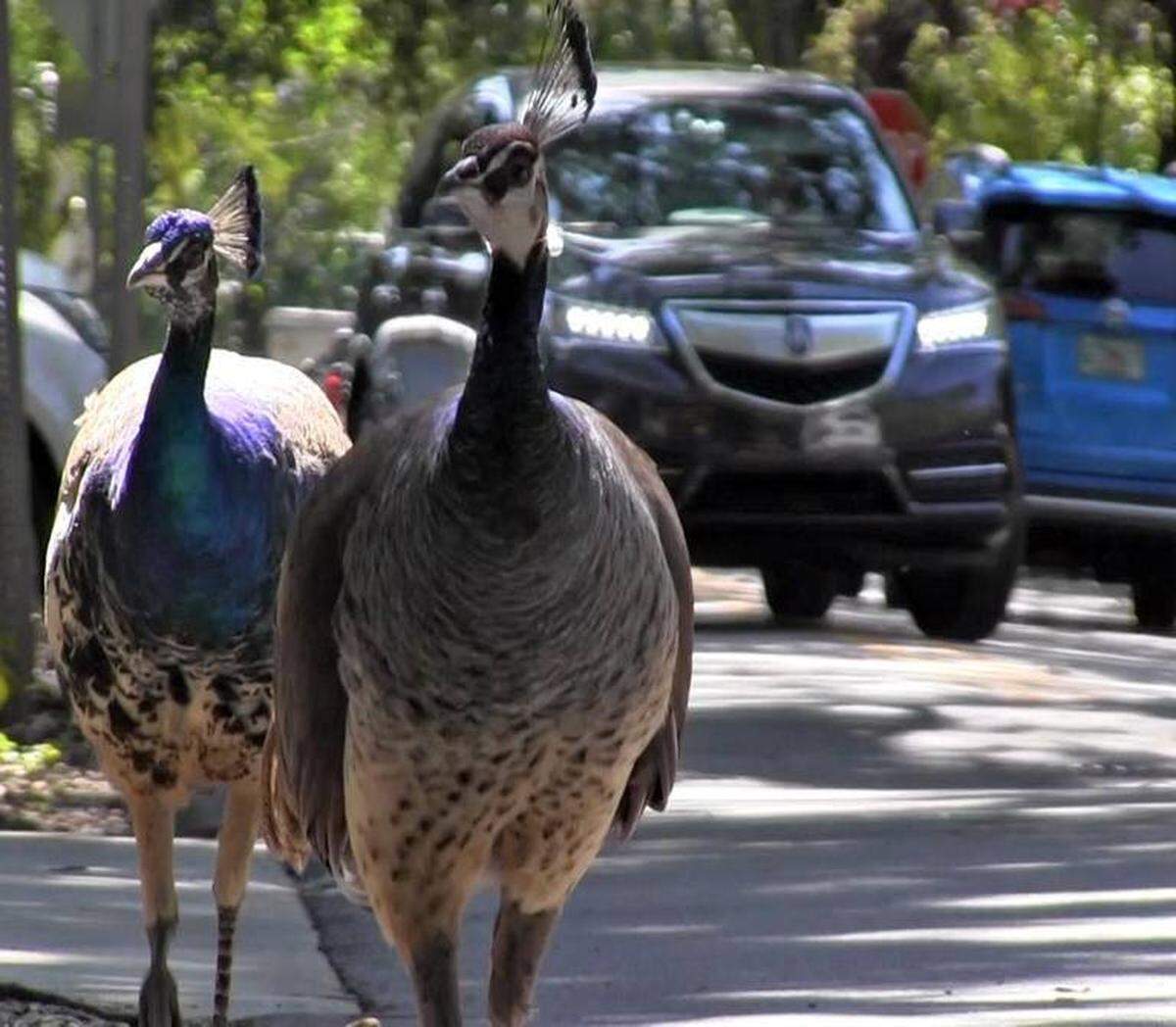
He even thinks the recipient might share part of the cost. One peacock farm owner in Iowa, Dennis Fett, said he has 24 people, besides him, who would like one or more of Miami’s peacocks.
‘I would take a dozen females right off the bat right now,” he said. “All we would have to do is put them in an express mail package and send them off to good homes.”
Fett, whose business is called “Mr. Peacock,” has worked with Rancho Palos Verdes, Ireland, Vancouver, Tampa and Miami on management plans to deal with the birds since the 1990s, he said.
Cities can create feeding stations to lure peacocks away from their properties and move them to a safe home, he explained. Some vote to remove them or residents illegally capture them. And some cities choose to flock in harmony with the peacocks.
Fett doesn’t think Miami’s plan to remove 10% of the birds will lessen the strain enough to last.
“I am almost 100% sure that unless every single bird is captured out of existence, this problem will never go away,” Fett said. “It will be ongoing for decades.”