
For disabled veterans, COVERT Adaptive Sports is therapy that works
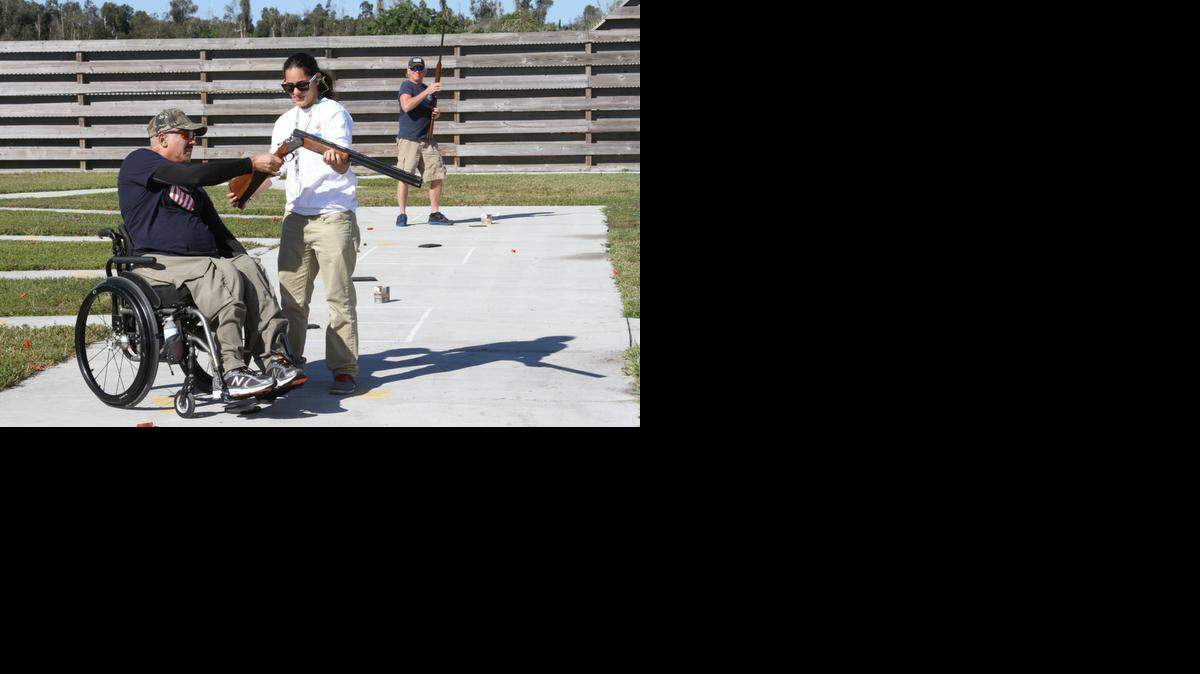
For disabled war veterans, the thought of playing sports may seem impossible, especially if suffering from post-traumatic stress disorder (PTSD), head traumas, amputations, spinal cord injuries or paralysis. Yet veterans like Brian Bohne, who says he’s “served all over” in his 15 years with the Army, and Francisco Abreu, a paraplegic who was stationed in Korea, want other disabled vets to know that adaptive sports — modified for people with disabilities — is a therapy that works.
A major hurdle exists though: extremely low turnout because of lack of knowledge from veterans about the programs.
Bohne travels from Fort Lauderdale and Abreu from Miami Gardens to Trail Glades, an outdoor rifle and shotgun shooting range in Southwest Miami. There, they unleash bullets and anxiety during trap shooting on Wednesdays, as part of Miami-Dade County Park’s adaptive sports program for disabled vets.
What Bohne likes about the program is being outside and around people. “When you’re retired, if you stay inside you’ll go crazy. I’m not going to sit inside and watch The View or anything,” he says.
Recently, Miami-Dade County’s Disability Services Division was granted nearly $23,000 from the U.S. Department of Veteran’s Affairs to expand and aid its COVERT program (Connecting the Outdoors with Veterans through Education, Recreation and Training). The goal is to promote lifelong mental and physical health through regular participation in adaptive sports. Last year’s grant came from U.S. Paralympics. The program is completely dependent on grants to operate.
Now, in its second year, COVERT helps local disabled veterans enjoy adaptive sports like archery, which begins in March, shooting (trap/air rifles/pistols), hand-cycling and swimming, which will begin in May.
The grant money will be used to purchase supplies like rounds of ammunition, shotgun rentals for vets, more hand-cycles, archery equipment, fund staff time and to keep the program running until Sept. 30, the end of the fiscal year.
Jody Cox, the head recreational therapist for the Disability Services department who oversees COVERT, works closely with therapists at Bruce Carter VA hospital in Miami as well as the Paralyzed Veterans Association, to recruit vets and get feedback on what sports they would like to participate in. Their interests led to the creation of COVERT and the four types of sports offered.
The program restarted in November and so far only has eight participants, compared to about 30 last year. Cox says for now, COVERT sports are only offered in South Dade, but she says that hand-cycling could possibly take place at other locations, like Crandon Park. For now though, it’s “whatever we have available that we’re able to do.” Transportation issues, distance and lack of knowledge about the program seem to be contributing factors for the low participation.
“With the war going on, we’ve seen an increase in disabled veterans coming back to the U.S.,” Disability Services manager Lucy Binhack says. “Sports help people with depression, post-traumatic stress disorder — whatever ails you, being active and healthy obviously helps. The returning veterans are very physical people, they want exciting things to do.
“The typical comments we hear are, ‘Wow, I had no idea this was here’ and ‘I had no idea I could do this.’ They’re surprised that after becoming disabled they can still participate in these enjoyable recreational activities,” she says.
Bohne and a county recreation leader, Candice Croes, 22, of Miami Gardens, exchange jiu-jitsu moves on each other, in slow motion, taking cues from each other. He doesn’t let his PTSD get the best of him and credits his active lifestyle as his outlet to relieve stress. In addition to working out in COVERT, he’s also a member at Valente Brothers Gracie Jiu-Jitsu in North Miami Beach and volunteers with Veterans Ocean Adventures, an organization that works with patients from the Miami VA Health Care System, to engage veterans in ocean sports like scuba diving, sailing and kayaking.
“These programs come so natural to them,” Croes said. “They’re so happy when they’re here. Look at Brian,” she points over to the tan, blond guy with a broad smile, “he’s like a kid. Look at that smile on his face!” When not assisting veterans with COVERT, she works at the county’s “out of school” sports and education program for kids with developmental disabilities, like Down syndrome and autism. “This is what they need,” she says as the echo from Bohne’s shotgun blast cracks through the sky and the pink clay disc explodes into pieces.
He scores just two points higher than Abreu during their first round of trap-shooting, hitting 19 clay discs out of 25. This is Bohne’s sixth time shooting at Trail Glades. He loves it so much that he even purchased his own Remington 12-gauge shotgun, though guns are available to rent at the range.
Abreu, who served in Korea for two years starting in 1974, used his Spanish Lanber over-under (one barrel on top, one on bottom) shotgun. This was his first time at Trail Glades. He hadn’t shot in more than two years. He reminisces on shooting doves in the sugarcane fields of his native Dominican Republic. “Whatever I kill, I eat. I’m kind of American in that way.”
The 61-year-old became paralyzed not from the war, but from a car accident in 1988 after he fell asleep at the wheel and crashed into a toll booth. He had been drinking at a bar before he drifted off. “Even one shot can mess you up,” Abreu says. He’s been in a wheelchair ever since. He takes full responsibility for what happened to him and says that he feels happiest when he’s doing volunteer work and helping other veterans.
“Sometimes you have a setback but this is therapy for us. If you have a strong mind you can be ready for anything that comes your way,” he says. In addition to trap-shooting, he also bowls, does archery and hand-cycling. He’s the sports director of Paralyzed Veterans Association of Florida, where he helps others learn how to hand-cycle.
Hand cycles, which have three wheels and sit low to the ground, are propelled by hands. People who’ve had any of their lower limbs amputated or if they’re paralyzed from the chest down, can build muscles in their arms and engage in friendly competition.
“We lost more veterans to suicide than combat,” says Bohne, who is open about his PTSD. “If I’m with these guys I don’t feel like I’m being judged. We understand one another. We don’t have to apologize for the way we are.”
What he likes best about the adaptive sports program: “The camaraderie is most important to me. Friendships are made, you’re outdoors, having fun — what could be better?”
If you go
▪ What: Trap Shooting at Trail Glades Shooting Range.
▪ Where: 17601 SW Eighth St., Miami.
▪ Time: 10 a.m. to noon Wednesdays, through February.
▪ What: Hand cycling.
▪ Where: Tropical Park, 7900 SW 40th St., Miami.
▪ Time: 10 a.m. to noon Tuesdays, through April 28.
▪ Information: Jody Cox, Miami-Dade Parks Disability Services Department / COVERT director at 305-234-1673 or jsantia@miamidade.gov.
This story was originally published February 5, 2015 at 2:57 PM with the headline "For disabled veterans, COVERT Adaptive Sports is therapy that works."