
Community policing touted as a way to improve relations with residents
Deidria Davis said the only time she really sees police officers in her Overtown neighborhood is when they are responding to a call — often, a shooting.
“We want to see more of them around,” Davis said Wednesday during a forum put on by Miami-Dade County’s Community Relations Board, meant to enhance trust and reduce tension between police and residents.
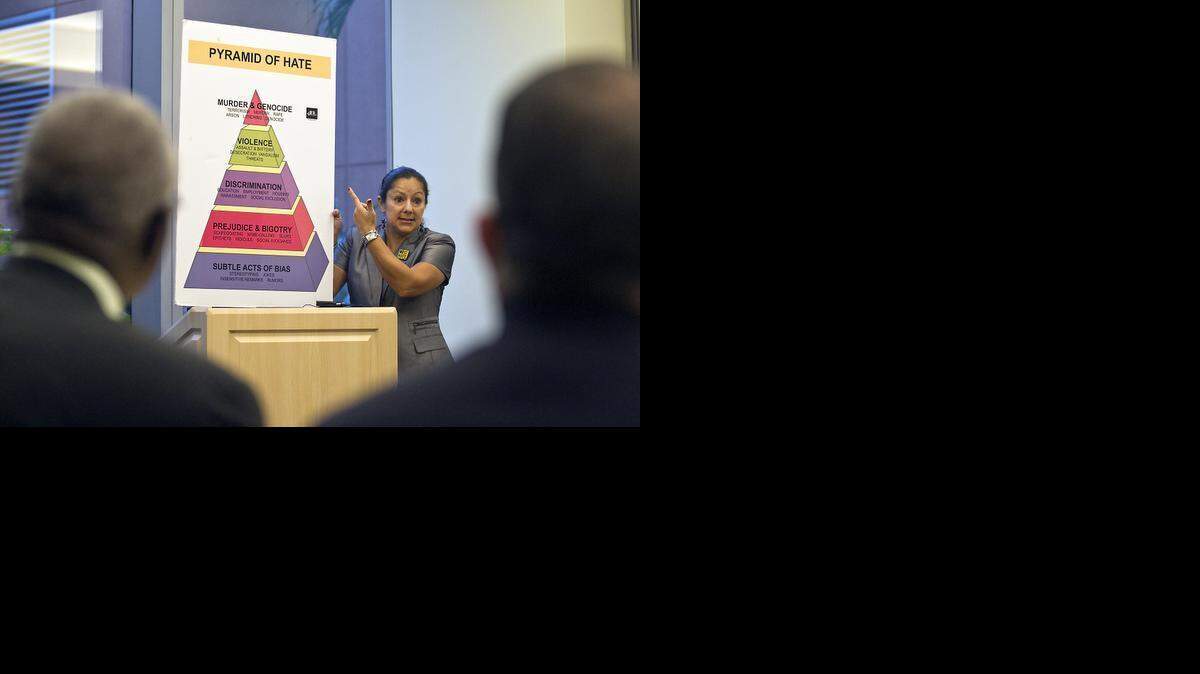
The meeting, held at the University of Miami Life Science and Technology Park, addressed what the board is calling the “most pressing community relations priority in Miami-Dade.” It is one in a series of five that will be used to develop better guidelines for police and community relationships.
“Information can cause transformation,” chairman Walter T. Richardson said after the three-hour session.
While some community members attended — airing concerns about the way police-involved shootings are handled and how victims are treated — there was an abundance of top brass from municipalities across the county, including Miami Beach, Key Biscayne, Miami-Dade and the city of Miami.
Rodolfo Llanes, the Miami Police Department’s new police chief, addressed Davis’ concerns, saying one of his goals is to beef up community policing, redeploying some the department’s nearly 1,100 officers to beats.
“The concept is to have more accountability,” he said, explaining that officers will be responsible for smaller slices of the city. “That way the residents know who to turn to when there is a problem.”
In the past few months, strained community relations gained visibility as locals joined a swell of demonstrations across the country denouncing police violence against African-Americans.
Dozens took to downtown Miami in December, blocking intersections and major thoroughfares during the crowded Art Basel festival, chanting “No justice, no peace” and “Hands up, don’t shoot.”
The protests emerged after a New York grand jury declined to indict a city police officer in the chokehold death of 43-year-old Eric Garner, and a Missouri grand jury decided not to indict former Ferguson police officer Darren Wilson in the shooting death of 18-year-old Michael Brown.
Recently, a group protested at North Miami Beach City Hall after learning the department had been using pictures of black men for sniper training. The city has since discontinued the practice and is using an outside agency to investigate.
North Miami Beach Deputy City Attorney Dotie Joseph addressed the issue at the hearing, saying the city “siezed the opportunity to address a lot of the issues” that had been discussed.
To go:
What: The Community Relations Board will hold two more forums on enhancing trust and reducing tensions between the police and the residents.
When and where: 5-8 p.m. Feb. 11 at North-Dade Regional Library, 2455 NW 183rd St. in Miami and from 5-8 p.m. Feb. 26 at West Kendall Regional Library, 10201 Hammocks Blvd., Miami.
For information: Contact the CRB at 305-375-1406 or CommunityRelations@miamidade.gov, or go to www.miamidade.gov/advocacy.
This story was originally published February 4, 2015 at 10:09 PM with the headline "Community policing touted as a way to improve relations with residents."