
Florida black bear hunt to go forward
Insisting the decision was not a “knee-jerk reaction” to a handful of recent black bear attacks in central and north Florida, the state’s wildlife agency decided Wednesday to proceed with re-opening bear hunting season following a 20-year closure.
The seven-member Fish and Wildlife Conservation Commission also agreed to begin developing rules prohibiting careless garbage disposal by residents in Florida’s bear country and allowing residents to take out nuisance bears when all other countermeasures have failed.
Public workshops will be held on the proposals before the commission’s April meeting in Tallahassee, and hunting season could be re-opened next fall.
“We have the responsibility to protect the citizens of our state and not have injury or death,” commission chairman Richard Corbett said.
Florida’s burgeoning bear population, which has sprung back from only a few hundred when the species was listed as threatened in the mid-1970s to an estimate of more than 3,000 now, has resulted in numerous conflicts between bears and people. Bear complaints have risen sharply over the past decade, and the species was removed from the “threatened” list in 2012. Following attacks on four women — three in Central Florida and one in the Panhandle since late 2013, none fatal — the FWC has stepped up its efforts to control nuisance bears.
Commissioners gave the nod to Thomas Eason, director of the division of habitat and species conservation, to use more aggressive measures — euthanizing repeated troublemakers and training residents to use paintball guns, slingshots and bear spray when necessary.
Eason said securing trash so bears don’t get in it and imposing penalties on the careless are just as important as opening a hunting season.
“We don’t think hunting is going to be the solution to conflicts,” Eason said. “We do see it as a tool to reduce the overall number of bears as appropriate.”
Commissioner Ron Bergeron of Weston was less eager than his colleagues to proceed with bear hunting. He proposed awaiting an updated statewide population assessment due in 2016.
“I’m not against hunting as long as the wildlife is sustainable,” Bergeron said.
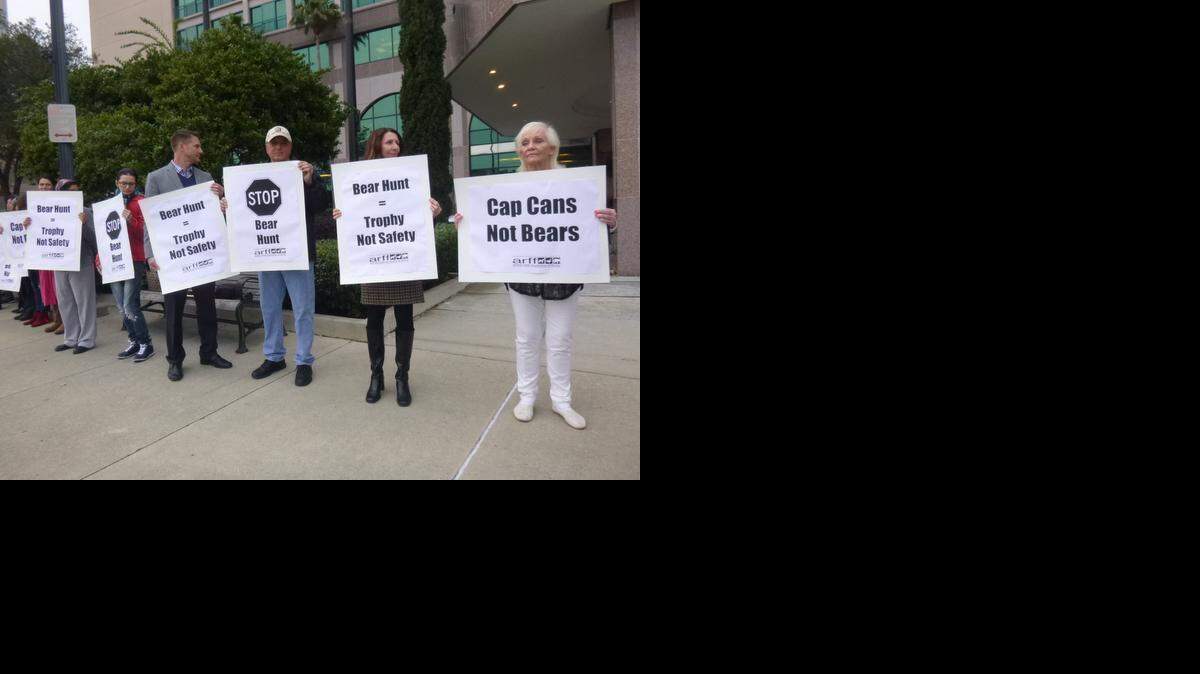
The commission decision followed a quiet morning protest demonstration by about 20 members of the Animal Rights Foundation of Florida outside the Jacksonville Hyatt Regency and nearly five hours of public testimony — split about evenly on the hunting issue — inside the packed meeting room.
“Because of the lack of hunting bears, we have at least five generations of bears that have no fear of humans,” said Tampa hunter Chuck Echenique. “Hunting will not solve the problem of nuisance bears, but hunting will instill a fear of humans into these animals.”
Countered Laura Bevan of the Tallahassee branch of the Humane Society of the U.S.: “Public safety is not going to be addressed by hunting. If we want to protect the public, we have to target the bears causing the problem. The science says garbage management and deterrents work. Opening the hunt is premature and potentially harmful.”
Commission vice-chair Brian Yablonski said the commission would move “conservatively forward” on preparing draft rules to allow hunting.
Initial staff recommendations include limiting hunting to areas where the bear population could sustain it; protecting females and cubs and any bear under 100 pounds; holding the season to one week in the fall; limiting the number of participants and charging $100 for Florida residents and $300 for non-residents; and prohibiting the use of dogs or attracting bears with feed.
But hunting rules likely will evolve over months of public workshops and commissioner input.
Said Yablonski: “I want to assure the public we have intent to have bears for future generations.”
This story was originally published February 4, 2015 at 6:45 PM with the headline "Florida black bear hunt to go forward."