
Fla. Gov. Rick Scott campaigns en español, drawing praise — and critics
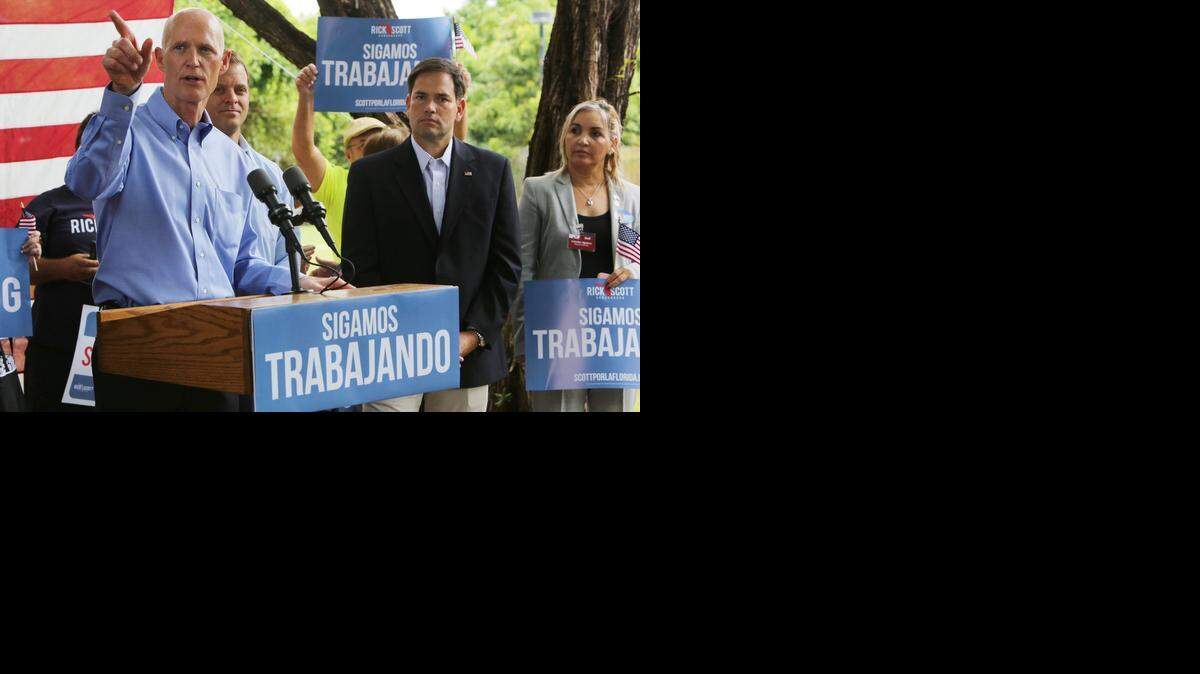
As the number of Hispanic voters across the country has grown, so has the number of gringo politicians who want to say something to them — in Spanish.
But Miami is not always a good place to come practice. So many locals are fluent that they can be merciless to those who mangle the language of Cervantes.
More than a few of those critics privately assailed Florida Gov. Rick Scott last week when he used his closing at a debate against Democratic rival Charlie Crist to deliver a halting paragraph — far beyond the usual cursory few words — in Spanish, a tongue the Republican governor concedes he has yet to master.
“Mi español no es perfecto,” Scott said Monday.
Yet Miami audiences can also be very forgiving. And plenty of people — namely Hispanic Republicans — have come to the defense of the governor, who is scheduled to participate in a third and final debate at 7 p.m. Tuesday on CNN.
At Monday’s GOP rally at the West Dade Regional Library, U.S. Rep. Mario Diaz-Balart of Miami praised Scott in Spanish as “a governor who is even learning to speak Spanish. So his opponent’s campaign criticizes him... because he speaks with an accent.”
“Our community is a community of diverse accents,” he continued. “We speak with an accent. But with a lot of pride.”
The pushback came because Crist’s running mate, Colombian-born Annette Taddeo, tweeted after last Wednesday’s debate about Scott: “Not again. If you don’t speak Spanish, don’t speak Spanish!”
Republicans reeling from “fangate” — the seven minutes Scott didn’t appear on the debate stage over a dispute about Crist’s portable fan — pounced on Taddeo’s remark. They accused her of dissuading people from learning Spanish, and briefly tried to get “languagegate” to become a post-debate talking point.
The next day, Taddeo said that the night before someone on her staff had “tweeted something I wouldn’t have said.”
“As you know, I struggled to learn English when I first came to the U.S. and now I run a translation business,” she wrote on Twitter. “I understand the work that goes into learning new languages, and I appreciate Gov. Scott’s trying to learn Spanish. I only wish he would put the same effort into caring about the issues that affect our community.”
That’s a key criticism of politicians who play the Spanish card: that deploying a few phrases doesn’t mean a candidate endorses policies to help Hispanics.
“It has to come across as authentic,” said Freddy Balsera, a Democratic political consultant in Miami who once wrote a television spot for Obama in Spanish. “In the case of Rick Scott, some people say it comes across as pandering because the politics of Rick Scott don’t line up with the Hispanic community.”
Scott backed legislation to crack down on illegal immigration styled after a similar controversial law in Arizona. He also didn’t push the Florida Legislature to expand Medicaid, which would particularly benefit uninsured Hispanics.
At the debates, Scott hardly got the greeting Republican President Ronald Reagan did in 1983, when he told an ecstatic crowd at the Dade County Auditorium, “¡Cuba sí, Castro no!” and concluded with what can only be described as a phrase in cowboy Spanish: “Vaya con Dios, amigo.”
But the governor has also managed — in two debates and his appearance in Miami on Monday — to avoid sticking his foot in his mouth. He may have fumbled his way through Spanish pronunciation, but his message of optimism and jobs has certainly been campaign-consultant tested.
The same couldn’t be said of Mitt Romney, when as a presidential candidate in 2007 he told the Miami-Dade County Republican Party, “¡Patria o muerte, venceremos!” — Fatherland or death, we shall overcome — the slogan Fidel Castro employed for decades to end speeches.
Scott’s spokespeople says the governor has been practicing Spanish since first recording advertisements for his 2010 campaign. He tries out phrases with a Hispanic staffer, and sometimes with Lieutenant Gov. Carlos Lopez-Cantera, a Miamian who has also polished his Spanish over the years, though it’s not as good as his English.
Scott’s efforts “should be lauded, not criticized,” Lopez-Cantera said Monday. “The question you should be asking is why hasn’t Charlie Crist learned to speak Spanish.”
Crist rarely ventures into Spanish, limiting his comments to a joke about how he studied the language for two years but never really learned it.
Lopez-Cantera has so far declined to debate Taddeo in her native español.
Many politicians are second- or third-generation Hispanics who never learned Spanish well at home — or first-generation immigrants who came to the U.S. at a young age from Latin America and lost their mother tongue. The U.S.-born Julián Castro, the former San Antonio mayor who’s now the U.S. housing and urban development secretary, and his twin brother, U.S. Rep. Joaquín Castro, are considered national rising stars in the Democratic Party despite not being fluent.
That’s far more difficult to do in South Florida, where political events routinely last twice as long as elsewhere in the state because most participants deliver remarks in English and then in Spanish. In cities such as Sweetwater, full discussions by commissioners have taken place entirely in Spanish. When Miami-Dade Mayor Carlos Gimenez gives big speeches, he sprinkles translations of key sentences throughout his remarks.
The Cuban-born Gimenez was once known by the Anglicized, ear-grating pronunciation of his name, “GEE-meh-nes,” instead of the correct “hee-MEH-nes.” He has deliberately practiced his Spanish with staff and family, and listened to the local news in the language, to improve, a spokesman said.
Balsera, the Democratic consultant, said the best Anglo politician to handle himself in both English and Spanish is another Miamian: potential Republican presidential contender and former Florida Gov. Jeb Bush, who is fluent and married to a Mexican-American woman.
“Jeb Bush is just brilliant the way he does it,” Balsera said. “He comes across culturally and emotionally as Hispanic.”
This story was originally published October 20, 2014 at 6:04 PM with the headline "Fla. Gov. Rick Scott campaigns en español, drawing praise — and critics."