
Land for Hialeah’s Underline could go to a campaign consultant in no-bid deal
A political fundraising consultant might secure a 99-year county development deal for a small plot of land under the Metrorail tracks that’s planned for Hialeah’s version of the Underline park.
Eileen Piñeiro, who has worked on multiple campaigns for local Republican candidates, including a current Miami-Dade commissioner, wants to build a 36-unit apartment building on a 1-acre lot bisected by elevated Metrorail tracks in Hialeah off of East Fourth Avenue.
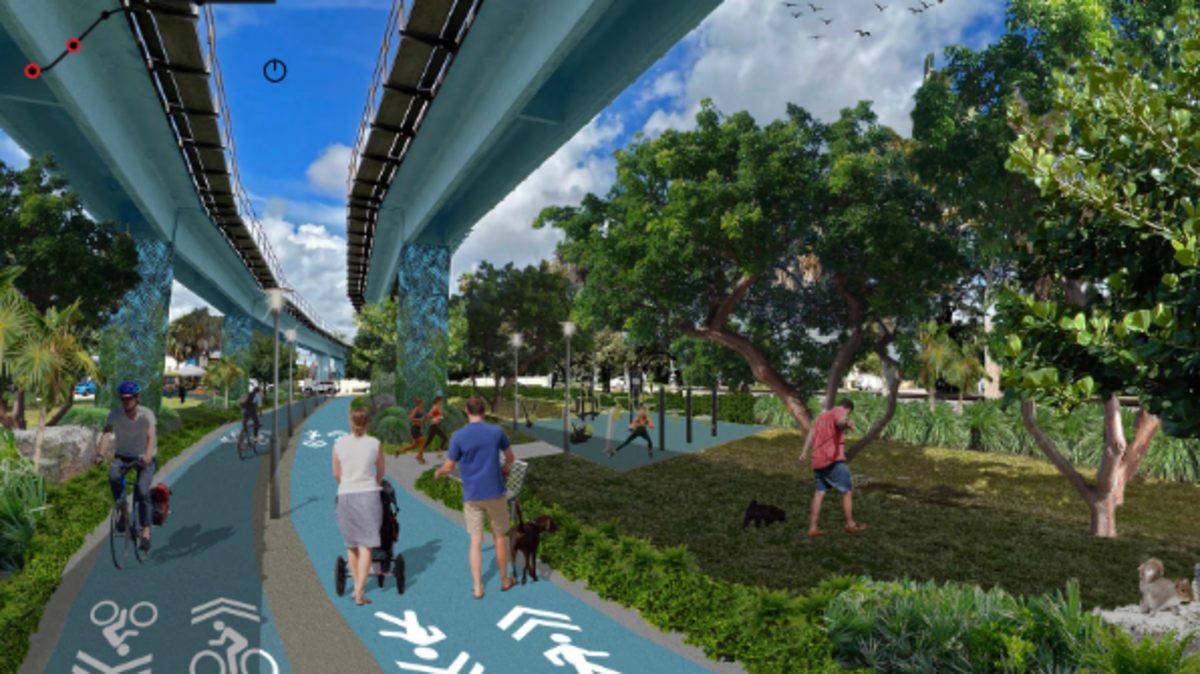
The county lot where Piñeiro’s Pine Development LLC wants to build a four-story building and a 46-space parking lot is also supposed to be the start of the Hia-Line. That’s a linear park that Hialeah wants to create on the narrow strip of land that runs for nearly a mile under the county’s Metrorail tracks between Fourth Avenue and the Hialeah Tri-Rail Station. A city presentation on the Hia-Line describes the county site as having “more than enough room for an inner-city park, holding the potential to transform and uplift the surrounding neighborhood.”
Hia-Line is modeled after the Underline, the 10-mile bike and jogging trail that will connect Metrorail’s Dadeland South and Brickell stations when construction finishes later this year.
The proposed county development agreement with Pine Development LLC requires the housing project to accommodate any future Hia-Line project on the lot.
“Tenant shall agree to join in the execution of any documents necessary to accomplish the planning, construction, implementation, operation and maintenance of the HIA-LINE project,” reads the draft lease up for a vote by Miami-Dade’s Housing Committee on Tuesday afternoon.
A Hialeah spokesperson said Thursday the city hadn’t been briefed on the potential construction on county land slated for the Hia-Line, which remains in the early planning stages.
“Any project of that nature should involve direct coordination with the City, especially if it has implications for the surrounding area or the future of the Hia-Line concept,” said Julio Ligorria, head of communications for Hialeah. “The City has concerns with any process that moves forward without direct engagement with Hialeah and its residents.”
In a statement Thursday afternoon, Pine Development said its plan would keep the bulk of the county site undeveloped and landscaped, allowing plenty of room for the Hia-Line to come through. “This project is not designed to eliminate green space,” the statement said.
Piñeiro’s Apex Strategies fundraising firm has done campaign work for local political leaders, including the former mayor of Hialeah, Esteban “Steve” Bovo, according to campaign-finance records. Bovo, who resigned his post last year to join a lobbying firm, was a political foe of Hialeah’s current mayor, Bryan Calvo.
Apex’s client list also includes Miami-Dade Commissioner Roberto Gonzalez, who does not sit on the Housing Committee, and Miguel Quintero, a candidate challenging Commissioner Marleine Bastien, who chairs the committee.
Quintero said his campaign no longer employs Apex. Gonzalez said Thursday he wasn’t aware of the proposed deal and hadn’t spoken to Piñeiro about the project.
A lawyer for Piñeiro said Thursday the project is a good way for Miami-Dade to turn barren land into extra housing supply for people who need it. He said that while Piñeiro is not a developer, she’s planning on bringing in people with experience building residential projects.
“The plan is to work with a reputable group — to partner up in some fashion — to build what we feel is much needed high-quality affordable and workforce housing in Miami-Dade County,” said Ryan Bailine, a land-use lawyer and lobbyist with Greenberg Traurig.
Piñeiro’s proposed apartment complex for older renters tries to capitalize on the planned park, naming the project the “Hialine Senior Living Center.”
The administration of Miami-Dade Mayor Daniella Levine Cava negotiated the deal with Pine Development and is recommending passage before the full County Commission. The deal lets Miami-Dade collect annual rent from the property starting at $37,000 and increasing 3% every year after that. If construction doesn’t start within five years, the lease is canceled.
While Piñeiro is the sole owner of Pine Development, the firm’s proposal cites other senior residential projects linked to what’s described as the development team. The proposal makes the case for Miami-Dade generating some revenue from unused land that’s mostly used by people parking illegally or dumping trash.
“Located in an underutilized section of the Metro Rail line, the Parcel provides a rare and unique opportunity for development, creating a neighborhood village around the public transport opportunities already in existence,” read the letter from Piñeiro that accompanied the June 5, 2023, proposal.
It first went to the county commissioner who was representing that part of Hialeah at the time, Kevin Cabrera, who left office in 2025 to become U.S. ambassador to Panama. Commissioner Natalie Milian Orbis took his place representing Miami-Dade’s District 6 and is sponsoring the legislation up for a vote next week.
Milian Orbis’ campaign did not employ Apex, and the commissioner released a statement about the project: “Housing solutions come in all shapes and sizes,” and smaller ones “can come online more quickly and begin serving residents sooner.”
Levine Cava’s office said in a statement Thursday that the proposal reflects “a development concept designed to address the site’s unique physical constraints while providing affordable housing. Multiple conditions must be satisfied before the lease becomes effective.”
While there are caps on the rents Pine Development can charge, they’re designed to be affordable for people making 20% more than the median income of $89,800 in Miami-Dade — a category known as “workforce housing” under Florida regulations.
That means a one-bedroom apartment could rent for about $3,000 a month under the current Miami-Dade cap, though Pine Development’s proposal said rents would be far cheaper, at about $1,400 a month. There are plans for retail on the first floor catering to the older residents living above, the proposal said.
“A development such as the one proposed in this location, will respond to the strong demand for quality housing by the community and be accessible to middle class elderly residents,” Piñeiro wrote in her 2023 letter introducing the proposal.