
Need help teaching your kid about technology? The Parent Club is here to help

Technology is evolving quickly — often faster than parents can keep up with, let alone teach their children how to safely navigate the digital landscape.
Many parents might feel overwhelmed, confused or unfamiliar with technology and media, especially when it comes to the right way to introduce and incorporate tech into their children’s lives.
From navigating AI to managing social-media use, families are facing new challenges every day.
“Especially in today’s digital world, where AI and online content play such a significant role in children’s lives, parents need support in navigating what their children consume online more than ever,” said James R. Haj, president and CEO of The Children’s Trust.
The trust wants parents to know they are not alone. The Miami-Dade government agency, funded by property taxes, invites families to join its Parent Club.
“The goal of Parent Club is for parents to have a place where they can come and learn, share and connect with one another about hot-topic issues,” said Katie Hart, director of the Center for Children and Families at FIU and director of the Children’s Trust Parent Club in partnership with FIU.
The Parent Club offers free, countywide workshops focused on relevant parenting topics and practical tools to help families thrive.

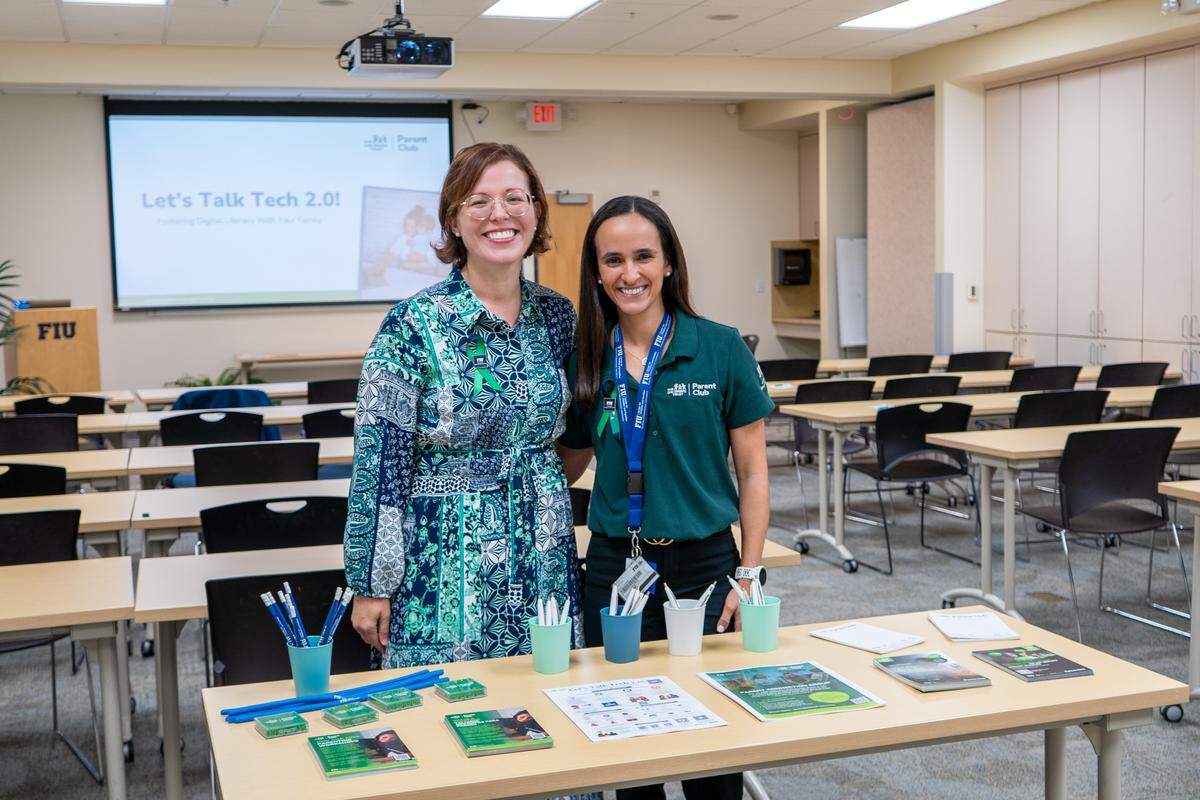
In recognition of National Children’s Mental Health Day on May 7, the Parent Club hosted Let’s Talk Tech 2.0 at the Center for Children and Families at FIU. The interactive workshop is designed to provide practical strategies for building healthy digital habits for all children.
“There’s a landscape that technology is evolving a lot faster than we can even keep up with,” said Carina Alvarez, a postdoctoral associate at FIU’s Center for Children and Families. “And many parents feel confused.”
Family media planning
Just like how you have to learn to read, you have to learn how to navigate technology, said Hart.
Digital literacy is how we think, interact and understand the digital world, but nowadays “the digital world is vast,” Hart said.
The digital world encompasses tablets, phones, smartwatches, TVs, computers as well as social media and AI.
A family media plan is something that parents can usually understand and apply easily, said Alvarez.
For example: What are your priorities around sleep? How important are school responsibilities? What does family dinner time look like? Is faith an important part of daily life?
Once families identify those values, they can build rules around them. That might include setting expectations for screen time, deciding on consequences and creating consistent routines at home.
It’s also important to talk through the plan with children, spouses or other caregivers ahead of time. Having clear expectations makes things more predictable. Children and adults, tend to do better with routines and consistency, said Alvarez.
A family media plan is something that Coral Gables mother of two Brooke Mullen has started to develop for her sons who are 4 and 9 years old.
Mullen has added more “quiet time,” which can entail more hands-on physical activities such as Lego building, so her kids don’t only rely on entertaining themselves with a device.
“That’s been really healthy for our family,” Mullen, who attended the Let’s Talk Tech 2.0 workshop said.
A common question that parents had at the workshop is how much screen time their kids should be having, but the answer isn't so black and white.
“It’s more so the quality and the content of what children are engaging with versus a specific number,” Alvarez said.
For parents who are thinking about getting their kids tablets for the first time, it’s important for them to pick “brain-building” content, Hart said.
“Back in the day, it was ‘Sesame Street’,” Hart said because the show has learning components, including letter and numbers of the day, and also teaches about social and emotional skills.
“Not all media that we have on the tablet or another device has that same type of quality,” Hart said.
Hart recommended for parents to look at Common Sense Media, a nonprofit organization that provides age-based ratings, reviews and educational resources for movies, TV shows, books, video games, apps and websites. Hart herself said she likes to watch “Bluey” with her kids.
The Parent Club recommends that parents hold off on buying kids their own devices until they are at least 3 years old.
Research continues to show that nothing can replace direct interaction between a child and a caregiver, Hart said.
The strongest predictor of healthy language and communication development is the “serve and return” interaction that children have with parents, grandparents, teachers and other caregivers, which is why families are encouraged to prioritize screen-free engagement during the early years whenever possible, she added.
“Sesame Street” and PBS Kids shows are often recommended because they are designed to support early learning and development. In contrast, growing concerns have emerged around constant exposure to fast-paced, short-form content, which might limit the development of attention span, impulse control and self-regulation skills that children need to succeed in school and everyday life.
The Parent Club also recommends apps such as Bark and Kidslox, which allow parents to set limits, monitor activity and help protect children from inappropriate online content or behaviors.
At the same time, Hart and Alvarez emphasize that parental modeling plays a critical role in shaping healthy technology habits. Caregivers are encouraged to be mindful of their own screen use, particularly around young children, who often notice when phones and notifications compete for their parents’ attention.
Hart and Alvarez caution that devices should not become substitutes for engagement, emotional regulation or caregiving. While technology can be a useful learning and entertainment tool, they warn that overreliance on screens as “pacifiers,” particularly for children with early behavioral challenges, might create additional difficulties for families over time. Instead, they encourage parents to build predictable routines and reinforce positive screen-use behaviors to support both child development and stronger parent-child relationships.
The Lets Talk Tech 2.0 workshop also addresses concerns such as cyberbullying, social comparison and the impact that social media can have on children’s mental health and behavior. The Parent Club encourages parents to watch for potential warning signs — including mood changes, shifts in eating habits or changes in how children interact online.
But Hart recognizes that technology can provide positive benefits, including creativity, social connection and supportive online communities.
The AI conversation
An easy way to start a conversation with your young child about AI is with a game, Alvarez said.
Common Sense Media has a game called “Two Truths & AI.”
“The game shows three movie posters — two real, one AI-generated. Your job? Find the fake. Look for clues like text errors, weird details, or things that just seem ... off,” the Common Sense Media website reads.
AI is new to kids, but it’s also new to parents, so the Parent Club encourages parents to research AI with their children.
“It’s embedded in so many different websites and apps,” Alvarez said. “It’s just learning what those are together and how the tools can provide very different things, depending on what you might like.”
Parents are keen on learning more about AI and how it will affect her kids.
“There needs to be some protection and some more due diligence around it,” Mullen, the Coral Gables mother of two, said.
Mullen worries that children using AI, especially to replace processes that require critical thinking, is a risk.
“If a computer does it all for you …, you’re missing those years and that time to develop those, you know, those fundamental skills.”
Hart says that early conversations between teachers, parents and children are essential to know how to navigate AI in education.
“AI is not perfect,” Hart said. “It’s communicating that also with your child, and fact-checking and look at different sources as well to provide more information.”