
In South Florida, English-only driver test leads to repeat failures, higher costs
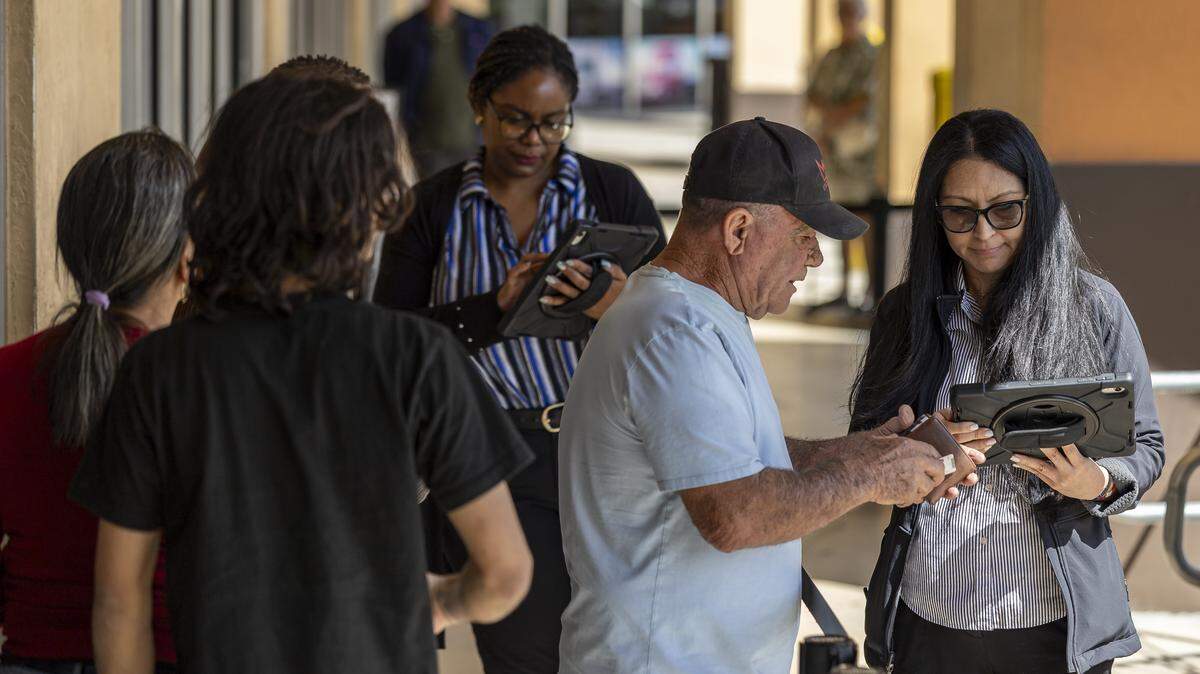
For years, driving school instructors in South Florida helped students learn the rules of the road in the language they understood best.
Now, many are teaching something else: how to survive a driver’s test in English.
Florida began requiring written and road tests to be administered in English only as of Feb. 6, ending access to written exams in other languages.
Across Miami-Dade, driving-school instructors say the change has turned the path to a license into a longer, more expensive and more stressful process for immigrants and other limited-English speakers who need to drive to work, buy groceries, take children to school and get to appointments.
For students, the written exam can come down to whether they recognize words like “left,” “right,” “traffic light” or “do not pass” quickly enough on a computer screen.
For instructors, it has created a new question: Are students getting to know the law, or just memorizing the terms they need to know to pass?
At Tri-County Traffic School in Hialeah, examiner and instructor Alina Díaz Massino said the week before the rule took effect showed how urgently people understood what was coming.
“Hundreds of people came to classes the week before Feb. 6,” Díaz said. “What does that tell you? That there are many more people out there without a license. They’re on the road illegally, endangering themselves and those around them.”
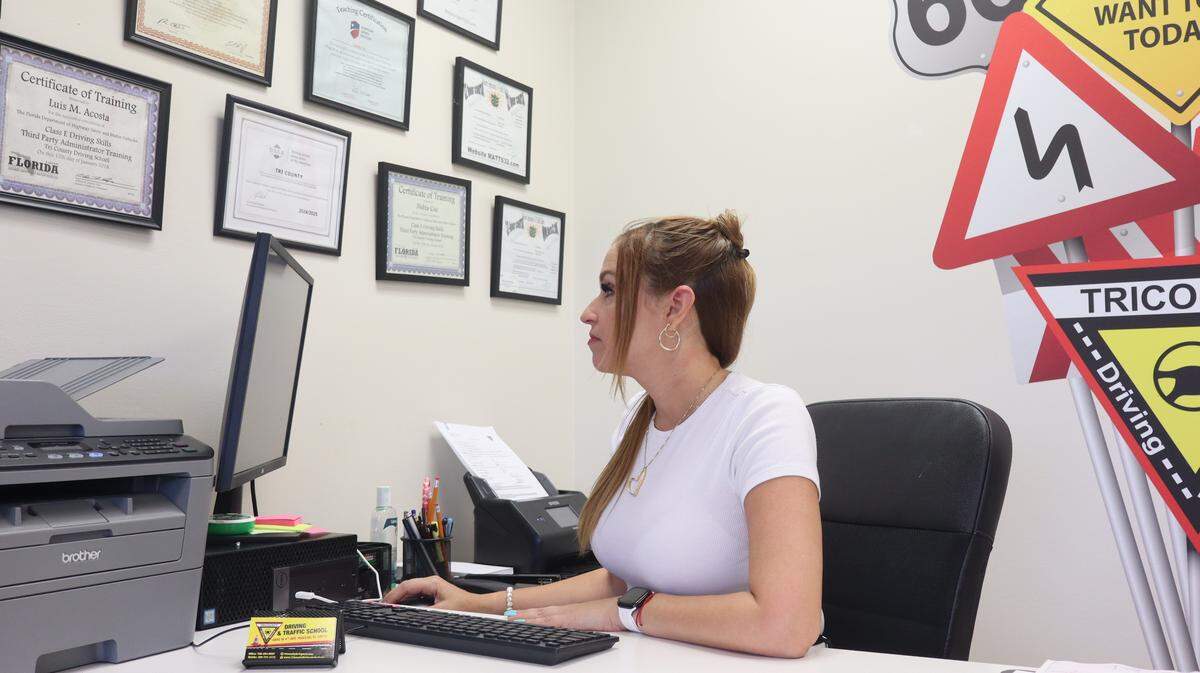
Before the rule changed, Díaz said, her classes focused on helping students understand Florida traffic laws, why they matter and what can happen when drivers ignore them. Most of that instruction happened in Spanish.
Now, she said, lessons often begin with translation and repetition of traffic terms in English.
A lesson about making a turn becomes a lesson about recognizing “left” and “right.” A lesson about traffic lights becomes a lesson about identifying words on the screen before the clock runs out. A lesson about pavement markings becomes a vocabulary drill on yellow lines, white lines, broken lines and solid lines.
Díaz now draws examples of what the test screen looks like, showing students where to click and how to move through the questions. She breaks down the driver handbook into keywords, distances and common phrases, trying to help students recognize what the computer is asking before time and nerves take over.
Students who once took two or three classes before passing the written exam now spend weeks or months preparing, she said. Some with a basic understanding of English have taken the test five or six times. Others have not passed since the rule took effect.
To get a driver’s license in Florida, residents must first score at least an 80% on the knowledge exam, taken on a computer. That is followed by the road test, a behind-the-wheel skills test. The tests can be taken at county- or state-operated driver license centers, but drivers can also take the exams at a state-approved private testing facility like Tri-County.
Students pay a set price for each exam at Tri-County — $160 for the written portion or $250 for the driving skills— and can attend as many classes as they need until they pass. But Díaz said the issue is not just cost, but time, pressure — and the fear that students are passing because they memorized English phrases, not because they fully understand the law.
Many students already know how to drive and held licenses in their home countries, she said.
“They can drive perfectly,” Díaz said. “They just can’t take the exam in English.”
That was the case for Rafael Pérez, 39, who moved from the Dominican Republic to Miami a little over a year ago.
Pérez had a license in his home country. In Miami, he said, the real challenge was reading in English quickly enough to answer questions on a timed computer test. Perez describes his English as “basic-level.”
He studied for about a month. He went to the school, took the test, failed, returned home, studied again and went back. Each time, he tried to remember the questions he missed.
He failed seven times before passing on his eighth attempt.
For Pérez, getting a license is tied to work. Back home, he worked as a mechanic, but he has struggled to find work in his field because he does not yet have work history in the United States. For now, he gets around by bicycle and works at a warehouse near his home in Hialeah.
Still, the hope of getting a better job pushed him to keep trying to pass both the written and the knowledge and the skills test.
“Every time I went, I memorized the new questions that came out on the computer,” Pérez said in Spanish. “If I failed one, I would say, ‘OK, this one says I can’t pass here,’ or, ‘this one says I can’t turn left.’ Then I would go home and write it down so I wouldn’t forget.”
Pérez said he would spend hours reviewing the questions. Once, he stayed at the school the entire day, reading, studying and practicing while instructors encouraged him to keep going.
The process became a cycle: take the test, remember the words that confused him, write them down, return to the guide and try again.
The hardest part, he said, was when the test gave him long paragraphs in English.
“If I read too much, the time runs out,” Pérez said. “That is the biggest challenge on the computer.”
Pérez said he knows some English, but not enough to read quickly under pressure. He could recognize some questions when he saw them, even if he could not pronounce the words out loud.
“I’m not perfect in English,” he said. “But if I see it on the computer, I can tell you what the question is.”
Deborah Pino, 22, moved from Cuba to Miami eight months ago. She had received a license in Cuba when she was 21, but said she had not driven much. In Miami, she waited until her immigration paperwork allowed her to take the exam.
She first studied alone at home using a question-and-answer guide. She took the exam twice and failed both times. The guide helped, she said, but it could not include every question that might appear on the test.
The difference came when she went to the driving school in person and reviewed the test with instructors. Sitting with them, she said, helped her understand how to approach the exam — not just by studying the rules, but by learning how those rules might appear in English.
She passed on her fourth attempt.
“When you don’t know the language, it’s complicated,” Pino said in Spanish.
Pino used Google Translate and memorized keywords: right, left, traffic light, turn. She learned enough, she said, to understand what the question was asking.
Pino sais she understands that immigrants in the United States should learn English. She also understands that drivers need to read signs and know traffic rules. But Florida’s change doing away with the driver tests in Spanish, she said, felt abrupt in a state where so many people speak Spanish or have just arrived.
“The important thing is that I know the traffic laws,” Pino said. “That I know I can’t cross a yellow line, that I know when I can’t change lanes.”
Pino lived in Madrid for nine years, where public transportation made it possible to live without a car. Miami, she said, is different. Even a trip to the nearest grocery store, 10 blocks from her home, becomes difficult without a car.
“In Miami, cars are your feet,” Pino said. “If you don’t have a car, you don’t have independence.”
At Amigos Driving School in Miami, instructor Lolien Valdez said the English-only requirement has increased the number of hours many students need to prepare, making the process more expensive for older adults and recent immigrants who may already be balancing work, family responsibilities and limited income.
“A person who used to have a set budget to learn how to drive now has to pay more,” Valdez said. “They need more hours because it is more complicated. They have to learn the skill of driving and understand the language.”
At Amigos, the cost can grow with each additional hour of preparation. The school lists several course prices, including $50 for the four-hour first-time driver course, $80 for a six-hour driver education traffic safety course, $100 for a six-hour driver education package and $150 for a six-hour package with practice. Other driver improvement courses range from $100 to $150.
For students struggling to pass the written exam in English, the language barrier can also become a financial burden.
Valdez said the rule has changed not only how long students study, but how they arrive to class. Some come in already afraid, she said, worried they will fail before they even sit in front of the computer.
The work of teaching has changed, too. Instructors are no longer only explaining traffic laws. They are helping students slow down questions, isolate familiar words and connect English terms back to rules they may already understand in Spanish.
The result, Valdez said, is a longer and more anxious path to a license.
Daniel Delgado, an examiner at Amigos, saw that fear turn into urgency the week before the English-only requirement began. That week, he said, the school completed nearly 200 driving exams as people rushed to get licensed before the change.
Afterward, he said, the school emptied out again.
“I did four exams today,” Delgado said. “That tells you there are a lot of people who are not coming because they are afraid.”
The Florida Department of Highway Safety and Motor Vehicles did not immediately respond to questions about how the rule has affected pass rates, retakes or exam volume in Miami-Dade County.
At Margarita Driving School in West Miami, manager Margarita Cardentey said the decline in students has already affected her business. She said she has had to tell some employees not to come in because there are not enough students. After the immediate February rush, she said, people who don’t trust themselves to pass the tests in English are too afraid to try at all.
The rule has forced her to rewrite how she teaches. She still explains road signs, pavement markings, school zones, emergency vehicles and safety rules in Spanish because that is how many of her students truly understand the information. Then she teaches them how those ideas may appear in English on the exam.
“I don’t think this is really meeting the objective” of the class, Cardentey said, because instructors have to reduce the lessons so students learn “the most important words.”
Cardentey said remembering the right words may help some students pass, but it does not replace understanding the rules of the road.
“It is memorizing,” she said. “It is mostly a photographic memory of the words.”