Florida anti-DEI law will end public funding for Haitian Heritage Month, other events
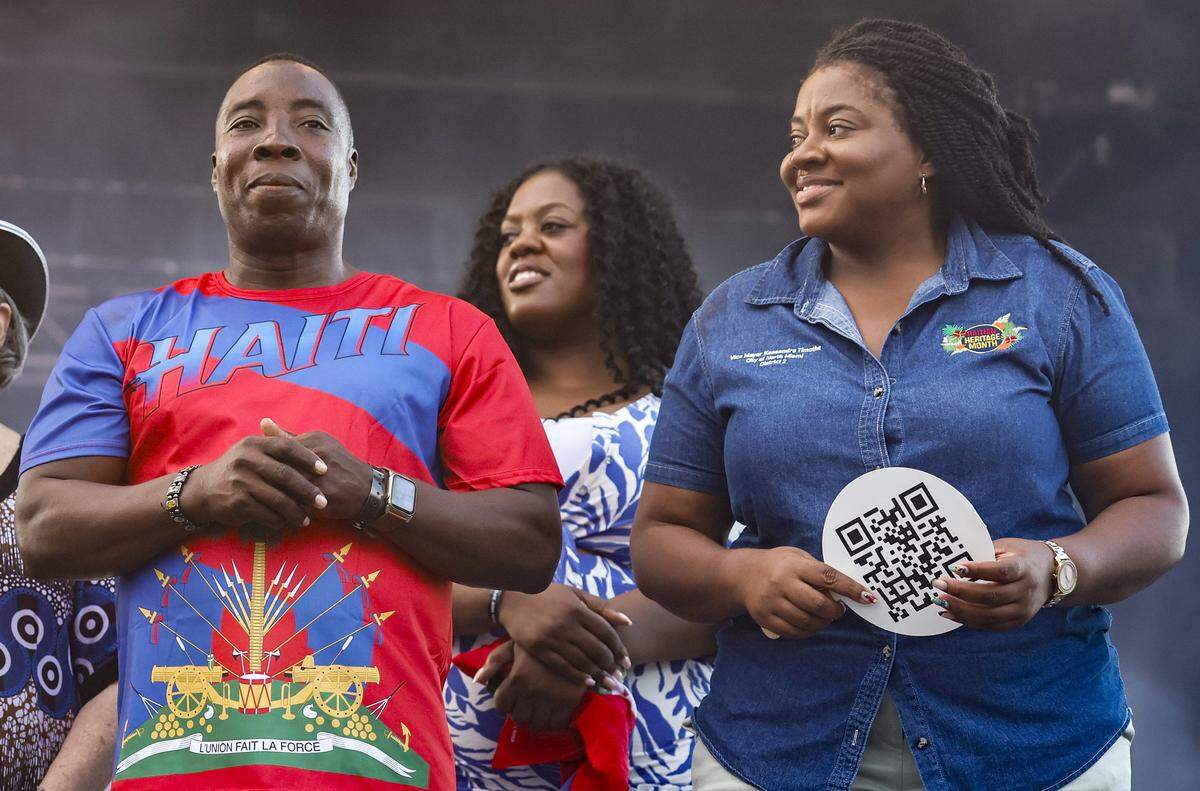
On the first day of this month, well-heeled members of South Florida’s Haitian community gathered under a colorfully decorated tent in the sweltering heat in North Miami-Dade County, enjoying rum punch and conch while dancing to Konpa and Haitian roots music.
In the audience was a who’s-who of South Florida’s diverse community that mingled with local politicians, including Miami-Dade County Mayor Daniella Levine Cava, County Commissioner Keon Hardemon and County Commissioner Marleine Bastien, whose office sponsored the opening reception celebrating her native Haiti’s culture and cuisine.
Three weeks later, Levine Cava and Bastien were back on the celebration trail, joining North Miami leaders at the 28th Annual Haitian Compas Festival, where the mayor delighted the crowd by declaring, “This is the best party in town.” Two days later, city officials hosted another celebration, this one marking May 18, Haitian Flag Day.
For nearly two decades, local governments across Miami-Dade and Broward counties have funneled hundreds of thousands of taxpayer dollars from their budgets and discretionary funds to support concerts, receptions and festivals celebrating Haitian Heritage Month, a fixture in May.
Now, local officials fear a new state law aimed at eliminating diversity, equity and inclusion initiatives could bring many public celebrations to an end.
Beginning Jan. 1, a new law takes effect barring elected officials from using public funds for cultural events not tied to a state or federal holiday. The law grew out of State Senate Bill 1134, which “prohibits counties and municipalities from funding, promoting, or implementing diversity, equity and inclusion (DEI) initiatives” and affects money promoting events like Haitian Heritage Month and LGBTQ events. Local officials who are found to have violated the law are subject to removal from office.

While critics say the law is vague, confusing and the latest example of Gov. Ron DeSantis’ cultural war, the governor and the law’s sponsor disagree. As DeSantis signed the legislation into law last month in Jacksonville, he said it limits “discriminatory DEI mandates on Floridians.”
Sen. Clay Yarborough, a Jacksonville Republican, also dismissed critics, specifically citing Broward County as he championed the law. The county, he said, had awarded $2.8 million in cultural grants on the basis of DEI criteria, and that the county makes intentional efforts to fund DEI-oriented programs. Though federally recognized observations such as Black History Month, Jewish American Heritage Month and Hispanic Heritage Month are exempt, the impact is broader than Haitian Heritage Month, which grew out of the May 18 Haitian Flag Day celebration and is a local initiative.
The broader effect is on programs, events and activities that fall under so-called DEI-related initiatives at the local level. That means offices and observances tied to diversity, equity, and inclusion efforts, such as Miami Dade Black Affairs initiatives, Women’s History Month programming, and a wide range of cultural and heritage related programming across Florida.
‘This is the last year’
Local governments say they are consulting with attorneys while trying to figure out how to make adjustments.
On Monday, the uncertainty — and prospect of removal from office — led North Miami Mayor Alix Desulme to warn a crowd gathered for Haitian Flag Day that “this is the last year” the city would sponsor the event.
Because of the new law, Desulme said, “this will be one of the events that we would no longer do — celebrating our culture. Again, we are going to enjoy ourselves tonight. We’re going to celebrate our culture, our flag.”
The announcement was met with boos, which in turn led fellow North Miami City Commissioner Kevin Burns to tell the crowd gathered at the Museum of Contemporary Art Plaza that “elections have consequences.”
In an interview before the announcement, Desulme said the law “really affects us as a local government, celebrating the culture of who we are.”

In addition to funding Haitian Flag Day, the North Miami Community Redevelopment Agency provided a $1.2 million grant to NoMi Village, Kate Murphy, the city’s communication director said. The money went to revitalize the complex, she said, which “was able to attract the Compas festival to the NoMi Village grounds.”
According to the latest U.S. Census, North Miami has an estimated population of 60,884 residents, with more than half of the population identifying as Black and being foreign-born. Within those statics is a Haitian population that makes the city the largest Haitian-American run municipality in the United States, with the majority of the council born in Haiti.
The city’s population is also 34 percent Hispanic, 16.5 percent white, 1 percent Asian and 22 percent who identify as multicultural.
Former North Miami Mayor Andre Pierre, who attended the Haitian Flag Day, along with local officials from Miami Gardens and North Miami Beach, was adamant that “this is not the last Haitian Flag Day celebration.”
“This is the last city of North Miami sponsored Haitian Flag Day celebration, but we will continue to have flag day celebrations every year in the city of North Miami,” he told the Miami Herald.
“We have many developers, we have many friends, we have many families who want to sponsor this event and this event will continue regardless of what the governor, the state, the county, the cities are doing,” he said. “May 18, 2027, we will be back here again.”
Like Burns, Pierre repeated: Elections have consequences. The new law underscores the need for “us to educate the voters about the people who are running for office,” he added.
“A lot of times, we don’t listen to what the politicians, the candidates are saying to us,” he said. “Sometimes they tell us exactly what they are going to do; if they tell you exactly what they are going to do then you come out and vote for them, you shouldn’t be surprised. We need to do better about informing out community about the people, the candidates who are running for office.”
Miramar grapples with law
North Miami is not the only municipality grappling with the implications of the new law.
“We have such a diverse city,” Miramar Vice Mayor Carson “Eddy” Edwards said this week as his office and the Haitian American Chamber of Commerce teamed up to celebrate Haitian Heritage Month with a dinner, a panel discussion and the awards.
“That diversity is our strength, and we want to celebrate it,” said Edwards, who was joined by Mayor Wayne Messam.
Edwards, who is the founder of the largest Jamaican Jerk Festival in the U.S., is known for promoting Caribbean culture and positioning both the city and Broward County as the hub for that celebration. He designated February as Reggae Month, and his office held month-long festivities including an Afro-Carib Festival and the Reggae Icon Awards.
Miramar has an estimated 2025 population of 142,570, according to the Census. With Blacks comprising 43.7 percent, the west Broward city boasts one of the nation’s largest Jamaican populations and a strong Caribbean presence. Hispanics make up 39.3 percent of the population, 19.2 percent are white and 4.9 percent are Asian and 26.2 percent identify as having two or more races.
That means the new legislation could have a profound effect in how the city celebrates its multicultural identity.
“I think we just have to get creative,” said Edwards, adding that officials want to comply with the law, but also want to preserve the city’s multicultural identity.
“Right now, our attorneys are looking at it, trying to interpret it and understand it,” he said of the law. “But for me personally, I am looking forward to celebrating our diversity, our strength in Miramar. It’s our reality.”
Miami-Dade County
Under the new law, local governments are banned from funding DEI offices or employing DEI officers, and they cannot authorize “funds to be used by employees, contractors, volunteers, vendors, or agents to promote diversity, equity, and inclusion initiatives.”
Still, local officials say the language of the law needs to be examined closely, as it defines DEI as promoting or providing “preferential treatment or special benefits to a person or group based on that person’s or group’s race, color, sex, ethnicity, gender identity, or sexual orientation; or promote or adopt training, programming, or activities designed or implemented with reference to race, color, sex, ethnicity, gender identity, or sexual orientation.”
In addition to banning local governments from funding DEI offices or employing DEI officers, the law bans officials from authorizing “funds to be used by employees, contractors, volunteers, vendors, or agents to promote diversity, equity, and inclusion initiatives.”
“We’re working very closely with our county attorneys to interpret the legislation, which was written in a manner that is very vague and hard to decipher,” Levine Cava, Miami-Dade’s mayor, said.
Even outside of Haitian Heritage Month festivities, the mayor’s public schedule regularly includes county-sponsored cultural receptions and heritage events. County attorneys, she said, are also reviewing the law to determine what remains permissible.
For example, at the entrance of Miami International Airport, a digital billboard currently recognizes Haitian Heritage Month and Asian American and Pacific Islander Heritage Month. While the latter was designated by Congress and remains exempt as part of the exception allowing local governments to recognize official state and federal holidays, the former is not.
Miami-Dade, with its 2.8 million residents, Levine Cava added, is very diverse, and “we want to reflect all of our community, all of our neighbors. It is our intention to continue to honor, to serve, to uplift and celebrate all..the people who choose Miami-Dade as their home.”
Miami Herald staff writer Doug Hanks contributed to this report.
This story was originally published May 22, 2026 at 3:22 PM.