
Faith coalition wins pledges from Miami-Dade leaders on housing, mental health

Nearly 800 Miami-Dade residents packed Corpus Christi Catholic Church on Monday night and secured public commitments from county leaders to advance long-delayed mental health services and overhaul how the county defines and incentivizes affordable housing.
The community-led assembly, called Nehemiah Action, was hosted by nonprofit People Acting for Community Together (PACT), one of Miami-Dade’s most politically engaged interfaith groups, to hold politicians’ feet to the fire on the county’s most pressing social issues.
“This progress would not have been possible if we didn’t come together tonight and show our people power,” said Rabbi Jessica Jacobs of Temple Beth Sholom in Miami Beach. “We continue our push to keep families whole and communities representative of the people who live in them. We continue to push for the support services that Miami-Dade residents deserve.”
PACT’s members belong to a variety of faith denominations and backgrounds, but their purpose is united, said PACT president Rev. Sherlain Stevens.
“That mission is to love our neighbor as we love ourselves. We are living out our faith and putting our beliefs into motion,” said Stevens who is the lead pastor at Ebenezer United Methodist Church.

The group, which was founded in 1988, represents more than 50,000 people in the member congregations, making it among the largest grassroots organizations in South Florida. Stevens said PACT’s work is important at a time when many democratic institutions are “weakening.”
“Democracy is not a spectator’s sport, it requires our participation. It requires courage. It requires perseverance, it requires all of us,” she said.
Elected officials sign on to PACT plans
At Monday’s assembly, faith leaders and congregants from various churches, synagogues and mosques outlined how rent hikes and rising costs are making Miami unaffordable, which puts renters at risk for evictions and homelessness. Attendees also presented their frustration with the county’s lack of mental health resources and the long-stalled opening of the Center for Mental Health & Recovery.
After hearing testimonies from residents facing unaffordable rents and lack of adequate mental health resources, the elected leaders in attendance made public commitments to solutions drawn up by PACT members.
Miami-Dade County Mayor Daniella Levine Cava, Commissioners Ralph “Rafael” Rosado and Oliver G. Gilbert agreed to support the opening of the Miami Center for Mental Health and Recovery with a nonprofit operator. The seven-story facility designed to shrink Miami-Dade’s jail population has been in the works since 2004 and is completely built, but still needs county approval to open.
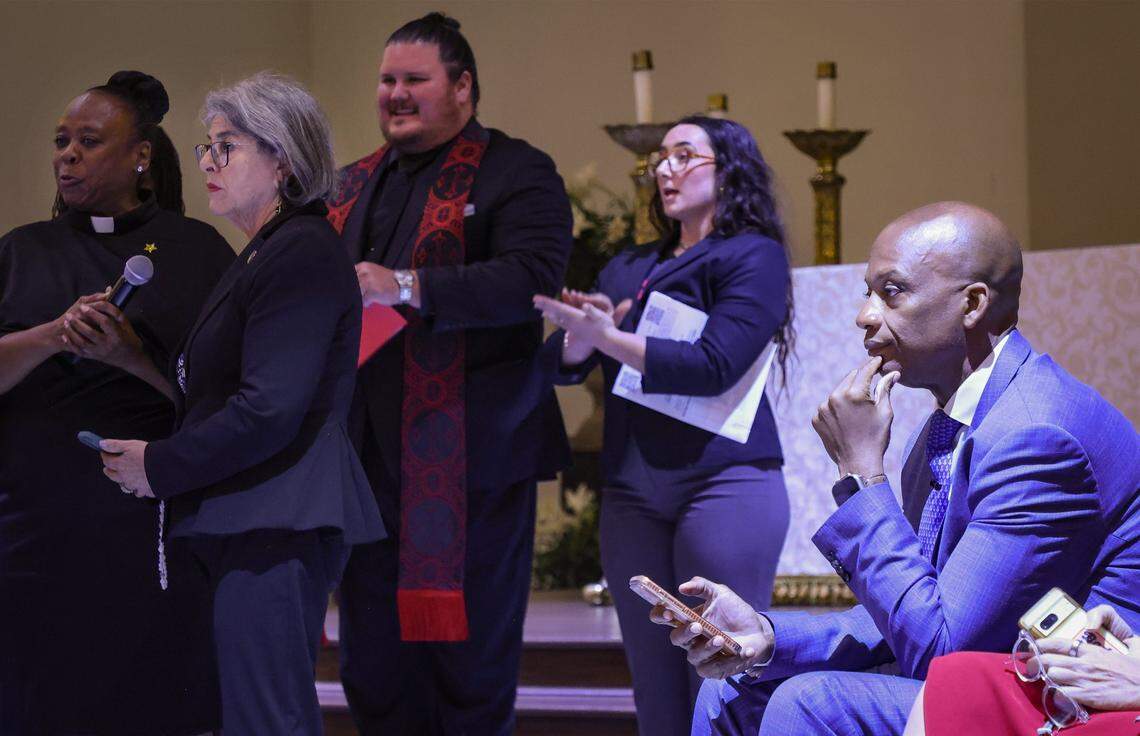
On the issue of affordable housing, Levine Cava, Rosado, Gilbert, Commissioner Raquel Regalado and Miami-Dade County Housing & Community Development Director Nathan Kogan largely agreed to support legislation to lower the “workforce housing” median income and establish an incentive program for developers that will result in housing that is actually affordable for residents. Gilbert was the only partial “no” of the night. He said he had an issue with the timeframe of making these changes happen in 90 days, but agreed to six months.
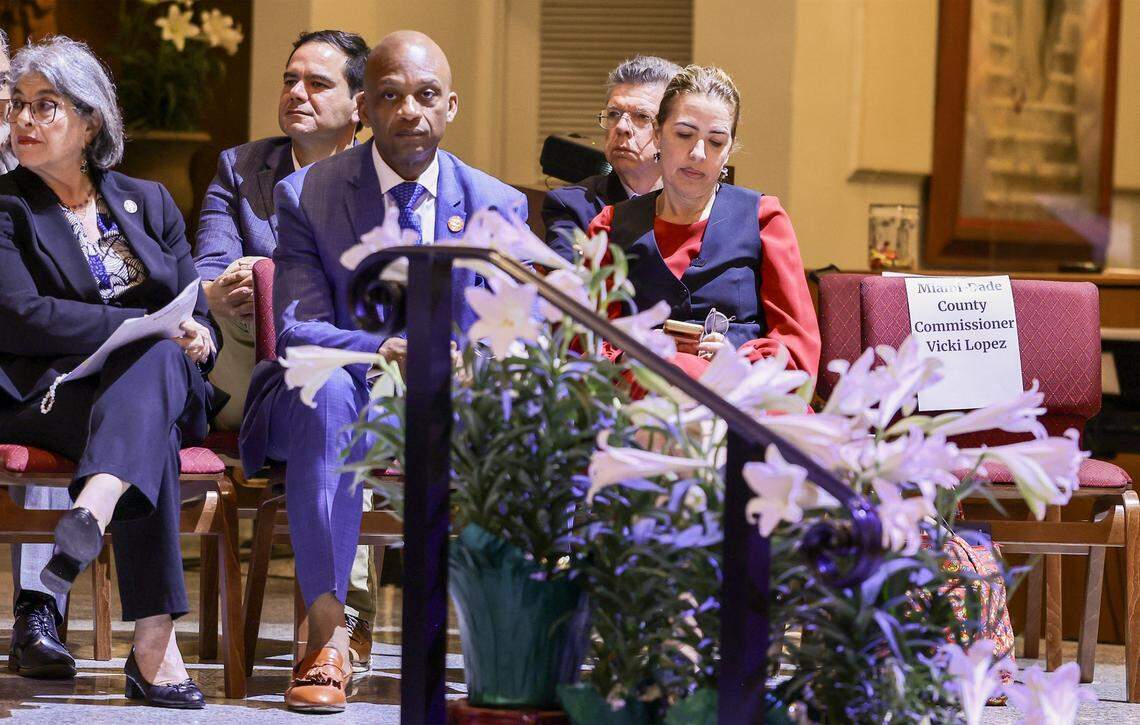
County Commissioner Vicki Lopez was the only elected official who was invited but did not attend due to a family emergency.
The commitments came after PACT’s members conducted months-long listening sessions with residents and research with experts to help come up with solutions for two of Miami-Dade’s most pressing issues.

‘The county broke that promise’
Though affordable housing is a top issue for most residents, PACT members pointed out that there are about 1,000 chronically homeless people struggling with mental illness in Miami-Dade County who need more than housing to survive. There’s an already-completed mental health facility to address this, PACT pointed out, but delays in opening the center have been a point of much frustration.
The all-encompassing center designed to provide mental health care, dental care, job training, transitional housing and more to people struggling with mental illness has already gone through a $51 million county-funded renovation but remains empty.
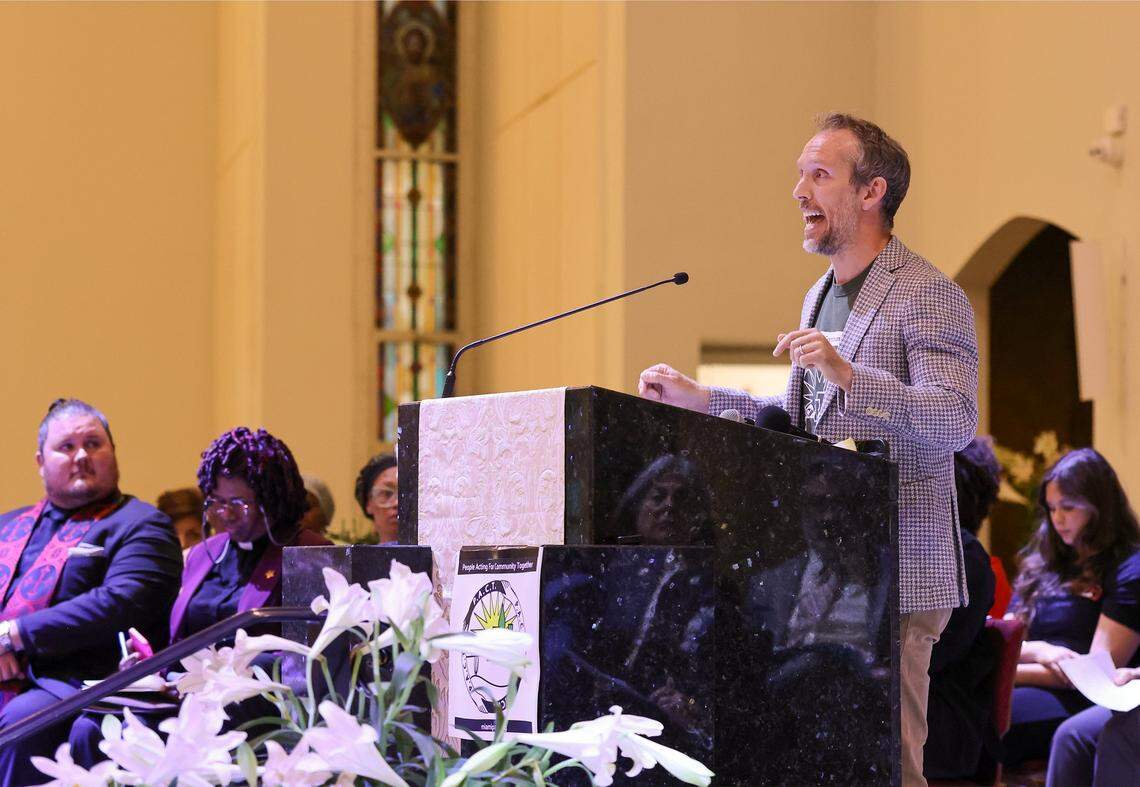
Steven Leifman, a judge and finance chair of the Homeless Trust, spoke to attendees about the importance of opening the facility.
“We have a once in a generation opportunity to fundamentally change how we deal with people with serious mental illnesses,” Leifman said.
The Miami-Dade County jail has effectively become the largest psychiatric facility in the state of Florida, costing taxpayers $1.1 million per day to incarcerate individuals with mental illnesses, “many of whom are there simply because they have nowhere else to go,” Leifman said.
The center is “designed to break the costly ineffective cycle of jail, emergency rooms and homelessness,” he said.
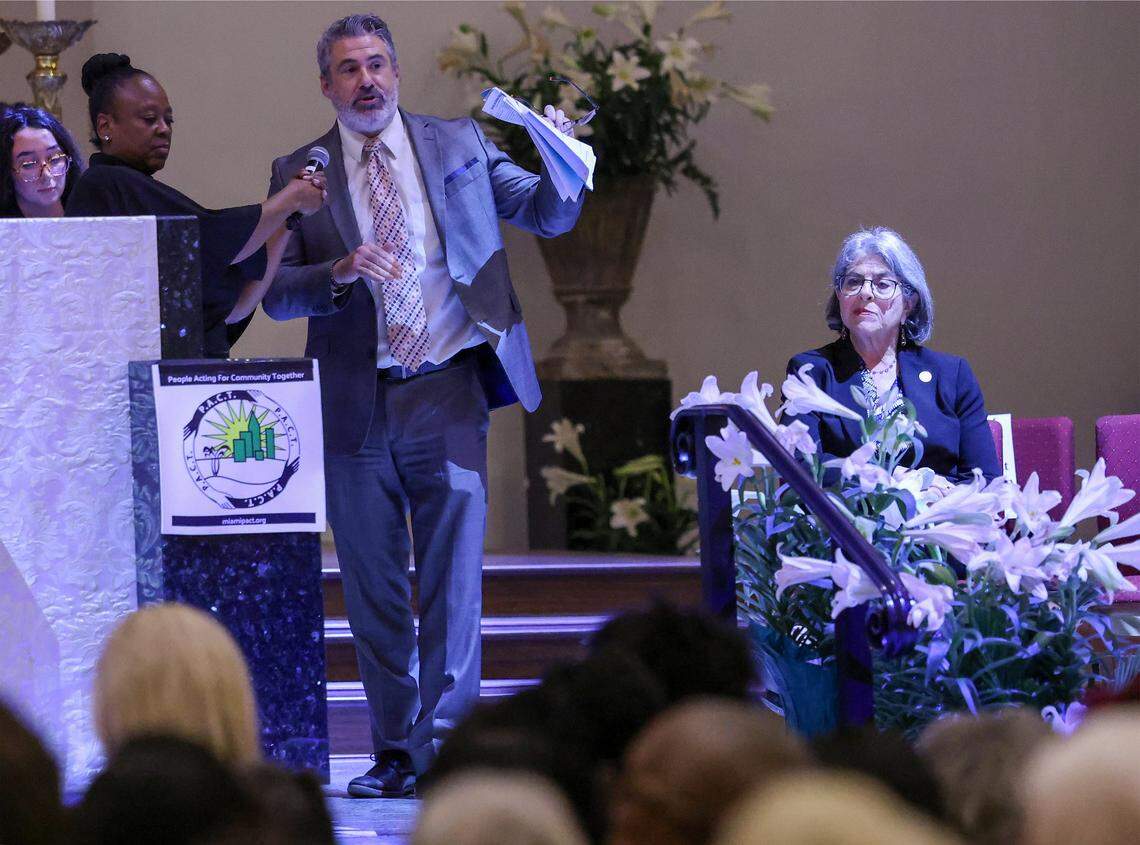
In an emotional testimony, Miami community lawyer Adam Saper described one of his clients, called Jordan, who could have received life-changing care there. Jordan, who spent a decade in prison, ended up taking his own life on the railroad tracks.
“He was supposed to receive care. We made a promise to Jordan. The county broke that promise and Jordan paid the ultimate price,” Saper said. “Every day the county delays, someone like Jordan pays the price.”
One of the reasons the center has been held up is because commissioners have denied the two nonprofits Leifman wants to open and run the Miami Center, citing budget strains once short-term funding runs out in three years. To complicate things further, months ago, the administration received a competing proposal from Recovery Solutions, a Tennessee-based for-profit psychiatric treatment provider with facilities in South Florida.
“The building is complete, it is ready to open and has everything ready to start them to the road to recovery with these much-needed services,” said Teolinda Christian of Fulford United Methodist Church. “Our community needs care not cages.”
PACT organizers pushed to get the county mayor and commissioners to commit to opening the center with the nonprofit operator , arguing that the for-profit provider is just looking to “make a quick buck” off the back of vulnerable people.
Levine Cava said she was “eager” to see the center open under the nonprofit proposal and acknowledged the substantial delays but said it is a decision that “rests with the commission” who needs to put it on the agenda at the next commission meeting.
Affordable for whom?
PACT members advocated strongly for Miami-Dade County to redefine “workforce housing,” as the current calculation does not match the actual income ranges of residents, making it difficult for many to afford housing.
The current program provides housing for people making 60 to 140 percent Area Median Income (AMI). The problem is the more than 40,000 billionaires and millionaires living in the county skew the number to be much higher than is representative of the workforce.
Currently, 140 percent AMI is equal to $121,000 per year for one person, whereas the average yearly salary for a Miami-Dade teacher is $51,000, according to research from PACT. This means that an affordable apartment for a teacher should cost no more than $1,420 per month, but developers can charge over $3,000 per month based on the county’s current calculations.
“Who is this workforce housing for that our tax dollars subsidize?” asked Madeline Maynard of Barry University. “As workforce housing continues to get developed, people in our neighborhoods can’t actually afford to live in these developments.”
At the assembly, elected officials all agreed to incorporate neighborhood level income data to determine median income.
“We’ve gotta dig deeper, we gotta do better on subsidies and all kinds of assistance,” said Commissioner Rosado. “I’m all about it.”

This story was produced with financial support from Trish and Dan Bell and donors in South Florida’s Jewish and Muslim communities, including Khalid and Diana Mirza and the Mohsin and Fauzia Jaffer Foundation, in partnership with Journalism Funding Partners. The Miami Herald maintains full editorial control of this work.
