
Miami Springs police shoot, kill coyote eying ducks on lake, police say
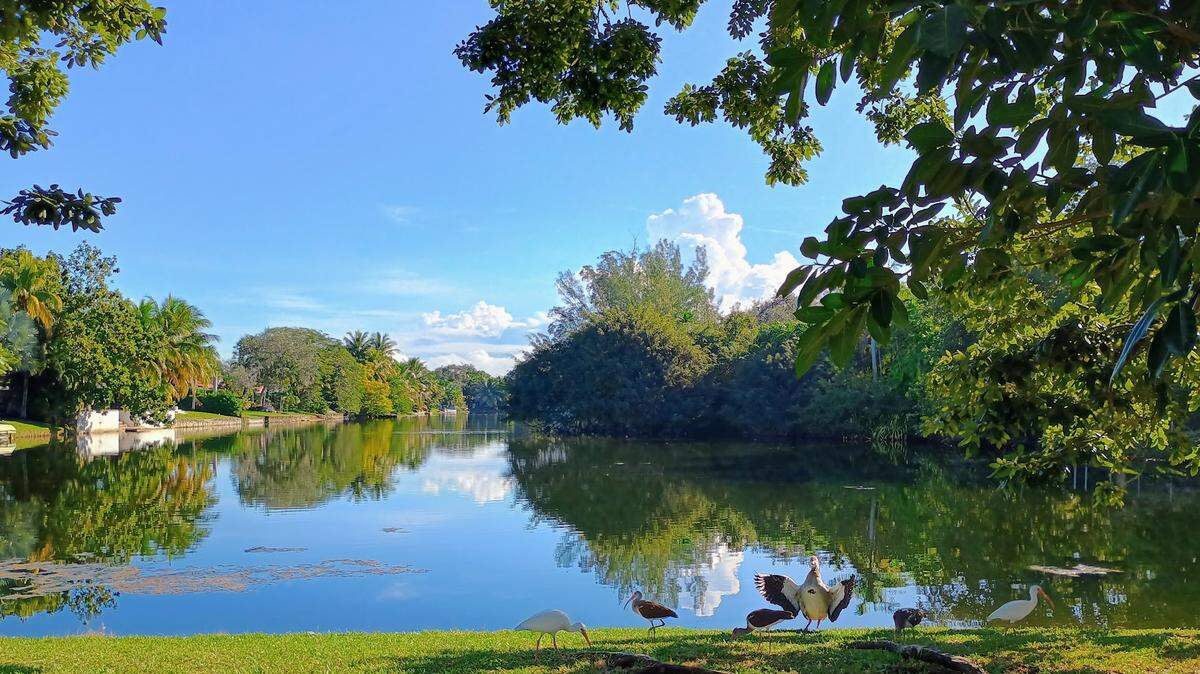
A coyote that had been roaming Miami Springs backyards for days was shot and killed by a police sergeant who said the animal was stalking ducks behind a lakeside home and then charged at him.
Sgt. Kyle Collins was dispatched around 5:45 p.m. Dec. 5 to a house on Corydon Drive after the homeowner, 67-year-old Carlos Leonard, reported a coyote in his yard watching ducks on the lake, according to a Miami Springs police incident report.
In his report, Collins wrote that the coyote stood at the water’s edge and “appeared to be waiting to attack one of the ducks.” He also noted that Miami Springs is a designated bird sanctuary.
After obtaining permission from Leonard to fire his weapon on the property “to eliminate the threat,” Collins said he evaluated the backdrop, determined it was safe and then opened fire with his 9mm Glock 17, the report said.
Collins reported firing three rounds in total: one initial shot and then two more when the coyote lunged toward him. No people, pets or property were struck, according to the report.
The shooting capped several days of sightings that had residents on edge. Neighbors said the animal had been seen slipping between yards, jumping fences and wandering through areas where children and pets play outside.
Miami Springs Police Chief Matthew Castillo said in a statement his highest priority is “the safety of our residents and their pets.” He said police fielded numerous calls about a coyote in backyards across the three-square-mile city just north of Miami International Airport, with residents worried about their kids and animals.
Castillo said officers responded to each call and “explored all reasonable options,” including contacting wildlife authorities, but those efforts were met “with negative results.”
Based on the coyote’s repeated presence in residential areas, Castillo said, the department concluded it posed a growing safety risk and he “wasn’t willing to risk the safety of our residents.” He added the outcome “is never what we prefer,” but said the decision was made after a thorough review.
On neighborhood social media pages, reaction was overwhelmingly supportive of how police handled the incident. “It also could’ve been a child playing outside. Thank you for putting our safety first!!” wrote resident Mercy Medina on Facebook.
One person questioned whether lethal force was necessary. “In my opinion, it could’ve been trapped and relocated,” wrote resident Susan Oliva.
The incident comes as coyote sightings have become more common across urban and suburban South Florida, where the highly adaptable animals find food in rodents, fruit, garbage, outdoor pet food and even bird feeders. Wildlife officials generally advise that simply seeing a coyote is not, by itself, an emergency, but that animals repeatedly appearing around homes, showing little fear of people or approaching pets can become a public safety concern.
Animal-protection advocates say the long-term answer is not killing coyotes, but cutting off the food and shelter that draw them into neighborhoods in the first place.
“Coyotes are survivors who can thrive anywhere from rural fields to dense cities, as long as there’s food to feed their families,” said Catie Cryar, a spokesperson for PETA, in an email. “If the food stays, so will the coyotes, and if the coyotes are killed or removed, more animals will simply take their place to use available resources.”
PETA says the focus should be on removing food sources, not wildlife, which mirrors what Miami Springs police are telling residents. Officers are urging people to secure trash, avoid leaving pet food outside, supervise small pets and report any aggressive wildlife behavior.