André ‘Dadou’ Pasquet, founder of legendary Miami Magnum Band, is dead at 72
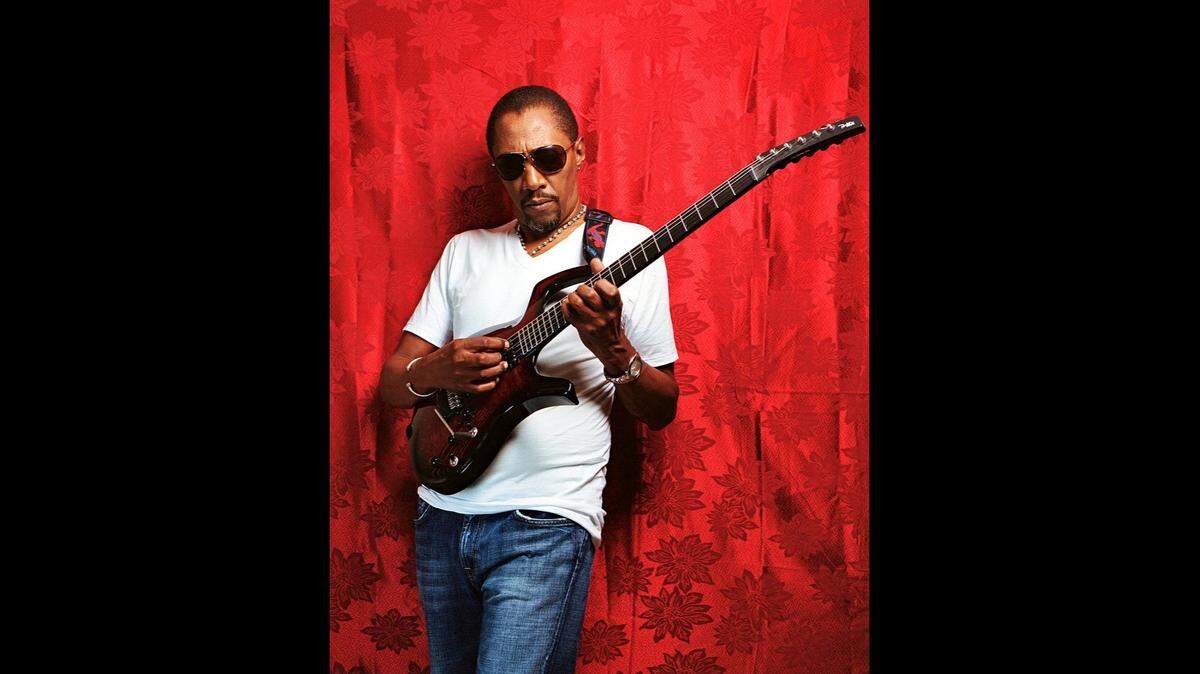
He was a beacon of Haitian culture whose riveting virtuosity with the guitar and rich compositions of konpa not only gave the music a new dimension but made him a legend among musicians and fans.
Once a staple in Miami nightclubs, he and his fellow musicians in Magnum Band kept Haitians tethered to their homeland through their own mix of Haitian konpa mixed with jazz and other Caribbean beats. Now André “Dadou” Pasquet has taken his final bow.
The legendary guitarist, singer and bandleader, who founded Magnum Band in Miami in the mid-1970s, died on Sunday, his family said. He was 72. No cause of death was given, but days earlier, in a plea for prayers, they announced he was facing serious challenges.
A former member of Tabou Combo, where he replaced musician Albert Chancy in the world renown Haitian group, Pasquet died in Miami, a city close to his heart though not where he would have preferred to take his last breath, said Magguie Rigaud, a former manager.
“It’s one of the things he didn’t want,” she said. “He always wanted to return home to his country to come work and to give his contribution. There was a period where he didn’t want to remain in the United States, and he wanted to return to Haiti.”
For a moment, it looked as if Pasquet would get his wish. He returned to Haiti and built a home with a recording studio in bucolic Fermathe, in the hills above Port-au-Prince in the Kenscoff area. But like so many Haitians forced into exile by armed criminal groups, he had to leave after gangs invaded the capital.
In a note, Haiti’s Transitional Presidential Council said Pasquet’s works have transcended time and generations. More than an artist, he was “an icon of Haitian music and the culture of an entire nation” who symbolized “humility, talent passion and creativity,” they said.
Wyclef Jean, the Grammy-Award Haitian artist and guitarist, likened Pasquet to the Mexican-born rock star Carlos Santana, who is known for fusing Latin, blues and rock rhythms. “You can’t be a guitar player and know Santana but don’t know Pasquet,” he told the Miami Herald on Monday.
Pasquet was born on Aug. 19, 1953. Among his many famous hits is his 1982 song “Liberte,” Freedom. The song is anthem on exile, migration and Haiti’s so-called boat people who were fleeing the Duvalier dictatorship regime to Miami in droves, but instead of finding freedom upon arriving, they found imprisonment and sometimes died on the high seas during the journey.
“You can’t sing stupid stuff,” he once told the Herald in an interview as his country was enmeshed in yet another political crisis. “There are too many serious things to sing about.”
Known for his quiet presence, Pasquet had been a child prodigy, Fabrice Rouzier, musician and founder of the Haitian band Mizik Mizik, said in an interview on Port-au-Prince-based Magik 9 on Monday.
“His death is a huge loss,” Rouzier said, as he traced the musician’s life from a 14 year-old playing with the legendary saxophonist, bandleader and arranger Raoul Guillaume to member of Tabou Combo less than four years later, then to head of his own band. He compared him to some of the country’s most famous musicians, including the founder of konpa music, Nemours Jean-Baptiste.
“Every 50 years, Haiti gives us one of these,” Rouzier said, “it’s truly extraordinary…that we’ve had the chance to live in the same period as an artist like this.”
Rouzier to understand Pasquet’s contribution to the culture, one has to understand the context in which Magnum Band was founded in June 24, 1976. Tabou Combo had just released its “New York City” album in 1975 in Italy and the band was riding high. Pasquet left and along with his brother launched Magnum Band. With its touches of rock and jazz, the sound became known as kadans rampa.
The date they chose for their debut, June 24, is the feast day of St. John the Baptist in the Catholic calendar. The band also chose a lodge in Miami for this first performance and launch of the new Haitian sound. Just years earlier, the area had documented the first boatload of Haitian refugees arriving in the United States.
“There is a mystical aspect to it,” said Rouzier, adding that the group’s rhythm section made you want to dance. “The sound wouldn’t leave you.”
Pasquet who spent six years with Tabou Combo ,once told the Herald that he left the group “because I couldn’t really exploit my inspiration as a composer.” He would go onto build a worldwide reputation with 14 albums spanning 14 years.
In one memorable performance, the group played for a crowd of 40,000 in Paris as part of a Caribbean show. His ultimate dream was for Magnum Band to find crossover success.
“I’ve been paying my dues for a long time and I’m tired,” he said in 1989. “But I want Magnum Band to make it and I won’t rest until it does.”
The club gigs, he said, “are just to keep the band tight.”
Rigaud said she believes Pasquet could have exploded on the world scene had he not been constrained by the limits of the Haitian music scene.
“He had a lot of barriers, a lot of limitations” said the owner of Press Café in Petion-Ville, once a regular venue for the group’s live performances.
Still, Pasquet brought his own style and conviction to konpa. “
The style with which he played meant that konpa was going to have a place. He had a lot of variations in how he played and took it to an international level,” she said. “Unfortunately, in Haiti, a lot of people didn’t understand his dimensions.”
In announcing Pasquet’s death, his family said he had “entered the eternal embrace of the Lord.”
“To the world he was a musical icon, a legendary guitarist whose work defined generations; to us, he was a cherished loved one whose humility matched his talent. He was a husband, father, a friend, and a beacon of Haitian culture whose artistry touched countless lives,” the family said. “He left this world gently, wrapped in the love of his family. His journey as an artist was marked by passion, grace, and an unwavering love for his people.”
His family said that when Pasquet was asked what he wanted to pass on to the world, his response was: “Jwe mizik lan.” Play my music.