
Will new Miami lifetime term limits disqualify Frank Carollo from runoff ballot?
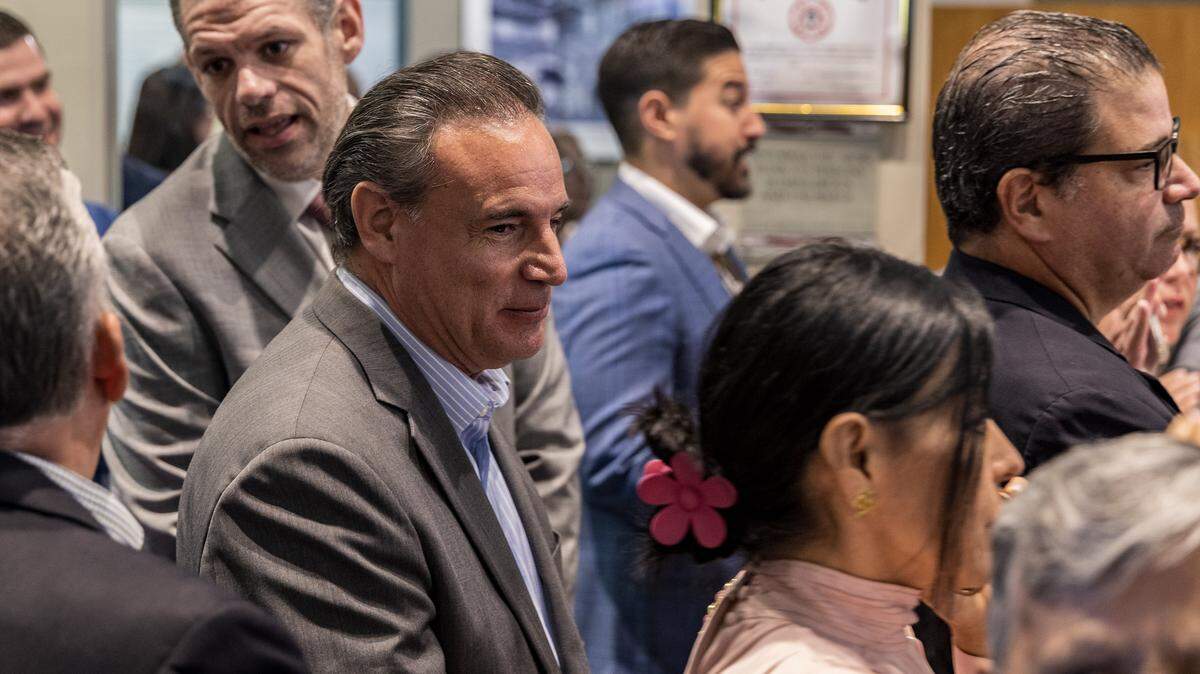
Frank Carollo may have gotten the most votes in last week’s election for the open District 3 seat, but Miami’s newly passed lifetime term limits threaten to knock the former city commissioner off the Dec. 9 runoff ballot.
Miami-Dade Circuit Court Judge Peter Lopez heard arguments Monday morning in a lawsuit filed by three residents who argue that while Carollo won 38% of the vote in the District 3 race last week, a successful referendum on the same ballot now bars him from advancing to the runoff election next month.
That referendum, which passed by a 79% margin, limits elected officials in the city to two terms as mayor and two terms as commissioner for their lifetime. Carollo has already hit the ceiling, serving two four-year terms as the District 3 commissioner, from 2009 to 2017. He’s now seeking a political comeback, vying to succeed his older brother, current District 3 Commissioner Joe Carollo, who is termed out.
The plaintiffs, which include third-place finisher Oscar Alejandro, argue that Frank Carollo should be removed from the runoff ballot and replaced by Alejandro, who would face off against second-place finisher Rolando Escalona, who netted 17% of the vote.
“The simple matter is, on Nov. 3, Frank Carollo was a lawfully qualified and eligible candidate, but on Nov. 5, he was not,” attorney Juan-Carlos Planas, representing Alejandro, said Monday. Planas represented Escalona, the second-place finisher, in a separate election challenge last month.
While the term limits referendum specified that the change was retroactive and would go into effect “immediately,” Carollo’s attorney Robert Fernandez argued that the referendum language was “absolutely silent” as to whether it would apply to a candidate on the same ballot.
In a Nov. 9 filing, Carollo’s legal team said that removing “an otherwise eligible and qualified candidate from the ballot in the middle of an election” could run afoul of the United States and Florida Constitutions — and that such a change would be “unprecedented and inconsistent with controlling law.”
“The requested emergency injunction will absolutely disenfranchise the 2,570 voters who cast their ballot in the general municipal election for F.Carollo to send him to the runoff, in addition to the thousands of other voters who selected the other candidates on the runoff ballot,” Carollo’s legal team wrote.
Fernandez said the only “appropriate mechanism” to thwart Carollo’s candidacy would be a post-election challenge.
But Planas argued that doing anything other than removing Carollo from the Dec. 9 ballot “basically voids what the overwhelming amount” of voters wanted by passing lifetime term limits. He also noted that most District 3 voters cast ballots in favor of someone other than Carollo, who failed to secure the more than 50% of the vote, which would have allowed him to avert a runoff.
“This was a clear message,” Planas said. “The voters knew what they were voting for.”
He also described removing Carollo from the ballot as “a very easy thing.”
“They can simply swap out the name of Frank Carollo with the name of Oscar Alejandro,” Planas said.
But Oren Rosenthal, an attorney for Miami-Dade Elections Supervisor Alina Garcia, said it might be a bit more complicated. While he said the elections office has no official position in the lawsuit, he also cautioned that time is of the essence. The Elections Department is already in the process of printing vote-by-mail ballots, with plans to stuff the envelopes Wednesday and mail them out on Nov. 17, Rosenthal said.
.jpg "IMG_1190 (1).jpg")
“At this point, any change in the ballots most likely will create a delay in the vote-by-mail ballot mail-out,” Rosenthal told the judge. “And that’s because it’s not as easy as just printing a ballot. They have to be programmed, then tested, then sent to the printers, printed, then quality-assured, and then go out.”
Rosenthal pointed out that there’s also a Dec. 9 runoff for Miami mayor between candidates Eileen Higgins and Emilio González, who would be featured on the same ballot as the District 3 candidates. Rosenthal said it’s possible for the District 3 ballots to be “carved out” or withheld.
“But by necessity, the mayoral election is on those ballots as well, and so you will be affecting the candidates for mayor as well,” Rosenthal said.
Attorneys for Higgins and González spoke briefly Monday, saying they didn’t take a position on the matter and were only concerned about ensuring the Dec. 9 runoff election took place as scheduled and with “expediency.”
Lopez scheduled a second hearing for Wednesday morning, when he expects to issue a ruling. The judge noted, however, that it’s likely one of the parties will appeal his decision to a higher court.
“I’m not the last word on this,” Lopez said. “So no matter what I do, the Third [District Court of Appeal] is going to have to chime in, so we need to get this done as expeditiously as possible.”
.jpg)