
Deep dive on the Miami mayor race: What voter data says about who will win
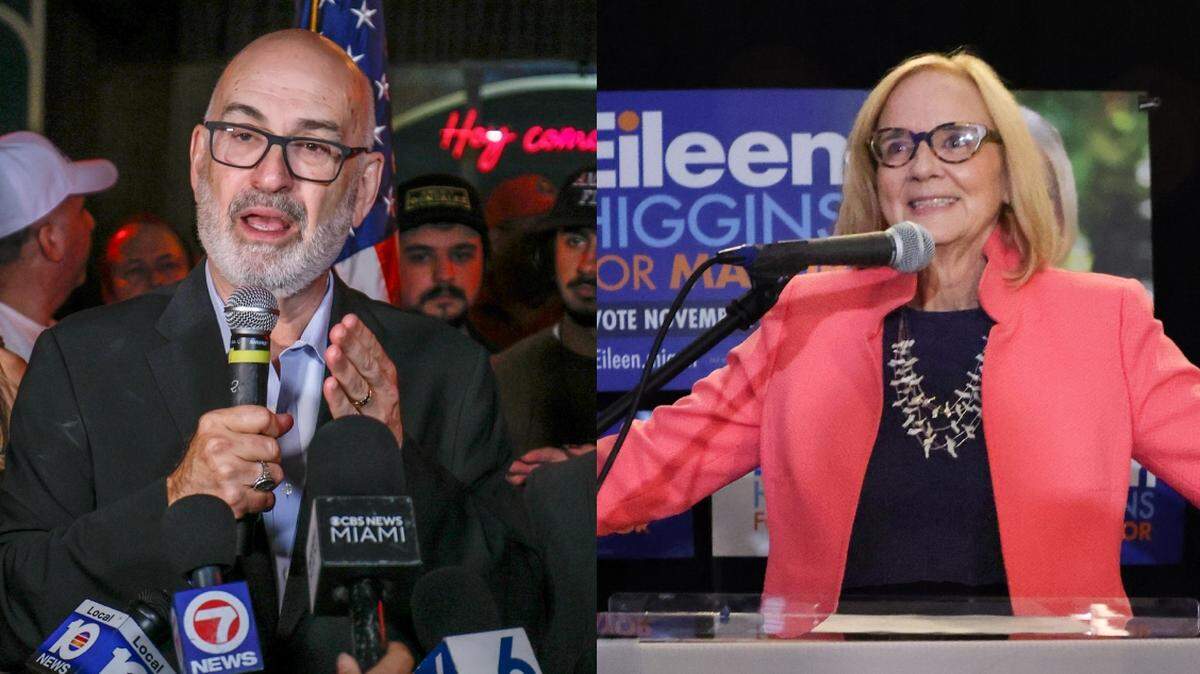
Tuesday’s election results were good for Democrats across the country, and Miami was no exception.
In the race for Miami mayor, Eileen Higgins, a two-term Democratic county commissioner, finished 16 points ahead of her main Republican opponent, former City Manager Emilio González. Now the two are competing in a runoff election on Dec. 9 — a contest that could end Republican control of the Miami mayor’s office for the first time since Barack Obama was president.
Higgins starts off the race as the vote leader, with 36% of the votes cast in Tuesday’s election going to her compared to González’s 20%. But the election starts fresh in the runoff cycle, meaning both candidates will be knocking on doors and spending heavily on ads and mailers over the next five weeks to push their supporters to come out to vote again just as the holiday season begins.
“Higgins and González both have a path,” said Matthew Isbell, a Democratic elections analyst who posted a detailed map of Miami’s results on his closely watched “Florida Data Geek” social media feed. “I see this as a toss-up, because it’s going to matter who turns out.”
What does González need to do to close the gap with Higgins and come out on top next month? Here are five things to watch:
Higgins dominated the Democratic vote on Tuesday. Will she again?
A Miami Herald analysis of precinct demographics and voting results suggest Higgins ran up the score with Democratic voters on Tuesday.
In precincts where registered Democrats make up at least 45% of voters, she was 20 points ahead of fellow Democratic candidate Ken Russell. Russell, a former city commissioner, took 25% of the vote in the Democratic precincts, well behind the more than 40% that Higgins received, according to the Herald tally. In those left-leaning precincts, González essentially tied for third place with Michael Hepburn, a largely unknown Democrat who finished near the back of the pack citywide.
In an interview Wednesday, Russell said he was hurt by the well-funded Higgins effort to brand herself as the Democratic choice in an officially nonpartisan race — including an endorsement by the county’s top Democrat, Mayor Daniella Levine Cava, and mailers calling Higgins the candidate that Democrats trust.
“Eileen’s air game was very effective campaigning as a Democrat,” Russell told the Herald on Wednesday. “I didn’t do that.”
Russell, who finished just two points behind González, ran on an anti-corruption platform and said he hasn’t decided whether to endorse his fellow Democrat in the runoff. He predicted his voters are up grabs.
“My voters could go either way,” he said. “There’s a broad coalition there that has nothing to do with party.”
Can González motivate GOP voters who didn’t vote for him to come out again in December?
González, who has been endorsed by Gov. Ron DeSantis and other prominent Republicans, was the GOP leader of the night. In precincts where at least 45% of the voters are registered Republicans, he took about a third of the vote.
While Higgins finished about 10 points behind him in those precincts, it’s the next tier of also-ran Republicans that are key for González. Combined, term-limited City Commissioner Joe Carollo and former Commissioner Alex Díaz de la Portilla received close to González’s 30% share of the vote in those precincts. Converting the votes for those Republican candidates into his own column on Dec. 9 would be a big step toward consolidating GOP support behind him.
“This election is going to go down along partisan lines in a way we haven’t seen,” said GOP campaign consultant Jesse Manzano-Plaza, who worked for outgoing Mayor Francis Suarez, also a Republican. “That means each campaign is going to go after their base. The person who is going to win this race is the one that has the most motivated party base.”
Nikki Fried, chair of Florida’s Democratic Party, posted a video Tuesday from the Higgins election night party, urging people to vote for her. Appearing with Fried, Higgins stuck to the same kind of good-government message that González promotes. “We really have the opportunity to set the city of Miami in a totally different direction,” Higgins said. “Where there’s no chaos. There’s no corruption.”
In an interview Wednesday, González said he’s expecting much broader support now that he’s only facing Higgins — who he worked with when was Miami-Dade’s Aviation director — and not having to contend with attacks from Carollo’s large war chest.
“Eileen was hitting me from the left, and Joe was hitting me from the right,” he said. “I’m very happy with my performance. It’s right where I thought it would be.”
How much Hispanic support can Higgins bring to the ballot box in December?
A native of New Mexico who speaks Spanish, Higgins became a county commissioner in an upset seven years ago by running as “La Gringa” in a heavily Cuban American district that includes Miami’s Little Havana. González, a retired U.S. Army colonel, was born in Havana before his family moved to Florida in the 1960s.
If elected, Higgins would be the first non-Hispanic to serve as Miami’s mayor since the 1990s. She appeared to do well with Hispanic voters on Tuesday, winning the top share of the vote in precincts where Hispanic voters make up at least 45% of the electorate. She won about 30% of the vote in those precincts, slightly higher than the 25% that went to second-place finisher González.
Consultant Christian Ulvert, who is running the Higgins campaign, said he expects Higgins to build on her numbers across Miami now that it’s a two-person race.
“We’re in a position where we can grow our support because we’ve already laid the foundation with our coalition,” he said.
Will City Commission races make a difference in Miami turnout?
On Tuesday, Higgins won all five of the city’s commission districts. Her highest margin came in District 5, where the incumbent, Commission Chair Christine King, was running for reelection. King won her race easily, soaring above the 50% threshold needed to avoid a runoff, meaning she won’t be on the ballot again on Dec. 9.
That means Higgins can’t count on the popular chairwoman to drive turnout in her majority Black district. Black voters are a big part of the Higgins base, with the Democrat winning more than half of the votes in precincts where Black voters make up at least 45% of the electorate.
Another commission race heading for a runoff could boost González, though. Frank Carollo, brother of the outgoing commissioner, will be on the Dec. 9 ballot in the contest to represent the city’s Republican-leaning District 3. Higgins beat Joe Carollo in his own district — taking 32% of the vote to Carollo’s 26%, according to a Herald tally of precinct data. But combined, Carollo, González and other Republican candidates accounted for roughly half the vote in District 3. In a low-turnout runoff, an energized District 3 race could mean extra votes for a Republican.
Can Democrats retain their edge in voter enthusiasm?
In a city where Republicans trail both independents and Democrats in voter registration, it’s no surprise fewer GOP voters turned out on Tuesday. About 44% of the ballots cast came from Democrats and 30% were from Republicans.
But the numbers show Democrats enjoyed an enthusiasm gap, too. Turnout for Democrats hit 27%, five points over the Republican rate. Compare turnout to the last election for mayor — the 2021 snoozer when Suarez easily cruised to a second term — and Democrat turnout is up 12 points, compared to just a 4-point bump for the GOP.
Democrats also turned up on Election Day itself, casting almost 2,500 more votes on Tuesday than Republicans did.
“The Democrats really surged out on Election Day,” said Isbell, the Democratic analyst. “If you maintain that into a December runoff, then Higgins has it wrapped up.”