
‘You are being over-taxed.’ Florida’s CFO targets Miami-Dade County’s spending
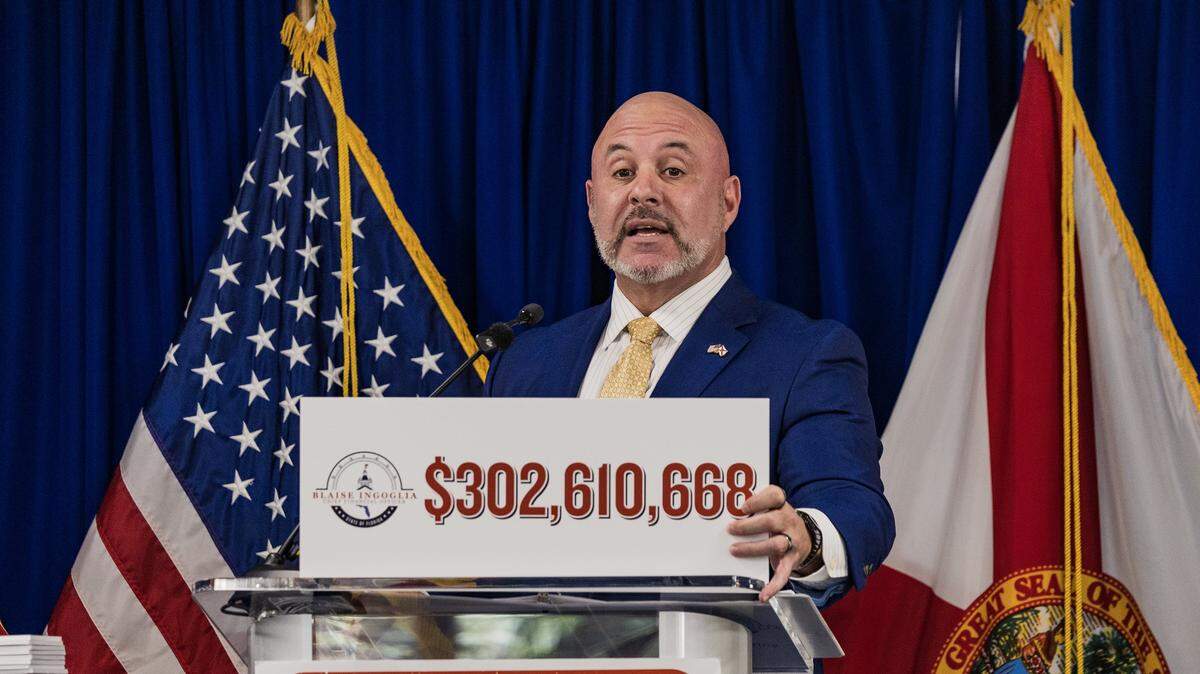
Using a formula he said will protect homeowners, Florida’s chief financial officer on Thursday argued that Miami-Dade County significantly overspends its tax dollars and should cut its $12.9 billion budget.
CFO Blaise Ingoglia applied the same austerity math to Miami-Dade as he has other local governments in the Republican’s barnstorming tour of Florida as he campaigns for a full term and for voters to pass tax-cutting amendments to the state constitution in 2026.
“There is no other way to put this, but you are being over-taxed,” Ingoglia said at a press conference at Florida International University’s Biscayne Bay campus, a school funded by the state. “They’re taking your tax dollars and spending it unwisely. … Miami-Dade needs to start being more fiscally responsible.”
Ingoglia did not identify any county expenditures he thinks should be cut. Instead, he walked reporters through the math of a formula he said calculates how much a local government’s tax-funded budget should grow.
That formula, which he applied last week at a press conference targeting the city of Miami, presumes tax-funded spending should only grow by the rate of inflation and the rate of local population growth. During Ingoglia’s tour of Florida, he has applied that formula to local governments and calculated what he says their budgets should have been if spending growth had matched his requirements during the last five years.
Using that math, Ingoglia claimed Miami-Dade’s $2.5 billion tax-funded budget for countywide general expenses — known as the “general fund” — was about $303 million too high.
In a statement, Miami-Dade Mayor Daniella Levine Cava did not directly rebut Ingoglia’s claims of overspending by the county. But she noted that her administration secured two 1% reductions in the countywide property-tax rate and boosted spending on law enforcement every year since she took office in 2020.
“I’m proud that every year of my administration we have passed our budget with strong bipartisan support,” said Levine Cava, a second-term Democrat, referring to a County Commission where Democrats narrowly outnumber Republicans. “We continue to run an efficient government that delivers on your priorities while maximizing every single taxpayer dollar.”
In September, Levine Cava secured County Commission approval for a $12.9 billion budget in 2026. About a quarter of that is funded by property taxes, with other revenue coming from water and trash bills, fees collected by Miami International Airport and Port Miami, and a mix of sales tax and state and federal funds.
The top consumers of countywide property taxes are the county’s jails, the Jackson Health hospital system, the Sheriff’s Office and the county’s transit system. Combined, they account for about 60 cents of every dollar spent in the countywide general fund, according to county budget documents. Other expenses include county elections, the Animal Services Department, the Parks system, and the offices that staff the mayor and the 13 county commissioners.
In his remarks, Ingoglia argued that local governments like Miami-Dade would have enough money to increase spending on public safety if it cut other unspecified services or expenses.
Ingoglia also criticized Miami-Dade’s staffing.
The county expanded hiring by nearly 3,000 people across the government since 2020 during a period of single-digit population growth — expansion that amounts to an average of about 2% per year for a government with a payroll now at about 31,000 positions. Departments that gained more than 200 positions between 2020 and 2025 include Fire Rescue, Transportation and Public Works, Parks, and Regulatory and Economic Resources, home to building inspectors, zoning administrators and environmental regulators.
Ingoglia said that, like most local governments, Miami-Dade would have plenty of room to expand public safety staff if local leaders resisted hiring more people in other departments.
“What happens? An extra piece of paper falls on their desk, and they say: ‘Go hire 10 more people?’” he said. “I just don’t get it.”
This story was originally published October 30, 2025 at 5:32 PM.