At MDC, an interfaith peace panel offers students ways to heal in divisive times
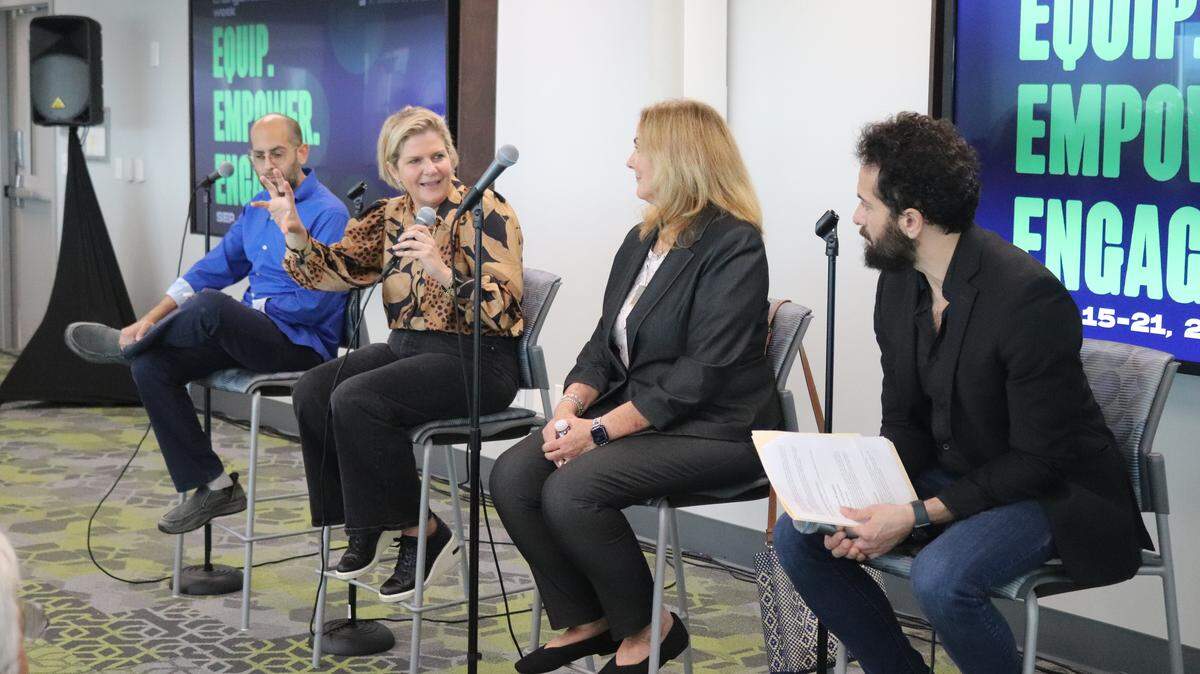
One student asked about the use of religious references to push political agendas. Another asked how to combat stigmas against religions that come from indigenous cultures, such as Yorùbá or Vodou. Many students — all from the Honors College at Miami-Dade College — asked why we’re seeing so much religious extremism reflected in the media and online.
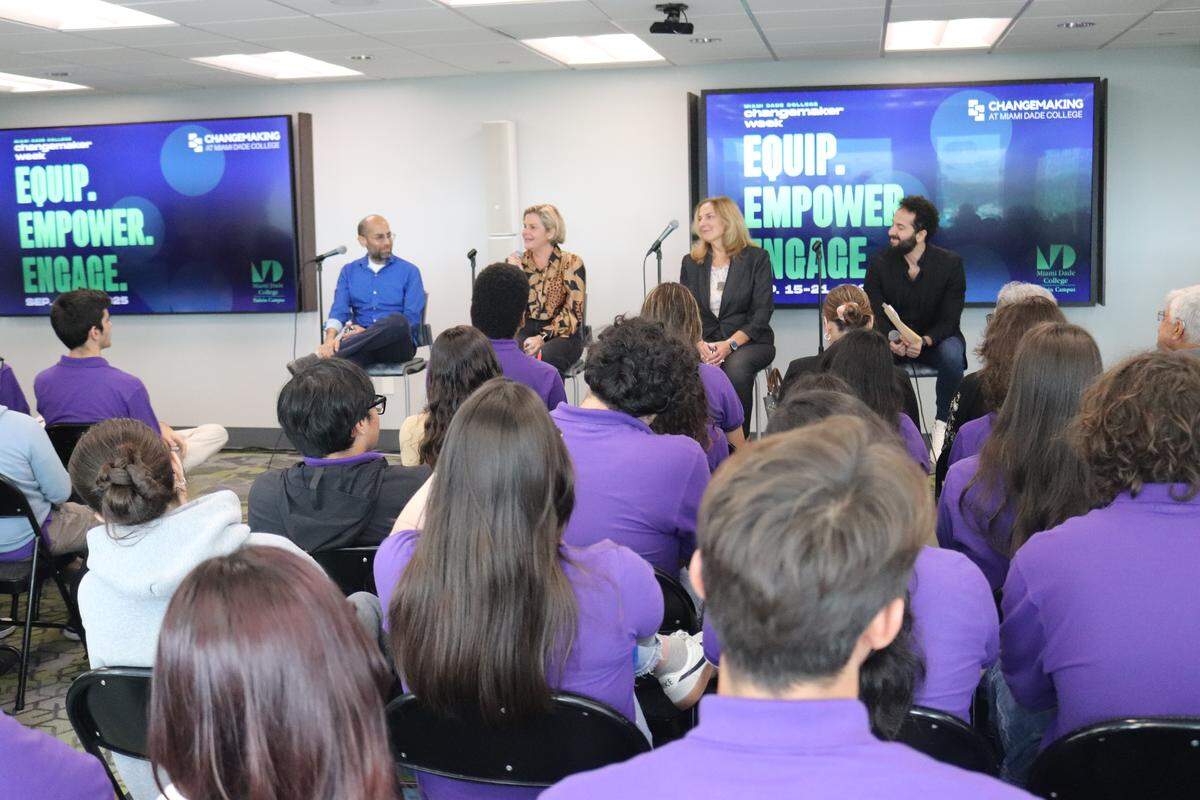
Last week’s public panel “Interfaith Dialogue and Peace” invited undergraduate students to hear from a variety of faith leaders — a Christian pastor, Reform Jewish rabbi and professor of Islamic studies — to learn more about how interfaith dialogue can be used for personal growth, community building and combatting polarization in communities.
The panel, hosted by the Jaffer Institute for Interfaith Dialogue and Education, also offered practical steps to bridging divides and gave students an opportunity to pose their own questions about religion, God, culture and politics. Some did not hold back.
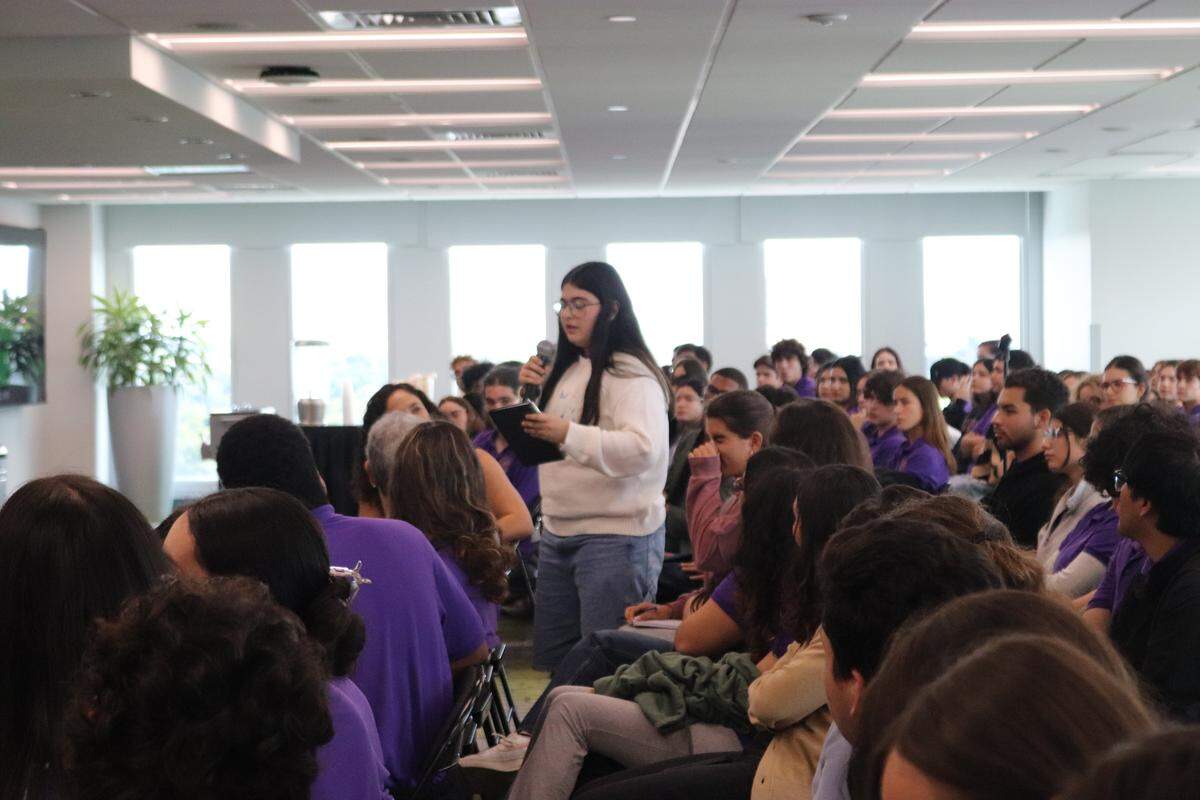
“What do you guys think about the use of God to spread hatred towards groups of people with different lifestyles or sexual orientations?” asked Camilla Cardozo, an international relations major at Miami-Dade College.
After the panel, Cardozo said she asked that question because using religion to justify hate is something she sees a lot, especially in the LGBTQ community, one that she is a part of.
“I grew up in a Hispanic household with my family that is very Catholic and religious oriented, but they have always taught me that the religious aspect is closer to love and respect, rather than hatred.”
Cardozo said it’s “important” to have “open” and candid conversations about religion — a topic that many find taboo to speak about in many settings.
Peace panel during polarized times
Moderator Mohammad Homayounvash, who is also the founding director of the Jaffer Institute, acknowledged that the peace panel, which was a part of the college’s Changemaker Week, comes at a time of rising polarization and division around the world.
On the heels of the shooting of Charlie Kirk, an event that has seemed to divide many people on the issues of free speech and gun violence, Homayounvash asked panelists to reflect on who or what is to blame for the current divisiveness in the world today. The answers were a mix of lack of community, increase in fear for ‘the other’ and a mere surface level understanding of most religions and viewpoints.
Rev. Audrey Warren said one problem is that people are working off of “soundbites,” meaning people are gathering incomplete information about complex topics from shortform social media videos.
“I’m a Christian, and most of the Christian rhetoric I hear I’m embarrassed by. I’m like, ‘I’m not that kind of Christian, I promise’,” said Warren, who is the senior pastor of First United Methodist Church of Miami.
She said another part of the polarization is that religion has become “consumer goods for politicians ... who want to get on top and you know what? We’re following it.”
Florida International University professor Iqbal Akhtar told students that moving away from a communal society could be another cause of rising division.
“We’ve become a very individualized society,” he said. “Covid sort of exacerbated that, but even before that, we stopped coming together as communities.”
Akhtar said interfaith dialogue — something he’s studied and worked on for decades within the Muslim and Jewish communities — “changes who you are as a person,” while bringing together unlikely communities.
“It has the capacity to be able to transcend the political moment,” he said. Akhtar also acknowledged the tension around the question “What does it mean to be an American?”
He said we’re trying to “create a new American story that all of us can buy into.” One that is “inclusive of the people that are represented here today, living in America, all the different faiths of the world, all the different peoples of the world, and their heritage, and at the same time, acknowledge both the good and the bad of American American history.”
Homayounvash then turned the conversation toward solutions.
Rabbi Jamie Aklepi said one easy way to work toward bridge building is to be aware of our own biases. She used an example of an assumption she held about Muslim panelist, Akhtar who she has known for many years.
“He leads religious services. He’s Muslim. I’m Jewish. And then I figured, okay, he’s from Southeast Asia. And then he says he was born and raised in Louisiana,” said Aklepi of Temple Beth Am, a Reform Jewish synagogue in Pinecrest.
Aklepi said that education is a classic way to overcome implicit bias. But that having a willingness to meet and listen to people who are different from us may be even more important.
“I mean understanding from the soul, a willingness to open your heart and to accept others in. You can know all the history ... but unless you are willing to be the person who expands oneself, one’s mind, one’s soul, then you can just learn your facts and stay where you are.”
Warren offered an example from her own church, First United, which has been attending interfaith vigils at Alligator Alcatraz, the state’s controversial migrant detention center in the Everglades. She said members for her church are always encouraged to serve in ways that help them meet different kinds of people while honoring a common principle or belief.
“I’ve gotten to meet all types of people from all different types of faith. And that’s been a wonderful thing to do together, to realize, wow, there’s a lot of things that actually bring us together,” she said.
READ MORE: ‘Shut it down.’ Every Sunday, they come to pray outside Alligator Alcatraz
Respecting different opinions
During the question and answer section, one student asked how the panelists would approach learning about different religions as someone who is already grounded in one tradition.
Akhtar offered this piece of advice: “You don’t have to believe everything that people in your faith say, and you don’t have to disbelieve everything in someone else’s faith.”
Within someone’s own faith, there may be things one agrees with or disagrees with. In his own religion of Islam, for example, Akhtar rejects the tradition of sacrificing and killing an animal, because it conflicts with his own beliefs as a pacifist and vegan, which he adopted through his studies of Jainism and Hinduism.
“I don’t believe in killing, I don’t think that violence is acceptable, and I don’t believe in eating meat, but I’m a Muslim,” he said. “And so it doesn’t have to conform to what the majority are doing. You can also tread your own path within your own tradition.”
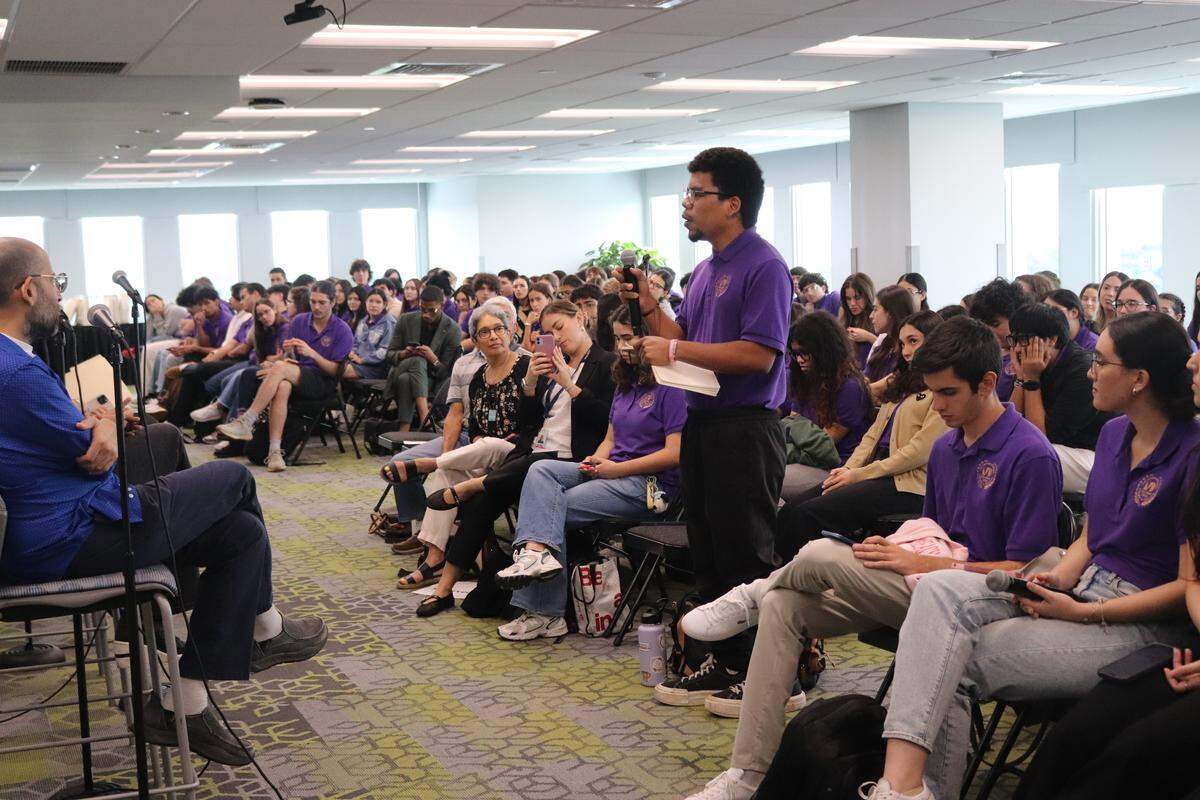
After the panel, student Gabriel Guevara reflected on how difficult it can be to find people talking about different religions in one place. He said he enjoyed hearing different viewpoints being communicated respectfully.
“I do believe that talking about religion is harder than to talk about politics,” said Guevara, who grew up in Venezuela and was raised Catholic. “Nowadays when you think different from someone, they say that you’re crazy, that what you’re thinking is wrong.”
Juan Subero-Bellizzio, who is an atheist, said he enjoyed the panel for similar reasons. His biggest critique is not having enough time to answer all the thought-provoking questions that came at the end.
“Even though I’m a very heavy atheist, and I disagree with many of the core concepts of what religions stand for .. I think it’s just important to every once in a while, just get to hear about this,” Subero-Bellizzio said. “Because, ultimately, it’s like what everyone’s been saying throughout this entire panel, it all comes down to acceptance ... and through acceptance, you just kind of make the world a better place.”
This story was produced with financial support from Trish and Dan Bell and from donors comprising the South Florida Jewish and Muslim Communities, including Khalid and Diana Mirza, in partnership with Journalism Funding Partners. The Miami Herald maintains full editorial control of this work.
This story was originally published September 23, 2025 at 5:22 AM.