
‘Game-changer’ project promises affordable rent for Miami’s cops, teachers and firefighters
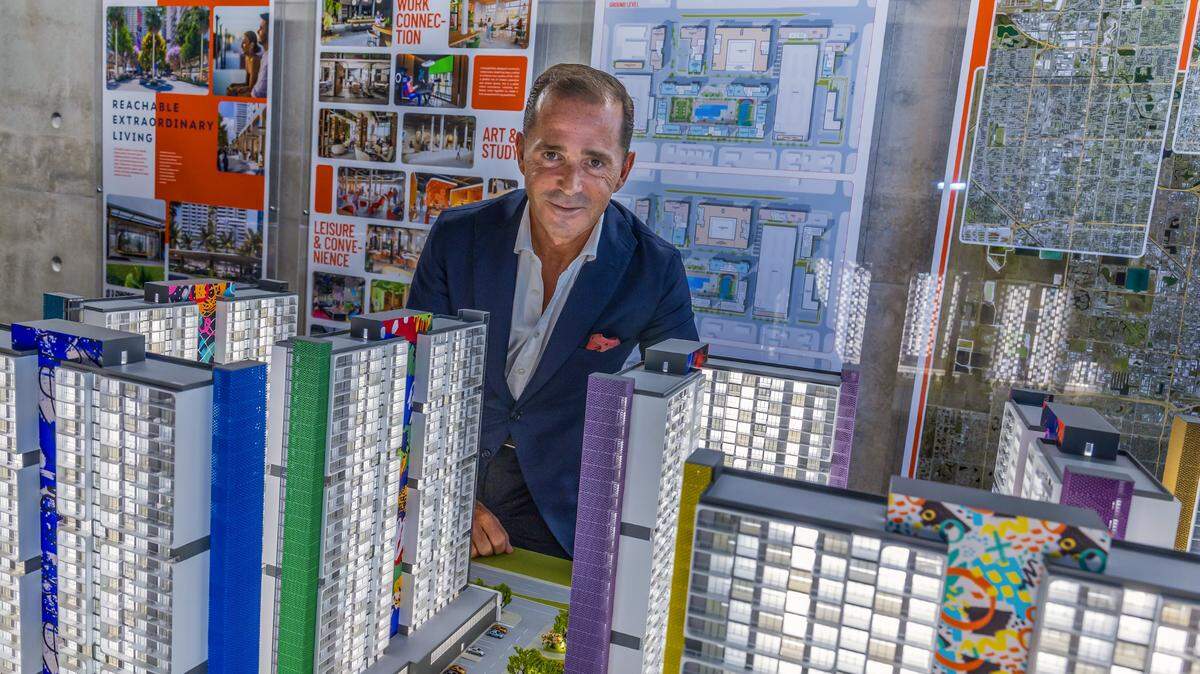
Two years ago, Spanish developer Pablo Castro settled with his family in Miami after selling off his Barcelona company, which specialized in building housing for the middle class, and he quickly recognized a singular opportunity.
It wasn’t a chance to build the latest waterfront billionaires’ lair. Pretty much the opposite, in fact.
Castro saw that few local developers are building homes for middle-income families, focusing instead mainly on luxury condos and upscale apartments that promise fatter profits but serve only the relative few. Miami-Dade’s teachers, first responders, nurses and office and service workers — the county’s vital workforce — meanwhile struggle to find housing they can afford amid a deep housing-supply crunch.
That’s a yawning gap in Miami’s real estate market that Castro, with 30 years of experience and a substantial fortune to his name, says he realized he could readily step into.
And now he’s doing so with an unexpected approach that marries a profit-making business model with European-style social goals, like lifelong learning, healthy eating and built-in dog walking and child care, all with a unique twist — binding guarantees of uncommonly low rents for Miami-Dade’s police, firefighters and teachers, among others.
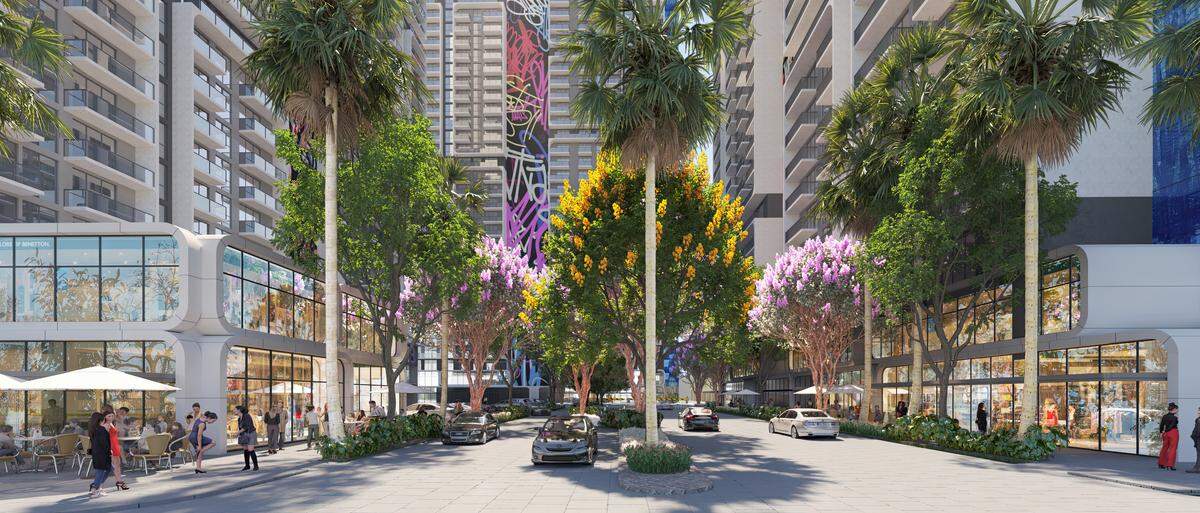
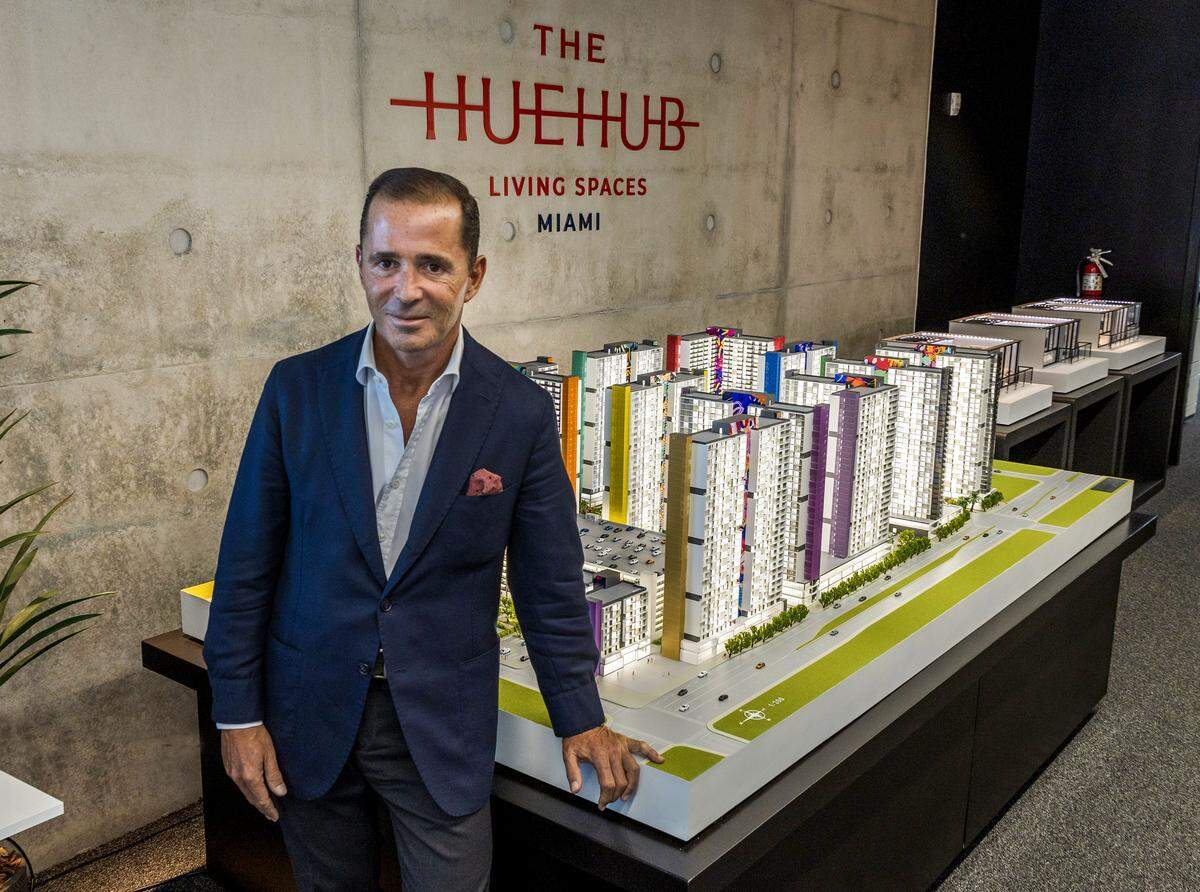
Castro’s $880 million plan for The HueHub, comprising more than 4,000 apartments and seven towers in largely overlooked West Little River, a sprawling and densely populated unincorporated enclave between Interstate 95 and Hialeah, is raising eyebrows not just for its size, but also for the developer’s unconventional promises.
Agreements with unions
He has signed agreements with unions and agencies representing Miami-Dade police, firefighters, teachers and professors at Miami Dade College’s nearby North Campus that offer their members guaranteed low rents at 3,000 HueHub apartments for 10 years, with incremental increases for inflation, once the project opens starting in late 2027 through 2028. Castro said he is also working on agreements with other groups.
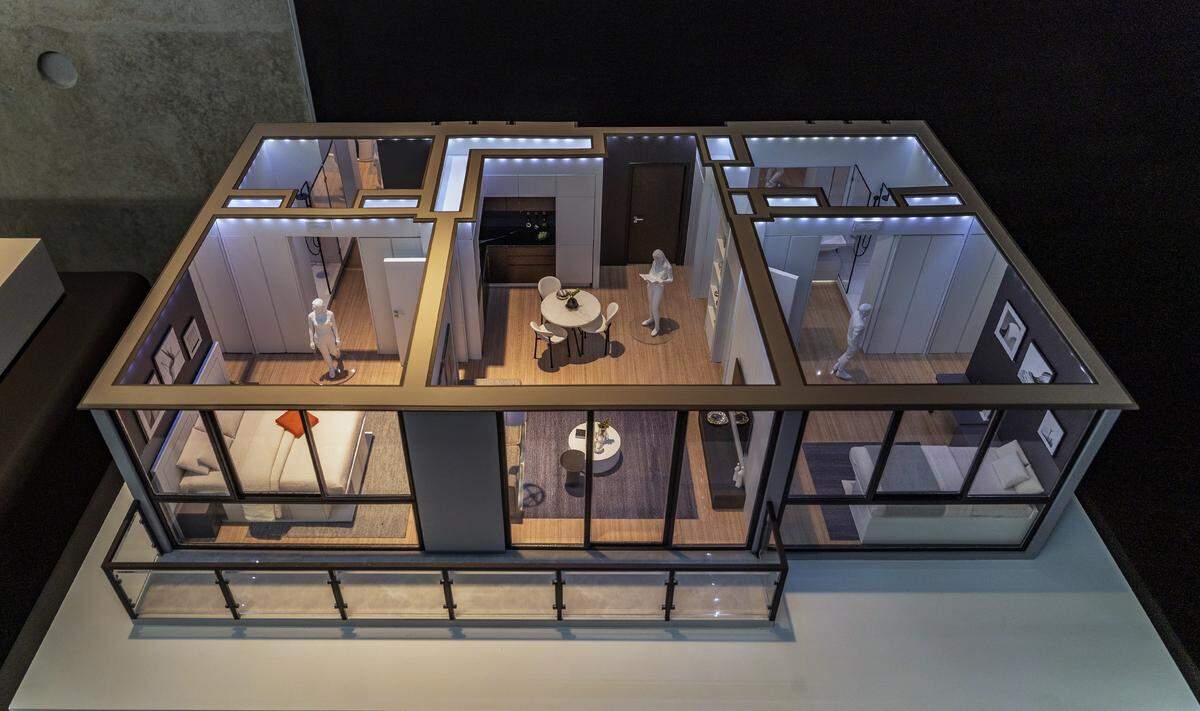
Those starting rents, which range from $1,300 for studios to $1,900 for two-bedroom apartments, are not just substantially lower than prevailing market rents, but also markedly lower than those in designated “workforce” residential projects touted as affordable by some developers and public officials. Also unusually, in a further savings for renters, all apartments will come fully furnished in a contemporary style, with pieces specifically designed to make the most efficient use of floor layouts.
But that’s not all.
Castro says the rents at HueHub will cover services like babysitting and dogwalking. Residents can also avail themselves of a typical suite of amenities, including co-working areas and not just one but several gyms and swimming pools, as well as an increasingly popular feature in high-end residential projects — wellness programs.

In addition, HueHub will boast some decidedly uncommon features: a library, a learning center for kids and older adults, a show kitchen offering lessons in healthy cooking, an art gallery focused not just on exhibition but on art education, and a two-acre central park with pickleball courts, a dog park and an outdoor “social hub.” The complex will also provide housecleaning services for a fee.
For him, Castro said, HueHub is an opportunity not just to make a profit, but to forge a community that improves life for its residents. The project’s name, which he said alludes to the hues of sunrise, is intended to underscore “a new vibe, a new beginning” for its residents.
“Of course it’s a real-estate project,” Castro said. “At the end, it has to be profitable. But it’s different. I did a lot of reflection. To me, it’s a social project. We are filling a gap.”
‘A fantastic deal’
Steadman Stahl, president of the South Florida Police Benevolent Association, said he was surprised and “excited” when Castro’s team approached him with the idea. The PBA has 7,500 members in Miami-Dade and Monroe counties, including sheriff’s deputies in both, and high housing costs are a major reason the agencies that employ them struggle to recruit and retain officers and support staff, he said.
“When 50 percent of your salary is going to rent, we are seeing officers leaving the Miami-Dade area to agencies like Palm Beach, where the pay and benefits are about the same, and they have a chance to buy a house or save up to buy a house,” Stahl said.
Stahl said he happily signed the agreement, which obligates the union only to publicize the availability of apartments at HueHub. The organization plans to bring in the developer and scale models to the union hall soon to present to members, he said.
“It was just a fantastic deal. It can be used as a hiring tool to draw people to work for you,” Stahl said. “I think this is going to be the future. It may not be for everybody, but it seems it will give some of these people a chance to get out of mom and dad’s house.”
Some of the potential beneficiaries work just steps away from the site — teachers at Miami-Dade public schools’ Dr. Henry W. Mack/West Little River K-8 Center, which sits a block away.
It may all sound too good to be true, Castro concedes. But he said it’s made possible by a combination of factors.
Those include the project’s scale, an innovative, money-saving design and building process centered on widely accepted modular construction methods, a willingness to think big, and his adoption of elements from two controversial laws — special Miami-Dade zoning rules that allow supersized projects near transit lines, and the state’s Live Local Act, which boosts allowable height and density and grants significant property-tax breaks for qualifying properties.
Castro bought the 12-acre site for HueHub, a former residential facility for disabled seniors that was converted into apartments, for $29.3 million in cash in 2023. A percentage of the apartments are vacant, and remaining leases are running out over the next couple of months and won’t be renewed. Castro said he won’t charge those tenants rent until then.
The complex also includes a church, which is moving elsewhere but is remaining rent-free until demolition begins early next year, and a public preschool, which will move temporary to the Mack campus, but return to HueHub once the project is built, Castro said. The Urban League of Greater Miami, which used to run the senior facility and whose offices are on the site, will move out temporarily but return to HueHub on completion.
Otherwise, Castro said, he’s ready to break ground next February.
He says his financials are solid, investors signed up and banks ready to lend. He and his partners have sunk $20 million so far into design and development, Castro said.
The county has granted development approvals and he’s waiting for construction permits from the building department. He intends to start construction early next year and build the entire project at once, which he said saves on costs. He expects construction to take 27 months
“My numbers are good. My investors are happy,” Castro said in an interview. “Why? It makes sense to them. The commitments are all there.”
As to the rent guarantees, which are laid out in signed agreements with several unions, Castro said: “It’s, first, a proof of commitment and, second, it makes me feel really good.”
.jpg "The HueHub_Exterior Amenities 3 (2).jpg")
‘Really revolutionary’
Castro’s architects at Arquitectonica, the Coconut Grove-based firm that has designed hundreds of projects across the globe, have relished the challenge of undertaking a project that founder Bernardo Fort-Brescia said is unlike any other they’ve worked on in the United States.
“It’s really revolutionary, like a city with amazing parks and amenities,” Fort-Brescia said. “What he’s doing is a small town. This is crazy fantastic. Because it’s very much needed.
“It will be a game-changer. It’s a very European model, first time I’ve seen this in the United States. We study architecture to do something for society. It’s like a dream for an architect.”
Fort-Brescia said he’s convinced that Castro is for real.
“Other developers will be baffled — how can he charge that little? But he has a particular mindset that is unusual,” Fort-Brescia said. “He is serious and direct, and he knows what he wants. He started doing this in Barcelona, and he comes with a lot of experience in this field.”
One reason the project is feasible is that the usual development process — design first, then hire a contractor to figure out how to build — was reversed, Castro and Fort-Brescia said. That saved substantial money up front.
“We decided first how to build it,” Castro said. “Then we designed it.”
They settled on tunnel form construction, a reliable method that uses reusable steel molds to rapidly cast concrete walls and slabs. The molds are removed, stacked above the previous floor and a new, identical floor is quickly created. They’re also using prefabricated modular kitchens and bathrooms.
“It’s extremely efficient and fast,” Fort-Brescia said, but he added that designing with the method was a learning process for the architectural team. “We have to design with this kind of modulation in mind. Everything is thought out in terms of how you can mass-produce it.”
The task was then to come with building designs for the 34-story towers that would avoid monotony and add some design and artistic flair, Fort-Brescia said.
“Once we understood the system, we designed with it. We tried to turn it into something artistic so it will feel unique to those who live it, that creates an identity,” Fort-Brescia said. “It wasn’t easy, but sometimes the challenge makes it better. It was an interesting process. It was really fun.”
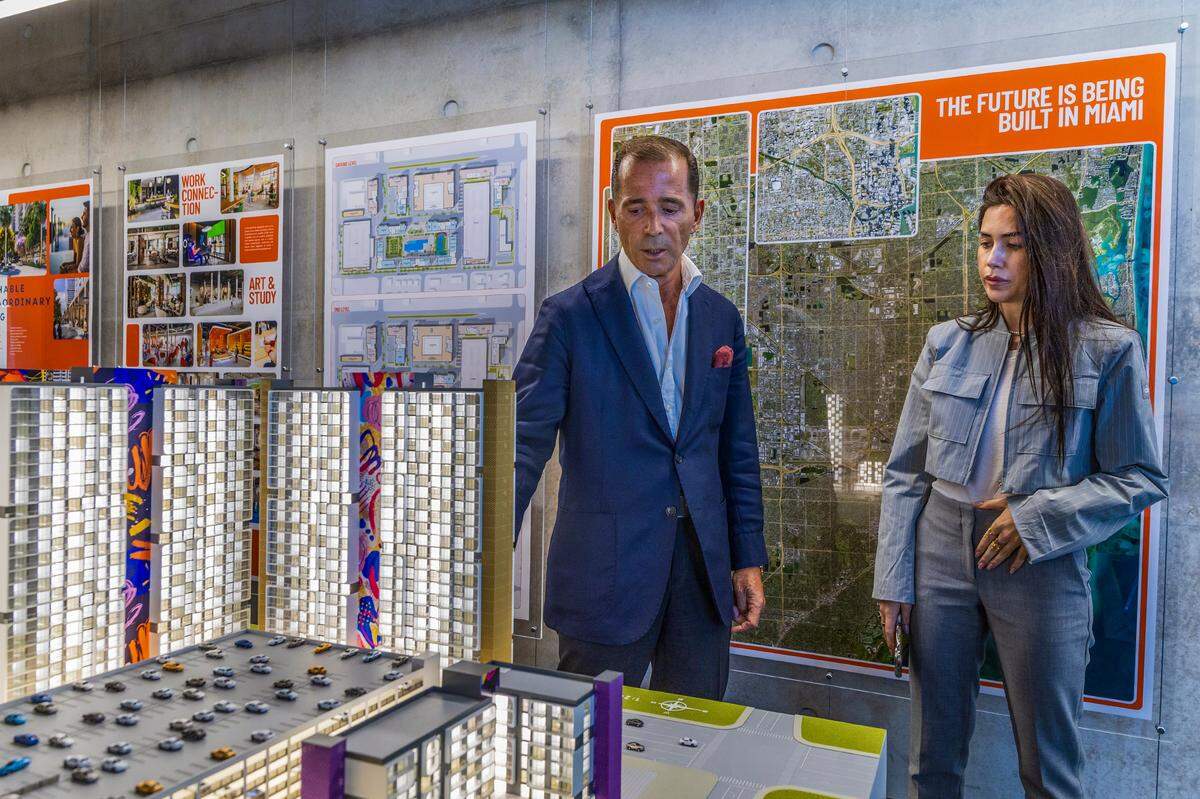
The architectural team did so by designing two different tower types, one in an L-shape and the other straight up, then arranging them in an irregular pattern them around the central public spaces. Apartment windows are floor-to-ceiling. Scalloped ledges surround groupings of apartment balconies add variety to the towers’ exteriors, as do commissioned murals for each that will rise the full height of the towers.
It also helps that the tower rise straight from the ground without the usual parking garage podiums, he said. That’s because parking will be in two stand-alone garages at the edges of the property. That also saves a lot of money because it simplifies the structural design of the towers.
It also allows for the first two stories of each building to be dedicated to public, community and amenity spaces, bringing life and foot traffic to the ground level. The fact that people will be walking in and out of the buildings, not driving, also fosters friendly interactions.
Designed with sense of community
It’s all a deliberate strategy to create a sense of community, Fort-Brescia said.
“It has elements of the traditional and modernity. He has these traditional, unexpected elements like a library,” Fort-Brescia said. “And notice that he builds everything around a central park, where people socialize and meet each other as neighbors.”
Castro, who also described his project as a response to a real estate and development industry he called “archaic,” said his chosen construction method has other advantages as well. It produces far less construction waste and is safer for construction crews.
Another significant cost-saving measure: The enclosed hallways in the towers will be ventilated but not air-conditioned, an approach common in Europe and Latin America.
“It’s another galaxy” in comparison to the typical Miami housing development, Castro said, and that’s in part because its conception grew out of numerous conversations with union leaders, local teachers’ groups like the nonprofit Education Fund, and elected officials.
What he learned was that there’s not enough housing for people and families making between $60,000 and $120,000 a year. Many cops, teachers and firefighters often live far from their jobs and the schools and communities they serve — in the case of some firefighters, whose shifts cover several days while they sleep in the station house, it means commuting from as far as Orlando.
And the lack of housing means counties, municipalities and schools have trouble recruiting and retaining their workforce. The county’s middle class, meanwhile, has been shrinking as people leave Miami-Dade for less expensive cities and towns.
“This is unsustainable,” Castro said.
Castro said he sought out properties that were centrally located, in areas with lower land costs, that were near transit facilities. The property he purchased at 8395 NW 27th Ave., once the Covenant Palms senior living complex, which closed several years ago, is close enough to the Metrorail line, which curves west at 79th Street, or four long blocks to the south, that it qualifies for upzoning under the county’s rapid transit zoning program. If a long-delayed Metrorail extension up Northwest 27th Avenue is ever built, the plan calls for a station in front of HueHub.
The transit-oriented and Live Local zoning does mean HueHub’s towers will be far taller than anything in the vicinity, including single-family homes and duplexes at its rear and a couple of new affordable and workforce housing developments nearby. It will, however, likely provide a boon to nearby businesses, including a strip mall across the street with a Presidente supermarket where owners have been upgrading shop brands.
Once the state passed Live Local in 2023, the project also qualified for big tax breaks. The act requires a developer to set aside 40 percent of units in a project as “workforce” housing, but Castro noted that his rents are lower than those set out under Live Local, and he’s setting aside two-thirds of his planned units.
Live Local project rents must be affordable to people making up to 120 percent of the local median household income -- $87,200 a year in Miami-Dade. Under federal guidelines, that means rents of $2,604 for studios and up to $3,345 for a two-bedroom apartment.
Overall, Castro noted, his rents are 30 percent lower than market averages for the county.
In fact, his promised “workforce” rents are so low they are affordable under those federal guidelines to people making as little as 60 to 70 percent of the county median. That’s near levels usually achieved only by heavily subsidized affordable housing developments.
Those HueHub rents are almost identical to rents listed in apartments.com for the new 600-unit Northside Transit Village affordable housing tower at the Metrorail station of that name, the closest to Castro’s project site. The Northside project, built on station land by an affordable housing developer, is aimed at people with moderate to very low incomes.