
On the issues, Scott and Crist offer major differences
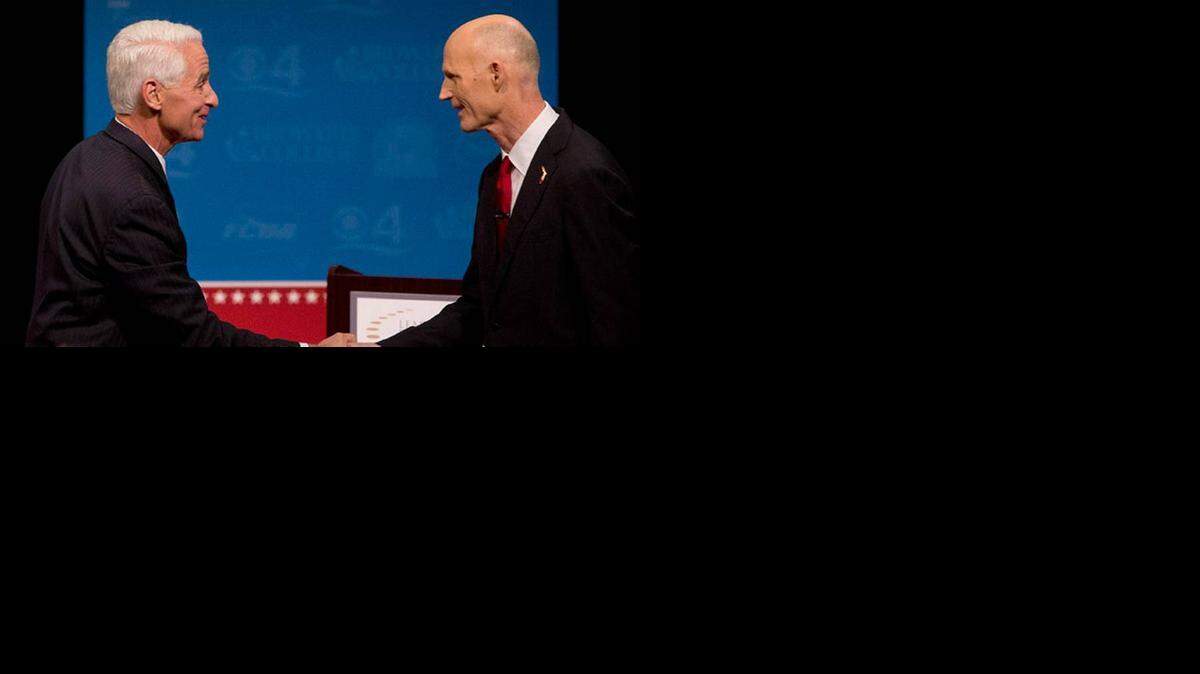
Florida’s race for governor may be one of the nastiest on record as candidates shout it out in more than $83 million in television ads, but beneath the rhetoric is a record of real differences between Gov. Rick Scott, the Republican, and his predecessor and challenger, former Gov. Charlie Crist, the Democrat.
Here is where they stand, and where they have been, on key issues:
ABORTION
Scott: Opposes abortion and has supported more restrictions on it; signed a bill Crist had vetoed that requires women to have an ultrasound before getting an abortion; signed bills to ban abortions after 24 weeks, including cases of rape and incest, tighten parental notification requirements and use proceeds from Choose Life license plate to pay for anti-abortion ads.
Crist: Throughout most of his political career, he has said he opposes abortion but has opposed tough abortion restrictions, while he has supported milder ones. In 1992, he said he was “pro-choice” but opposed state-funded abortion; in 1995, he helped kill a bill to require 24-hour waiting period for women to get an abortion; in 2006, he called himself “pro-life” but said he didn’t want to change the law; in 2010, he vetoed a bill that would have required women seeking abortions to get an ultrasound; and in 2014 he says he opposes any additional abortion restrictions.
AMENDMENTS ON BALLOT
AMENDMENT ONE, Florida land and water preservation
Scott: Opposes
Crist: Supports
AMENDMENT TWO, medical marijuana
Scott: Opposes
Crist: Supports
AMENDMENT THREE, appointment of judges
Scott: Supports
Crist: Opposes
CIVIL RIGHTS
Scott: With a GOP-controlled Cabinet, repealed provision adopted by Crist and Cabinet that allowed released felons, under certain conditions, to have civil rights restored without hearings; imposed new requirement that felons wait a minimum wait of five years before they can apply for restoration of civil rights.
Crist: With a bi-partisan Cabinet, streamlined the process for restoring civil rights to felons without hearings, except for violent crimes and sex offenders. Supports returning to that policy.
DRUG TESTS
Scott: Initiated effort to conduct random drug tests for state workers and people seeking public assistance. Federal court ruled it unconstitutional and rule is suspended.
Crist: Opposes random drug tests for state workers and people seeking public assistance.
ENVIRONMENT/GROWTH
Scott: In his first year, Scott cut $700 million from the water management district budgets, forcing layoffs and a reduction in environmental oversight; signed legislation repealing most of the state’s 25-year growth management laws; rejected Crist’s contract to buy U.S. Sugar land for Everglades clean-up but funded other Everglades restoration projects and fought EPA’s water rules. Proposes $1 billion to protect Florida’s waters, including $50 million a year on springs, continued funding of Everglades restoration; developing an Indian River Lagoon plan and cleaning up wastewater in the Keys.
Crist: During his term, initiated plan to buy 187,000 acres of from Clewiston-based U.S. Sugar Corp. for Everglades restoration; wants a state plan to reduce nutrient pollution particularly from Big Sugar, and stricter consumptive use water permits to protect the state’s springs; promises to restore Florida Forever land-conservation program that has been slashed during Scott’s term to protect key pieces of land.
ENERGY
Scott: Won’t say whether he still believes that humans have contributed to climate change; repealed solar installation rebates; supports fracking for natural gas; supports renewable energy but not renewable energy mandates.
Crist: Proposed a plan to reduce state greenhouse gas emissions by 40 percent and require utilities to produce 20 percent of their power from renewables that was rejected by state legislators; supports incentives to increase Florida’s renewable energy mix, especially solar expansion; opposes fracking for natural gas and wants existing utilities to reduce dependence on coal and carbon-based fuel.
ENERGY REGULATION
Scott: Supported law that allows utility regulators to charge customers in advance for nuclear power plants; signed law that imposed new requirements on utility companies after Duke Energy was able to collect up to $3.2 billion for a nuclear power plant that it scrapped; appointed regulators to Public Service Commission backed by utility industry.
Crist: Wants to “overhaul” the state Public Service Commission which regulates utilities and repeal the nuclear fee; replaced pro-utility regulators on PSC with consumer advocates but GOP-led legislators blocked their confirmation; said he would pull back two appointments made by Scott, Julie Imanuel Brown and Jimmy Patronis, but would have to wait until the terms expire of other utility-backed commissioners: Lisa Edgar, Ronald Brisé and Art Graham.
GAMBLING COMPACT
Scott: Supports expansion of gambling as long as it includes a local referendum. Was prepared to support giving the Seminole Tribe the ability to expand its casino footprint in Florida from seven to eight casinos and prohibit the construction of a casino in Miami for at least 7 years in exchange for $2 billion in revenues over 7 years. The proposal was never approved after legislators opposed it.
Crist: Remains unspecific about a gambling agreement with the Seminole Tribe except that it must enhance the economy and revenues for education; says he’s “not convinced yet on destination casinos.”
GAY MARRIAGE
Scott: Supports Florida’s ban on gay marriage but has recently said he will go along with what courts decide.
Crist: Supported civil unions but not gay marriage in 2006; supported constitutional ban on same-sex marriage in 2008; now favors same-sex marriage and repeal of the state’s ban.
HIGHER ED/TUITION
Scott: Opposes any tuition increases; signed budget that raised requirements for Bright Futures scholarships for 26,000 students and cut $300 million from higher education budget his second year.
Crist: Proposes creating a loan-forgiveness program for students who study science and math-related fields (STEM) and work in Florida; wants to expand financial assistance to low-income, first-generation college students and create a loan financing program to help students refinance debt. Vetoed a tuition increase his first year as governor.
IMMIGRATION
Scott: Reversed himself on two issues he campaigned on in 2010 -- he backed away from his 2010 promise to pass an Arizona-style immigration law and, after vetoing a bill in 2013 to give DREAMers (undocumented illegal immigrants who are accepted into college or military) driver’s licenses, he signed it this year.
Crist: Reversed himself on in-state tuition for illegal immigrants, opposed it 2006 as a Republican candidate for governor but supports it now.
K-12/COMMON CORE
Scott: Issued an executive order calling for town hall meetings and public feedback on the Common Core State Standards; supports the revised benchmarks now known as the Florida Standards.
Crist: Supports the Common Core State Standards.
K-12/FUNDING
Scott: Supported cut of $1.3 billion in education spending; wants to raise per-pupil spending by $232 to an all-time high of $7,176; supports expanding school vouchers to students in low-performing schools.
Crist: Wants to raise per-pupil funding to an all-time high, but has not specified a dollar amount; set a goal to improve Florida’s ranking in reading, math, science and technology by 2020; opposes expanding any school vouchers.
K-12/TESTING
Scott: Has called for a “thorough investigation into all standardized testing.”
Crist: Supports some assessments for students, but says testing is “out of control;” would like to see the overall number of tests reduced.
K-12 VOUCHERS
Scott: Supports school vouchers, as well as a new program that provides scholarships to children with the most profound special needs; signed legislation increasing the amount of the corporate scholarship and creating partial scholarships for children from higher-income families.
Crist: Was an early supporter of the school voucher program in his first term; now says the program is in need of a comprehensive review and public schools should benefit from a similar tax credit program; supports teachers union lawsuit challenging the constitutionality of the voucher program.
MEDICAL MARIJUANA
Scott: Opposes Amendment 2 that would allow for cultivation and dispensing of marijuana under a doctor’s order for certain medical conditions; signed into law a bill to allow for low-THC marijuana to be used exclusively for patients with epilepsy, muscle spasms and cancer.
Crist: Supports Amendment 2 which is being pushed by his employer, lawyer John Morgan.
MEDICAID EXPANSION
Scott: Would support legislation that uses federal Medicaid expansion dollars to reduce the number of uninsured Floridians but only if it is 100 percent funded by the federal government; has not made Medicaid expansion priority and did not actively lobby the Legislature to pass it.
Crist: Would make Medicaid expansion a priority and either call a special session to force the Legislature to act or implement it through executive order.
MINIMUM WAGE
Scott: Opposes changes to the minimum wage, which is $7.93.
Crist: Supports increasing minimum wage to $10.10 an hour.
PROPERTY INSURANCE
Scott: Scott’s appointees to state-run Citizens Property Insurance have helped to shrink the size of the company by 500,000 policies – most of which have been moved into the private, newly-formed companies; during his term, regulators ushered in a system that has raised rates for homeowners and reduced coverage but also reduced the state’s risk and likelihood of assessments on other policies.
Crist: Promises to reduce property insurance rates; previously supported a cap on property insurance rate hikes and vetoed the bill Scott eventually signed that limited sinkhole coverage and allowed for rate increases.
TRANSPORTATION
Scott: Rejected $2.4 billion in federal funds for high-speed rail between Tampa and Orlando in his first year; supports the privately-run All Aboard Florida effort and signed budgets with new money to pay for infrastructure needed for the project; supports efforts to convert major highways to toll ways and backs plan to create new toll roads in rural areas.
Crist: Supports reviving the high-speed rail between Tampa and Orlando scuttled by Scott; undecided about All Aboard Florida; shelved plan to create new toll roads in rural areas preferring to focus on existing roads; supports incentives for fuel efficient cars and mass transit.
Miami Herald reporter Kathleen McGrory and Tampa Bay Times reporter Steve Bousquet contributed to this report.
Mary Ellen Klas can be reached at meklas@MiamiHerald.com and on Twitter @MaryEllenKlas
This story was originally published October 20, 2014 at 2:41 PM with the headline "On the issues, Scott and Crist offer major differences."