Miami archbishop asks to hold Mass at Alligator Alcatraz. ‘Still waiting’ for answer
Miami’s top Catholic leader stopped by the state’s controversial Everglades detention center for migrants during a Sunday motorcycle ride with dozens of other Catholic bikers.
Archbishop Thomas Wenski visited ‘Alligator Alcatraz,’ Florida’s new migrant detention center located in an isolated airstrip near the Big Cypress National Preserve, to pray for for detainees — a trip that he said “emerged organically” when his group of Catholic bikers wanted to visit Florida City for lunch. But the entrance of the facility is as far as the group was able to go without approval from officials.
“Sunday PM about 25 Knights on Bikes stopped at entrance of Alligator Alcatraz and prayed a rosary for the detainees,” Wenski wrote on a post on X. “Archdiocese is still waiting for approval to access to provide Mass for detainees.”Wenski, in an interview with the Miami Herald, said the head of the Archdiocese’ Detention Ministry went in person over a week ago to request access for religious services, but never heard back from the facility. In addition, Wenski said he reached out to both federal and state officials, who pointed at each other to handle the request for religious services.
“We’ve gotten a lot of runaround,” Wenski said. “We don’t know who’s really accountable for that facility, whether it’s the state of Florida or the federal government.”Wenski said the Florida Conference of Catholic Bishops has also been making requests with the governor’s office and the Florida Department of Corrections, but has not yet heard back about gaining access.
Officials at the Archdiocese said they are hopeful that the facility will allow chaplains and clergy to visit and “offer spiritual care, the sacraments, and the healing presence of Christ to those in detention.”
“Mass is important because ... the harsh conditions there, very far from being the Four Seasons as governor DeSantis says that he didn’t want to create the Four Seasons there, but the harsh conditions are seemingly designed to dehumanize people,” Wenski said.
Wenski recalled a situation that happened earlier this year when a Catholic priest was turned away from Krome Detention Center because it was “too crowded.” Wenski said this wasn’t “an acceptable answer” and was later permitted to offer Easter Sunday mass for the detainees. He said it’s a gesture that he said was appreciated by those who are held in detention, many of whom have been living in Miami for decades.
“When we celebrate mass, we’re bringing God to people. And by bringing God to people is one way of humanizing them and affirming their dignity as human beings, and telling them that they’re not forgotten,” he said.
Wenski, who recently denounced the detention center, was joined by around 25 “Knights on Bikes,” a charitable Catholic ministry within the Knights of Columbus organization, and shared photos and videos of the pastoral excursion.
The Archdiocese of Miami called the visit “a powerful moment of prayerful solidarity,” that reflects the organization’s “ongoing commitment to ministering to the marginalized and incarcerated.”
“...Decency requires that we remember the individuals being detained are fathers and mothers, brothers and sisters of distressed relatives,” Wenski said in a statement. “We wish to ensure that chaplains and pastoral ministers can serve those in custody, to their benefit and that of the staff.”
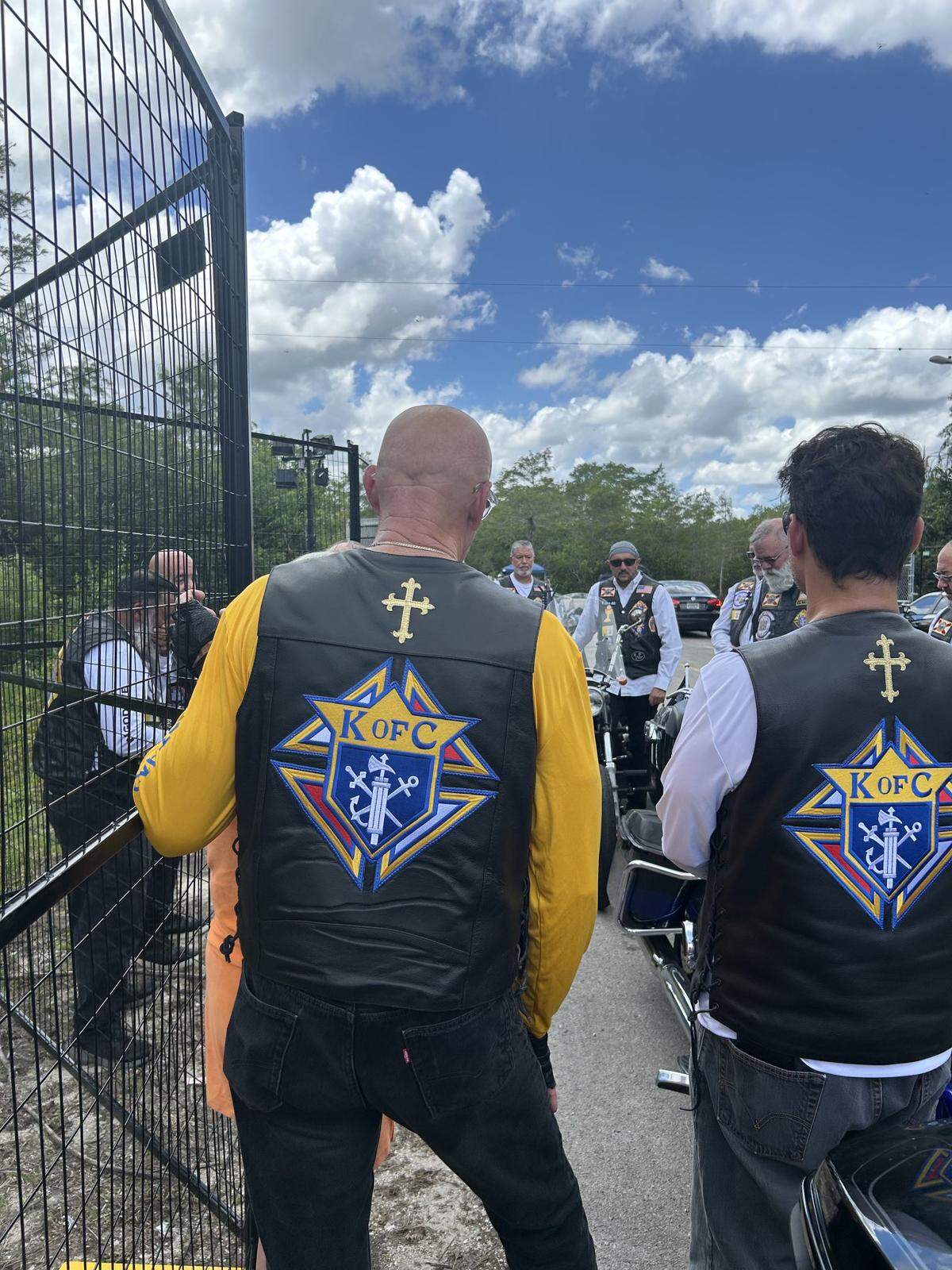
Sunday’s motorcycle visit is the second act of solidarity the Catholic church has shown in recent weeks to oppose Florida’s crackdown on deportations. In a prior statement, Wenski said it was “alarming to see enforcement tactics that treat all irregular immigrants as dangerous criminals.”
In the strongly word column posted to the Archdiocese of Miami’s website earlier this month, Wenski said “the apparent lack of due process in deportation proceedings in recent months,” was surprising and called the rhetoric surrounding the ‘Alligator Alcatraz’ “intentionally provocative.”
Gov. Ron DeSantis and other state officials have repeatedly defended conditions for detainees at the pop-up migrant camp. Earlier this month, Stephanie Hartman, a spokeswoman for the Florida Division of Emergency Management, said detainees’ stories about problems at the facility — including toilets that don’t flush, large bugs and temperatures that fluctuate from icy to sweltering — were inaccurate.
“The reporting on the conditions in the facility is completely false,” Hartman told the Herald. “The facility meets all required standards and is in good working order.”
This story was produced with financial support from Trish and Dan Bell and from donors comprising the South Florida Jewish and Muslim Communities, including Khalid and Diana Mirza, in partnership with Journalism Funding Partners. The Miami Herald maintains full editorial control of this work.
This story was originally published July 21, 2025 at 2:48 PM.