
These pickleballs don’t clog up landfills with microplastic. And they perform, team says
David Neill was playing pickleball in Daytona Beach about 18 months ago when the idea for his company was born.
“I saw people throwing cracked pickleballs into trash cans,” said Neill, 58, of Cocoa Beach. “Some guys were just throwing balls over the fence and not even putting them into trash cans.
“I thought: ‘This could harm this great sport because we’re not being good neighbors.’”
Neill did some research and discovered that an estimated 500 million pickleballs are produced annually, and that means that 77 million pounds of microplastic ends up in landfills, where they leak into the ground water.
“The average pickleball takes more than 100 years to decompose,” Neill said. “We can’t keep adding to what is already a crisis regarding plastics in the environment.”
There had to be a better way, and Neill and co-founder Dave Milo started a company called Komodo Pickleball.
Together, Neill and Milo created BioBall, which they say is the world’s first biodegradable ball approved by the United States Pickleball Association, the sport’s governing body.
According to Neill, the BioBall is five times more durable than traditional pickleballs, lasting up to 60 or 70 games on a single ball.
At the core of BioBall is its proprietary biodegradable polymer composition.
“The BioBall breaks down within three to five years, and it leaves no harmful micro-plastics or toxic residues behind,” said Neill, who has a background in technology and marketing. “This is a responsible technological advancement. The goal is to reduce the sport’s carbon footprint by replacing the traditional plastic pickleball.”
The key for the eco-friendly BioBall, however, is that it addressed environmental concerns without compromising on performance.
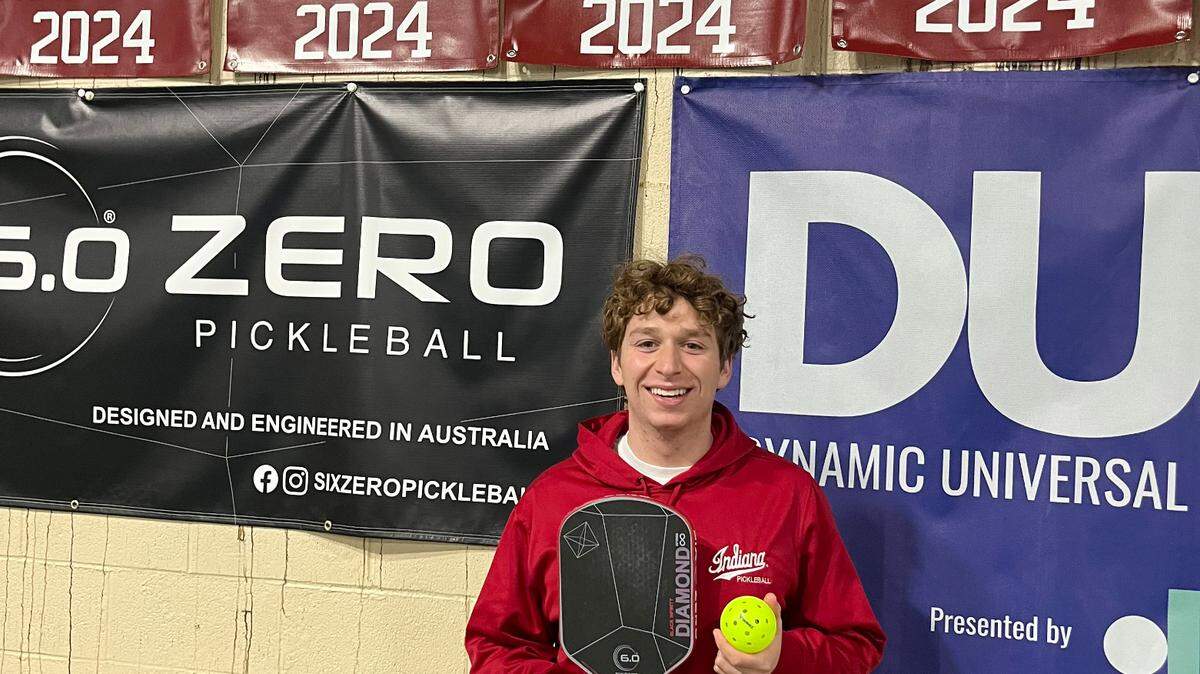
“I have a lot of ‘ball nerds’ on my team,” said Timber Tucker, pickleball coach at Indiana University. “They never seem to be happy with a ball.
“But the first time we used the BioBall, which was in a tournament in Cincinnati, one of my players came up to me during warm-ups and said, ‘Hey, this [BioBall] is really fast.’
“Our players really liked the ball, and they asked me to reach out to the company to get more.”
Tucker said the BioBall seems sturdier than the competition even though the weight (26 grams) is the same.
As for how the ball helps the environment, the Indiana players knew nothing about that when they first used the BioBall in Cincinnati.
“I think our kids are concerned with the environment,” Tucker said. “But if they didn’t like the ball, they wouldn’t use it — flat out.”
Neill said the price of the BioBall – $3.62 per ball — is in line with the competition. They are sold only through the company’s website, komodopickleball.com
“We’re not trying to gouge consumers,” Neill said. “We want a path of no resistance — a better-performing ball that is sustainable for the environment.
“The BioBall is youth focused, and we are the official ball for the National Collegiate Pickleball Association.
“Our tagline for BioBall is: ‘Built for the game, designed for the planet.’”

To our pickleball fans and readers: A new pickleball column will be posted every other week. If you have any suggestions on future columns, please email me at: wvilla07@yahoo.com