
‘My price is my price’: Miami Art Week is a business opportunity for visual artists
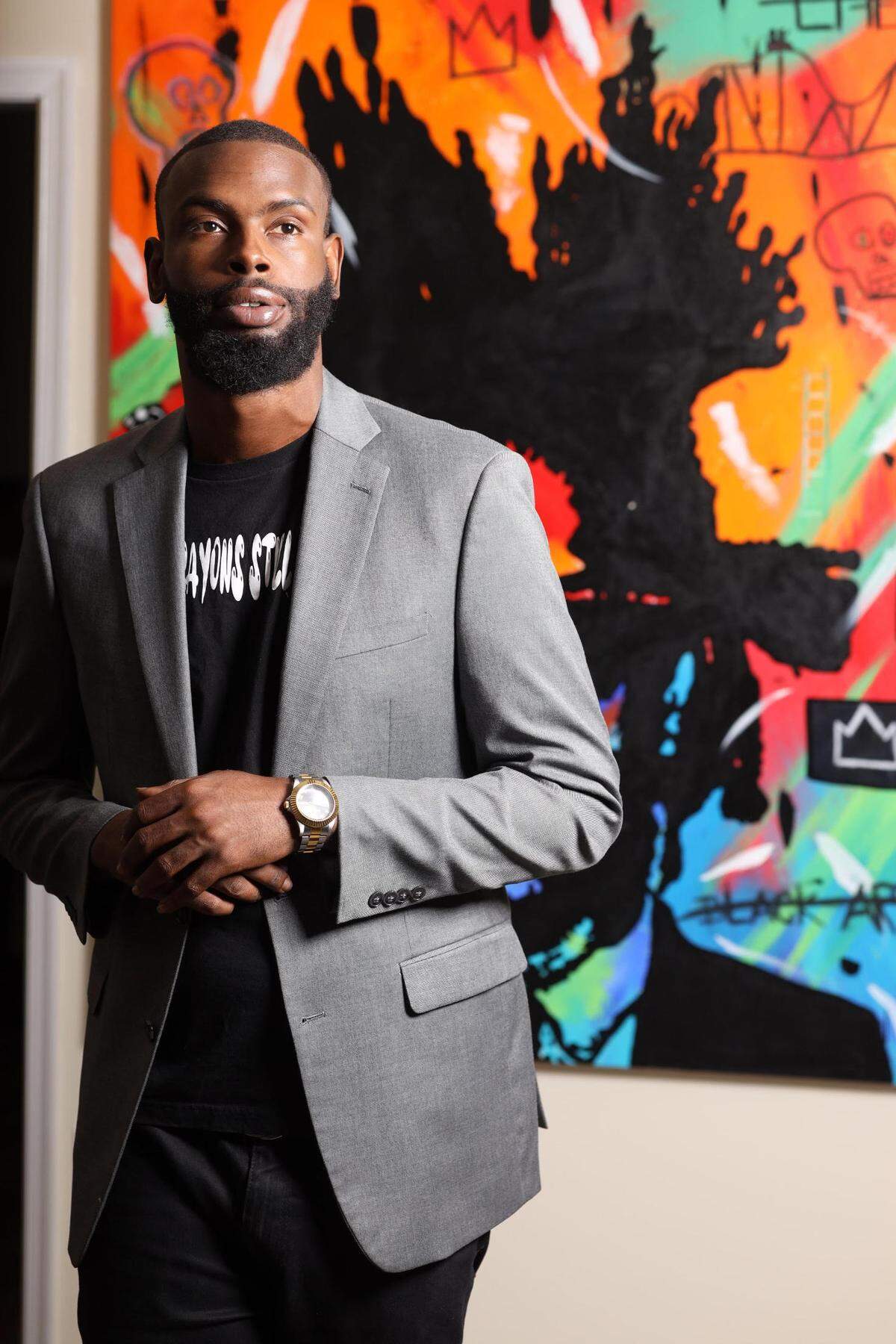
Eddie Graham worked as an airplane fueler at the Philadelphia International Airport before he was laid off in 2018, something he saw as a sign that he needed to pursue his artwork full time.
That year was the first time he was selected to participate in a Miami Art Week show. Graham, 36, has traveled back and forth between his home in Chester, Pennsylvania, and Miami since then.
In his years of visiting for Art Week, Graham has noticed how much his business can fluctuate. During some years, Graham has made nearly $10,000 in one week. In others, he’s made $1,500 or less.
“At some shows, the artist has to actually be the salesman and interact with the guests and people interacting with their artwork, “ he said. “Some artists can’t do that. If a person is on the fence of buying a work, that’s [where] it comes in.”
For visual artists, Miami Art Week is an opportunity to showcase their work to tourists, celebrities and art enthusiasts that view the city as the center of the art world for seven days. It’s also an opportunity to sell artwork and directly interact with potential customers with whom they would not typically meet.
Kendall native and multidisciplinary artist Smita Sen sees Art Week as a way to appreciate other artists and art lovers from around the world and values the opportunity to network with those individuals. Those moments can possibly lead to sales, but she understands that selling her work is not guaranteed.
“It’s such a special, energetic moment,” said Sen, 30. “Sales are always important, but it’s not always something you’ll always be able to pull off.”
Over the past decade, Sen has created artwork that reflects the body’s transformation during injuries and illness. She trained as a dancer and sustained dance-related injuries before pivoting to visual art and later took care of her late father as he dealt with a terminal illness.
“Both showed me how the body has changed over time,” she said. “Illness is transformative.”
Sen’s work is primarily on display at North Miami’s Museum of Contemporary Art and ranges from drawings to short films. Learning how to raise funds as an artist has been as important for Sen as honing her skills as an artist.
For pieces that require a team, such as film projects, she seeks grant funding that usually ranges between $2,000 and $15,000. After securing funding, she then reaches out to potential collaborators.
“I apply for funding before I get other team members so I don’t put people in positions where they won’t be supported,” she said. “I’ve been diligent about applying for funding, knowing who to go to and putting together a strong proposal. I’m proud that I can nurture a sincere artmaking process.”
Having a close experience with illness shaped Sen’s perspective on having health insurance and a stable income as an artist. She maintains a full-time job as a design tech teacher while working on her art.
“I don’t want to set up a GoFundMe every single time something happens,” she said. “I like to be able to get my cousin a gift if she’s having a baby. I want to [be able to] take my mom out for Mother’s Day lunch.”
Graham, the Pennsylvania artist, said he hasn’t had a day job since 2018, when he began receiving more commissions for his artwork. For one memorable commission around that time, he received a bulk order from an organization to design 50 custom jackets.
“From there, that was what I was supposed to be doing,” Graham said. “I found my purpose within life. Everyone has a calling and doesn’t have to be stuck within the norms.”
Graham’s business consists of participating in art shows, painting murals, completing commissions, and teaching kids and individuals with special needs. While he takes pride in all of his work, Miami Art Week has a unique allure for Graham.
In his first few years of attending the event, Graham focused on being able to sell his work in the city’s most popular areas. He put decals on the sides of a rented pickup truck that had the name of his Instagram handle so that people could follow him on social media.
When Graham parked, his artwork was on the outside of the truck to catch people’s attention as they walked by. This method helped Graham connect with potential customers and helped him market himself.
As a full-time artist participating in Love of Urban Design (LOUD), an Art Week event in Miami Gardens that features Black artists, Graham believes that Miami during Art Basel is the ultimate marketplace for his work.
He believes in the high value of the work he creates and has the confidence to not sell it for less than what he believes it is worth.
“For me, my price is my price,” he said.
%20Cropped.jpg)