
A developer wants to build outside Miami-Dade’s urban zone. County: no problem
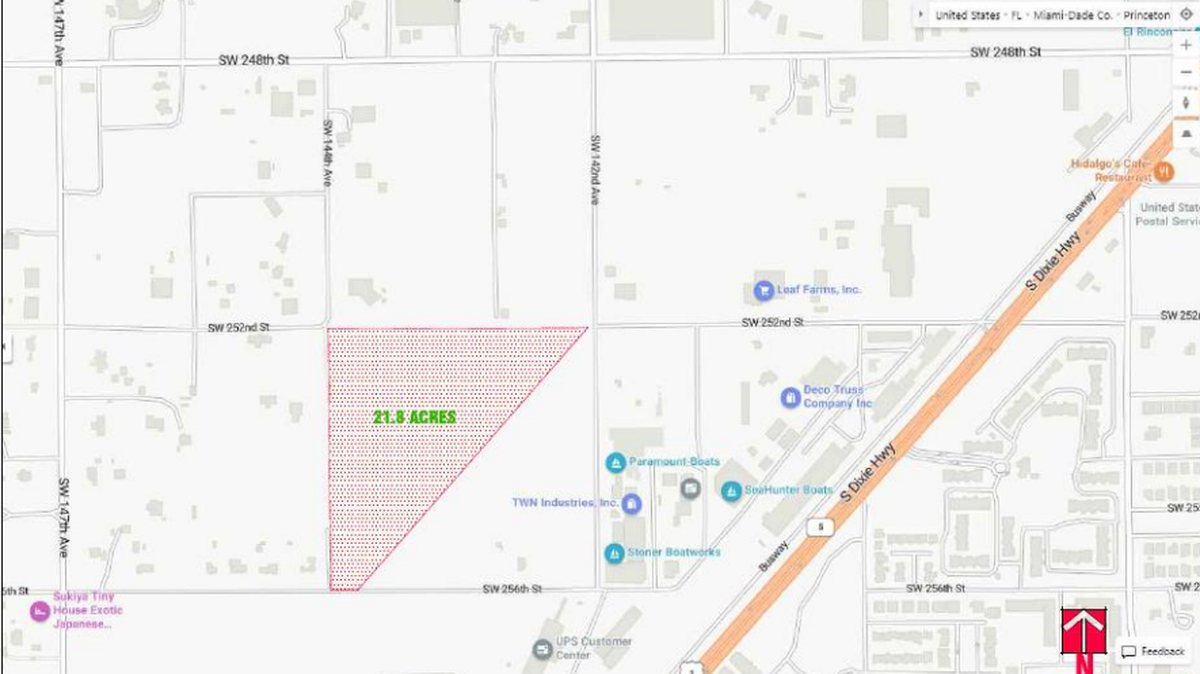
Developers usually face a big fight to expand the boundary between suburban development and rural Miami-Dade County.
But on Thursday, before a vote to expand what’s known as the Urban Development Boundary, TMC Naranja Holdings LLC met a half-empty County Commission chambers, an embrace from the administration of Mayor Daniella Levine Cava and even a partial endorsement from a group whose typical role is fighting expansion requests.
“This is the right place for future growth,” Laura Reynolds, head of the Hold the Line coalition, told commissioners ahead of their unanimous vote to expand the Urban Development Boundary (UDB) by 20 acres to allow construction of an apartment and townhouse complex off of Southwest 248th Street. That’s about a half-mile northwest from U.S. 1 and the county’s new rapid-transit bus line.
READ MORE: ‘Flood gates are opened.’ More projects want approval outside Miami-Dade development zone
Reynolds did ask commissioners to fortify protections for the Everglades by removing some environmentally sensitive acreage from consideration for future expansions.
That request — which commissioners ignored — was the only pushback from environmental groups to a commission that was bombarded by opposition the last time the board considered expanding the development boundary. That was in 2022, when developers wanted to bring 380 acres of farmland into the development zone to build a warehouse complex off Florida’s Turnpike about 3 miles southwest of the Naranja proposal.
Environmental groups attacked that project as wanting farmland that might be needed for a major Everglades restoration effort. By a one-vote margin, commissioners approved expanding the development boundary over Levine Cava’s veto — the first time the development zone grew in nine years.
The site was also criticized for being so prone to flooding by Biscayne Bay that construction would require changes to Miami-Dade policies against development in areas vulnerable to storm surge.
The Naranja project didn’t have that kind of environmental baggage. About 25% of the project site already sits within the urban development zone, a result of the property being split by the original boundary when commissioners first laid it out in the 1980s. A similar apartment complex is already being built in the area that’s within the development zone.
“We feel this is a property that never should have been left out of the UDB,” Javier Vazquez, a lawyer and lobbyist for the project, told commissioners. “As we see things, this is a correction, not so much an expansion.”
The project plans roughly 600 rental units, most of them apartments but with some townhomes. About 20% of the units will be capped at “workforce” rent prices, currently about $3,000 for a one-bedroom apartment, but the county report noted that rents well lower than the cap are already readily available within 5 miles of the project site.
The property sits within walking distance of a new county transit line expected to open next year. That’s the South Dade rapid-transit bus system, which will use the existing dedicated bus lanes — now known as the Transitway — to run express routes between Florida City and the Dadeland South Metrorail station.
Commissioner Danielle Cohen Higgins said it makes no sense to discourage development on land so close to transit options like the bus corridor — proximity she said explained the lack of pushback to the Naranja proposal.
“That’s why the environmental community isn’t here,” she said.
With Levine Cava’s planning staff recommending approval of the boundary expansion for Naranja, Commissioner Roberto Gonzalez questioned why the administration couldn’t find ways to support other projects.
“Let’s speak plainly,” he said. “Staff is recommending development outside the UDB because the UDB matters until staff decides that it doesn’t.”