
Homeless count dips in Miami Beach amid arrests. Is that related to an uptick in Miami?
Miami-Dade County’s unsheltered homeless population has held relatively steady since last summer, hovering around 1,000 people.
But a breakdown of the numbers recently released by the county’s Homeless Trust shows a decrease in Miami Beach — from 152 people last August to 132 now — and an increase in Miami — from 534 people to 619 — that caught the attention of Homeless Trust Chairman Ron Book.
Book said that, while it’s too soon to draw definitive conclusions, the figures raise questions about whether heightened enforcement of an outdoor sleeping ban in Miami Beach may be resulting in homeless people migrating across the bay.
“I think it’s too early to answer that, but clearly there’s a population shifting from the Beach,” Book said.
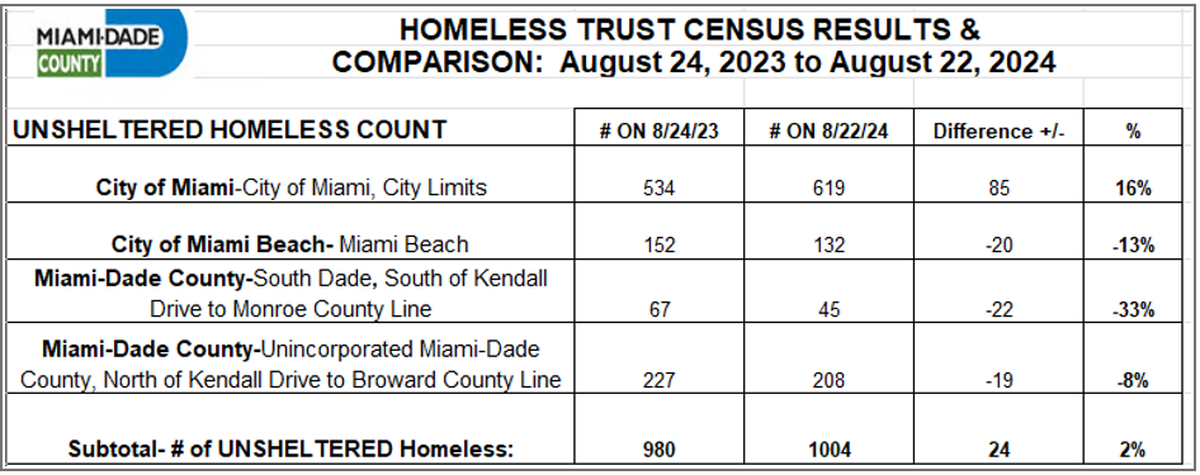
The countywide total of unsheltered people in an Aug. 22 overnight count was 1,004, up from 980 last August.
The Homeless Trust has not yet released updated data on how many people are staying in homeless shelters countywide. As of last August, that number was 2,740.
“Our shelters are bursting at the seams,” Book said.
The Homeless Trust does two counts of the unsheltered population per year, one in January and another in August. The organization prefers to compare its August point-in-time counts with past years’ August counts, saying it’s the best way to measure changes in the homeless population over time.
In January, the unsheltered count was 631 people in Miami and 154 in Miami Beach. Despite the number of unsheltered people in Miami decreasing slightly from January to August, Book said the overall trend indicates an uptick in Miami’s homeless population.
“The bottom line is, Miami clearly had the only real increase,” Book said.
Miami Beach police have made more than 200 arrests for illegal camping under the revised ordinance that took effect in October, according to a city memo issued last week.
Under the ordinance, police must give people experiencing homelessness a chance to accept shelter before making an arrest. There are no shelter beds in Miami Beach, but the city has contracts for more than 70 beds at shelters in Miami.
READ MORE: ‘It is inhumane’: Miami Beach ramps up enforcement of sleeping law aimed at homeless
In late July, Miami Beach Mayor Steven Meiner announced an initiative, Operation Summer Relief, with a goal of “not having any homeless person living on our streets” in August.
Meiner has called the city’s approach “compassionate” and a form of “tough love,” saying it gives homeless people a chance to accept shelter and other services and only imposes penalties if they refuse to do so.
Homeless advocates disagree, arguing that the city’s offerings don’t include permanent affordable housing and that making arrests just perpetuates the cycle of homelessness once the person is released.
“You can’t arrest your way out of homelessness,” Book said.
Officials in Miami are taking note of the aggressive posture in Miami Beach — and, like Book, are wondering if it’s having an effect on their city.
Miami City Commissioner Damian Pardo, whose district includes downtown, said Wednesday that reducing homelessness requires a collaborative effort between municipalities.
“This should be a regional issue, and we should approach it with regional policy,” Pardo said. “If you’re just moving a situation to different parts of an area, no one wins.”
That means working in tandem instead of acting in silos, Pardo said, though he said he doesn’t know enough about the full impact of Miami Beach’s policies to independently determine if they have contributed to an increased homeless population in Miami.
Miami Mayor Francis Suarez, who vowed to prioritize reducing homelessness in his State of the City address in January, said in a statement Wednesday that he was encouraged by the latest figures showing a slight decrease in the city’s homeless population since January.
Suarez said the city has allocated about $2 million and plans to allocate an additional $2 million “to support organizations that serve individuals who are homeless or are suffering from homeless situations,” in addition to the city’s “regular budgetary allocations.”
“Thanks to these measures our count has decreased,” Suarez said. “We are seeing progress in our 631 number from January 2024 to 619 in August 2024. We will continue to monitor and interact with other municipalities to see if there’s any correlation in the steps being taken to address homelessness.”
A Miami Beach spokesperson did not respond to questions Wednesday about the latest Homeless Trust figures.
Last week, as he observed the overnight homeless count on Lincoln Road Mall, Miami Beach City Manager Eric Carpenter told the Herald the city is “trying to do what we think is best for both the constituents that are homeless as well as the rest of the city.”
“We’re trying to constantly strike that balance,” he said. “I do think that we are giving people every opportunity to choose to accept our services and hopefully get themselves in a better place in life.”
The Homeless Trust’s point-in-time counts are seen as the best available estimate of the county’s population of people without housing. But the process is far from scientific.
Last Thursday, Homeless Trust staff, city officials and police split into teams across the county, walking the streets to identify individuals who appeared to be homeless or who officials recognized from their work in the community.
In Miami Beach, the teams were instructed to determine whether people were homeless based on their judgment and expertise without asking them directly about their situations, in an effort to make the process more efficient.
“The goal is to make sure we are counting everybody that’s out there,” Book told workers who gathered at Miami Beach’s Homeless Outreach office in South Beach before the count.
The unsheltered population in Miami-Dade County pales in comparison to that of many other large metro areas.
In San Francisco, for example, a recent point-in-time count indicated there were more than 4,300 unsheltered people citywide. Miami-Dade’s total population is more than three times that of San Francisco.
Still, a new Florida law is putting pressure on local governments to further reduce their unsheltered populations. Gov. Ron DeSantis signed House Bill 1365 into law in March at a news conference in Miami Beach, forbidding cities and counties from allowing people to sleep or camp in public spaces beginning Oct. 1.
The law will allow people, businesses and the attorney general to sue local governments to force them to remove homeless people from the streets starting Jan. 1.
Those communities could instead create camps — away from neighborhoods and businesses — approved by the Department of Children and Families. Most communities would have to offer security, sanitation and behavioral health services to people staying at the camps.
Book, who works as a powerful Tallahassee lobbyist in addition to running the Homeless Trust, voiced support for the legislation earlier this year, saying he was encouraged by state leaders “tackling the issue of homelessness” despite his opposition to establishing mass encampments.
He was more critical of the law in an interview with the Herald on Wednesday.
“The encampment law is not a good law,” Book said. “We don’t think it’s good, and we don’t like it.”
This story was originally published August 29, 2024 at 5:00 AM.

.jpg)