
Can good design help solve the housing crisis? One South Florida designer is betting on it
Some architects dream of building lofty skyscrapers or attention-grabbing homes for the rich and famous.
Not Margi Glavovic Nothard. The Fort Lauderdale-based design director has built a thriving architectural firm by instead applying her considerable design chops to a heretofore unglamorous field of development: Low-income housing.
Her Glavovic Studio does it with style, bringing to affordable housing the kind of design flair that wins accolades from architecture critics. There’s no cookie-cutter in the firm’s portfolio, just one-of-a-kind designs, contemporary in look and function, that Nothard says aim to do all the responsible things high-end architecture should aspire to — adapt to the environment, to the surroundings, to the community — while keeping costs down.
“The architecture itself has to be elevated, “Nothard said. “Every building should be like that, not just those for rich people. If you can do something great and beautiful for people who maybe don’t make a lot of money, it can uplift all of us.”
It’s a socially responsible focus that had fallen out of vogue in architecture and remains rare in the profession despite something of a revival in recent years. But amid the national housing crisis, it’s paying off for Nothard after 25 years of under-the-radar practice in Fort Lauderdale and 35 years in architecture.
She now has half a dozen high-profile affordable-housing projects under way in Miami-Dade County, in Dallas and in Los Angeles, where the firm also maintains a small office, that embrace a range of innovations to speed up construction, lower costs and bolster sustainability.
And that’s not all the versatile firm does. The studio has long experience with civic, arts and cultural commissions that embrace a similar community-minded ethic, like its arts-oriented redo of Hollywood’s Young Circle park, which has helped energize the city’s renascent downtown.
The latest, completed in May: a sculptural installation that’s truly on the edge. Located in a park where the road literally ends in the suburban Broward County city of Tamarac, Nothard’s “Sunset Hammock” consists of a long, sloping ramp, executed in aluminum powder-coated a bright red, that takes visitors up to what she calls a periscope offering an otherwise unavailable glimpse of the Everglades just over the abutting six lanes of Interstate 75.
To Nothard, the studio’s multifarious work is all of a piece.
“The work we do is to provide public value for the public good,” Nothard said. “Ninety-nine percent of our work is about elevating the quality of life for the average person.”
All it takes is patience. Sunset Hammock, paid for in bits and pieces with a National Endowment for the Arts grant and water-conservation funds, took 10 years. Her extensive improvements to the NSU Art Museum Fort Lauderdale took place over seven years Those included a revamped lobby, a new cafe and a landscaped entry plaza with a monumental exterior steel staircase that provides views of the New River.
And though affordable housing is now a front-burner issue, it wasn’t always so, and progress has come slowly, she notes.
A decade ago, when her studio launched its first design for low-income housing, the Dr. Kennedy Homes on Fort Lauderdale’s Broward Boulevard, next to the historic Sailboat Bend neighborhood, local residents initially resisted the plan, Nothard recalls. But the city’s housing authority and its private development partners allowed her considerable runway for a design that incorporated open green spaces and both conventional and modular construction elements to keep costs down, winning neighbors over.
The result, wrote then-Miami Herald architecture critic Alastair Gordon in 2015, was “a truly sustainable community with dynamic architecture and open, flowing spaces that reach out into adjacent neighborhoods” — and at less than $100 a square foot, a low cost he called “almost impossible to comprehend.”
That’s a template Nothard has followed since in her designs for a slate of private affordable-housing developments that are now close to breaking ground after years of planning, a consequence of the constraints and complications involved in financing projects aimed at people making under 50 percent of the local median income, which typically requires significant subsidies.
In a 2016 article after a studio visit to Glavovic, the Architects’ Newspaper said Nothard is “someone who should be better known outside Florida.” That’s now starting to happen.
Her Kennedy homes design brought her to the attention of the affordable-housing arm of the giant AIDS Healthcare Foundation, which provides health services to people living with HIV around the globe. The L.A.-based foundation has expanded its reach to development of low-income housing that is not restricted to people with HIV, and turned to Nothard and Glavovic Studio for both conversion of historic buildings into apartments as well as ground-up construction.
Since 2017, Nothard has been working on a set of residential and mixed-use projects for the AIDS organization’s Healthy Housing Foundation — two of them in Miami-Dade.
Her designs have been everything the foundation wished for and more, said Ebonni Chrispin, the organization’s director of legislative affairs and community engagement.
“Margi has been doing incredible community work for years,” Chrispin said. “She’s very humble. But as an architect for over 25 years, she is very clear-minded when it comes to thinking about architecture and development, and how it impacts racial justice, older people, the environment. She truly is innovative. It’s how we should be building globally and local. She is, to me, the top of the top.”

The first to start construction, likely in September, will be the Renaissance Center, a 15-story tower with 216 apartments in downtown Los Angeles’ Skid Row that will be that city’s first high-rise made of prefabricated modular pieces. Touted as a “national prototype,” it’s meant for people with very low and extremely low incomes.
In L.A., Glavovic has also designed the conversion for the AIDS foundation of a pair of historic buildings, including the famed Morrison Hotel — notably photographed for the cover of the Doors’ album of the same name — into affordable housing. In Dallas, also for the foundation, she’s designing the conversion of another existing building into affordable apartments.
In Miami-Dade, Nothard has completed designs for two upcoming projects for the AIDS foundation in a pair of hot, gentrifying neighborhoods, Edgewater and Little River.
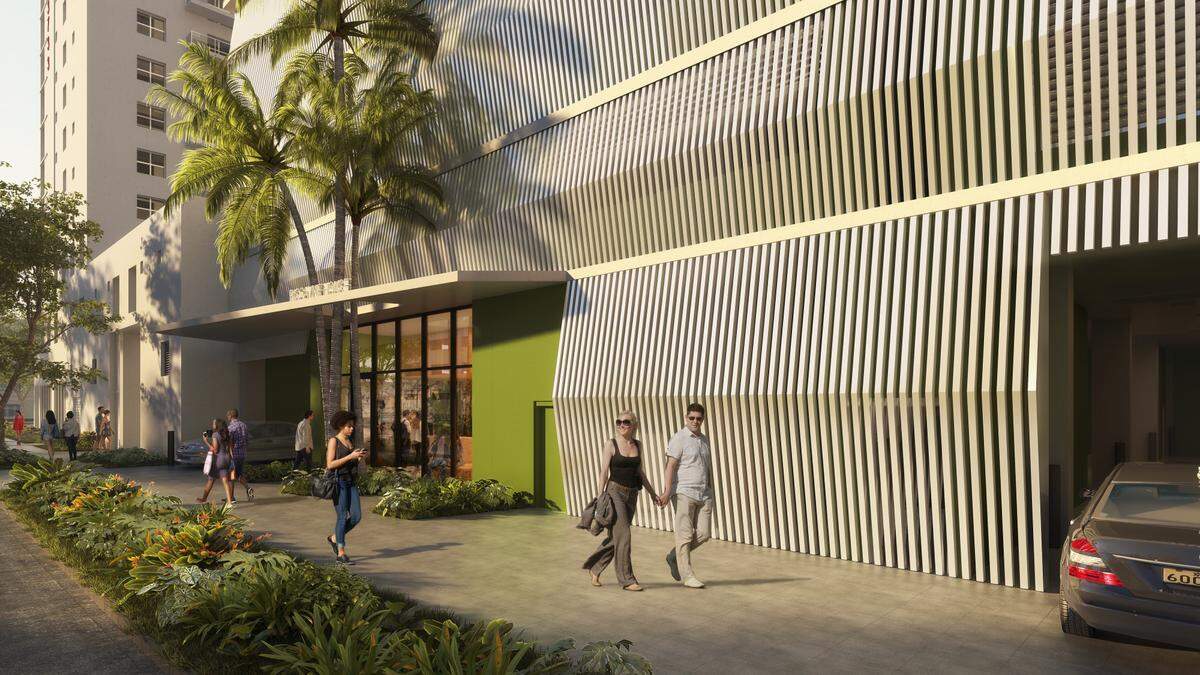
The pedestrian-friendly, 12-story Biscayne House will be nestled between two of Edgewater’s high-priced high-rises, with 75 apartments for people making 50 percent or below of the county’s median income, which works out to $39,750. To keep a lid on costs and speed up construction, prefab kitchen and bath pods will be inserted into the apartments as they’re built. Cooling overhangs and wraparound, landscaped balconies help reduce electricity costs for tenants. Each floor of the four-story garage is screened off with a slightly bulging metallic latticework that creates edgy visual interest for people on the street.
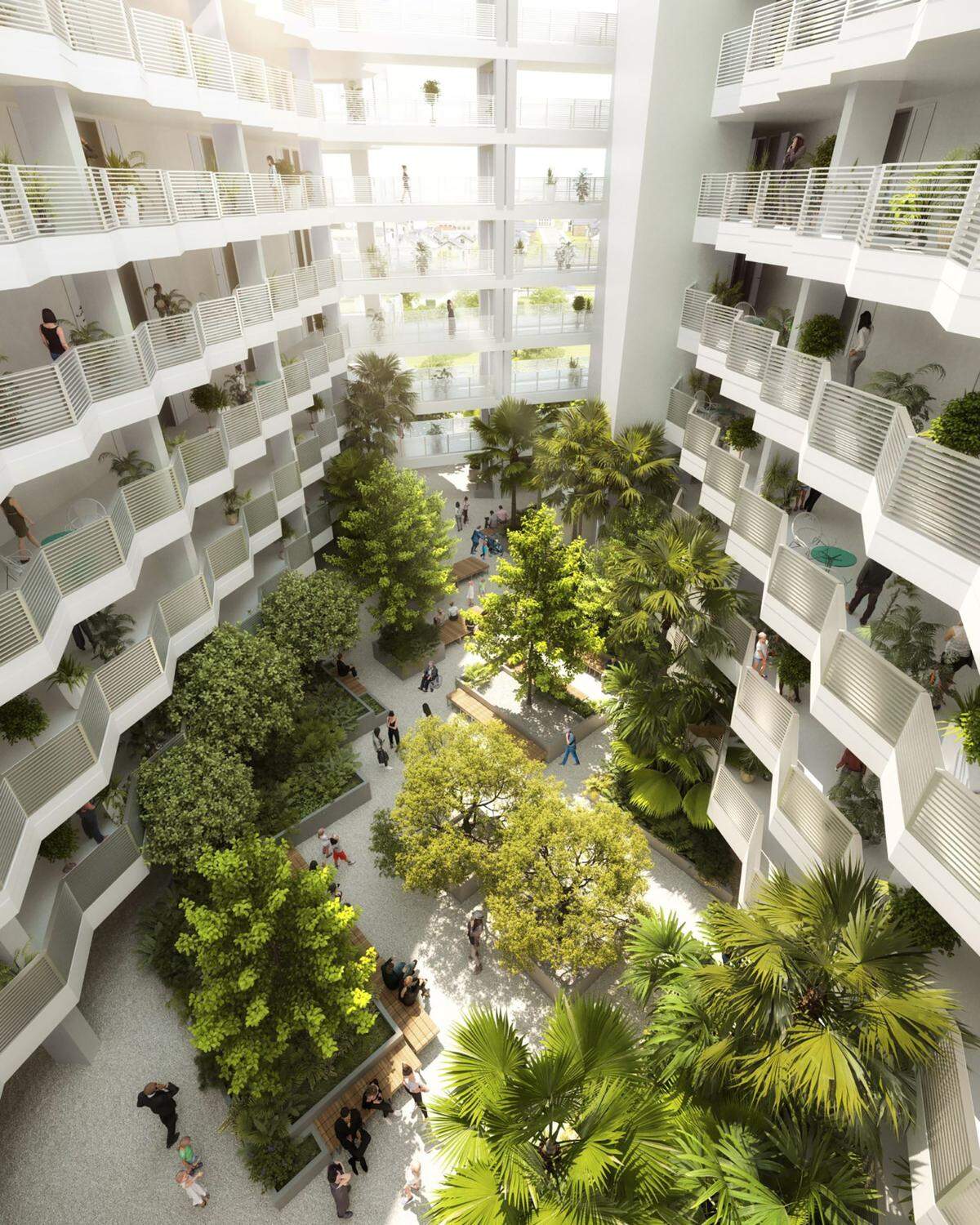
Little River Plaza, on Northeast 79th Street, will comprise 250 apartments in a 12-story tower, also for people making 50 percent or less of area median income. It features passive cooling from shady wraparound balconies and aluminum screens and balcony railings. Thanks to a large lot, the plan also includes a landscaped plaza at the center of the complex as well as indoor and outdoor community gathering spaces on each floor. A market will be on the ground floor.
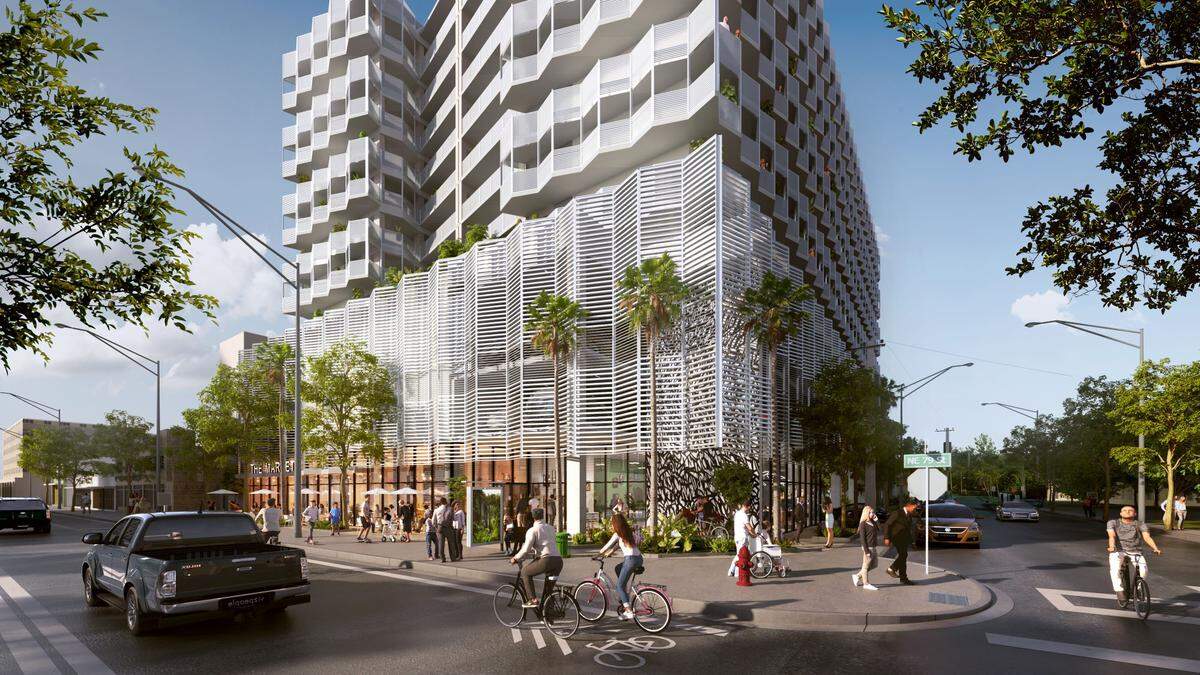
Both projects, Nothard said, are awaiting building permits from the city of Miami and should start construction later this year.
Nothard has also designed an affordable-housing community in Homestead in South Miami-Dade for another socially-oriented client, the nonprofit religious organization Touching Miami with Love, in a partnership with New York developer Procida.
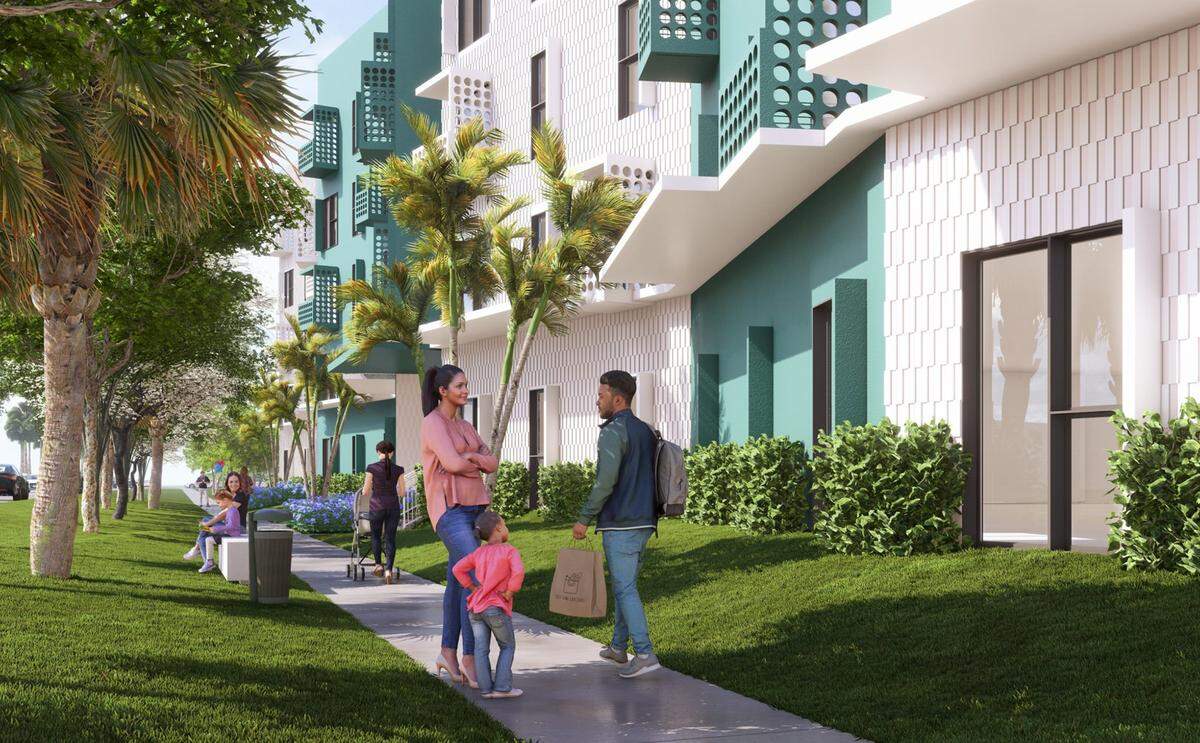
For a lot next to the organization’s campus in western Homestead, the studio designed a low-rise, L-shaped apartment building that creates a pedestrian-friendly environment on the street through an undulating facade punctuated by tropical colors and overhangs, canopies and balconies. Its 100 units boast porches and verandas for cooling and outdoor living space.
Amenities include a gym, playground and community room. The design also calls for recycled construction materials and eschews harmful chemicals. Its extensive native landscaping will use water from a cistern that captures rain. Common areas will be powered by solar panels.
The Homestead project was approved unanimously by the city council on June 26, and should break ground by the middle of 2025, Nothard said.
The work, Nothard said, is all underpinned by her view of housing as a fundamental human right and a sense of social and environmental responsibility she attributes in part to her upbringing in her native South Africa under the former apartheid regime. Her love of nature was nurtured by her father, an environmental lawyer who would take the family “hiking through the bush,” Nothard said.
She left for the United States to pursue an architectural education in what she thought would be a more equitable society, only to find it facing its own set of racial, social and economic imbalances.
“I grew up in a country that was deeply problematic and with so little equity,” Nothard recalls. “I know what I do is just a small blip, but I came to America as a place where I could find that equity.”
She attended SCI-Arc, a private architecture school in Los Angeles known for instilling an artistic and avant-garde bent in its students After working in Los Angeles for 10 years, including a brief stint with the firm of star architect Frank Gehry, she moved to Fort Lauderdale with her husband, Kim Nothard, who works in advertising, and opened Glavovic Studio in 1999. When she sought advice on the move, she recalls, her grad-school director had one bit of advice.
“He said to me, ‘Go where you can make a difference,’ “ Nothard said.
And that’s what she’s done. But building a practice almost entirely, though not exclusively, on public commissions and now affordable housing was an uncommon route in the profession.
“Everyone thought I was crazy,” she said of her decision to turn to low-income housing design. “It was considered sort of a negative. I was. ‘Okay, I could figure it out.’ “
Support has gotten much better, but Nothard finds there’s still considerable denial on the part of some government agencies and the public.
“We still have a lot of people who don’t want to deal with it. It still hasn’t got that urgency in every case,” she said.
In the meantime, Nothard is basking in the glow of finally seeing the commission in Tamarac’s Sunset Point Park through to completion — another case in which the architect managed to make the most with little.
The location where the rail-like ramp stands had been a garbage dump next to a sliver of preserved wetlands. On the north side of the park are townhomes and houses in a dense residential subdivision, with I-75 forming a noisy barrier to the west. On the south are massive distribution centers for Amazon and City Furniture.
So Nothard opted to take advantage of the mound of buried garbage to create a viewing platform that allows visitors to rise above the surrounding development to take in the natural landscape that lies just beyond.
“It becomes a new way of looking at the Everglades. I think this was a poignant location between something important and what’s dominating our culture. It has the drama of going up,” she said. “You almost never get to go up in Florida.”
Correction: An earlier version of the article referred to Margi Glavovic Nothard as an architect. She is a design director.
This story was originally published July 11, 2024 at 5:30 AM.