A baby stopped breathing on a packed Miami highway. What happened next changed lives
Pamela Rauseo is stuck in gridlock on the Dolphin Expressway, a crying baby in the backseat.
She’s on the phone with her husband and also listening to the radio about the crisis in Venezuela. The baby’s wails are deafening. And then, suddenly, silence from the backseat.
Rauseo pulls the car partially onto the shoulder and jumps into the backseat. Her 5-month old nephew Sebastian is still, his face blue.
She tries calling 911, but her fingers won’t move. So Rauseo rushes into the bumper-to-bumper traffic, cradling her nephew, shouting for help.
—
“I felt like I got hit in the gut with a bat and something told me ‘this is not right,’” Rauseo said in an interview this month, recalling the scare on the Miami highway 10 years ago. “He was changing colors on me like a chameleon,” Rauseo recalled.
—
Lucila Godoy, in a nearby car, and Miami Herald photographer Al Diaz, also stuck in traffic between the Northwest 45th and 57th Avenue exits, come to the rescue.
Rauseo drops to her knees, and begins chest compressions and blows air into Sebastian’s mouth, using her CPR training from years ago. Diaz dashes toward a Sweetwater police cruiser a few cars away away and pounds on the window. With emergency lights flashing, the officer follows him to Rauseo.
—
“I was shaking like a leaf,” Diaz said, remembering that day a decade ago.
—
After returning to Rauseo, Diaz steps away and grabs his camera. He stops trembling.
He sees Rauseo drop to the ground and blow air into Sebastian’s mouth for a second time. Other police officers and fire rescue crews, stuck in the gridlock, begin to arrive.
And Diaz starts taking pictures.
Click. Click. Click.
—
On Feb. 20, 2014, Sebastian de la Cruz nearly died on State Road 836 from what doctors later learned were life-threatening cysts on his trachea, his windpipe. He was saved by the heroic and quick-thinking actions by his Aunt Pamela and a group of strangers on the highway.
Since 2008, the American Heart Association has recommended that bystanders not trained in CPR use “Hands-Only CPR,” which includes chest compressions, but not mouth-to-mouth breathing, to help adults and teens who suddenly collapse with cardiac arrest. It still recommends “conventional CPR,” which includes a combination of mouth-to-mouth breathing and compressions, in certain medical emergencies, including for infants and children.
Rauseo underwent CPR training after she and her husband experienced their own scare years earlier, when their infant son stopped breathing. She never used the training until Sebastian stopped breathing on the highway in 2014. Rauseo knows it’s the reason why Sebastian, or Seba as his family calls him, is here today.
Tuesday, Feb. 20, marks 10 years since Rauseo’s heroic efforts — immortalized in a photo taken by Diaz and seen around the world — saved her nephew’s life.
Sebastian, now 10, learned about his rescue last year.
On a February afternoon, while sitting next to his aunt at her Kendall home for an interview with the Miami Herald, Seba — described by his family as a jokester with a big personality — is somber while looking at the image of his aunt on the ground, breathing life back into him.
It’s not the first time he’s seen the photo, but the emotion is the same: “Surprised” that he caused his family a scare and “happy” that his aunt saved him.
For his family, it was a miracle.
“I felt like it was God working through me that day,” said Rauseo, now 47.
“When you think about it, there was an ambulance in traffic, there was a police officer and then there was Al,” the Herald photographer, said Paola Vargas, Sebastian’s mom and an ICU nurse at Jackson Memorial Hospital in Miami.
“Everybody was there at the same time — like, what are the odds?”
—
As Rauseo breathes air into Sebastian’s lungs again, more help arrives.
Miami-Dade Fire Rescue Capt. Anthony Trim and Lt. Alvaro Tonanez are in separate vehicles and stuck in traffic about a half-mile away from Rauseo and the baby. They are returning from a training session in Miami Beach when they hear the emergency call — “kid in respiratory distress or cardiac arrest” — crackle across the emergency radio.
They turn on their lights, and then a miracle in Miami: Drivers actually move aside, opening a path for them to get through.
”I saw Pamela on her knees and the baby on a mat on the shoulder of the road,’‘ Tonanez, a paramedic and firefighter, says. “As I came up, she grabs Sebastian and passes him to me.”
After quickly assessing the infant’s condition, Tonanez begins blowing air around his nose and mouth.
“The aunt did pretty much all we needed to do to get Sebastian back. Did I help by blowing a little bit? Hopefully I did help clear the passageway,” Tonanez says. “His appearance was improved considerably by the time we passed him onto the rescue truck.”
A Miami paramedic unit rushes Sebastian, with Rauseo by his side, to Holtz Children’s Hospital at Jackson Memorial. Rauseo waits until they are at the hospital to call his mom, three months pregnant with her second child.
—
“I remember how confused I was when I walked in and feeling like it was a movie. ... I hear Sebastian crying but I see so many people on top of him,” said Vargas, now 37.
Emergency room visits were common for Sebastian, who was born prematurely and had respiratory issues. In fact, Rauseo was returning home with Sebastian following an appointment with a pulmonologist on Jackson’s campus when they got stuck on the Dolphin Expressway.
If Rauseo had never learned CPR, if she hadn’t been behind the wheel, Sebastian may have died on the highway. And if he hadn’t stopped breathing, doctors would have possibly never discovered the cysts on his trachea, his family said.

Rauseo, Vargas’ older sister who is “like a second mom to her,” was numb in the aftermath. And then, a few days later, while attending church, “the floodgates opened” and she began to sob.
Neither sister can believe how fast time has gone by. They’ve made so many memories with Sebastian since his second chance at life.
And while the scare is not usually on their minds, they say it’s a stark reminder on the importance of knowing CPR. Rauseo’s three sons know the lifesaving technique, and Vargas wants Sebastian to learn CPR when he’s older, too.
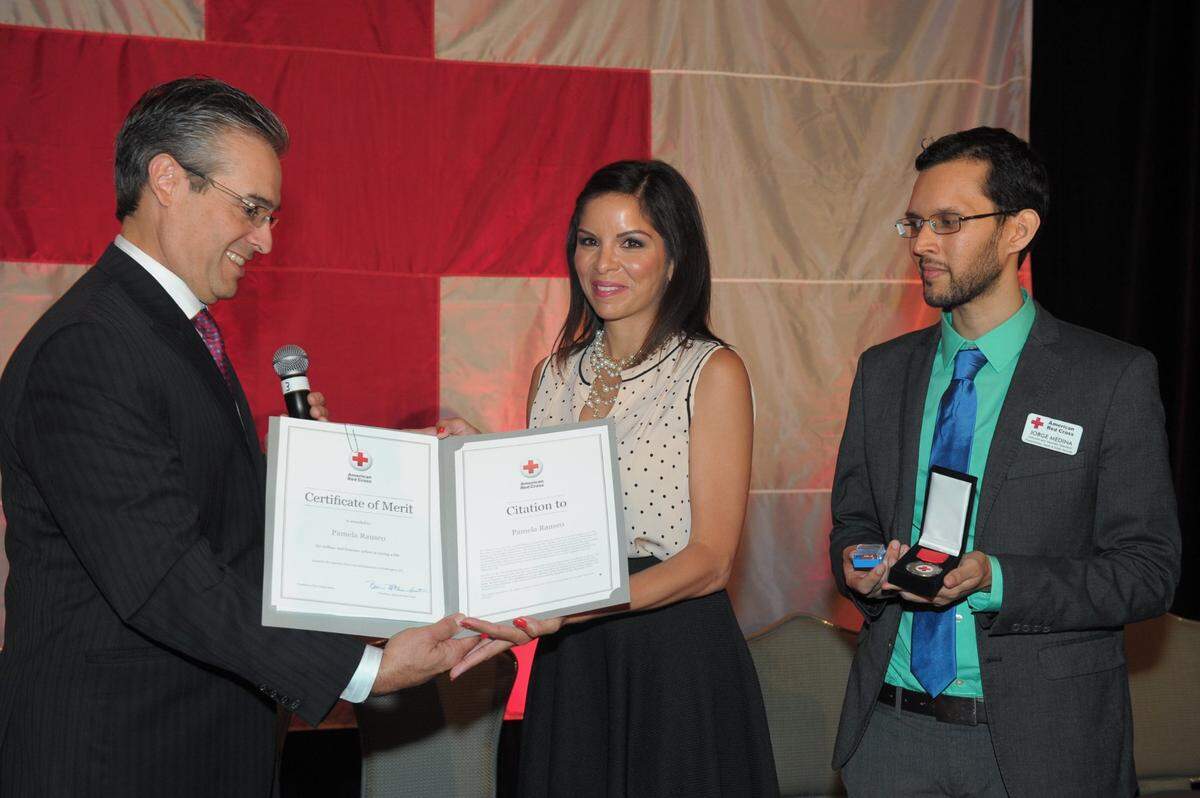
“I think any parent, every parent, should know CPR because if I hadn’t, then our family wouldn’t be complete today,” said Rauseo, who in April 2014 was honored by the American Red Cross South Florida Region for her use of CPR to save Sebastian.
As for Sebastian, the fourth-grader is healthy and doing just fine. He loves math, and is on a soccer team with his sister, Chloe. She’s his best friend.
He wants to be a professional soccer player when he grows up, just like his favorite soccer star Cristiano Ronaldo. He’s also not shy about how much he loves his Aunt Pam. On the day he learned about his rescue, he sent her a video, saying how much he loves her.
For Vargas and Rauseo, as they sit on the sofa, with Sebastian snuggled between them, they reminisce about their favorite memories — dance-offs, family trips.
“It’s just, seeing him that little ... like, this is my reality now,” said Rauseo, holding Sebastian close as she looks at the dramatic award-winning photo Diaz shot those many years ago.
“It brings back really painful memories; it just highlights how fragile that moment was,” Rauseo said. “And how if everything hadn’t aligned the way that it did, we wouldn’t have had the results that we did.”
This story was originally published February 16, 2024 at 6:56 AM.