Decision on Miami voting map rests with federal appeals court. Here are the arguments
A legal battle over how to best draw the city of Miami’s voting map faces an important crossroads that will impact elections in three city districts this November.
Will the U.S. Court of Appeals for the 11th Circuit in Atlanta side with the plaintiffs — community groups represented by the American Civil Liberties Union — whose preferred map was selected by a federal trial judge? Or will the appeals court grant the city’s request to block that map and order a city-approved map to be implemented?
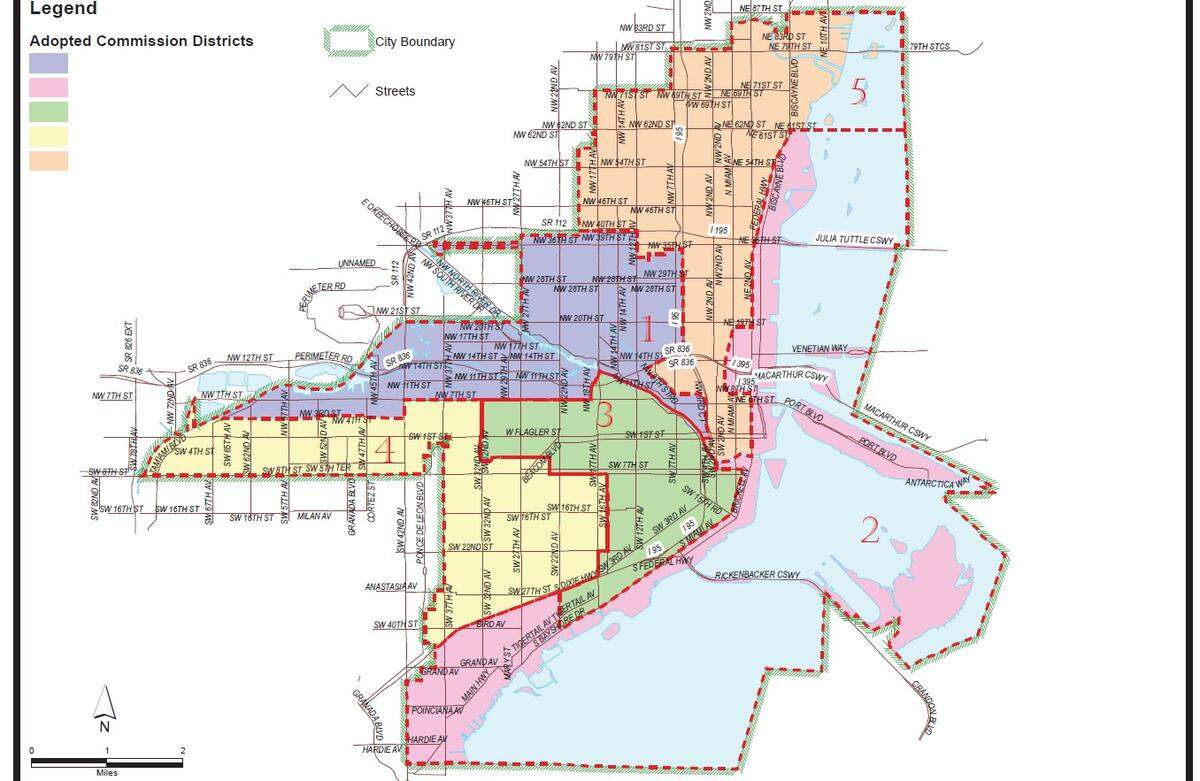
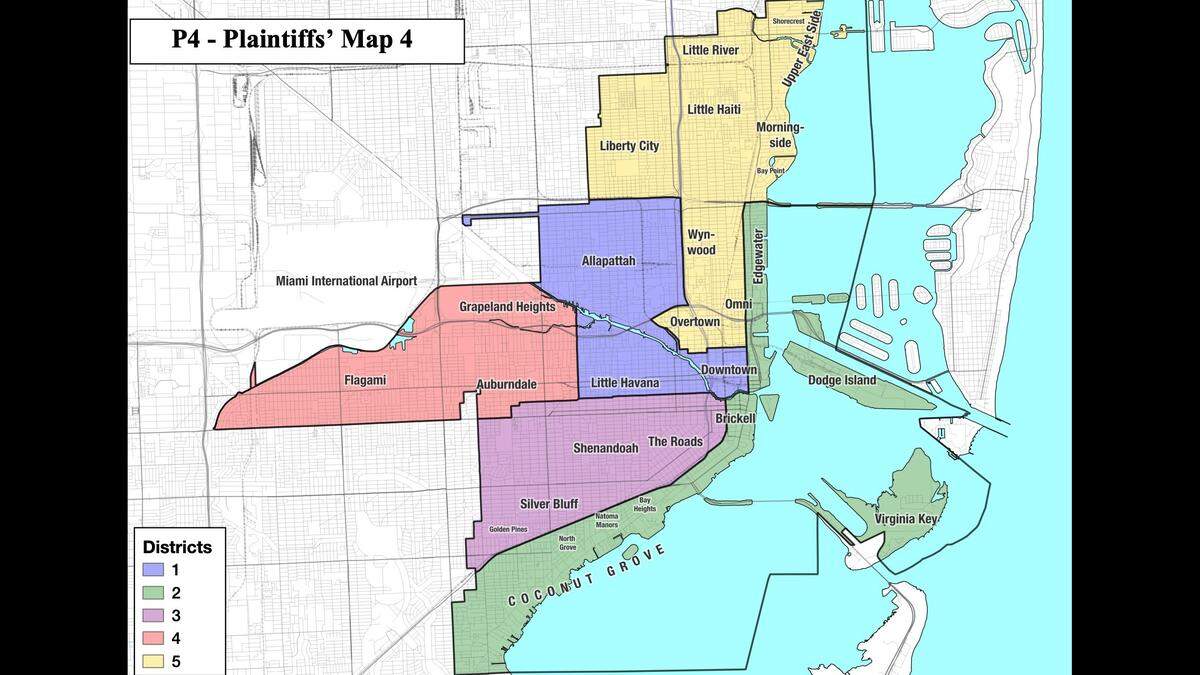
The decision is the latest turning point in a federal lawsuit filed against the city over the 2022 redistricting process, where commissioners redrew the boundaries for the city’s five commission districts. The boundaries matter because they decide who can vote in each district and who is eligible to run for City Commission to represent each district. In Miami’s case, the legal dispute could also create an issue for Commissioner Joe Carollo — in the plaintiffs’ map, his home is no longer in the district he now represents.
Community groups and city residents represented by the ACLU accused the city of passing a racially gerrymandered map that unconstitutionally packed Black and Hispanic voters into certain districts, diluting those voters’ influence in adjacent districts. Two local branches of the NAACP, Engage Miami and Coconut Grove community group GRACE are among the groups suing.
The city’s commissioners and attorneys have maintained they lawfully drew boundaries aimed at preserving an ethnic balance on the City Commission: three Hispanic members, one Black member and one “Anglo” member in a seat that has been previously held commissioners who were non-Hispanic and white.
Both sides have filed their arguments with the appellate court. Officials at the Miami-Dade County Elections Department say they hope the court provides a decision soon so they can properly prepare for elections in districts 1, 2 and 4 on Nov. 7.
“The department is waiting for a decision from the appellate court, which we hope to receive by August 2nd, so that we can proceed with preparing for the city’s November 7th election, including making any necessary changes to precinct boundaries and polling locations in time for the election,” said Vanessa Innocent, a spokesperson for the department.
How did we get here?
The latest back-and-forth is part of an unresolved lawsuit over drawing a voting map that faces a major complication: Which district boundaries should apply to this year’s elections?
The case has not been decided, but after preliminary arguments in the spring, U.S. District Court Judge K. Michael Moore decided to temporarily block the 2022 map and install a new one while the case continues because he found that the plaintiffs had a likelihood of success in the lawsuit.
The legal solution is to implement a temporary map while the lawsuit continues and attorneys prepare for a trial that is expected to take place in 2024. The current dispute is over which boundaries to temporarily use until the case is decided.
On Sunday, after Moore ordered the city to adopt the plaintiffs’ preferred map, the city immediately filed an emergency motion to block the order. Late Monday, the Court of Appeals for the 11th Circuit granted the city’s request to temporarily pause the process until the emergency motion is reviewed.
City’s argument
The city told the appeals court that imposing “radically different district maps barely three months from an election” violates a doctrine established in a U.S. Supreme Court case that says federal district courts should not change election laws close to an election. Adopting a new map now would be “disruptive” and throw the upcoming election into “chaos,” according to the city.
“This Court is ‘tinkering’ with the election law less than four months before an election by mandating a new plan that significantly changes three incumbents’ districts,” reads a section of the city’s motion that quotes case law.
Miami’s attorneys, outside counsel from law firm GrayRobinson, also argued that the map Moore ordered exacerbates the problem of packing minorities into districts. The city said one district would be about 95% Hispanic, and the the historically majority Black district in both maps is not “statistically significantly different.”
The city argued that the maps commissioners approved in June met legal standards, and the lawyers representing the community groups took too long to challenge the 2022 maps. Commissioners approved the maps in March 2022. The lawsuit was filed in December.
The judge also took too long to make a final decision, said City Attorney Victoria Méndez. She also said “the court did not truly give the City Commission the presumption of good faith” with regard to the commission’s role as the city’s policymakers.
The city’s arguments also acknowledges that Carollo is no longer in his district under the new map, “arguably in violation of the residency requirements,” according to the city’s motion.
Community groups’ response
Attorneys with the ACLU are arguing that the city is doing too little too late to reverse a legal decision that was made months ago.
In a response filed Tuesday afternoon, the plaintiff’s lawyers emphasize that the trial judge decided in May that a new map was needed for the November elections while the case is pending. While the city quickly appealed, it abandoned that appeal to focus on drawing a new map that meets legal standards — and now it’s too late to resume that appeal.
The ACLU attorneys also state that he map commissioners approved June 14 was substantially similar to the one the judge threw out weeks before, and statements made in public meetings indicate commissioners had the same goal of preserving the board’s current ethnic balance.
The plaintiffs’ response includes a quote from case law to illustrate their point about the differing philosophies on how to create single-member districts.
“When the [government] assigns voters on the basis of race, it engages in the offensive and demeaning assumption that voters of a particular race, because of their race, ‘think alike, share the same political interests, and will prefer the same candidates at the polls,’” reads the quote.
On the timing of Moore’s decision, the plaintiffs argued that the city has known about the Aug. 1 deadline since January. Both sides of the case agreed to work toward a resolution by that date, which was set by the Miami-Dade Elections Department as a reasonable time frame that would allow county staffers to assign voters to precincts before the election.
The plaintiffs flip the city’s argument, writing that the city’s request threatens to create confusion after the case established that a new map was needed by Tuesday. The response also notes the case law shows the Purcell principle could not be applied in a similar case out of Jacksonville, where a new map was adopted about a month before candidates could qualify for the election.
After midnight Tuesday, the city filed a legal memo responding to the plaintiffs, saying the response is based on flawed procedural arguments and emphasizing that the case has not been decided, and the City Commission was never stripped of its law-making authority.
This story was originally published August 2, 2023 at 11:20 AM.