
Homeless chief takes ‘hard line’ on shelter for migrants in Miami, calls it feds’ job
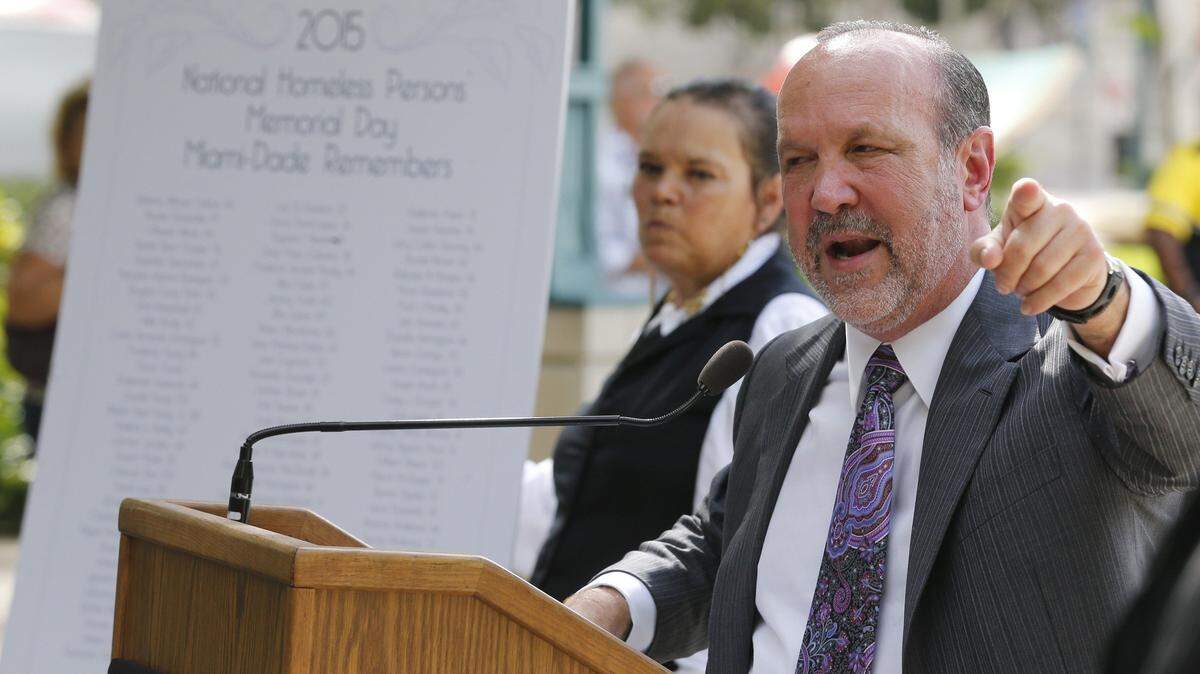
As more migrants arrive in Miami without a place to live, the leader of the county’s homeless agency says it won’t spend local dollars to provide them beds.
“Any recent migrant, who we’ve determined based on the interview process, will not be taken into shelter or housing,” said Ron Book, the lobbyist who oversees Miami-Dade’s homeless funds as chair of the county board in charge of the agency known as the Homeless Trust.
He later added: “I’ll be damned if it’s going to be me that puts those people ahead of the people that we already got here that are in my system, waiting for housing and waiting for shelter.”
The Homeless Trust’s “hard line” policy, as Book called it in a board meeting last fall, comes as other leaders are striking a more welcoming tone for migrants in a community where over half of the county’s 2.6 million residents are listed as foreign born in the latest Census data.
“Miami-Dade County is made whole by generations of immigrants and refugees who came to this community in search of a new home and new opportunity for themselves and their families,” Mayor Daniella Levine Cava wrote in a June 24 letter to Homeland Security Secretary Alejandro Mayorkas. ”We feel a sense of responsibility to provide that same opportunity to those who need it most.”
County administrators say they don’t track the immigration status of the more than 1,000 people estimated to be living on the streets in Miami-Dade.
Cindy Torres, social services coordinator at Catholic Legal Services, said she’s found it harder to get homeless help from Miami-Dade as she manages more cases from migrants arriving in Miami.
While she used to be able to register recently arrived clients with the Homeless Trust’s intake line for people seeking beds, Torres said that seemed to change with a call last fall when an operator asking about a Social Security number found out the person needing help was undocumented.
“The lady on the phone was like, ‘He’s a non-citizen; we can’t register him,’ ” she recalled. Torres said she replied: “This is ridiculous. I’ve never heard of this.”
While more migrants are seeking help as housing options narrow, Torres said she’s not turning to the county for assistance. She shared her experience trying to help a family who arrived from Colombia three weeks ago only to have the person hosting them change plans and order them to leave. “I said: ‘I normally would tell you to call the Homeless Trust hotline,’ ” Torres said. “ ‘Now I can’t.’ ”
The Homeless Trust is paying a local nonprofit, Hermanos de la Calle — Street Brothers — to find private housing for homeless migrants, including funds to transport hundreds out of Florida to live with friends or family in other states. Malena Legarre, a founder of the nonprofit, said the group has relocated 425 people from the Miami area during the recent migrant wave.
“At the beginning, we did a lot to Wichita, Kansas,” she said. “We do Chicago, Houston.”
Regulations tied to the federal grants that fund most long-term housing complexes in the Homeless Trust’s placement pipeline mostly exclude undocumented people from help. But emergency shelters using local homeless-tax dollars aren’t governed by the same rules.
Book argues Washington needs to step in with relief for housing and other needs for people who make their way to Miami after crossing the U.S. border by land from Mexico or by sea in the Florida Straits and being processed by immigration authorities. He said it’s not fair to divert already strained local dollars away from an existing homeless population that already tops 1,000 people needing beds.
“I am not going to hopscotch someone who illegally arrived here with the help of the federal government to get ahead of those 1,100 people,” said Book, who uses his non-paying position as board chair to have final say in the homeless agency’s day-to-day operations. “I have shelters that are bursting at the seams. I have limited housing that I beg people for.”
Political divisions on migrants
The issue of how much help to give migrant arrivals has already divided elected leaders across the country and in Tallahassee, where Book, a registered independent, is a leading lobbyist. (His daughter, Lauren Book, is the Democratic leader in the Florida Senate.)
Florida Gov. Ron DeSantis has paid for flights to shuttle migrants in Texas to Massachusetts, a move critics ridiculed as a political stunt but the Republican governor defended as an appropriate state action in the face of the Biden administration’s failure to stem border crossings.
Levine Cava holds a board seat on the Homeless Trust, and has her top deputy for social programs, Chief Community Services Officer Morris Copeland, sit on the panel. Levine Cava called the migrant influx a “crisis” in a letter to the Biden administration last summer asking for more federal resources to help Miami-Dade.
“We need additional funding to address the challenge of securing safe, affordable, long-term housing for immigrants and refugees,” Levine Cava wrote. She asked for federal landlord incentives to house migrants, federal grants to nonprofits helping find employment for the new arrivals and expedited work authorizations for them.
The flow of people has continued since Miami-Dade’s mayor wrote the letter. In the last two weeks alone, hundreds of Cuban and Haitian migrants have reached South Florida by sea.
Peter Routsis-Arroyo, chief executive of Catholic Charities, said he has observed a significant increase in recently arrived migrants in Miami in the last year and a half. He said his organization will shelter people regardless of immigration status.
“Miami is such a resilient community where the Cubans will take Cubans in, Haitians will take Haitians in, Central Americans will take Central Americans in, Venezuelans will take Venezuelans in,” he said. “We get the fallout of the cases where they are coming here and they just don’t have a sponsor or family, or that sponsor or family fell through.”
In a joint statement this week, Book and the county’s Democratic mayor, Levine Cava, did not directly address the Homeless Trust’s policy toward migrants but emphasized the need to help people fleeing their countries.
Miami-Dade is “working together with all our federal, state and local partners to coordinate resources and ensure that those who are fleeing political persecution and oppression have access to social services,” the statement reads. “The Mayor continues to advocate for additional federal funds, and is convening major stakeholders to mobilize resources to support a coordinated County response to the growing numbers of migrant arrivals to Miami-Dade.”
At a meeting of the County Commission’s housing committee, the Homeless Trust’s executive director, Victoria Mallette, said she expects more migrants seeking housing once the Biden administration lifts “Title 42,” a public health order that makes it easier to turn away people crossing the border.
“I can’t tell you how much strain they’re under,” Mallette said of Hermanos de la Calle and the services it provides migrants. “We only anticipate that will increase once Title 42 is lifted.”
Book presides over the 27-person board that governs the Homeless Trust and the $38 million budgeted this year from the county’s 1% tax on restaurant bills. That money is reserved for paying for homeless services and measures to help domestic-violence victims.
At a Sept. 23 board meeting, Book told members he didn’t want to be pressured into helping house a wave of migrants that should be the federal government’s burden.
“The trust is not going to become the receiving end of a failed immigration policy in the United States,” he said. “I’ve taken an extremely hard line against spending our limited resources to try and house people who have come across the borders.”
Migrant relocation to Wichita, Chicago, Houston
For Hermanos de la Calle, the last year or so has brought a change in how Miami’s communities absorb the bulk of migrant arrivals. Legarre, a founder of the nonprofit, said more migrants arrive without plans on where to stay.
She’s also seeing more plans fall through, with friends or family already housing too many recent arrivals in small apartments or facing unexpected crackdowns from landlords in a tight housing market.
“In the last year what we’ve seen is a lot of people coming to Miami-Dade without a specific place to go,” she said. “Or if they go to a specific place they have to leave it because there are too many people living in the same place.”
Legarre said she’s working with private funders to find temporary housing for migrants, while using county money to find them new places to live elsewhere in the country.
Hermanos “can’t use Homeless Trust funds to house the recent migrants,” she said. “We are using our organization to do that.”
Under the Homeless Trust’s Nov. 1 contract, the Hermanos group is charged with providing “migrant support and relocation services,” including travel and food expenses. The agency instructs Hermanos to document the people being relocated and have help waiting for them, with “verification of supports in the relocation destinations” a requirement of the contract.
Though the Homeless Trust publicly is saying recent migrants won’t get emergency housing, Legarre said privately administrators are more flexible. “No child can be sleeping in a car. I have orders from the Homeless Trust they have to be in a hotel until we can find a shelter,” she said. “Migrant or no migrant.”
Shed Boren, a former chief executive of the Camillus House homeless shelter in Miami, said he doubted Miami-Dade would actually be turning away undocumented people seeking help even if that’s the public position.
“I just don’t see that actually having a basis in reality,” he said. “That they would actually be discriminating against people who are undocumented.”
Marleine Bastien, a recently elected Miami-Dade County commissioner who runs a nonprofit specializing in helping Haitian immigrants, said the community needs “to have a plan to help those who come to us and seek help.
“I could write books about the trauma suffered by refugees,” she said. “And when they come here, we can’t find it in our heart to support them?”
This story was originally published January 13, 2023 at 6:00 AM.