
Flagler’s Ludlam Trail development plan meets resident opposition
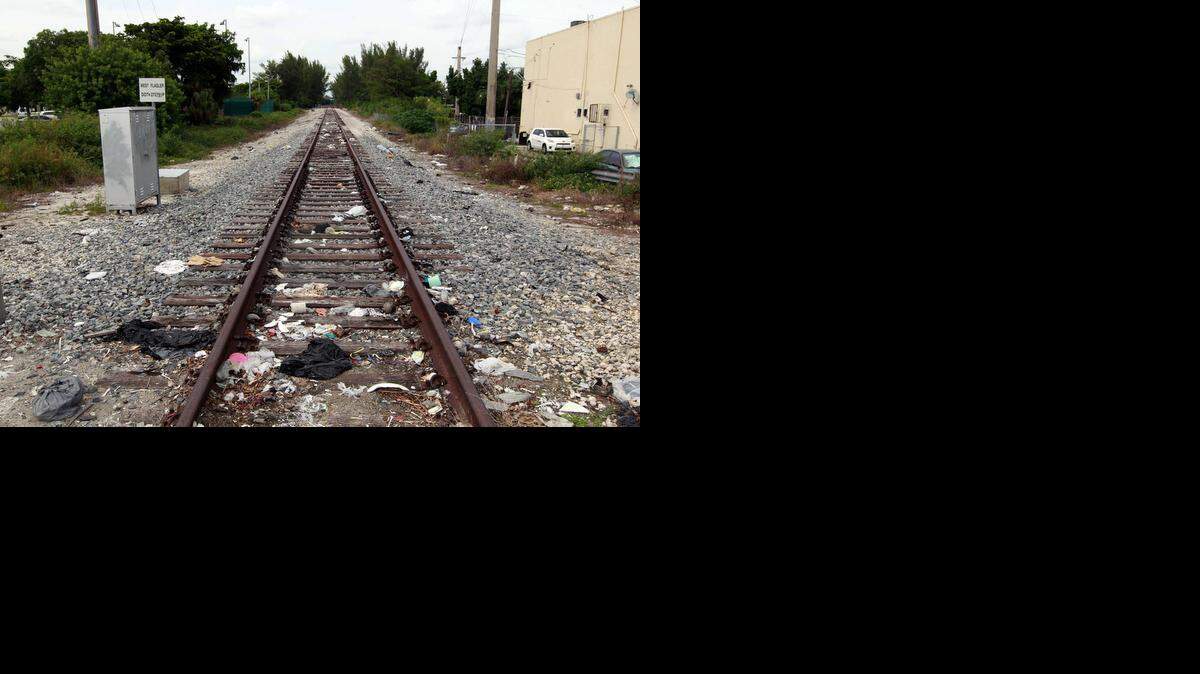
Tucked away behind dense clusters of homes and offices parks lies one of Miami-Dade County’s best-kept urban secrets: An old rail line running in a perfectly straight shot for 6.2 miles from Dadeland to Miami International Airport.
Neighborhood activists and county planners have long had their eye on the corridor, vacant since most of the tracks were pulled up a decade ago. They say it presents a once-in-a-generation chance for conversion into a verdant cycling and walking trail that would connect some of the county’s most populated residential neighborhoods with shopping, schools, workplaces and parks.
After years of prodding, the corridor’s owner, a corporate cousin of the old Florida East Coast rail company, has come around to embrace the Ludlam Trail vision.
But there’s a catch: Their development arm, Flagler, first wants to build homes and commercial buildings along the edges of the corridor, which at its widest measures no more than 100 feet across.
Now a formal land-use application by Flagler, filed in May with the county, has run into a firestorm of opposition. Neighbors are up in arms. Three community councils have rebuffed it. And some of the trail idea’s staunchest proponents are calling for a time-out to retool.
For one thing, skeptical residents say, Flagler has not explained how the trail would fit in the space, nor who would own and maintain it once it’s built.
“I am not against development,” said resident Lisa Vale, who owns multiple properties near the trail. “But we’re talking about an area that, just common sense will tell you, it can’t be done in a nice way.”
Flagler officials say they’re in the early stages of developing a plan, so the details haven’t yet been decided. But they say a quarter of the land within the corridor would be available for the trail, which the company would build.
Development would be concentrated in areas where it fits, like Dadeland, and would be compatible with the surroundings, they say — that is, single-family homes up against single-family neighborhoods, and commercial development where the trail runs up against existing industrial or office uses. Having homes and businesses overlooking the trail would also bring more users to its doorstep and improve visibility and safety on the path, they add.
“There’s already development density here,” said attorney Joseph Goldstein, who gave Flagler’s presentations at the community council meetings. “We think it’s best to have some eyes on the path to make sure people can go from Blue Lagoon all the way down to Dadeland.”
Right now, stretches of the corridor have a desolate, even blighted, feel, especially in the northern portion, where piles of trash pop up and chain-link fences separate it from office parking lots. Along Bird Road, a billboard advertising breast augmentation stands inside the corridor right across from A.D. Barnes Park.
To the south, the corridor turns into a lush, tree-lined green landscape surrounded by large homes on acre lots.
To accomodate the mixed-use and trail development, Flagler officials say, they first need the Miami-Dade County Commission to change the corridor’s land-use and zoning designations, which now limit it to transportation uses or uses in conjunction with adjacent properties. They’ve proposed a new “Ludlam Trail Corridor’’ designation that would allow the company to prepare a detailed plan for mixed-use development and creation of the trail.
But members of three community councils with jurisdiction found that a hard lump to swallow. The councils are the first stop on the way to the county planning board and ultimately a commission vote.
Two councils — Kendall and North Central — voted to pass the application on to the planning board, but recommended that the board deny it. Last week, the Westchester council voted to kill the application completely. Like many residents who spoke at the hearings, council members thought the application wording too vague, and said they could not rely on verbal promises by Flagler officials not detailed in the documents they filed.
“We’re supposed to transmit this plan, not what you’re telling us you’re going to do,” said Miriam Planas, a Westchester council member.
County staffers, council members and critical residents raised a number of issues with the application:
▪ It doesn’t guarantee the creation of the trail.
▪ The language doesn’t specify who would cover the substantial cost of maintaining the trail.
▪ The application doesn’t include plans to coordinate with the City of Miami for the portion of the corridor that falls inside city limits.
▪ Residents who live along the corridor, which narrows in places to as little as 50 feet, fear that allowing buildings within it would not leave enough space for any trail wider than a sidewalk.
▪ Even if buildings did go up, there are no guidelines in the application to control uses and densities, so that, for example, a business could go up next to a single-family home.
Advocates with Friends of the Ludlam Trail, a nonprofit group formed to support creation of the pathway, urged Flagler to withdraw and refine its application.
“This is going to be a centerpiece of the Miami-Dade County trail network,” said group chairman Tony Garcia, an independent urban planner. “Given all the questions, how can we move forward with such unspecific application language?”
The friends group, whose board members have substantial planning expertise, has offered to work with Flagler to develop a balanced plan that satisfies residents’ concerns while ensuring the company can earn a profit, Garcia said.
Officials at Flagler’s corporate parent, Florida East Coast Industries, say pulling the application back now would entail a loss of about $500,000 the company has laid out on it so far. But they have since met with county officials and are willing to continue public discussions.
As they develop the plan, company officials promise to hold community meetings to get residents’ input on the specifics as well as the ultimate design, for which Flagler has hired New York-based planning and architecture firm Hart Howerton.
“Why would we risk our reputation on this project when we want to stick around?” said Alfred Lurigados, director of corporate development for Florida East Coast Industries, while giving a reporter a tour of the corridor.
FECI said it’s willing to entertain offers for at least the right-of-way for the trail, but supporters say it’s unlikely any local government or organization could afford the land, which is valued at tens of millions of dollars.
But company officials say the trail plan is not feasible unless they can develop the balance of the land. They say about a third of the proposed housing and commercial development, for instance, would be clustered at the Dadeland Mall end, which is already surrounded by townhouses and multi-family buildings, with the rest distributed at appropriate densities along the trail.
That would be a plus for the trail, boosting activity on it, the company says.
“When you move these densities around and uses around, it activates the space,” said Kathryn Moore, community outreach director for the project.
The idea of converting unused rail lines to trails is hardly radical.
Scores of such projects can be found all across the country and Florida, where they have proven for the most part hugely popular. The Rails-to-Trails Conservancy, a Washington, D.C., nonprofit that supports conversions, says there are some 20,000 miles of so-called rail-trails in the United States.
Florida has 35 rail-trails that total 300 miles, said Ken Bryan, state director for the conservancy. The conversions are typically funded through a combination of federal, state and local dollars, he said.
In some instances, he said, trail conversions are accompanied by development, though none of the Florida rail-trails includes the scale of mixed-used development that Flagler has proposed for the Ludlam project.
Miami-Dade has long identified the Ludlam rail corridor as a key link in a planned network of bike and pedestrian trails that could one day stretch across the county.
But a lack of state and local funding, in combination with high local property values, has made it difficult to acquire land for rail-trails in Miami-Dade, Bryan said.
Two of the biggest pools of money for trail conversion in the state came from the Florida Forever Act and Preservation 2000 campaign, but Miami-Dade didn’t see any of that money, Bryan said.
“Miami, in my opinion, didn’t get its fair share of trail dollars,” Bryan said.
Backers of the Ludlam Trail, however, say that could change if state voters approve an amendment to the Florida Constitution on the Nov. 4 ballot.
The Florida Water and Land Conservation Amendment, or Amendment One on the ballot, would set aside money “to acquire, restore, improve, and manage conservation land” over a 20-year period.
That would provide significant funding to purchase land and build and maintain trails in Miami-Dade, including the Ludlam Trail, Bryan said.
Flagler has supported the amendment since citizens proposed it, FECI’s Lurigados said.
He warned that if the application falls by the wayside, the trail may never happen. If there’s one thing all sides on the Ludlam Trail issue agree, it’s that that would be a waste.
“I think we’re looking at a future where we can connect libraries and schools and parks,” Moore said. “And this does it on an unprecedented level.”
Herald staff writer Andres Viglucci contributed to this report.
An earlier version of this story said the corridor is limited to transportation uses. However, Flagler could also develop in conjunction with the adjacent uses or sell it to developers who would do so. The proposed land use amendment allows for the mixed-use and trail development.
Meeting dates to look out for:
- Oct. 20, 2014: The application will go before the Planning Advisory Board
- Nov. 19, 2014: The application will go before the Board of County Commissioners
- February/March 2015: Final decision by the BOCC
This story was originally published October 10, 2014 at 3:40 PM.